Free oscillations of a standing surface wave and its mechanical analogue
Pith reviewed 2026-05-18 18:19 UTC · model grok-4.3
The pith
An analogy is established between standing surface wave oscillations and a mechanical oscillator, yielding a novel Mathieu-like equation for super-harmonic stability that matches numerical solutions in most cases.
A machine-rendered reading of the paper's core claim, the machinery that carries it, and where it could break.
Core claim
The equations of motion governing both systems have qualitatively similar solutions - trivial as well as time-periodic with finite amplitude. The time-periodic solutions can be linearly unstable in both cases depending on the oscillation amplitude, thereby leading to interesting dynamics.
Load-bearing premise
The mechanical oscillator model captures the essential nonlinear dynamics of the fluid interface sufficiently well that linear stability results, including the derived Mathieu-like equation for super-harmonic perturbations, transfer directly between the two systems.
Figures



read the original abstract
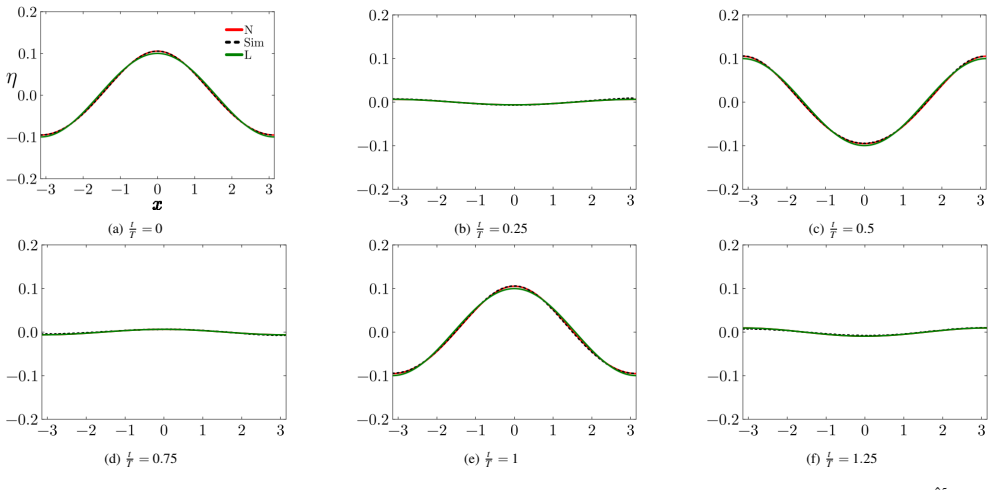
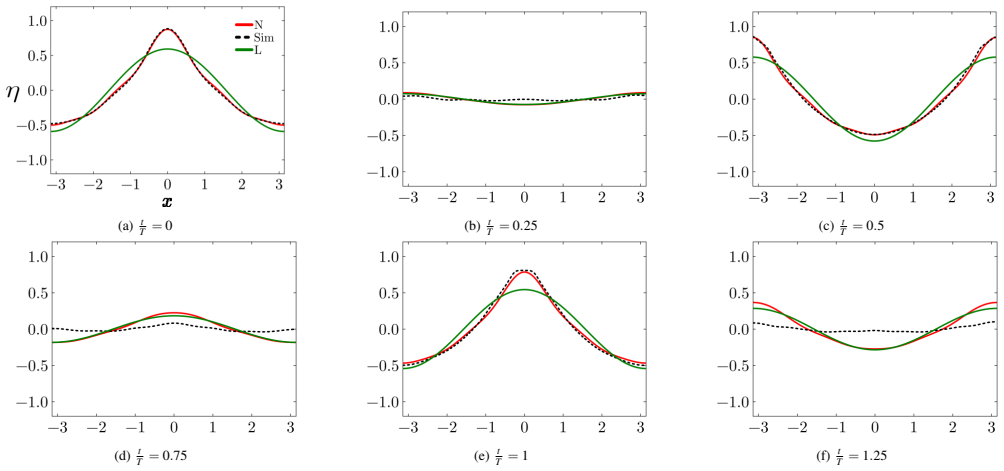
We present an analogy between natural oscillations of the standing wave type on a pool of liquid with an interface and a mechanical oscillator model. It is shown that the equations of motion governing both systems have qualitatively similar solutions - trivial as well as time-periodic with finite amplitude. The time-periodic solutions can be linearly unstable in both cases depending on the oscillation amplitude, thereby leading to interesting dynamics. Linear stability results of both systems are discussed in detail; a novel Mathieu-like equation is derived for the stability of the standing wave to a super-harmonic perturbation. This is obtained through a much simpler approach that yields linear stability results while also reinforcing the analogy. Analytical predictions are compared against numerical solutions to the full nonlinear governing equations for both systems. A good match is obtained in most cases with theory; mismatches are further analysed and the limitations of this analogy are also pointed out.
Editorial analysis
A structured set of objections, weighed in public.
Referee Report
Summary. The manuscript establishes an analogy between free oscillations of standing surface waves on a liquid interface and a mechanical oscillator model. It shows that the governing equations for both systems admit qualitatively similar solutions, including the trivial equilibrium and finite-amplitude time-periodic states. These periodic solutions can exhibit linear instability depending on amplitude. A novel Mathieu-like equation is derived for the stability of the standing wave against super-harmonic perturbations via a simplified approach that also reinforces the analogy. Analytical predictions are compared to numerical integrations of the full nonlinear equations for both systems, with good agreement reported in most cases; mismatches are analyzed and limitations of the analogy are discussed.
Significance. If the nonlinear fidelity of the analogy holds, the work provides a transparent mechanical model for exploring amplitude-dependent instabilities in standing waves, which could be useful for both theoretical insight and pedagogical purposes in fluid dynamics. The simplified derivation of the Mathieu-like equation is a strength, as is the direct numerical validation. The explicit discussion of mismatches and limitations helps bound the applicability of the results.
major comments (2)
- [§ on derivation of equations of motion for the mechanical analogue] § on derivation of equations of motion for the mechanical analogue: the central claim that linear stability results (including the Mathieu-like equation) transfer between systems at finite amplitude requires that the cubic and higher-order coefficients in the effective restoring force or potential match between the fluid free-surface and mechanical models. The manuscript should add an explicit side-by-side comparison of these nonlinear coefficients to confirm the transfer is justified rather than assumed.
- [Numerical comparison sections] Numerical comparison sections: while the abstract states good agreement 'in most cases,' quantitative measures (e.g., relative L2 errors, amplitude ranges where deviation exceeds a stated threshold) are not provided. This makes it difficult to assess how well the instability thresholds are reproduced and whether the analyzed mismatches undermine the qualitative similarity claim.
minor comments (2)
- [Figures] Figure captions should explicitly label which curves correspond to the fluid system and which to the mechanical analogue to avoid reader confusion when comparing solutions.
- [Notation] The notation for the perturbation amplitude and the super-harmonic frequency should be introduced once and used consistently in both the stability analysis and the numerical sections.
Simulated Author's Rebuttal
We are grateful to the referee for their positive assessment and valuable suggestions for improving the clarity and rigor of our manuscript. We have carefully considered each major comment and provide point-by-point responses below. Where appropriate, we have revised the manuscript to incorporate the referee's recommendations.
read point-by-point responses
-
Referee: § on derivation of equations of motion for the mechanical analogue: the central claim that linear stability results (including the Mathieu-like equation) transfer between systems at finite amplitude requires that the cubic and higher-order coefficients in the effective restoring force or potential match between the fluid free-surface and mechanical models. The manuscript should add an explicit side-by-side comparison of these nonlinear coefficients to confirm the transfer is justified rather than assumed.
Authors: We thank the referee for highlighting this important point. The mechanical analogue was constructed to reproduce the linear frequency and the leading cubic nonlinearity of the fluid system, which governs the amplitude-dependent frequency correction and the structure of the derived Mathieu-like equation. To make the justification explicit, we have added a new table in the revised manuscript comparing the coefficients in the effective restoring force (or potential) expansion for both systems up to fifth order. This shows exact agreement in the linear and cubic terms by design of the analogue, with differences appearing only at quartic and higher orders. These differences are consistent with the mismatches observed at large amplitudes and help bound the regime where the stability results transfer reliably. revision: yes
-
Referee: Numerical comparison sections: while the abstract states good agreement 'in most cases,' quantitative measures (e.g., relative L2 errors, amplitude ranges where deviation exceeds a stated threshold) are not provided. This makes it difficult to assess how well the instability thresholds are reproduced and whether the analyzed mismatches undermine the qualitative similarity claim.
Authors: We agree that quantitative metrics would strengthen the presentation. In the revised manuscript we have augmented the numerical comparison sections with explicit measures, including relative L2 errors between the analytical instability thresholds and the numerically computed ones, reported as a function of amplitude. We have also indicated the amplitude ranges (e.g., where deviations remain below 5 %) in which the agreement is considered good, and we have related the onset of larger discrepancies to the higher-order coefficient differences discussed in the new table. These additions clarify the extent of the qualitative similarity while preserving the discussion of limitations already present in the original text. revision: yes
Circularity Check
No significant circularity; derivations validated against independent numerical solutions
full rationale
The paper derives the equations of motion and a Mathieu-like stability equation for the standing wave and mechanical analogue through direct analysis of the governing dynamics. These analytical predictions are then compared to numerical integrations of the full nonlinear equations for both systems, with mismatches explicitly analyzed and limitations noted. No load-bearing step reduces to a fitted parameter, self-definition, or self-citation chain; the central claims rest on the independent numerical benchmarks and the modeling choice of the analogue, which is presented with acknowledged discrepancies rather than asserted as exact.
Axiom & Free-Parameter Ledger
axioms (1)
- domain assumption The mechanical oscillator equations qualitatively reproduce the essential nonlinear behavior of the standing surface wave for finite amplitudes.
Reference graph
Works this paper leans on
-
[1]
J. W. Strutt, Deep water waves, progressive or stationary, to the third order of approximation, Proceedings of the Royal Society of London. Series A, Containing Papers of a Mathematical and Physical Character 91 (1915) 345– 353
work page 1915
-
[2]
W. G. Penney, A. T. Price, Finite periodic stationary grav- ity waves in a perfect liquid, Philosophical Transactions of the Royal Society of London. Series A, Mathematical and Physical Sciences 244 (1952) 254–284. 15
work page 1952
-
[3]
T.-L. Yang, R. Rosenberg, On the vibrations of a particle in the plane, International Journal of Non-Linear Mechan- ics 2 (1967) 1–25. doi:https://doi.org/10.1016/00 20-7462(67)90015-7
work page doi:10.1016/00 1967
-
[4]
R. H. Rand, Lecture Notes on Nonlinear Vibrations, Available online:https://ecommons.cornell.edu /handle/1813/28989, 2012
work page 2012
-
[5]
C. M. Bender, S. A. Orszag, Advanced mathematical methods for scientists and engineers I: Asymptotic meth- ods and perturbation theory, Springer Science & Business Media, 2013
work page 2013
-
[6]
J. J. Stoker, Nonlinear Vibrations in Mechanical and Elec- trical Systems, Wiley Classics Library, Reprint Edition, 1992
work page 1992
-
[7]
A. H. Nayfeh, D. T. Mook, Nonlinear Oscillations, John Wiley & Sons., 1995
work page 1995
-
[8]
R. A. Ibrahim, Liquid sloshing dynamics: theory and ap- plications, Cambridge University Press, 2005
work page 2005
-
[9]
H. Ockendon, J. R. Ockendon, How to mitigate sloshing, SIAM Review 59 (2017) 905–911
work page 2017
-
[10]
M. Turner, Dynamic sloshing in a rectangular vessel with porous baffles, Journal of engineering mathematics 144 (2024) 22
work page 2024
-
[11]
Molin, On the piston and sloshing modes in moon- pools, Journal of Fluid Mechanics 430 (2001) 27–50
B. Molin, On the piston and sloshing modes in moon- pools, Journal of Fluid Mechanics 430 (2001) 27–50
work page 2001
-
[12]
Miles, Gravity waves in a circular well, Journal of Fluid Mechanics 460 (2002) 177–180
J. Miles, Gravity waves in a circular well, Journal of Fluid Mechanics 460 (2002) 177–180
work page 2002
-
[13]
B. Chu, X. Zhang, G. Zhang, J. Chen, On the nonlinear moonpool responses in a drillship under regular heading waves, Physics of Fluids 36 (2024)
work page 2024
-
[14]
Coastalwiki, Harbour resonance, 2020.https://www.co astalwiki.org/wiki/Harbor_resonance[Accessed: May 14th 2025]
work page 2020
-
[15]
L. R. Mack, Periodic, finite-amplitude, axisymmetric gravity waves, Journal of Geophysical Research 67 (1962) 829–843
work page 1962
-
[16]
J. W. Miles, Harbor seiching, Annual Review of Fluid Mechanics 6 (1974) 17–33
work page 1974
-
[17]
Q. Zhu, Y . Liu, D. K. Yue, Three-dimensional instability of standing waves, Journal of Fluid Mechanics 496 (2003) 213–242
work page 2003
-
[18]
P. Concus, Standing capillary-gravity waves of finite am- plitude, Journal of Fluid Mechanics 14 (1962) 568–576
work page 1962
-
[19]
P. G. Saffman, H. C. Yuen, A note on numerical computa- tions of large amplitude standing waves, Journal of Fluid Mechanics 95 (1979) 707–715
work page 1979
-
[20]
L. Schwartz, A. Whitney, A semi-analytic solution for nonlinear standing waves in deep water, Journal of Fluid Mechanics 107 (1981) 147–171
work page 1981
-
[21]
J. W. Rottman, Steep standing waves at a fluid interface, Journal of Fluid Mechanics 124 (1982) 283–306
work page 1982
-
[22]
C. H. Rycroft, J. Wilkening, Computation of three- dimensional standing water waves, Journal of Compu- tational Physics 255 (2013) 612–638
work page 2013
-
[23]
G. N. Mercer, A. J. Roberts, Standing waves in deep wa- ter: Their stability and extreme form, Physics of Fluids A: Fluid Dynamics 4 (1992) 259–269. doi:10.1063/1. 858354
work page doi:10.1063/1 1992
- [24]
-
[25]
M. Okamura, Instabilities of weakly nonlinear standing gravity waves, Journal of the Physical Society of Japan 53 (1984) 3788–3796
work page 1984
-
[26]
S. Fauve, Pattern forming instabilities, COLLEC- TION ALEA SACLAY MONOGRAPHS AND TEXTS IN STATISTICAL PHYSICS (1998) 387–492
work page 1998
-
[27]
M. S. Krieger, Interfacial fluid instabilities and kapitsa pendula, The European Physical Journal E 40 (2017) 1– 11
work page 2017
-
[28]
R. Dasgupta, Introduction to interfacial waves - NPTEL lectures by Ratul Dasgupta, IIT Bombay, 2020.https:// www.youtube.com/watch?v=4zjCBIQw8Tc[Accessed: May 13th 2025]
work page 2020
- [29]
-
[30]
J. Rajchenbach, D. Clamond, Faraday waves: their disper- sion relation, nature of bifurcation and wavenumber selec- tion revisited, Journal of Fluid Mechanics 777 (2015) R2
work page 2015
-
[31]
I. M. Koszalka, Vibrating pendulum and stratified fluids, in: 2005 Program in Geophysical Fluid Dynamics: Fast Times and Fine Scales, Woods Hole Oceanographic Insti- tution, 2005, pp. 205–224
work page 2005
-
[32]
R. R. H. Kovacic, I., S. Mohamed Sah, Applied Mechan- ics Reviews 70 (2018) 020802–1–020802–22
work page 2018
-
[33]
S. Popinet, collaborators, Basilisk C: volume of fluid method,http://basilisk.fr(Last accessed: August 23, 2023), 2013–2024
work page 2023
-
[34]
G. I. Taylor, An experimental study of standing waves, Proceedings of the Royal Society of London. Series A. Mathematical and Physical Sciences 218 (1953) 44–59. 16
work page 1953
-
[35]
P. K. Kundu, I. M. Cohen, D. R. Dowling, Chapter 8 - Gravity Waves, sixth edition ed., Academic Press, Boston, 2016, pp. 349–407. doi:https://doi.org/10.1016/ B978-0-12-405935-1.00008-3
work page 2016
-
[36]
W. R. Inc., Mathematica, Version 12.1, ???? URL:http s://www.wolfram.com/mathematica, champaign, IL, 2024
work page 2024
- [37]
-
[38]
C. Rackauckas, Q. Nie, collaborators, Differentialequations.jl–a performant and feature- rich ecosystem for solving differential equations in julia, Journal of Open Research Software 5 (2017) 15
work page 2017
- [39]
- [40]
- [41]
- [42]
- [43]
-
[44]
G. G. Stokes, On the Theory of Oscillatory Waves, Cam- bridge Library Collection - Mathematics, Cambridge Uni- versity Press, 2009, p. 197–229
work page 2009
-
[45]
J. A. Tsamopoulos, R. A. Brown, Nonlinear oscillations of inviscid drops and bubbles, Journal of Fluid Mechanics 127 (1983) 519–537. doi:10.1017/S002211208300286 4. 17
discussion (0)
Sign in with ORCID, Apple, or X to comment. Anyone can read and Pith papers without signing in.