REVIEW 4 major objections 4 minor 26 references
Compact moduli of elliptic surfaces with a multiple fiber
T0 review · 4 major / 4 minor · reviewed 2026-08-04 · deepseek-v4-flash
Pith's one-line read The paper constructs projective compact moduli spaces for marked rational elliptic surfaces of index m and identifies the boundary surfaces arising when a multiple fiber degenerates to an additive fiber.
desk verdict The boundary-list idea and the four gluing types are new and plausible, but the write-up is a sketch; the stress-test's numerical objection misses that A^2=3, so the real issue is missing details, not a false theorem. read the letter →
The pith
A machine-rendered reading of the paper's core claim, the machinery that carries it, and where it could break.
The reading
What carries the argument
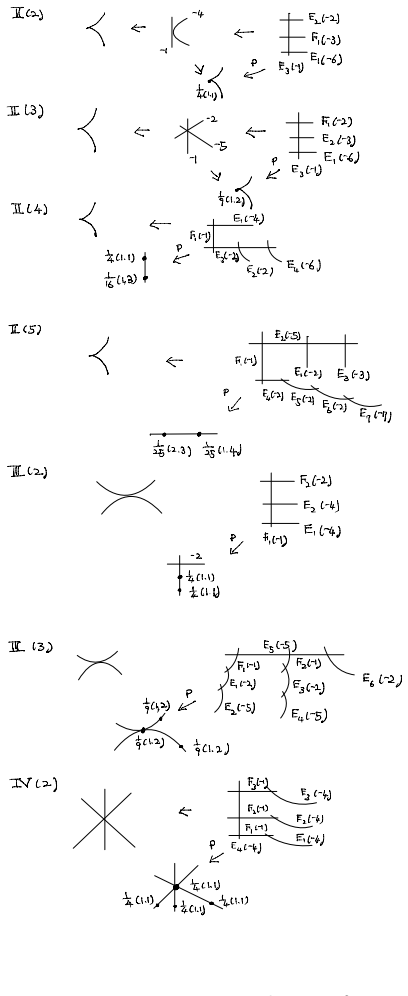
The load-bearing machinery is the theory of $(d,c,v,\sigma)$-stable minimal models and stable Calabi–Yau pairs: for the rational elliptic surface of index $m$, the pair is $(X, F_m)$ with $A = \bar{A} + 2F_m$, where $F_m$ is the reduced support of the multiple fiber and $\bar{A}$ the $m$-multi-section, giving a $(2,1,3)$-stable Calabi–Yau pair that maps into a proper Deligne–Mumford stack. On the degeneration side, the key objects are the four semi-log-terminal (slt) surfaces $X = X_1 \cup_{\mathbb{P}^1} X_2$ glued along twisted fibers of types $I_0^*$, $II|II^*$, $III|III^*$, $IV|IV^*$; the proof that they smooth Q-Gorensteinly runs through the vanishing $H^1(T^1_{QG,X})=0$ and $H^2(T_X)=0$, the latter via non-zero sections of $\omega_{X_i}^{-1}$.
What would settle it
Take a one-parameter family of Dolgachev surfaces of type $(2,3)$ from the smooth deformation space supplied in Proposition 1.1 and try to extend the $6$-multi-section $C\subset S_t$ to a relative divisor over the base; if the limit of $C$ is not flat—for instance if the Hilbert polynomial of the relative multi-section jumps—then the Section 3 compactification fails for that family, while Theorem 5.2's smoothing statements would still stand independently.
Extended reading notes
Core claim
The paper's central assertion is that the natural moduli problem for rational elliptic surfaces of index $m$—and, under a flatness hypothesis, for Dolgachev surfaces—has a projective compactification with explicitly known boundary. Theorem 3.2 states that for every integer $m\ge 2$, marked rational elliptic surfaces of index $m$ (a rational elliptic surface together with an $m$-multi-section) form a proper Deligne–Mumford stack with projective coarse moduli space, realized inside the moduli of $(2,1,3)$-stable Calabi–Yau pairs. Proposition 3.3 establishes that every Dolgachev surface of coprime type $(p,q)$ has a $pq$-multi-section; with a recent moduli theorem for stable minimal models, this yields a projec
Load-bearing premise
In Section 3, the compactification of marked Dolgachev surfaces is introduced conditionally: the $pq$-multi-section whose existence is proved in Proposition 3.3 is assumed to be sufficiently non-singular and to deform flatly in every family of Dolgachev surfaces, and no proof of that flatness is given; if the assumption fails for some family, the proposed projective moduli space of marked Dolgachev surfaces does not exist as constructed.
Editorial extensions
If this is right
- For every m≥2 the moduli of marked rational elliptic surfaces of index m is a proper Deligne–Mumford stack with projective coarse space, so the space of these surfaces has a natural compactification in the stable-Calabi–Yau category.
- The boundary of the classical compactification of pencils of cubics becomes stable-geometric: the four two-component slt surfaces of Theorem 5.2 are the limits of a multiple fiber degenerating to an additive fiber, and each smooths to an index-1 rational elliptic surface.
- Applying logarithmic transforms to those smoothings produces Dolgachev surfaces of every coprime type (m1,m2), so the same boundary surfaces lie in the closure of the moduli of Dolgachev surfaces of each type.
- For multiple fiber multiplicity at most 5, the log canonical thresholds of Lemma 5.1 imply a genuine wall-crossing structure: as the coefficient c of (X, cB) moves below the threshold, the compact moduli space changes by a birational contraction.
- Because the construction uses Q-Gorenstein smoothings rather than complex-analytic logarithmic transforms, the boundary description works in arbitrary characteristic, at least for surfaces built from pencils over Spec Z.
Reading between the lines
- If the pq-multi-section's flat-deformation hypothesis fails on a single Dolgachev surface family, the Section 3 compactification would be empty for that family; testing this on the smooth deformation space of Dolgachev surfaces of type (2,3) would settle the main open gap.
- The rational log canonical thresholds in Lemma 5.1 (1/2, 2/3, 3/4, 4/5, 1) predict that the stable-pair compactifications for indices 2 through 5 have chambers at these values; identifying the flipped surfaces at each wall would make the wall-crossing picture explicit and parallel to the known section case.
- The same four gluing patterns should appear on the boundary of moduli of other pg=q=0 elliptic surfaces, such as Enriques surfaces, whose moderate degenerations have different multiplicity data; adapting the smoothing argument with multiplicities (2,2) would test whether these slt types are universal.
- The construction suggests that the entire moduli problem for rational elliptic surfaces of index m could be rephrased purely as stability of Halphen pencils of degree 3m with marked base points, potentially connecting the (2,1,3)-stable pairs to GIT for plane curves of higher degree.
Signed reviews
Editorial analysis
A structured set of objections, weighed in public.
Referee Report
Summary. The paper proposes compact moduli constructions for elliptic surfaces with a multiple fiber, focusing on rational elliptic surfaces of index m and Dolgachev surfaces. The main theorem (Theorem 3.2) asserts that marked rational elliptic surfaces of index m form a proper Deligne–Mumford stack with projective coarse space, realized as (2,1,3)-stable Calabi–Yau pairs in Birkar's formalism. Section 4 reviews Kawamata's classification of moderate degenerations, and Section 5 identifies slt boundary surfaces obtained by gluing two rational elliptic surfaces along twisted I_0^*, II|II^*, III|III^*, and IV|IV^* fibers; these are claimed to admit Q-Gorenstein smoothings to rational elliptic surfaces of index 1 (Theorem 5.2) and, after logarithmic transforms, to Dolgachev surfaces (Corollary 5.3). The paper is concise and often refers to prior work for key steps.
Significance. If the main theorems are correct, the paper provides the first Birkar-style compact moduli stack for marked rational elliptic surfaces without a section for all indices m, complementing Miranda's GIT construction for index 1 and Zanardini's treatment of index 2. The explicit slt surfaces in Section 5 give a concrete conjectural boundary description for degenerations in which a multiple fiber becomes an additive fiber, and the connection to Dolgachev surfaces via Q-Gorenstein smoothings is a useful contribution. The paper also demonstrates a plausible route to using Birkar's recent moduli theory in elliptic surface settings. However, the manuscript is largely a sketch: several load-bearing verifications are asserted rather than proved, and the Dolgachev moduli construction is explicitly conditional. The central numerical check in Theorem 3.2 does work, but the proof as written is too terse.
major comments (4)
- [§3, Theorem 3.2 and the volume condition] The proof says it is 'straightforward' that the pairs (X,F_m), A form (2,1,3)-stable Calabi–Yau pairs, but the required verification is not given. Since K_X+F_m ~ 0, the contraction f in Birkar's definition is trivial, so v = vol(A|_F) = A^2. One computes A^2 = (\bar A+2F_m)^2 = \bar A^2 + 4\bar A·F_m + 4F_m^2 = -1 + 4·1 + 0 = 3, using \bar A·F_m = 1 (because \bar A·F_o = m and F_o = mF_m) and F_m^2 = 0. Thus the stated v=3 is correct; the numerical objection in the evaluation is based on the incorrect value \bar A·F_m=m. Nevertheless, the paper should contain this computation and also check that (X,F_m+tA) is slc for some t>0 and that the coefficient condition holds. As written, the central compactification theorem depends on an unproved assertion.
- [§3, Proposition 3.3 and Remark 3.4] The proposed compactification of marked Dolgachev surfaces is conditional. Proposition 3.3 shows the existence of an abstract pq-multi-section, but the transition to a moduli space requires that such a multi-section be 'not too singular' and 'admit a flat deformation in a family of Dolgachev surfaces.' No proof of these properties is supplied. The sentence in the introduction — 'Hence ... one obtains a compact moduli space of marked Dolgachev surfaces' — overstates what is established. This needs to be rephrased as a conjecture or open condition, or the deformation condition must be proved for the natural families.
- [§5, Theorem 5.2 and Corollary 5.3] The smoothing argument is too compressed for the claims made. In particular, the assertion T^1_{QG,X} = i_*O_{P^1}(4) is stated uniformly for all four cases, despite the differing local groups (Z/2, Z/3, Z/6, Z/4) and weight choices; the Diff computation is not shown. The application of Hacking's lemma [14, Lemma 9.4] also requires hypotheses (such as d-semistability and Q-Gorensteinness) that are not checked. In Corollary 5.3, the step from a smoothing of the Jacobian union Y to a smoothing of X by logarithmic transforms is not justified: one needs to know that the total space remains Q-Gorenstein and that the logarithmic transforms can be performed compatibly in the family. These are load-bearing for the claimed boundary interpretation.
- [§5, Lemma 5.1] The log resolutions used for the lct computations are not described in the text, and Figure 1 is unreadable in the current version. Since the stated lct values are used for the wall-crossing remark, the paper should provide a clear description of each resolution (or at least the dual graph and discrepancies) and the computation of the minimum (b_j+1)/r_j.
minor comments (4)
- [Throughout] There are several typographical issues: 'Dolagchev' in Remark 3.4; the garbled text and figure in Section 4; inconsistent use of script and roman P for the moduli functor. Please proofread carefully.
- [§5] The notions 'twisted I_0^*, II|II^*, III|III^*, IV|IV^*' are used without a definition or reference. A precise reference to Kodaira's notation or to the relevant smoothing literature would help the reader.
- [§3, Theorem 3.2] The proof says 'The closure of the image of U_m provides the desired proper Deligne–Mumford stack.' Since U_m maps to the coarse moduli space or to the stack P_{2,1,3}, the stack-theoretic closure should be specified explicitly, and the isomorphism of marked surfaces versus isomorphic stable pairs should be stated as a separate lemma.
- [§2, Definition of families] In the displayed definition of a family of (d,c,v,σ)-stable minimal models, the notation B=cD and A=cN is confusing when c=1 and A has coefficient 2. Clarify the convention for 'coefficients in cZ_{\ge0}'.
Circularity Check
No significant circularity: the main constructions are direct applications of Birkar's moduli theorem and previously published smoothing techniques.
full rationale
The paper's central claim (Theorem 3.2) is an application of Birkar's moduli theorem, not a derivation of a predicted quantity from fitted inputs. The verification that a marked rational elliptic surface of index m is a (2,1,3)-stable Calabi-Yau pair is a direct intersection computation: with B = F_m and A = \bar A + 2F_m, one has K_X + B ~ 0 and A^2 = 3 using \bar A^2 = -1, \bar A . F_m = 1, and F_m^2 = 0. This is an independent numerical check, not a parameter fitted to the conclusion. The smoothing results in Sections 4 and 5 rely on Kawamata's classification and on previously published deformation-theoretic methods [22], [21], [8]; although some of these are papers by the authors, they are external published results used as tools rather than citations that assume the target statement. Remark 3.4 explicitly conditions the Dolgachev-surface compactification on a flat-deformability hypothesis for a pq-multisection; this is an acknowledged limitation/caveat, not a hidden circular reduction. No equation in the paper reduces to its own input by construction, no fitted parameter is renamed as a prediction, and no self-citation is used to force the main choice. Therefore the paper has no significant circularity.
Assumptions & free parameters
assumptions (5)
- standard math Birkar's existence of proper DM stacks for (d,c,v,sigma)-stable minimal models (Theorem 3.1), used as a black box.
- standard math Kawamata's classification of moderate degenerations of elliptic surfaces and the list of admissible central fiber types (Theorem 4.2).
- standard math Ogg-Shafarevich theory: the order of an elliptic torsor equals the smallest degree of a multisection ([10, Prop 4.6.5, Cor 4.6.6]).
- standard math Q-Gorenstein smoothing existence for the constructed slt surfaces from [22, Section 2], [21, Section 6], and [8, Section 2].
- standard math Artin's contractibility criterion [1, Theorem 2.3] for contracting curves to obtain normal surfaces.
Cite this review
Pith. "Pith review of Compact moduli of elliptic surfaces with a multiple fiber." pith.science (2026). https://pith.science/paper/25TG4HL3
@misc{pith2026250907467,
  author       = {Pith},
  title        = {Pith review of: Compact moduli of elliptic surfaces with a multiple fiber},
  year         = {2026},
  howpublished = {\url{https://pith.science/paper/25TG4HL3}},
  note         = {Machine review of arXiv:2509.07467}
}
abstract
Motivated by Miranda and Ascher--Bejleri's works on compactifications of the moduli space of rational elliptic surfaces with a section, we study constructions and boundaries of compact moduli spaces of elliptic surfaces with a multiple fiber. Particular emphasis is placed on rational elliptic surfaces without a section and on Dolgachev surfaces. Our main goal is to understand the limit surfaces when a multiple fiber degenerates into an additive type singular fiber, via $\mathbb{Q}$-Gorenstein smoothings of slc surfaces.
Figures
Reference graph
Works this paper leans on
- [8]
- [21]
- [22]
-
[1]
Artin,Some numerical criteria for contractability of curves on algebraic surfaces, Amer
M. Artin,Some numerical criteria for contractability of curves on algebraic surfaces, Amer. J. Math. 84(1962), 485–496
work page 1962
-
[2]
K. Ascher and D. Bejleri,Log canonical models of elliptic surface, Adv. Math.320(2017), 210–243
work page 2017
-
[3]
K. Ascher and D. Bejleri,Moduli of weighted stable elliptic surfaces and invariance of log plurigenera. With an appendix by Giovanni Inchiostro, Proc. Lond. Math. Soc. (3)122(2021), no. 5, 617–677
work page 2021
-
[4]
K. Ascher and D. Bejleri,Compact moduli of degree one del Pezzo surfaces, Math. Ann.384(2022), no. 1-2, 881–911
work page 2022
- [5]
Show all 26 references
-
[6]
Birkar,Moduli of algebraic varieties, arXiv:2211.11237
C. Birkar,Moduli of algebraic varieties, arXiv:2211.11237. 15
-
[7]
Cantat and I
S. Cantat and I. Dolgachev,Rational surfaces with a large group of automorphisms, J. Amer. Math. Soc.25(3) (2012), 863–905
2012
-
[9]
Corti,Adjunction of log divisors
A. Corti,Adjunction of log divisors. Flips and abundance for algebraic threefolds. Papers from the Second Summer Seminar on Algebraic Geometry held at the University of Utah, Salt Lake City, Utah, August 1991. Ast´ erisque No. 211 (1992)
1991
-
[10]
Cossec, I
F. Cossec, I. Dolgachev, and C. Liedtke, Enriques Surfaces I, Springer (to appear)
-
[11]
Dolgachev,Algebraic surfaces withp g =q= 0, in Algebraic Surfaces, CIME 1977, Liguori Napoli, 1981, 97–215
I. Dolgachev,Algebraic surfaces withp g =q= 0, in Algebraic Surfaces, CIME 1977, Liguori Napoli, 1981, 97–215
1977
-
[12]
Friedman,Vector bundles andSO(3)-invariants for elliptic surfaces, J
R. Friedman,Vector bundles andSO(3)-invariants for elliptic surfaces, J. Amer. Math. Soc.8(1) (1995), 29–139
1995
-
[13]
Friedman and J
R. Friedman and J. Morgan,On the diffeomorphism types of certain algebraic surfaces. I, J. Differential Geom.27(1988), no. 2, 297–369
1988
-
[14]
Hacking,Compact moduli of plane curves, Duke Math
P. Hacking,Compact moduli of plane curves, Duke Math. J.124(2) (2004), 213–257
2004
-
[15]
Hartshorne, Algebraic geometry
R. Hartshorne, Algebraic geometry. Graduate Texts in Mathematics, No. 52 (1977), Springer-Verlag, New York-Heidelberg
1977
-
[16]
Hassett,Stable log surfaces and limits of quartic plane curves, Manuscripta Math.100(1999), no
B. Hassett,Stable log surfaces and limits of quartic plane curves, Manuscripta Math.100(1999), no. 4, 469–487
1999
-
[17]
Kawamata,Moderate degenerations of algebraic surfaces, Complex algebraic varieties (Bayreuth, 1990), 113–132, Lecture Notes in Math., 1507, Springer, Berlin, 1992
Y. Kawamata,Moderate degenerations of algebraic surfaces, Complex algebraic varieties (Bayreuth, 1990), 113–132, Lecture Notes in Math., 1507, Springer, Berlin, 1992
1990
-
[18]
Koll´ ar,Families of varieties of general type, Cambridge Tracts in Mathematics, vol
J. Koll´ ar,Families of varieties of general type, Cambridge Tracts in Mathematics, vol. 231, Cambridge University Press, Cambridge, 2023. With the collaboration of K. Altmann and S. J. Kov´ acs
2023
-
[19]
Koll´ ar and S
J. Koll´ ar and S. Mori, Birational geometry of algebraic varieties. With the collaboration of C. H. Clemens and A. Corti, Cambridge Tracts in Mathematics, 134. Cambridge University Press, Cam- bridge
-
[20]
Lazarsfeld, Positivity in algebraic geometry
R. Lazarsfeld, Positivity in algebraic geometry. II. Positivity for vector bundles, and multiplier ideals. Ergebnisse der Mathematik und ihrer Grenzgebiete. 3. Folge. A Series of Modern Surveys in Mathe- matics, 49. Springer-Verlag, Berlin, 2004
2004
-
[23]
Miranda,On the stability of pencils of cubic curves, Amer
R. Miranda,On the stability of pencils of cubic curves, Amer. J. Math.102(1980), no. 6, 1177–1202
1980
-
[24]
Miranda,The moduli of Weierstrass fibrations overP 1, Math
R. Miranda,The moduli of Weierstrass fibrations overP 1, Math. Ann.255(1981), no. 3, 379–394
1981
-
[25]
Serrano,Fibered surfaces and moduli
F. Serrano,Fibered surfaces and moduli. Duke Math. J.67(1992), no. 2, 407–421
1992
-
[26]
Zanardini,Stability of pencils of plane sextics and Halphen pencils of index two, Manuscripta Math
A. Zanardini,Stability of pencils of plane sextics and Halphen pencils of index two, Manuscripta Math. 172(2023), no. 1-2, 353–374. Center for Complex Geometry, Institute for Basic Science (IBS), 55 Expo-ro, Yuseong-gu, Daejeon, 34126 Korea Email address:dglee@ibs.re.kr Center...
2023
Reviewed August 4, 2026 · model on record in the stance chip above.
Discussion (0). Continue with ORCID to comment.