REVIEW 4 major objections 6 minor 37 references
Digital Twins for Extended Reality Tourism: User Experience Evaluation Across User Groups
T0 review · 4 major / 6 minor · reviewed 2026-08-04 · deepseek-v4-flash
Pith's one-line read Digital-twin XR tourism apps are enjoyable and low-effort, but VR beginners hit usability and cybersickness walls.
desk verdict Solid pilot data for two XR tourism apps, but the abstract's 'low task load and high enjoyment' overstates what was measured. read the letter →
The pith
A machine-rendered reading of the paper's core claim, the machinery that carries it, and where it could break.
The reading
What carries the argument
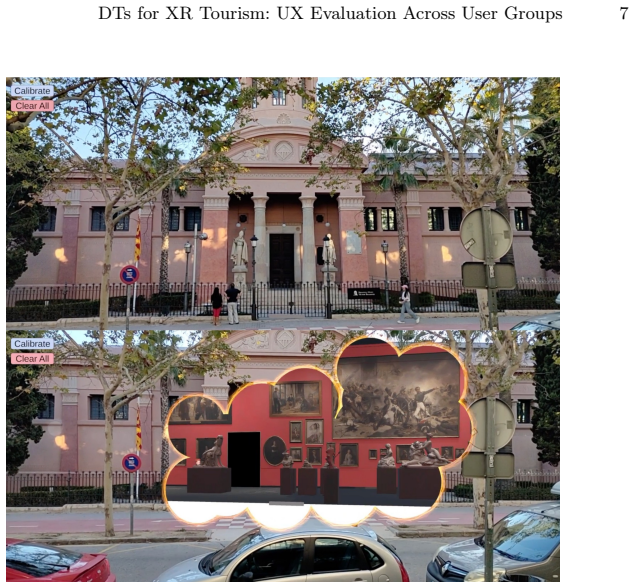
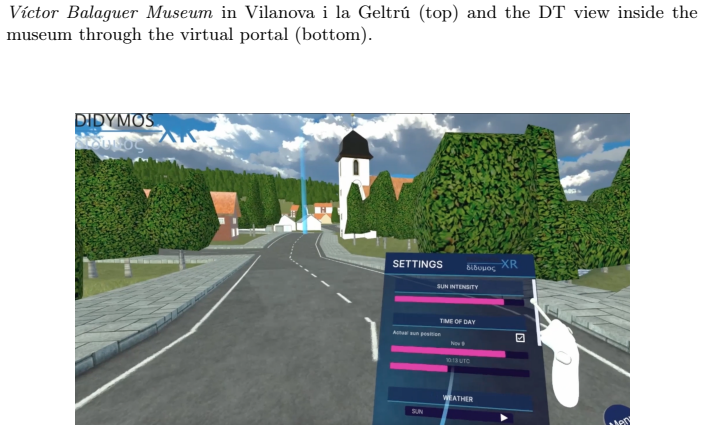
The carrying mechanism is the paired application design plus a standardized questionnaire battery. AR-VT places a user on the sidewalk with a smartphone and lets them tap a virtual portal into the building's digital twin; VR-VT places the user inside the village twin with locomotion, weather control, and snapshot features. The evaluation relies on UEQ-S for UX, NASA-TLX for task load, SAM for emotion, IPQ for presence, CSQ-VR for cybersickness, and ATI for technological affinity. These instruments convert subjective experience into comparable scores, and Spearman correlations link those scores to age, prior XR experience, and tech affinity.
What would settle it
Run the same AR-VT and VR-VT applications with a pre-registered, balanced sample of actual tourists at the intended museum sidewalk and village locations, with at least 20 per group and matched devices. The central claim weakens if novices no longer show lower pragmatic quality and higher cybersickness, or if the AR app's UX advantage over VR disappears.
Extended reading notes
Core claim
The central empirical claim is that digital-twin XR tourism applications are viable and generally well received, but the two formats differ sharply. The AR-VT, a smartphone app that opens a virtual portal into a building's digital twin, produced high UX scores and low task load across all three participant groups, with high enjoyment. The VR-VT, a headset experience of a reconstructed village, produced moderate presence but pragmatic-quality scores below the UEQ benchmark and cybersickness symptoms concentrated among less experienced users. The paper further claims that user factors explain a meaningful share of response: prior XR experience correlated strongly with higher pragmatic quality
Load-bearing premise
The load-bearing premise is that the convenience samples and field locations represent the broader tourist population well enough that the measured UX levels and correlations reflect the applications rather than recruitment, setting, or device differences.
Editorial extensions
If this is right
- If the claims hold, AR digital-twin tours can serve as low-effort on-site enhancements even outside opening hours, since task load was low and UX high across groups.
- VR digital-twin tours should not be assumed ready for the general public: usability and cybersickness scores suggest novices need onboarding, comfort options, and simpler locomotion before broad deployment.
- Prior XR experience is a usable predictor: designers can expect novices to rate pragmatics lower and report more cybersickness, so evaluation should oversample novices.
- Age and technology affinity are relevant covariates in XR tourism studies; ignoring them can misattribute app quality to user traits or vice versa.
- A follow-up iteration should focus on visual fidelity and richer interaction, since qualitative feedback flagged movement, zoom, and information content as weak points.
Reading between the lines
- The same data imply that cybersickness may be partly trainable: if prior experience is strongly protective, brief acclimation sessions could reduce symptoms before the tour, a testable design change the paper does not propose.
- A controlled within-subject comparison of AR-VT and VR-VT on the same city would isolate format effects; the present field design cannot separate format from location and sample.
- If visual fidelity was the main cause of low perceived realism, improving the 3D reconstruction or rendering should raise IPQ realism and possibly pragmatic scores, which could be tested by varying digital-twin quality while holding content constant.
- The ATI correlations suggest the same app may need adaptive UI: simpler gestures for low-affinity users and richer features for high-affinity users.
Signed reviews
Editorial analysis
A structured set of objections, weighed in public.
Referee Report
Summary. This paper reports an exploratory in-field user study of two digital-twin-based XR tourism applications: an AR Virtual Tour (AR-VT) for on-site exploration and a VR Virtual Tour (VR-VT) for remote exploration. A total of 84 participants were recruited in three groups (Etteln n=16, Fair n=50, Vilanova n=18). UX, task load, presence, cybersickness, emotion, and custom feature-related items were collected with standardized questionnaires. The results show mixed outcomes: the VR app had moderate presence, low perceived realism, usability and cybersickness problems, and negative overall UEQ-S scores; the AR app's UX varied across groups, with only the Fair Group reaching 'good' UEQ-S ratings. The authors also report several Spearman correlations with age, XR experience, and affinity for technology interaction. The abstract and conclusion generalize the findings to 'both applications' with 'low task load and high enjoyment,' but the data do not support this claim as stated.
Significance. If the reported results were supported, the paper would provide useful early evidence about user experience with digital-twin-based XR tourism applications in real-world settings, including insights for tailoring interfaces to XR novices. The study addresses an underexplored area, uses standardized instruments, and is transparent about several of its own limitations, including the unintended omission of the custom questionnaire for two groups and the field-setting constraints. However, the central claims in the abstract outrun the measurements: task load was collected only for AR-VT, enjoyment was collected only for the small Etteln group, and the 'high UX' assertion for AR-VT does not hold for the Etteln and Vilanova groups. These gaps do not invalidate the whole study, but they require the headline conclusions to be substantially qualified.
major comments (4)
- [Abstract and §3.6/§4.1] The abstract's lead finding that 'both applications provided a low task load and high enjoyment' is not supported by the measurements. §3.6 states that NASA-TLX was used 'only to validate the AR application' and that the custom questionnaires were 'unintentionally not used for the Vilanova and Fair Group.' Consequently §4.1 reports no task-load data for VR-VT, and §4.2 reports enjoyment only for the Etteln Group (n=16). The low-task-load claim for VR-VT and the high-enjoyment claim for AR-VT participants outside Etteln are therefore without measurement. Please revise the abstract, §1, and §6 to state precisely which metrics were collected for which groups, or collect the missing data before asserting the headline result.
- [Abstract and §4.2] The abstract's statement that 'the AR-based tour achieved high UX ratings' is contradicted by the group-level UEQ-S results in §4.2: only the Fair Group's overall mean (1.41) falls in the 'good' category; the Etteln Group (0.70) and Vilanova Group (1.11) are both classified 'below average.' Thus high AR UX is a subgroup result, not an overall result. Please qualify the claim, for example by reporting that the Fair Group rated the AR-VT as 'good' while the other two groups rated it below average.
- [§5.1, §4.1, §3.6] The VR-VT 'enjoyment' claim rests on a single custom item collected only from the Etteln Group (n=16), with mean 4.44 on a 7-point scale. The UEQ-S overall mean for the same application is -0.10, described as 'bad' in §5.1. Calling the experience 'high enjoyment' in the abstract is not warranted. Please describe the VR-VT result as mixed: moderate presence, low realism, usability problems, and moderate cybersickness, with an enjoyment item that was only administered to one small group.
- [§3.8, §4.1, §4.2] The correlation analysis is reported as the basis for 'significant relationships' with age, XR experience, and ATI, but it is an uncorrected exploratory search across many variables. In the Etteln group (n=16), many correlations are tested; by chance alone one would expect several p<0.05 findings. For the claim that 'correlation analysis revealed significant relationships ... for both applications,' please provide the full correlation matrix, state the number of comparisons made, and either apply a correction or explicitly present the findings as hypothesis-generating. Also note that the scatter-plot regression lines in Figs. 3-4 imply linear associations while Spearman rank correlations were reported.
minor comments (6)
- [§3.2] The subgroup labels 'elderly (n=7), young (n=5), and middle-aged (n=4)' are used without age brackets; given the overall age range of 16-79 years, please define these categories.
- [§4.2] UEQ-S benchmark classifications ('below average', 'good', etc.) are used without a citation to the UEQ-S benchmark data; please provide the reference so readers can interpret these labels.
- [§3.6] NASA-TLX was altered from its original continuous response format to a 7-point scale. Please add a sentence in the limitations section noting that this modification may affect comparability with other NASA-TLX studies.
- [§3.3/§3.4] The Fair Group was tested at a fairground rather than in front of the museum, and different smartphone models were used across groups. These are acknowledged in §6.2, but the conclusion could more explicitly avoid generalizing the AR-VT results to the intended tourist scenario.
- [§3.7] The VR-VT procedure included a training phase, while the AR-VT procedure did not describe an equivalent familiarization step. This asymmetry should be acknowledged as a possible confound when comparing task demand across the two applications.
- [§6.1] The statement about expanding evaluation methodologies to include 'DT-specific metrics' would benefit from a concrete example, since the paper does not propose what such a metric would measure.
Circularity Check
No circularity: self-contained empirical UX evaluation; reuse of prior methodology is framing only.
full rationale
This paper is an empirical field study comparing AR-VT and VR-VT digital-twin tourism applications across three participant groups. It contains no formal derivation, fitted model, or statistical prediction that reduces to its inputs. The only self-referential element is Section 3.5, where the application descriptions are adapted from the authors' prior methodology paper [18]. However, that reuse is purely descriptive: the measured outcomes (UEQ-S, IPQ, CSQ-VR, SAM, NASA-TLX, custom questionnaires) are collected directly from participants and are not computed or predicted from [18]. Thus the prior publication is not load-bearing for the reported results. A separate limitation is explicitly stated in Section 3.6: NASA-TLX 'was used only to validate the AR application' and the custom questionnaire 'was unintentionally not used for the Vilanova and Fair Group.' This means the abstract's claim that 'both applications provided a low task load and high enjoyment' is partially unsupported by the data actually collected, but this is a measurement-coverage issue, not circularity. No fitted parameter is renamed as a prediction, no uniqueness theorem is imported, and no ansatz is smuggled in via citation. Accordingly, no circular steps are identified.
Assumptions & free parameters
assumptions (4)
- domain assumption Standardized questionnaires validly measure the intended constructs in the translated and altered forms used here.
- domain assumption The convenience samples and field settings can support inferences about the applications and about XR novices.
- domain assumption The applications' visual and interaction quality is representative of the current digital twin approach rather than dominated by specific devices or test location.
- domain assumption Self-reported XR experience and ATI scores are comparable across German and Spanish participants.
Cite this review
Pith. "Pith review of Digital Twins for Extended Reality Tourism: User Experience Evaluation Across User Groups." pith.science (2026). https://pith.science/paper/LO2ODAAV
@misc{pith2026250907740,
  author       = {Pith},
  title        = {Pith review of: Digital Twins for Extended Reality Tourism: User Experience Evaluation Across User Groups},
  year         = {2026},
  howpublished = {\url{https://pith.science/paper/LO2ODAAV}},
  note         = {Machine review of arXiv:2509.07740}
}
read the original abstract
This study evaluates the user experience (UX) in extended reality (XR) tourism of two digital twin-based applications: an Augmented Reality Virtual Tour (AR-VT) for enhanced on-site visits and a Virtual Reality Virtual Tour (VR-VT) for remote exploration. Using a quantitative exploratory approach, 84 participants from Spain and Germany, divided into three sample groups, assessed UX, task load, presence, cybersickness, and emotional response through standardized questionnaires. Findings indicate that both applications provided a low task load and high enjoyment. The VR-based tour enhanced presence but posed usability and cybersickness challenges, while the AR-based tour achieved high UX ratings, with qualitative feedback suggesting areas for refinement. Correlation analysis revealed significant relationships between age, prior XR experience, and technological affinity with the measured metrics for both applications. These results highlight the importance of well-designed experiences tailored to XR novices, reinforcing the critical role of UX in digital twin-based XR tourism.
Figures

Figures from the paper (1 more)

Reference graph
Works this paper leans on
-
[1]
Digital twins in tourism: a systematic literature review
deAlmeida,D.S.,Boavida-Portugal,I.,etal.:Digitaltwinsintourism:asystematic literature review. arXiv preprint arXiv:2502.00002 (2025)
work page Pith review arXiv 2025
-
[2]
Journal of behavior therapy and experimental psychiatry 25(1), 49–59 (1994)
Bradley, M.M., Lang, P.J.: Measuring emotion: the self-assessment manikin and the semantic differential. Journal of behavior therapy and experimental psychiatry 25(1), 49–59 (1994)
work page 1994
-
[3]
Tourism Review79(5), 1076–1087 (2024)
Deng, B., Wong, I., Lian, Q.: From metaverse experience to physical travel: the role of the digital twin in metaverse design. Tourism Review79(5), 1076–1087 (2024). https://doi.org/10.1108/TR-05-2023-0315
-
[4]
Frontiers in Virtual Reality2(Oct 2021)
Dilanchian, A.T., Andringa, R., Boot, W.R.: A pilot study exploring age differences in presence, workload, and cybersickness in the experience of im- mersive virtual reality environments. Frontiers in Virtual Reality2(Oct 2021). https://doi.org/10.3389/frvir.2021.736793,https://www.frontiersin.org/ journals/virtual-reality/articles/10.3389/frvir.2021.736793/full
-
[5]
IEEE Transactions on Visualization and Computer Graphics pp
Doty, T.A., Kelly, J.W., Gilbert, S.B., Dorneich, M.C.: Cybersickness abatement from repeated exposure to vr with reduced discomfort. IEEE Transactions on Visualization and Computer Graphics pp. 1–12 (2024). https://doi.org/10.1109/TVCG.2024.3483070
-
[6]
Florido-Benítez, L.: The use of digital twins to address smart tourist destinations’ future challenges. Platforms2(4), 234–254 (2024). https://doi.org/10.3390/platforms2040016,https://www.mdpi.com/2813-4176/ 2/4/16
-
[7]
International Journal of Human-Computer Interaction35(6), 456–467 (2019)
Franke, T., Attig, C., Wessel, D.: A personal resource for technology interaction: development and validation of the affinity for technology interaction (ati) scale. International Journal of Human-Computer Interaction35(6), 456–467 (2019)
work page 2019
-
[8]
In: Proceedings of the 22nd International Conference on Mobile and Ubiquitous Multimedia
Gallist, N., Hagler, J.: Tourism in the metaverse: Digital twin of a city in the alps. In: Proceedings of the 22nd International Conference on Mobile and Ubiquitous Multimedia. p. 568–570. MUM ’23, Association for Computing Machinery, New York, NY, USA (2023). https://doi.org/10.1145/3626705.3631880,https://doi. org/10.1145/3626705.3631880
Show all 37 references
-
[9]
Hart, S.G., Staveland, L.E.: Development of NASA-TLX (Task Load Index): Re- sults of Empirical and Theoretical Research, vol. 52, p. 139–183. Elsevier (1988). https://doi.org/10.1016/S0166-4115(08)62386-9
1988 doi
-
[10]
Online, www.igroup.org/pq/ipq/items.php
I-Group.org Project: Igroup Presence Questionnaire (IPQ) Item Download. Online, www.igroup.org/pq/ipq/items.php
-
[11]
CIRP Journal of Manufacturing Science and Technology29, 36–52 (May 2020)
Jones, D., Snider, C., Nassehi, A., Yon, J., Hicks, B.: Characterising the digital twin: A systematic literature review. CIRP Journal of Manufacturing Science and Technology29, 36–52 (May 2020). https://doi.org/10.1016/j.cirpj.2020.02.002
2020 doi
-
[12]
https://doi.org/10.13140/RG.2.2.36571.03362
Kourtesis, P., Linnell, J., Amir, R., Argelaguet, F., MacPherson, S.: Cy- bersickness in virtual reality questionnaire (csq-vr): A brief tool for evalu- ating the virtual reality induced symptoms and effects (vrise) (Dec 2022). https://doi.org/10.13140/RG.2.2.36571.03362
2022
-
[13]
In: 2024 IEEE 3rd International Conference on Elec- trical Engineering, Big Data and Algorithms (EEBDA)
Li, S., Feng, Y., Chu, Q., Chen, G.: Design of smart tourism visual analysis plat- form based on digital twin. In: 2024 IEEE 3rd International Conference on Elec- trical Engineering, Big Data and Algorithms (EEBDA). pp. 1300–1303 (2024). https://doi.org/10.1109/EEBDA60612.2024...
2024
-
[14]
https://doi.org/10.1108/WHATT-06-2023-0074
Litavniece, L., Kodors, S., Adamoniene, R., Kijasko, J.: Digital twin: an approach toenhancingtourismcompetitiveness.WorldwideHospitalityandTourismThemes 15(5), 538–548 (2023). https://doi.org/10.1108/WHATT-06-2023-0074
2023 doi
-
[15]
Ethics and Information Technology25(61) (2023)
Rahmadian, E., Feitosa, D., Virantina, Y.: Digital twins, big data governance, and sustainable tourism. Ethics and Information Technology25(61) (2023). https://doi.org/10.1007/s10676-023-09730-w
2023 doi
-
[16]
In: 2022 International Confer- ence on Culture-Oriented Science and Technology (CoST)
Sang, F., Wu, H., Liu, Z., Fang, S.: Digital twin platform design for zhejiang rural cultural tourism based on unreal engine. In: 2022 International Confer- ence on Culture-Oriented Science and Technology (CoST). pp. 274–278 (2022). https://doi.org/10.1109/CoST57098.2022.00063
2022
-
[17]
International Jour- nal of Interactive Multimedia and Artificial Intelligence4, 103 (Jan 2017)
Schrepp, M., Hinderks, A., Thomaschewski, J.: Design and Evaluation of a Short Version of the User Experience Questionnaire (UEQ-S). International Jour- nal of Interactive Multimedia and Artificial Intelligence4, 103 (Jan 2017). https://doi.org/10.9781/ijimai.2017.09.001
2017 doi
-
[18]
In: 2025 IEEE In- ternational Conference on Artificial Intelligence and eXtended and Virtual Reality (AIxVR)
Vona, F., Warsinke, M., Kojić, T., Voigt-Antons, J.N., Möller, S.: User-centric eval- uation methods for digital twin applications in extended reality. In: 2025 IEEE In- ternational Conference on Artificial Intelligence and eXtended and Virtual Reality (AIxVR). pp. 142–146 (20...
2025
-
[19]
Gender –Female –Male –Other
-
[20]
Are you a Student? –Yes –No
-
[21]
How experienced are you with Extended Reality technologies? (Virtual Re- ality, Augmented Reality, Mixed Reality) –Not all all 1 2 3 4 5 6 7 Very experienced
-
[22]
What of the following technologies have you used before? –Virtual Reality on Headset –Virtual Reality on Smartphone –Augmented Reality on Headset –Augmented Reality on Smartphone A.2 AR-VT (English Version)
-
[24]
Warsinke et al
How easy was it to find the place to frame? –Very difficult 1 2 3 4 5 6 7 Very easy 18 M. Warsinke et al
-
[25]
How easy was it to find the point of interest? –Very difficult 1 2 3 4 5 6 7 Very easy
-
[26]
How easy was it to open the portal? –Very difficult 1 2 3 4 5 6 7 Very easy
-
[27]
How easy was it to look inside the portal? –Very difficult 1 2 3 4 5 6 7 Very easy
-
[28]
Would you recommend other gestures to open the portals? –Yes –No
-
[29]
Do you think a headset like the one in the figure (HoloLens 2) would have been better for this experience instead of the smartphone? –Yes –No
-
[30]
Additional comments: A.3 VR-VT (English Version)
-
[31]
How much did you enjoy the experience? –Not at all 1 2 3 4 5 6 7 Enjoyed very much
-
[32]
How easy was it to navigate with the free movement? –Very difficult 1 2 3 4 5 6 7 Very easy
-
[33]
How easy was it to navigate with teleportation? –Very difficult 1 2 3 4 5 6 7 Very easy
-
[34]
How easy was it to reach a point of interest? –Very difficult 1 2 3 4 5 6 7 Very easy
-
[35]
What movement did you prefer? –Free Movement –Teleportation
-
[36]
How easy was it to take a snapshot? –Very difficult 1 2 3 4 5 6 7 Very easy
-
[37]
How would you rate the usefulness of this feature? –Not at all 1 2 3 4 5 6 7 Very useful
-
[38]
Additional comments:
Reviewed August 4, 2026 · model on record in the stance chip above.
Discussion (0). Continue with ORCID to comment.