REVIEW 3 major objections 4 minor 73 references
Unveiling Galactic substructures with M Giant stars: A kinematic and chemical study based on LAMOST DR9, Gaia DR3 and APOGEE DR17
T0 review · 3 major / 4 minor · reviewed 2026-08-04 · deepseek-v4-flash
Pith's one-line read M giant stars recover the Milky Way's known substructures and reveal metal-rich stars formed from gas delivered by the ancient Gaia-Enceladus merger.
desk verdict Solid catalog paper with honest limitations; overstates its conclusions in the abstract. read the letter →
The pith
A machine-rendered reading of the paper's core claim, the machinery that carries it, and where it could break.
The reading
What carries the argument
The central machinery is the integrals-of-motion (IoM) space built from five orbital parameters—eccentricity, semi-major axis, orbital pole direction, and apocenter direction—computed from each star's full six-dimensional phase-space coordinates. In this space, the paper applies a friends-of-friends algorithm with an orbit-likelihood distance, so stars sharing similar orbits link into groups even when dynamical mixing has scrambled their current positions. The load-bearing tracer is the M giant itself: luminous and less affected by extinction, it reaches low Galactic latitudes and large distances, which is why the recovered groups extend earlier samples built from K giants, RR Lyrae stars, o
What would settle it
Recompute the clustering on the same 3,343 M giants using distances from an independent calibration, for example asteroseismic or spectrophotometric distances, and repeat the friends-of-friends linkage. Then check whether the 115 Gaia-Enceladus-Sausage members—especially the metal-rich ones with two alpha sequences—still occupy the high-eccentricity, low-angular-momentum locus. If the metal-rich group dissolves, shifts toward the thick-disk sequence, or changes its energy-angular momentum shape, the claim that these stars formed from merger-delivered gas is unsupported. A cheaper check: apply
Extended reading notes
Core claim
The paper's central claim is that an M-giant sample, clustered in integrals-of-motion space, can both recover known Milky Way substructures and reveal the chemical signature of star formation fed by an ancient merger. Using five orbital parameters—eccentricity, semi-major axis, orbital pole direction, and apocenter direction—the authors compute an orbit-likelihood distance and apply friends-of-friends clustering to 3,343 M giants. They identify 47 groups totaling 1,597 stars: 182 in the Sagittarius stream, 594 in the Galactic Anticenter Substructure, 115 in the Gaia-Enceladus-Sausage, 121 in Splash, and 557 in the high-alpha disk. The GES members show the characteristic low-angular-momentum,
Load-bearing premise
The load-bearing premise is that the catalog's photometric distances—with roughly 25% relative uncertainty—are accurate enough that the computed orbital parameters separate true stellar groups rather than distance-error artifacts; the authors themselves replace those distances for Sagittarius stream members because they are noticeably underestimated.
Editorial extensions
If this is right
- M giants can serve as standard tracers for low-latitude and distant Galactic substructures, complementing K giants, RR Lyrae stars, and BHB stars.
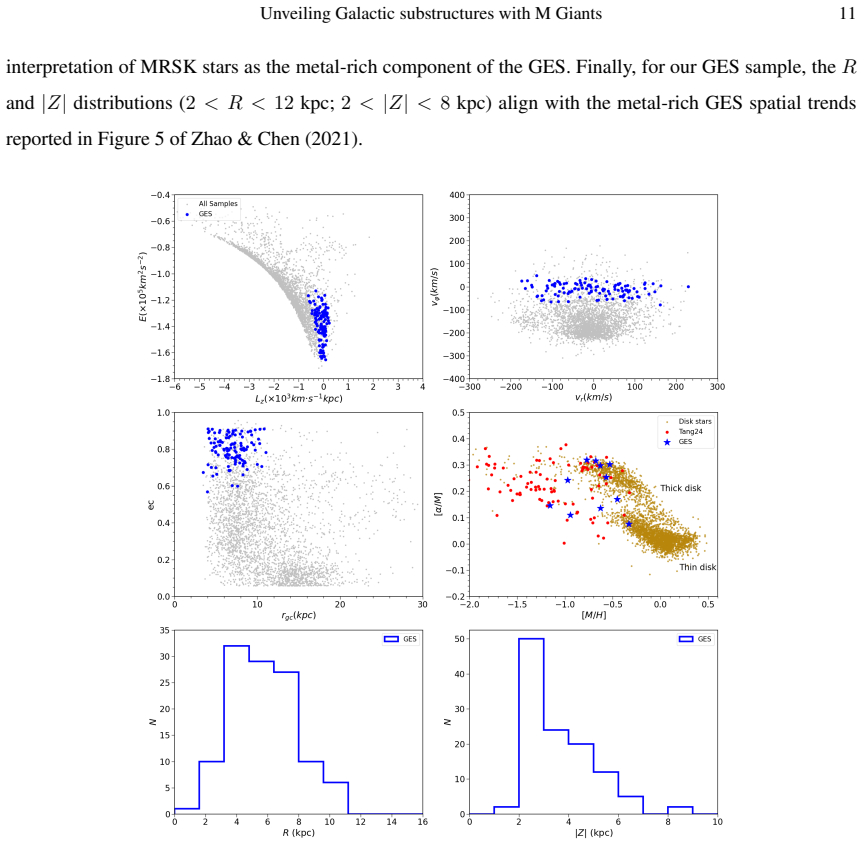
- The GES sample is extended toward metal-rich M giants with two alpha sequences, supporting the idea that the GES progenitor delivered gas that formed new stars.
- The GASS sample grows to 594 M giants, giving more leverage on the outer disk's structure and possible ripple patterns.
- Splash and high-alpha disk samples provide an independent view of the early disk heating event: the same thick-disk chemistry appears in two different orbital states.
- Two previously unknown groups with no clear counterpart suggest that M giants may reveal further structures not seen with other tracers.
Reading between the lines
- If the distance systematics that forced a correction for Sagittarius stream members also affect GES members, the metal-rich GES claim could be tested by re-running the clustering with an independent distance scale; the paper does not propagate these uncertainties.
- The two unclassified groups might be fragments of known structures—Group 2 could be a metal-rich tail of the low-energy retrograde substructure Thamnos—or genuinely new groups; the paper only offers these as hypotheses.
- Jointly using chemistry inside the clustering likelihood could suppress the low-alpha contamination the paper notes within the high-alpha disk group.
- The M giants with |Z|<2 kpc, deliberately excluded here, could extend the same analysis into the disk plane where extinction matters most and where M giants are especially valuable.
Editorial analysis
A structured set of objections, weighed in public.
Referee Report
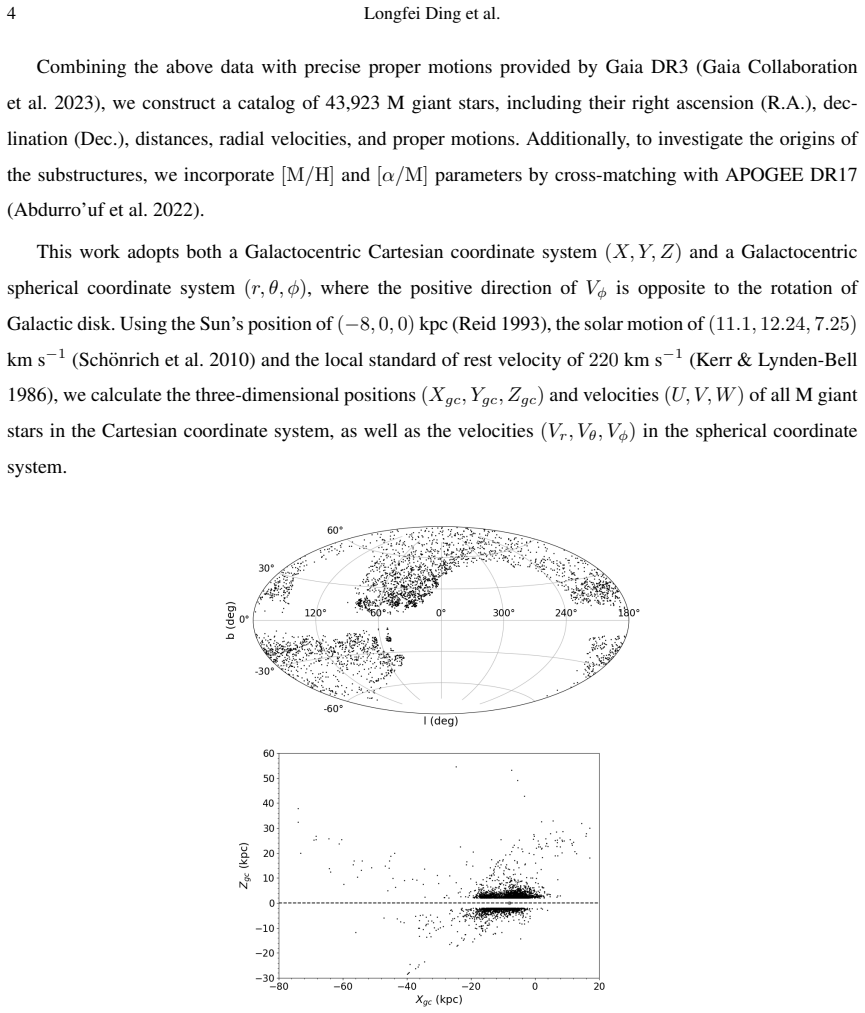
Summary. The paper uses the LAMOST DR9 M-giant catalog of Li et al. (2023), distances from Qiu et al. (2023), Gaia DR3 proper motions, and APOGEE DR17 abundances to identify Milky Way substructures through a Friends-of-Friends clustering algorithm applied in integrals-of-motion space. The authors report members of the Sagittarius stream, GASS, GES, Splash, and the high-α disk, plus two groups without clear literature counterparts. They further claim that metal-rich M giants in the GES region show bimodal α-abundances, supporting the Zhao & Chen (2021) scenario in which the GES progenitor delivered metal-enriched gas, and that the identified Splash and high-α disk populations confirm a specific early-Milky-Way evolutionary picture.
Significance. If the structure identifications are robust, the paper provides a useful demonstration that M giants are viable tracers of known Galactic substructures in IoM space, and the metal-rich GES M giants with low- and high-α sequences add an independent observational datapoint to the debate about the GES progenitor's gas content and star formation. The external benchmarks against Belokurov et al. (2014), Hernitschek et al. (2017), Yang et al. (2019b), Li et al. (2021), and Tang et al. (2024) are a strength, and the machine-readable tables of member parameters are a useful community resource. However, the central quantitative claim—the association of individual M giants with specific substructures—rests on orbital parameters derived from photometric distances with ~25% relative uncertainty, and the paper does not demonstrate that the clustering is stable under realistic distance errors. The strongest wording of the conclusions, especially 'confirm the existence of metal-rich constituents within the GES' and 'confirm the evolutionary scenario,' goes beyond what the data and analysis can support.
major comments (3)
- [§2, §3, §4.1] The paper never quantifies how the ~25% relative distance uncertainty of Qiu et al. (2023) propagates into the orbital parameters used in Eq. (1) and into the FoF group assignments. Since the linking lengths are as small as 0.138 in normalized units, a star displaced by a 25% distance error (0.6–1.3 kpc at the relevant distances) can easily cross the boundaries between groups. The problem is not hypothetical: §4.1 states that the Qiu et al. distances for Sgr members are 'noticeably underestimated' and the authors replace them with a different calibration. That correction was applied after clustering for Sgr only, and the same systematic bias could affect the GASS, GES, Splash, or high-α memberships. A robustness test—e.g., re-running the FoF with distance realizations drawn from the quoted uncertainties, or a bootstrap over distance/velocity errors—is needed to show that the 115 GES, 121
- [§4.3, §5] The claim that metal-rich M giants 'confirm' the existence of metal-rich constituents within GES and the evolutionary scenario is not supported by the presented evidence. The GES sample has only 11 stars with reliable APOGEE [M/H] and [α/M] measurements, and the bimodal low-α/high-α separation is based on a visual inspection of Figure 6. No statistical test of bimodality, no significance estimate, and no contamination assessment from the background disk/halo are provided. With only 11 stars, the bimodal appearance could arise from small-number statistics or from overlap with Splash and thick-disk populations. The abstract and §5 should be tempered to 'consistent with' or 'suggest' rather than 'confirm'.
- [§4.1] The Sgr distance correction introduces an inconsistency in the analysis pipeline. Clustering in §3 used the original Qiu et al. (2023) distances, while §4.1 replaces the distances for Sgr members with the Li et al. (2016a) color-magnitude relation and then compares the corrected Sgr sample with literature data. It is not stated whether the orbital parameters and group membership were recomputed after the correction, nor how this correction affects the other substructures. This inconsistency weakens the reliability of the Sgr leading-arm decomposition and raises questions about the uniform application of the distance model across the full sample.
minor comments (4)
- [Abstract] The wording 'confirm the existence' and 'confirms the evolutionary scenario' is too strong for the data presented; consider using 'suggests' or 'supports'.
- [§3, Table 2] The linking length is selected individually for each group (Appendix A). The paper should state how many groups used each of the two extreme values and whether the results are stable to small changes in the linking length.
- [§4.5, Figure 9] The authors acknowledge low-α disk contamination in the high-α sample. It would be useful to quantify the contamination fraction, e.g., by comparing the [α/M] distribution of members with the field sample.
- [§4.6] Group 1 and Group 2 have only 15 and 13 members, respectively, with essentially no chemical data. The claim that Group 2 is a metal-rich extension of Thamnos is highly speculative and should be labeled as such.
Circularity Check
No significant circularity: the orbit-based grouping is benchmarked against external literature, and the GES chemical claim is not defined by the scenario it supports.
full rationale
The derivation chain is self-contained rather than circular. The M-giant sample and distances are taken from published catalogs (Li et al. 2023; Qiu et al. 2023), the orbital parameters entering the friends-of-friends clustering are computed from the explicit definitions in Section 3 and Eq. (1), and the resulting groups are labeled by comparing with externally defined substructures (Belokurov et al. 2014, 2018; Hernitschek et al. 2017; Naidu et al. 2020; Li et al. 2021; Tang et al. 2024). The metal-rich GES claim is not circular: the 11 APOGEE-matched GES M giants are selected purely from IoM clustering, not from the Zhao & Chen (2021) MRSK metallicity/kinematic cuts, so finding bimodal alpha abundances in that sample is an independent observation rather than a restatement of the input definition. The Sgr distance correction in Section 4.1 is a post-identification data correction, not a fitted parameter renamed as a prediction. Heavy self-citation exists (e.g., Li et al. 2023; Qiu et al. 2023; Wang et al. 2022; Yang et al. 2019b; Zhao & Chen 2021; and the in-preparation Xue et al. 2024 cited for the IoM parameter set), but these citations supply data, method, or interpretation; they do not by construction force the reported substructure memberships or the chemical conclusions. No equation in the paper reduces to another by construction, and no fitted quantity is presented as an independent prediction. The main vulnerabilities, such as ~25% distance uncertainties and small APOGEE-matched samples for GES, are correctness/robustness concerns rather than circularity.
Assumptions & free parameters
free parameters (4)
- FoF linking length per group =
0.138 to 0.487 (per-group value not listed)
- Orbit-likelihood weights in Eq. 1 =
adopted from Wang et al. (2022), values not given
- Minimum FoF group size =
10 members
- Sgr distance correction scale (Li et al. 2016a CMR) =
not quantified
assumptions (6)
- domain assumption Integrals of motion persist as valid labels for accretion remnants despite phase mixing
- domain assumption Five IoM parameters (e_c, a, l_orbit, b_orbit, l_apo) computed in a spherical potential without dynamical friction
- domain assumption The unstated Milky Way potential used for E, Lz, a, e is accurate
- domain assumption Photometric distances with ~25% uncertainty are accurate enough for clustering
- domain assumption Visual overlap with published members is sufficient to assign groups to known substructures
- domain assumption APOGEE DR17 abundances for the matched subset are representative of each population
invented entities (3)
-
Group 1 (15 M giants)
-
Group 2 (13 M giants)
-
Two-component Sgr leading stream
Cite this review
Pith. "Pith review of Unveiling Galactic substructures with M Giant stars: A kinematic and chemical study based on LAMOST DR9, Gaia DR3 and APOGEE DR17." pith.science (2026). https://pith.science/paper/W5OW4OCB
@misc{pith2026250907744,
  author       = {Pith},
  title        = {Pith review of: Unveiling Galactic substructures with M Giant stars: A kinematic and chemical study based on LAMOST DR9, Gaia DR3 and APOGEE DR17},
  year         = {2026},
  howpublished = {\url{https://pith.science/paper/W5OW4OCB}},
  note         = {Machine review of arXiv:2509.07744}
}
read the original abstract
Based on the updated M giant star catalog selected from LAMOST DR9, we iden-tify substructures within the integrals-of-motion space through Friends-of-Friends cluster-ing algorithm. We obtain members belonging to several known substructures: the Sagittarius stream, Galactic Anticenter Substructure (GASS), Gaia-Enceladus-Sausage (GES), Splash, and the high-{\alpha} disk. Furthermore, we also identify two groups which cannot be clearly asso-ciated with previously known substructures. Our findings confirm the existence of metal-rich constituents within the GES, representing newly formed stars that originated from the metal-enriched gas delivered during the GES merger event and subsequently evolved. Additionally, this study further expands the sample of GASS, high-{\alpha} disk, and Splash stars. Analysis of these metal-rich M giant stars as members of the GES, Splash, and high-{\alpha} disk compo-nents supports an evolution scenario for the early Milky Way, as proposed by previous stud-ies. In this scenario, stars initially formed in a high-{\alpha} primordial disk were dynamically heated by the massive accretion event (GES). This process redistributed stellar orbits, creat-ing the Splash population, while the undisturbed portion of the primordial disk persisted as the present-day high-{\alpha} disk component.
Figures


Figures from the paper (8 more)




Reference graph
Works this paper leans on
-
[1]
2022, ApJS, 259, 35, doi:10.3847/1538-4365/ac44144
Abdurro’uf, Accetta, K., Aerts, C., et al. 2022, ApJS, 259, 35, doi:10.3847/1538-4365/ac44144
-
[3]
2020, ApJS, 249, 3, doi:10.3847/1538-4365/ ab929e2
Ahumada, R., Allende Prieto, C., Almeida, A., et al. 2020, ApJS, 249, 3, doi:10.3847/1538-4365/ ab929e2
-
[5]
2021, A&A, 654, A15, doi:10.1051/0004-6361/20214101512
Balbinot, E., & Helmi, A. 2021, A&A, 654, A15, doi:10.1051/0004-6361/20214101512
-
[6]
Belokurov, V ., Erkal, D., Evans, N. W., Koposov, S. E., & Deason, A. J. 2018, MNRAS, 478, 611, doi:10. 1093/mnras/sty9822, 6, 10
work page 2018
-
[8]
Belokurov, V ., Zucker, D. B., Evans, N. W., et al. 2006, ApJ, 642, L137, doi:10.1086/5047977
-
[9]
Belokurov, V ., Evans, N. W., Bell, E. F., et al. 2007, ApJ, 657, L89, doi:10.1086/5131447, 12
-
[11]
2003, A&A, 410, 527, doi:10.1051/0004-6361:20031213 14
Bensby, T., Feltzing, S., & Lundstr¨om, I. 2003, A&A, 410, 527, doi:10.1051/0004-6361:20031213 14
-
[12]
2012, MNRAS, 426, 1324, doi:10.1111/j.1365-2966.2012.21757.x2
Binney, J. 2012, MNRAS, 426, 1324, doi:10.1111/j.1365-2966.2012.21757.x2
arXiv 2012
Show all 73 references
-
[13]
2008, Galactic Dynamics: Second Edition 2
Binney, J., & Tremaine, S. 2008, Galactic Dynamics: Second Edition 2
2008
-
[14]
F., & Kere ˇs, D
Bonaca, A., Conroy, C., Wetzel, A., Hopkins, P. F., & Kere ˇs, D. 2017, ApJ, 845, 101, doi:10.3847/ 1538-4357/aa7d0c12, 13, 17
2017
-
[15]
A., et al
Bonaca, A., Conroy, C., Cargile, P. A., et al. 2020, ApJ, 897, L18, doi:10.3847/2041-8213/ab9caa 2, 12, 13, 14, 15, 17
2020 doi
-
[16]
L., Sheffield, A
Carlin, J. L., Sheffield, A. A., Cunha, K., & Smith, V . V . 2018, ApJ, 859, L10, doi:10.3847/ 2041-8213/aac3d87
2018
-
[17]
2019, ApJ, 887, 22, doi:10.3847/1538-4357/ab517c14
Carollo, D., Chiba, M., Ishigaki, M., et al. 2019, ApJ, 887, 22, doi:10.3847/1538-4357/ab517c14
2019 doi
- [18]
-
[20]
Q., Nissen, P
Chen, Y . Q., Nissen, P. E., Zhao, G., Zhang, H. W., & Benoni, T. 2000, A&AS, 141, 491, doi:10.1051/ aas:200012414
2000
-
[22]
1993, A&A, 275, 101 14
Edvardsson, B., Andersen, J., Gustafsson, B., et al. 1993, A&A, 275, 101 14
1993
-
[23]
K., Sahlholdt, C
Feuillet, D. K., Sahlholdt, C. L., Feltzing, S., & Casagrande, L. 2021, MNRAS, 508, 1489, doi:10.1093/ mnras/stab26142 Unveiling Galactic substructures with M Giants 21
2021
-
[24]
1998, A&A, 338, 161 14 Gaia Collaboration, Vallenari, A., Brown, A
Fuhrmann, K. 1998, A&A, 338, 161 14 Gaia Collaboration, Vallenari, A., Brown, A. G. A., et al. 2023, A&A, 674, A1, doi:10.1051/ 0004-6361/2022439402, 4
1998
-
[25]
R., Bovy, J., Holtzman, J
Hayden, M. R., Bovy, J., Holtzman, J. A., et al. 2015, ApJ, 808, 132, doi:10.1088/0004-637X/808/ 2/13214
2015 doi
-
[29]
2020, ARA&A, 58, 205, doi:10.1146/annurev-astro-032620-0219172
Helmi, A. 2020, ARA&A, 58, 205, doi:10.1146/annurev-astro-032620-0219172
2020 doi
-
[30]
H., et al
Helmi, A., Babusiaux, C., Koppelman, H. H., et al. 2018, Nature, 563, 85, doi:10.1038/ s41586-018-0625-x2, 10, 17
2018
-
[31]
2017, ApJ, 850, 96, doi:10.3847/1538-4357/aa960c 6, 7, 8
Hernitschek, N., Sesar, B., Rix, H.-W., et al. 2017, ApJ, 850, 96, doi:10.3847/1538-4357/aa960c 6, 7, 8
2017 doi
-
[33]
F., & Stolte, A
Ibata, R., Irwin, M., Lewis, G. F., & Stolte, A. 2001, ApJ, 547, L133, doi:10.1086/3188947
2001 doi
-
[34]
2021, ApJ, 914, 123, doi:10.3847/1538-4357/abfcc22
Ibata, R., Malhan, K., Martin, N., et al. 2021, ApJ, 914, 123, doi:10.3847/1538-4357/abfcc22
2021 doi
-
[35]
A., Gilmore, G., & Irwin, M
Ibata, R. A., Gilmore, G., & Irwin, M. J. 1994, Nature, 370, 194, doi:10.1038/370194a07
1994 doi
-
[36]
J., & Lynden-Bell, D
Kerr, F. J., & Lynden-Bell, D. 1986, MNRAS, 221, 1023, doi:10.1093/mnras/221.4.10234
1986 doi
-
[37]
2018, ApJ, 860, L11, doi:10.3847/2041-8213/aac882 10
Koppelman, H., Helmi, A., & Veljanoski, J. 2018, ApJ, 860, L11, doi:10.3847/2041-8213/aac882 10
2018 doi
-
[38]
H., Helmi, A., Massari, D., Price-Whelan, A
Koppelman, H. H., Helmi, A., Massari, D., Price-Whelan, A. M., & Starkenburg, T. K. 2019a, A&A, 631, L9, doi:10.1051/0004-6361/2019367382, 5, 15, 17
-
[40]
J., Carlin, J
Li, J., Newberg, H. J., Carlin, J. L., et al. 2012, ApJ, 757, 151, doi:10.1088/0004-637X/757/2/151 9
2012 doi
-
[41]
C., Zhong, J., et al
Li, J., Smith, M. C., Zhong, J., et al. 2016a, ApJ, 823, 59, doi:10.3847/0004-637X/823/1/597
-
[42]
2019, ApJ, 874, 138, doi:10.3847/1538-4357/ab09ef3, 7
Li, J., FELLOW, L., Liu, C., et al. 2019, ApJ, 874, 138, doi:10.3847/1538-4357/ab09ef3, 7
2019 doi
-
[43]
2021, ApJ, 910, 46, doi:10.3847/1538-4357/abd9bf2, 3, 5, 6, 9, 10, 17
Li, J., Xue, X.-X., Liu, C., et al. 2021, ApJ, 910, 46, doi:10.3847/1538-4357/abd9bf2, 3, 5, 6, 9, 10, 17
2021 doi
-
[44]
2023, ApJS, 266, 4, doi:10.3847/1538-4365/acc3953, 16
Li, J., Long, L., Zhong, J., et al. 2023, ApJS, 266, 4, doi:10.3847/1538-4365/acc3953, 16
2023 doi
-
[45]
S., Balbinot, E., Mondrik, N., et al
Li, T. S., Balbinot, E., Mondrik, N., et al. 2016b, ApJ, 817, 135, doi:10.3847/0004-637X/817/2/ 13512 22 Longfei Ding et al
-
[47]
T., Schiavon, R
Mackereth, J. T., Schiavon, R. P., Pfeffer, J., et al. 2019, MNRAS, 482, 3426, doi:10.1093/mnras/ sty295510
2019 doi
-
[48]
2022, ApJ, 930, L9, doi:10.3847/2041-8213/ac67da2, 5
Malhan, K. 2022, ApJ, 930, L9, doi:10.3847/2041-8213/ac67da2, 5
2022 doi
-
[49]
2024, ApJ, 964, 104, doi:10.3847/1538-4357/ad18852, 5
Malhan, K., & Rix, H.-W. 2024, ApJ, 964, 104, doi:10.3847/1538-4357/ad18852, 5
2024 doi
-
[50]
H., & Helmi, A
Massari, D., Koppelman, H. H., & Helmi, A. 2019, A&A, 630, L4, doi:10.1051/0004-6361/ 2019361352, 5
2019 doi
-
[51]
2023, MNRAS, 520, 5225, doi:10.1093/mnras/stad3212
Mateu, C. 2023, MNRAS, 520, 5225, doi:10.1093/mnras/stad3212
2023 doi
-
[53]
C., Evans, N
Myeong, G. C., Evans, N. W., Belokurov, V ., Sanders, J. L., & Koposov, S. E. 2018, ApJ, 863, L28, doi:10. 3847/2041-8213/aad7f72, 10
2018
-
[54]
C., Vasiliev, E., Iorio, G., Evans, N
Myeong, G. C., Vasiliev, E., Iorio, G., Evans, N. W., & Belokurov, V . 2019, MNRAS, 488, 1235, doi:10. 1093/mnras/stz17702
2019
-
[55]
P., Conroy, C., Bonaca, A., et al
Naidu, R. P., Conroy, C., Bonaca, A., et al. 2020, ApJ, 901, 48, doi:10.3847/1538-4357/abaef42, 5, 6, 7, 10, 12, 13, 14, 15, 17
2020 doi
-
[56]
2020, Nature Astronomy, 4, 1078, doi:10.1038/ s41550-020-1131-22
Necib, L., Ostdiek, B., Lisanti, M., et al. 2020, Nature Astronomy, 4, 1078, doi:10.1038/ s41550-020-1131-22
2020
-
[57]
J., & Carlin, J
Newberg, H. J., & Carlin, J. L., eds. 2016, Astrophysics and Space Science Library, V ol. 420, Tidal Streams in the Local Group and Beyond, doi:10.1007/978-3-319-19336-62
2016 doi
-
[58]
J., Yanny, B., Rockosi, C., et al
Newberg, H. J., Yanny, B., Rockosi, C., et al. 2002, ApJ, 569, 245, doi:10.1086/3389839
2002 doi
-
[59]
E., Christensen-Dalsgaard, J., Mosumgaard, J
Nissen, P. E., Christensen-Dalsgaard, J., Mosumgaard, J. R., et al. 2020, A&A, 640, A81, doi:10.1051/ 0004-6361/20203830014
2020
-
[60]
1965, ARA&A, 3, 113, doi:10.1146/annurev.aa.03.090165.0005532
Ollongren, A. 1965, ARA&A, 3, 113, doi:10.1146/annurev.aa.03.090165.0005532
1965
-
[61]
2023, Research in Astronomy and Astrophysics, 23, 055008, doi:10.1088/ 1674-4527/acc1533, 7, 16
Qiu, D., Tian, H., Li, J., et al. 2023, Research in Astronomy and Astrophysics, 23, 055008, doi:10.1088/ 1674-4527/acc1533, 7, 16
2023
-
[62]
2014, A&A, 567, A5, doi:10.1051/ 0004-6361/20132294414
Recio-Blanco, A., de Laverny, P., Kordopatis, G., et al. 2014, A&A, 567, A5, doi:10.1051/ 0004-6361/20132294414
2014
-
[63]
Reid, M. J. 1993, ARA&A, 31, 345, doi:10.1146/annurev.aa.31.090193.0020214
1993
-
[64]
2022, ApJ, 941, 45, doi:10.3847/1538-4357/ac9e012
Rix, H.-W., Chandra, V ., Andrae, R., et al. 2022, ApJ, 941, 45, doi:10.3847/1538-4357/ac9e012
2022 doi
-
[65]
J., Majewski, S
Rocha-Pinto, H. J., Majewski, S. R., Skrutskie, M. F., Crane, J. D., & Patterson, R. J. 2004, ApJ, 615, 732, doi:10.1086/4245859
2004 doi
-
[66]
U., Hattori, K., & Valluri, M
Roederer, I. U., Hattori, K., & Valluri, M. 2018, AJ, 156, 179, doi:10.3847/1538-3881/aadd9c5 Sch¨onrich, R., Binney, J., & Dehnen, W. 2010, MNRAS, 403, 1829, doi:10.1111/j.1365-2966. 2010.16253.x4
2018 arXiv
-
[67]
V ., Majewski, S
Sharma, S., Johnston, K. V ., Majewski, S. R., et al. 2010, ApJ, 722, 750, doi:10.1088/0004-637X/ 722/1/7509
2010 doi
-
[68]
F., Cutri, R
Skrutskie, M. F., Cutri, R. M., Stiening, R., et al. 2006, AJ, 131, 1163, doi:10.1086/4987082 Unveiling Galactic substructures with M Giants 23
2006 doi
- [69]
-
[70]
2024, ApJ, 965, 62, doi:10.3847/1538-4357/ad32402, 5, 7, 10, 11, 12, 13, 14
Tang, X.-Z., Zhao, J.-K., Yang, Y ., et al. 2024, ApJ, 965, 62, doi:10.3847/1538-4357/ad32402, 5, 7, 10, 11, 12, 13, 14
2024 doi
-
[71]
2024, ApJ, 965, 10, doi:10.3847/1538-4357/ ad2c062
Tian, H., Liu, C., Luo, C., Xue, X.-X., & Yang, Y . 2024, ApJ, 965, 10, doi:10.3847/1538-4357/ ad2c062
2024 doi
-
[72]
A., Shetrone, M
Venn, K. A., Shetrone, M. D., Irwin, M. J., et al. 2012, ApJ, 751, 102, doi:10.1088/0004-637X/751/ 2/1028, 16
2012 doi
-
[73]
W., Xue, X
Wang, F., Zhang, H. W., Xue, X. X., et al. 2022, MNRAS, 513, 1958, doi:10.1093/mnras/stac874 2, 5, 6, 10, 12, 17, 18
2022 doi
-
[74]
2022, Nature, 603, 599, doi:10.1038/s41586-022-04496-514
Xiang, M., & Rix, H.-W. 2022, Nature, 603, 599, doi:10.1038/s41586-022-04496-514
2022 doi
-
[75]
2025, Nature Astronomy, 9, 101, doi:10.1038/ s41550-024-02382-w14
Xiang, M., Rix, H.-W., Yang, H., et al. 2025, Nature Astronomy, 9, 101, doi:10.1038/ s41550-024-02382-w14
2025
-
[76]
J., Carlin, J
Xu, Y ., Newberg, H. J., Carlin, J. L., et al. 2015, ApJ, 801, 105, doi:10.1088/0004-637X/801/2/ 1059
2015 doi
-
[77]
2022, The Innovation, 3, 100224, doi:10.1016/j.xinn.2022
Yan, H., Li, H., Wang, S., et al. 2022, The Innovation, 3, 100224, doi:10.1016/j.xinn.2022. 1002242
2022 doi
-
[78]
2019a, ApJ, 880, 65, doi:10.3847/1538-4357/ab24622, 11, 12 —
Yang, C., Xue, X.-X., Li, J., et al. 2019a, ApJ, 880, 65, doi:10.3847/1538-4357/ab24622, 11, 12 —. 2019b, ApJ, 886, 154, doi:10.3847/1538-4357/ab48e22, 3, 4, 5, 6, 7, 8, 9, 11, 13, 14, 16
-
[79]
J., Kent, S., et al
Yanny, B., Newberg, H. J., Kent, S., et al. 2000, ApJ, 540, 825, doi:10.1086/3093867
2000 doi
-
[80]
G., Adelman, J., Anderson, John E., J., et al
York, D. G., Adelman, J., Anderson, John E., J., et al. 2000, AJ, 120, 1579, doi:10.1086/3015132
2000 doi
-
[81]
C., & Huang, Y
Yuan, Z., Chang, J., Beers, T. C., & Huang, Y . 2020, ApJ, 898, L37, doi:10.3847/2041-8213/ aba49f2
2020 doi
-
[82]
2021, ApJS, 256, 14, doi:10.3847/1538-4365/ac08343
Zhang, B., Li, J., Yang, F., et al. 2021, ApJS, 256, 14, doi:10.3847/1538-4365/ac08343
2021 doi
-
[83]
2024, ApJ, 966, 174, doi:10.3847/1538-4357/ad31a62, 6, 18
Zhang, R., Matsuno, T., Li, H., et al. 2024, ApJ, 966, 174, doi:10.3847/1538-4357/ad31a62, 6, 18
2024 doi
-
[84]
B., Chen, Y
Zhang, Z., Shi, W. B., Chen, Y . Q., et al. 2022, ApJ, 933, 151, doi:10.3847/1538-4357/ac723117
2022 doi
-
[85]
2021, Science China Physics, Mechanics, and Astronomy, 64, 239562, doi:10
Zhao, G., & Chen, Y . 2021, Science China Physics, Mechanics, and Astronomy, 64, 239562, doi:10. 1007/s11433-020-1645-52, 10, 11, 13, 17
2021
-
[86]
2012, Research in Astronomy and Astrophysics, 12, 723, doi:10.1088/1674-4527/12/7/0022
Zhao, G., Zhao, Y .-H., Chu, Y .-Q., Jing, Y .-P., & Deng, L.-C. 2012, Research in Astronomy and Astrophysics, 12, 723, doi:10.1088/1674-4527/12/7/0022
2012 doi
Reviewed August 4, 2026 · model on record in the stance chip above.
Discussion (0). Continue with ORCID to comment.