Subbath Cluster Dynamical Mean-Field Theory
Pith reviewed 2026-05-18 17:42 UTC · model grok-4.3
The pith
Subdividing the discrete bath into independent subbaths lets cluster DMFT use larger baths while solving only one small exact-diagonalization problem at a time.
A machine-rendered reading of the paper's core claim, the machinery that carries it, and where it could break.
Core claim
By subdividing the discrete bath into independent subbaths, each carrying a distinct hybridization function to the cluster, and by performing exact diagonalization on only one subbath at a time, SB-CDMFT reproduces the particle-hole symmetry and Mott physics of conventional CDMFT while reducing the computational expense to a fraction of the standard cost.
What carries the argument
Subbath subdivision of the discrete bath, with each subbath coupled via its own hybridization function so that exact diagonalization runs on one subbath at a time.
If this is right
- Particle-hole symmetry is preserved exactly.
- Mott insulating behavior is recovered at the expected interaction strengths.
- Larger numbers of bath sites become practical without exponential growth in Hilbert-space dimension.
- The overall computational effort scales with the size of one subbath rather than the full bath.
Where Pith is reading between the lines
- The same subbath idea could be tested in single-site DMFT or in other impurity solvers that face similar scaling limits.
- Different ways of partitioning the bath into subbaths might affect how quickly results converge with bath size.
- The method opens the door to treating clusters with more orbitals or longer-range interactions that were previously too costly.
Load-bearing premise
Splitting the bath into independent subbaths with distinct hybridization functions leaves the essential physics of the original impurity problem unchanged and introduces no artifacts in the self-energy or Green's function.
What would settle it
A side-by-side calculation on a small cluster and bath size where both standard CDMFT and SB-CDMFT are feasible, checking whether the Green's function and self-energy agree to numerical precision.
Figures


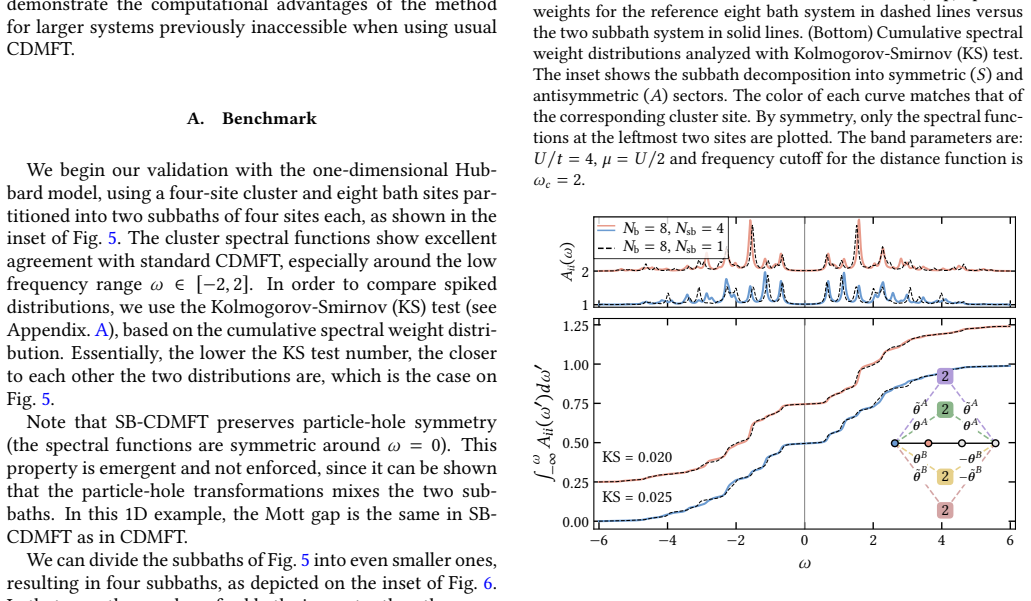


read the original abstract
Cluster Dynamical Mean-Field Theory (CDMFT) with an Exact Diagonalization (ED) impurity solver faces exponential scaling limitations from the Hilbert space dimension. We introduce Subbath CDMFT (SB-CDMFT), an alternative to the conventional ED-CDMFT method in which the discrete bath is subdivided into separate subbaths, each coupled to the cluster with distinct hybridization functions. In this approach, only one subbath at a time is actively involved in ED, dramatically reducing the computational cost by replacing a single large impurity problem with multiple smaller separate ones. Our method successfully reproduces key physical properties including particle-hole symmetry and Mott physics, while allowing for an extended bath representation at a fraction of the typical computational cost.
Editorial analysis
A structured set of objections, weighed in public.
Referee Report
Summary. The manuscript introduces Subbath Cluster Dynamical Mean-Field Theory (SB-CDMFT) as a modification to conventional Exact Diagonalization (ED) Cluster Dynamical Mean-Field Theory (CDMFT). The discrete bath is subdivided into independent subbaths, each with its own hybridization function; only one subbath is included in the ED impurity solve at a time, and the resulting Green's functions are combined to approximate the full problem. The central claim is that this procedure reproduces particle-hole symmetry and Mott physics while permitting larger effective bath sizes at substantially lower computational cost than standard ED-CDMFT.
Significance. If the subbath combination step is shown to be accurate, the method would allow ED-CDMFT calculations with significantly larger bath representations for models of strongly correlated electrons, improving resolution of spectral features and phase boundaries (e.g., Mott transitions) without the full exponential cost of a single large bath. The reported preservation of symmetry and Mott physics is encouraging, but the absence of quantitative validation leaves the practical gain uncertain.
major comments (2)
- [§3] §3 (method): the effective impurity Green's function is obtained by solving separate cluster+subbath Hamiltonians and combining outputs. Because the interacting cluster renders G a non-linear functional of the total hybridization, this combination cannot be guaranteed to reproduce the Green's function or self-energy of the full combined-bath ED problem without an additional approximation (additive self-energies, averaged G, or perturbative reconstruction). No derivation or error bound for the combination step is provided.
- [Results] Results section / abstract claims: the manuscript states that particle-hole symmetry and Mott physics are reproduced, yet supplies no quantitative benchmarks, error bars, or side-by-side comparisons of Green's functions or self-energies against conventional ED-CDMFT on identical clusters and parameters. Without such data the accuracy of the subbath approximation remains unverified.
minor comments (1)
- [§2] Notation for the subbath hybridization functions and the precise rule used to combine subbath Green's functions should be defined explicitly with an equation, rather than described only in prose.
Simulated Author's Rebuttal
We thank the referee for their careful reading of the manuscript and for the constructive comments. We address the two major points below and indicate the changes planned for the revised version.
read point-by-point responses
-
Referee: §3 (method): the effective impurity Green's function is obtained by solving separate cluster+subbath Hamiltonians and combining outputs. Because the interacting cluster renders G a non-linear functional of the total hybridization, this combination cannot be guaranteed to reproduce the Green's function or self-energy of the full combined-bath ED problem without an additional approximation (additive self-energies, averaged G, or perturbative reconstruction). No derivation or error bound for the combination step is provided.
Authors: We agree that the combination of results from independent subbath solves is an approximation, since the Green's function is a non-linear functional of the hybridization when interactions are present on the cluster. In SB-CDMFT the subbaths are treated as independent with distinct hybridizations; the effective Green's function is obtained by averaging the individual subbath Green's functions. This procedure is exact in the non-interacting limit and preserves particle-hole symmetry by construction. We will revise §3 to provide an explicit description of the averaging step, demonstrate exact recovery of the non-interacting Green's function, and add numerical tests on small clusters that quantify the deviation from a single large-bath ED calculation. revision: yes
-
Referee: Results section / abstract claims: the manuscript states that particle-hole symmetry and Mott physics are reproduced, yet supplies no quantitative benchmarks, error bars, or side-by-side comparisons of Green's functions or self-energies against conventional ED-CDMFT on identical clusters and parameters. Without such data the accuracy of the subbath approximation remains unverified.
Authors: The current text shows preservation of particle-hole symmetry via symmetric spectra and Mott physics via the gap opening at half filling, but we accept that direct quantitative benchmarks against standard ED-CDMFT are missing. In the revised manuscript we will add a new figure in the results section that overlays the local Green's function and self-energy obtained from SB-CDMFT and from conventional ED-CDMFT for the same total bath size on a 2×2 Hubbard cluster at several interaction strengths, together with the point-wise differences to provide a quantitative measure of the approximation error. revision: yes
Circularity Check
No circularity: SB-CDMFT is a direct algorithmic reformulation of the ED solver
full rationale
The paper introduces Subbath CDMFT as an explicit change to the impurity solver: the discrete bath is subdivided into independent subbaths, each solved separately via ED with its own hybridization function, then combined. This is presented as a computational shortcut rather than a derived result. No equation reduces the output Green's function or self-energy to a fitted parameter chosen to match the target; no self-citation supplies a uniqueness theorem or ansatz that forces the method; and the reproduction of particle-hole symmetry and Mott physics is asserted via numerical checks on the new procedure, not by construction from the inputs. The derivation chain is therefore self-contained and non-circular.
Axiom & Free-Parameter Ledger
axioms (1)
- domain assumption The hybridization functions for each subbath can be chosen independently while still reproducing the physics of the original bath.
Lean theorems connected to this paper
-
IndisputableMonolith/Cost/FunctionalEquation.leanwashburn_uniqueness_aczel unclear?
unclearRelation between the paper passage and the cited Recognition theorem.
We split the full Nb sites bath into Nsb subbaths... only one subbath at a time is actively involved in ED... average the self-energies: Σ̃c(z) ≡ 1/Nsb Σα Σαc(z)
-
IndisputableMonolith/Foundation/RealityFromDistinction.leanreality_from_one_distinction unclear?
unclearRelation between the paper passage and the cited Recognition theorem.
The approach extends standard CDMFT with ED impurity solvers in order to increase the size of the bath at constant computational cost.
What do these tags mean?
- matches
- The paper's claim is directly supported by a theorem in the formal canon.
- supports
- The theorem supports part of the paper's argument, but the paper may add assumptions or extra steps.
- extends
- The paper goes beyond the formal theorem; the theorem is a base layer rather than the whole result.
- uses
- The paper appears to rely on the theorem as machinery.
- contradicts
- The paper's claim conflicts with a theorem or certificate in the canon.
- unclear
- Pith found a possible connection, but the passage is too broad, indirect, or ambiguous to say the theorem truly supports the claim.
Reference graph
Works this paper leans on
-
[1]
J. Hubbard and B. H. Flowers, Electron correlations in narrow energy bands, Proceedings of the Royal Society of London. Se- ries A. Mathematical and Physical Sciences276, 238 (1963)
work page 1963
-
[2]
T. Sch ¨afer, N. Wentzell, F.ˇSimkovic, Y.-Y. He, C. Hille, M. Klett, C. J. Eckhardt, B. Arzhang, V. Harkov, F. m. c.-M. Le R ´egent, A. Kirsch, Y. Wang, A. J. Kim, E. Kozik, E. A. Stepanov, A. Kauch, S. Andergassen, P. Hansmann, D. Rohe, Y. M. Vilk, J. P. F. LeBlanc, S. Zhang, A.-M. S. Tremblay, M. Ferrero, O. Par- collet, and A. Georges, Tracking the fo...
work page 2021
-
[3]
C. Gros and R. Valent´ı, Cluster expansion for the self-energy: A simple many-body method for interpreting the photoemission spectra of correlated Fermi systems, Physical Review B48, 418 (1993)
work page 1993
-
[4]
D. S ´en´echal, D. Perez, and M. Pioro-Ladri `ere, Spectral Weight of the Hubbard Model through Cluster Perturbation Theory, Physical Review Letters84, 522 (2000)
work page 2000
-
[5]
D. S ´en´echal, D. Perez, and D. Plouffe, Cluster perturbation the- ory for hubbard models, Phys. Rev. B66, 075129 (2002)
work page 2002
-
[6]
M. Potthoff, M. Aichhorn, and C. Dahnken, Variational Cluster Approach to Correlated Electron Systems in Low Dimensions, Phys. Rev. Lett.91, 206402 (2003)
work page 2003
-
[7]
C. Dahnken, M. Aichhorn, W. Hanke, E. Arrigoni, and M. Pot- thoff, Variational cluster approach to spontaneous symmetry breaking: The itinerant antiferromagnet in two dimensions, Phys. Rev. B70, 245110 (2004)
work page 2004
-
[8]
M. Potthoff, Making use of self-energy functionals: The vari- ational cluster approximation, inDMFT at 25: Infinite dimen- sions, Vol. 4, edited by E. Pavarini, E. Koch, A. Lichtenstein, and D. Vollhardt (Forschungszentrum J¨ulich, 2014) pp. 9.1–9.37
work page 2014
-
[9]
G. Kotliar, S. Y. Savrasov, G. P´alsson, and G. Biroli, Cellular Dy- namical Mean Field Approach to Strongly Correlated Systems, Physical Review Letters87, 186401 (2001)
work page 2001
-
[10]
A. I. Lichtenstein and M. I. Katsnelson, Antiferromagnetism and d-wave superconductivity in cuprates: A cluster dynami- cal mean-field theory, Physical Review B62, R9283 (2000)
work page 2000
-
[11]
M. H. Hettler, A. N. Tahvildar-Zadeh, M. Jarrell, T. Pruschke, and H. R. Krishnamurthy, Nonlocal dynamical correlations of strongly interacting electron systems, Physical Review B58, R7475 (1998)
work page 1998
-
[12]
K. Aryanpour, M. H. Hettler, and M. Jarrell, Analysis of the dy- namical cluster approximation for the Hubbard model, Physi- cal Review B65, 153102 (2002)
work page 2002
- [13]
-
[14]
A. M. S. Tremblay, B. Kyung, and D. S ´en´echal, Pseudogap and high-temperature superconductivity from weak to strong cou- pling. towards a quantitative theory, Low Temp. Phys.32, 424 (2006)
work page 2006
-
[15]
E. Gull, A. J. Millis, A. I. Lichtenstein, A. N. Rubtsov, M. Troyer, and P. Werner, Continuous-time monte carlo methods for quantum impurity models, Rev. Mod. Phys.83, 349 (2011)
work page 2011
-
[16]
K. Haule, Quantum monte carlo impurity solver for cluster dynamical mean-field theory and electronic structure calcu- lations with adjustable cluster base, Phys. Rev. B75, 155113 (2007). 8
work page 2007
-
[17]
D. Tahara and M. Imada, Variational monte carlo method com- bined with quantum-number projection and multi-variable op- timization, Journal of the Physical Society of Japan77, 114701 (2008)
work page 2008
-
[18]
M. Charlebois and M. Imada, Single-Particle Spectral Function Formulated and Calculated by Variational Monte Carlo Method with Application to$d$-Wave Superconducting State, Physical Review X10, 041023 (2020)
work page 2020
-
[19]
P. Rosenberg, D. S ´en´echal, A.-M. S. Tremblay, and M. Charlebois, Fermi arcs from dynamical variational monte carlo, Phys. Rev. B106, 245132 (2022)
work page 2022
-
[20]
M. Qin, T. Sch¨afer, S. Andergassen, P. Corboz, and E. Gull, The hubbard model: A computational perspective, Annual Review of Condensed Matter Physics13, 275–302 (2022)
work page 2022
-
[21]
J. P. F. LeBlanc, A. E. Antipov, F. Becca, I. W. Bulik, G. K.- L. Chan, C.-M. Chung, Y. Deng, M. Ferrero, T. M. Hender- son, C. A. Jim ´enez-Hoyos, E. Kozik, X.-W. Liu, A. J. Millis, N. V. Prokof’ev, M. Qin, G. E. Scuseria, H. Shi, B. V. Svis- tunov, L. F. Tocchio, I. S. Tupitsyn, S. R. White, S. Zhang, B.-X. Zheng, Z. Zhu, and E. Gull (Simons Collaborati...
work page 2015
-
[22]
M. Caffarel and W. Krauth, Exact diagonalization approach to correlated fermions in infinite dimensions: Mott transition and superconductivity, Phys. Rev. Lett.72, 1545 (1994)
work page 1994
-
[23]
Dagotto, Correlated electrons in high-temperature super- conductors, Rev
E. Dagotto, Correlated electrons in high-temperature super- conductors, Rev. Mod. Phys.66, 763 (1994)
work page 1994
-
[24]
T. N. Dionne, A. Foley, M. Rousseau, and D. S ´en´echal, Pyqcm: An open-source Python library for quantum cluster methods, SciPost Phys. Codebases , 23 (2023)
work page 2023
-
[25]
E. H. Lieb and F. Y. Wu, Absence of mott transition in an exact solution of the short-range, one-band model in one dimension, Phys. Rev. Lett.20, 1445 (1968)
work page 1968
-
[26]
P. W. Anderson, Localized magnetic states in metals, Phys. Rev. 124, 41 (1961)
work page 1961
-
[27]
E. Koch, G. Sangiovanni, and O. Gunnarsson, Sum rules and bath parametrization for quantum cluster theories, Phys. Rev. B78, 115102 (2008)
work page 2008
-
[28]
A. Liebsch and N.-H. Tong, Finite-temperature exact diag- onalization cluster dynamical mean-field study of the two- dimensional hubbard model: Pseudogap, non-fermi-liquid be- havior, and particle-hole asymmetry, Phys. Rev. B80, 165126 (2009)
work page 2009
- [29]
-
[30]
R. S. Mulliken, Electronic structures of polyatomic molecules and valence. iv. electronic states, quantum theory of the double bond, Phys. Rev.43, 279 (1933)
work page 1933
-
[31]
F. J. Massey, The Kolmogorov-Smirnov test for goodness of fit, Journal of the American Statistical Association46, 68 (1951)
work page 1951
discussion (0)
Sign in with ORCID, Apple, or X to comment. Anyone can read and Pith papers without signing in.