REVIEW 1 major objections 5 minor 25 references
Exploring Formal Math on the Blockchain: An Explorer for Proofgold
T0 review · 1 major / 5 minor · reviewed 2026-08-04 · deepseek-v4-flash
Pith's one-line read A web-based explorer for the Proofgold blockchain makes the formal mathematics embedded in the chain — theories, definitions, theorems, proofs, and bounties — browsable and interactive, demonstrated on 33 category-theory adjunction conjectu
desk verdict A real, working explorer for Proofgold with a solid case study; the reorg/cache question is legitimate but minor, and the paper deserves peer review. read the letter →
The pith
A machine-rendered reading of the paper's core claim, the machinery that carries it, and where it could break.
The reading
What carries the argument
The load-bearing mechanism is the explorer-mode extension of the Proofgold Lava client: thirty-four OCaml hashtables that precompute and hold roughly ten gigabytes of structured metadata about every formal object on the chain, refreshed hourly, so that lookups of theories, definitions, proofs, owners, dependencies, and bounty histories do not require re-traversing the whole ledger. The formal side of the argument is carried by the case-study machinery: the HOTG set-theory encoding of category theory given by the predicates MetaCat, MetaFunctor, MetaNatTrans, and MetaAdjunction_strict — the last asserting that two explicitly supplied functors and two natural transformations form an adjunction
What would settle it
Take a sample of the on-chain proof documents the explorer displays as 'proven' and re-check them with an independent implementation of the same logic (intuitionistic higher-order logic with functional extensionality); if any accepted document fails the independent check, the explorer's status display is not trustworthy. A cheaper test: submit a deliberately flawed proof document through the explorer's transaction interface and see whether the chain rejects it before it can appear as 'proven.'
Extended reading notes
Core claim
The paper's central claim is that the explorer it built — extending the Proofgold Lava client with an 'explorer mode' that precomputes and caches structured information about the chain's formal content — gives users efficient, structured access to theories, definitions, theorems, proofs, and bounties, and supports light interaction such as submitting signed transactions. The cached indexes (34 OCaml hashtables holding roughly 10 gigabytes, refreshed hourly) turn an unwieldy full-history traversal into fast lookups of formal entities, their owners, dependencies, and bounty status, served to a PHP front end over a custom RPC layer. The paper further claims this infrastructure supports a practi
Load-bearing premise
The Proofgold proof checker for intuitionistic higher-order logic is sound and correctly implemented; the explorer only relays the chain's proven/disproven verdicts, and the paper provides no independent verification of that checker, so a checker bug would make the displayed statuses and the case-study conclusions unreliable.
Editorial extensions
If this is right
- Formal knowledge on Proofgold becomes inspectable by anyone with a browser, so results such as the 12 of Wiedijk's 100 theorems proved in Megalodon can be read and built upon without running a node or learning the CLI.
- Proof bounties become a visible marketplace: users can see the highest open and collected bounties and focus effort on valuable open conjectures such as the free-group adjunction.
- The chain graph's coloring of theory-defining, proof-carrying, and bounty-carrying nodes, plus its marking of invalid or missing nodes, gives a public audit view of both the ledger and the quality of the formal content in it.
- The Megalodon Wiki integration creates an end-to-end pipeline from a collaboratively edited formal file to an on-chain, bounty-bearing proof document.
- The case study demonstrates that bounty-backed conjectures can drive real mathematical findings, including a refutation that revealed a definitional bug in the formal category of monoids (semigroup homomorphisms that need not preserve identity).
Reading between the lines
- If this explorer becomes the standard gateway, the practical trust question shifts from data access to the soundness of the on-chain checker itself: users will read 'proven' and 'disproven' as ground truth, so an independent audit of the Proofgold checker becomes the natural next stress test.
- The 19 still-open adjoint conjectures constitute a public, bountied benchmark suite for automated theorem proving; they could be used to compare proof-finding and formalization automation in a way that standard libraries cannot, because the attached rewards create a measurable incentive.
- The architecture generalizes: any append-only repository of structured mathematical content could receive the same treatment of precomputed offline indexes plus a web front end, making the explorer a template for mathematical knowledge management beyond blockchains.
- The monoid refutation suggests a testable hypothesis about incentive design: bounty systems can serve as a distributed bug-finding mechanism for formal libraries, which would be a new argument for attaching rewards to conjectures in centralized repositories too.
Editorial analysis
A structured set of objections, weighed in public.
Referee Report
Summary. The paper presents a web-based blockchain explorer for Proofgold, a blockchain that stores formal mathematical content. The authors describe the system architecture: a modified Proofgold Lava client in a new 'explorer mode' that caches structured information about formal objects, a PHP backend, and an RPC layer. The explorer supports viewing blocks, transactions, addresses, theories, definitions, proofs, bounties, and the chain graph, and it includes a transaction submission interface. The paper also presents a case study of 33 adjunction conjectures in category theory formalized in Proofgold's HOTG theory, reporting which are proven, disproven, or open, and discussing two examples in detail. The paper claims the explorer provides accessible, structured access to formal mathematical content on the blockchain.
Significance. If the described system works as claimed, it is a useful contribution to the infrastructure for decentralized formal mathematics. The explorer lowers the barrier to Proofgold, which was previously CLI-only, and integrates with the Megalodon Wiki. The case-study results are backed by machine-checked proofs processed by the Proofgold proof checker, and the paper gives live URLs and screenshots. The paper does not claim to verify the proof checker itself, which is appropriate for a system description. The formalization of category theory and the discussion of the monoid 'bug' are interesting concrete illustrations. Overall, this is a relevant systems paper for the formal mathematics / blockchain community.
major comments (1)
- [Section 3 and Section 5 (Table 1)] The caching layer is described as 'periodically (every hour) refreshed' and stored in 34 OCaml hashtables, but the paper never states which chain tip the cache follows or how reorganizations are processed. This matters because Figure 3 shows competing chain tips, and the explorer displays 'proven', 'disproven', 'collected', and 'open' statuses that Table 1 relies on. If the cache is built from a branch that is later orphaned, the displayed statuses are stale or indefinitely wrong unless reorg handling is specified. Please add an explicit statement of the canonical-chain selection policy and how the hourly refresh interacts with chain reorganizations (e.g., the cache is rebuilt from the current best chain).
minor comments (5)
- [Section 5] In the description of the functor F1, 'the arrow from F0 X to F1 Y' should presumably be 'the arrow from F0 X to F0 Y' (f: X -> Y should map to D(F0 X, F0 Y)).
- [Section 4] Typo: 'conejctures' should be 'conjectures' in the paragraph about bounty categories.
- [Figure 3] The chain graph includes node labels such as 'qf8mw' and 'qn76a' that are not explained in the caption. A brief explanation in the caption or text would improve readability.
- [Throughout] The spelling 'Groethendieck' appears in Figures and text; the standard spelling is 'Grothendieck'.
- [Section 3] The paper describes the modified Lava client and PHP backend but does not provide a repository link for the source code. Adding such a link would aid reproducibility for other researchers.
Circularity Check
No significant circularity: the explorer's functionality is documented as a live system and the formalization statuses are outputs of an independent proof checker, not consequences of the paper's own assumptions.
full rationale
The paper's central contribution is a web-based blockchain explorer for Proofgold. Its claims are about the existence and behavior of a software system, supported by architecture descriptions, screenshots, and a live deployment (Section 3–4). The case study (Section 5) presents 33 conjectures with statuses (proven/disproven/open) obtained from the Proofgold blockchain, where the status is determined by the Proofgold proof checker—an implementation described in prior work [8] by overlapping authors. This is a real external check, not a self-fulfilling prediction: the checker itself is not formally verified, but the paper does not claim to derive the statuses from the checker's correctness; it merely reports what the checker says. No parameter is fitted, no uniqueness theorem is invoked to force a choice, and no known result is merely renamed. The self-citations to Proofgold [8] and HOTG [9] provide background and infrastructure, but they are not load-bearing in the sense that the explorer's utility or the formalization outcomes reduce to those citations by construction. The only substantive assumption—soundness of the proof checker—is an external trust boundary, not a circular step. Thus the paper is essentially self-contained for its claims, and any concerns about reorg handling or cache staleness are correctness risks, not circularity.
Assumptions & free parameters
assumptions (1)
- domain assumption HOTG axioms (Tarski-Grothendieck set theory) and the proof-checking rules of intuitionistic higher-order logic
Cite this review
Pith. "Pith review of Exploring Formal Math on the Blockchain: An Explorer for Proofgold." pith.science (2026). https://pith.science/paper/ETJEAMW6
@misc{pith2026250908267,
  author       = {Pith},
  title        = {Pith review of: Exploring Formal Math on the Blockchain: An Explorer for Proofgold},
  year         = {2026},
  howpublished = {\url{https://pith.science/paper/ETJEAMW6}},
  note         = {Machine review of arXiv:2509.08267}
}
read the original abstract
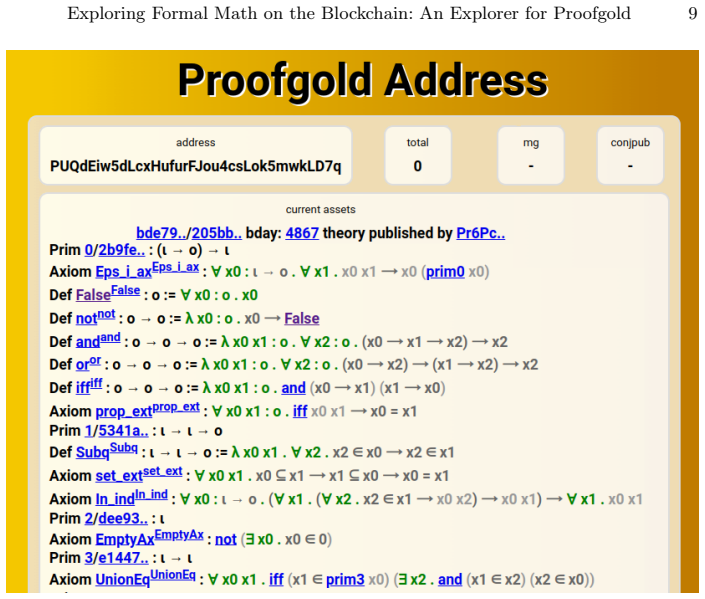
Proofgold is a blockchain that supports formalized mathematics alongside standard cryptocurrency functionality. It incorporates logical constructs into the blockchain, including declarations of formal theories, definitions, propositions and proofs. It also supports placing and collecting bounties on proving these propositions, incentivizing the development of the formal libraries contained in Proofgold. In this paper, we present a web-based blockchain explorer for Proofgold. The system exposes not only the usual transactional data but also the formal mathematical components embedded in the chain and allows some interaction with them. The explorer allows users to inspect blocks, transactions, and addresses, as well as formal objects: theories, definitions, theorems and their proofs. We also support the submission of transactions to the blockchain using our interface. We describe the system architecture and its integration with the Proofgold Lava software, highlighting how the explorer supports navigation of formal content and facilitates mathematical knowledge management in a decentralized setting, as well as a number of formalizations in category theory done in the system.
Figures


Figures from the paper (10 more)




Reference graph
Works this paper leans on
-
[1]
CoRRabs/1910.09336(2019),http://arxiv
The Lean mathematical library. CoRRabs/1910.09336(2019),http://arxiv. org/abs/1910.09336
arXiv 1910
-
[2]
Ahrens, B., Matthes, R., Mörtberg, A.: From signatures to monads in Uni- Math. J. Autom. Reason.63(2), 285–318 (2019).https://doi.org/10.1007/ S10817-018-9474-4,https://doi.org/10.1007/s10817-018-9474-4
-
[3]
In: Filliâtre, J., Paulin-Mohring, C., Werner, B
Asperti, A., Guidi, F., Coen, C.S., Tassi, E., Zacchiroli, S.: A content based math- ematical search engine: Whelp. In: Filliâtre, J., Paulin-Mohring, C., Werner, B. (eds.) Types for Proofs and Programs, International Workshop, TYPES 2004, Jouy-en-Josas, France, December 15-18, 2004, Revised Selected Papers. Lecture Notes in Computer Science, vol. 3839, p...
-
[4]
Bancerek, G., Byliński, C., Grabowski, A., Korniłowicz, A., Matuszewski, R., Naumowicz, A., Pąk, K.: The role of the Mizar mathematical library for interactive proof development in Mizar. J. Autom. Reason.61(1-4), 9– 32 (2018).https://doi.org/10.1007/S10817-017-9440-6,https://doi.org/ 10.1007/s10817-017-9440-6
-
[5]
In: Kaliszyk, C., Brady, E.C., Kohlhase, A., Coen, C.S
Bercic, K., Kohlhase, M., Rabe, F.: Towards a unified mathematical data in- frastructure: Database and interface generation. In: Kaliszyk, C., Brady, E.C., Kohlhase, A., Coen, C.S. (eds.) Intelligent Computer Mathematics - 12th Interna- tional Conference, CICM 2019, Prague, Czech Republic, July 8-12, 2019, Pro- ceedings. Lecture Notes in Computer Science,...
-
[6]
Bhargavan, K., Delignat-Lavaud, A., Fournet, C., Gollamudi, A., Gonthier, G., Kobeissi, N., Kulatova, N., Rastogi, A., Sibut-Pinote, T., Swamy, N., Zanella- Béguelin, S.: Formal verification of smart contracts: Short paper. In: Murray, T.C., Stefan, D. (eds.) Proceedings of the 2016 ACM Workshop on Programming Lan- guages and Analysis for Security, PLAS@C...
-
[7]
In: Kerber, M., Carette, J., Kaliszyk, C., Rabe, F., Sorge, V
Blanchette, J.C., Haslbeck, M.W., Matichuk, D., Nipkow, T.: Mining the archive of formal proofs. In: Kerber, M., Carette, J., Kaliszyk, C., Rabe, F., Sorge, V. (eds.) Intelligent Computer Mathematics - International Conference, CICM 2015, Washington, DC, USA, July 13-17, 2015, Proceedings. Lecture Notes in Com- puter Science, vol. 9150, pp. 3–17. Springer...
-
[8]
In: Dargaye, Z., Schneidewind, C
Brown, C.E., Kaliszyk, C., Gauthier, T., Urban, J.: Proofgold: Blockchain for for- mal methods. In: Dargaye, Z., Schneidewind, C. (eds.) 4th International Work- shop on Formal Methods for Blockchains, FMBC@CAV 2022, August 11, 2022, Haifa, Israel. OASIcs, vol. 105, pp. 4:1–4:15. Schloss Dagstuhl - Leibniz-Zentrum für Informatik (2022).https://doi.org/10.4...
Show all 25 references
-
[9]
In: Kaliszyk, C., Brady, E.C., Kohlhase, A., Coen, C.S
Brown, C.E., Pąk, K.: A tale of two set theories. In: Kaliszyk, C., Brady, E.C., Kohlhase, A., Coen, C.S. (eds.) Intelligent Computer Mathematics - 12th Interna- tional Conference, CICM 2019, Prague, Czech Republic, July 8-12, 2019, Pro- ceedings. Lecture Notes in Computer Sci...
2019 doi
-
[10]
In: Blanchette, J., Hritcu, C
Buzzard, K., Commelin, J., Massot, P.: Formalising perfectoid spaces. In: Blanchette, J., Hritcu, C. (eds.) Proceedings of the 9th ACM SIGPLAN Inter- national Conference on Certified Programs and Proofs, CPP 2020, New Orleans, LA, USA, January 20-21, 2020. pp. 299–312. ACM (20...
2020
-
[11]
Formalized Mathematics 1(2), 409–420 (1990),http://fm.mizar.org/1990-1/pdf1-2/cat_1.pdf
Byliński, C.: Introduction to categories and functors. Formalized Mathematics 1(2), 409–420 (1990),http://fm.mizar.org/1990-1/pdf1-2/cat_1.pdf
1990
-
[12]
In: Kauers, M., Kerber, M., Miner, R., Windsteiger, W
Corbineau, P., Kaliszyk, C.: Cooperative repositories for formal proofs. In: Kauers, M., Kerber, M., Miner, R., Windsteiger, W. (eds.) Towards Mecha- nized Mathematical Assistants, 14th Symposium, Calculemus 2007, 6th Interna- tional Conference, MKM 2007, Hagenberg, Austria, J...
2007 doi
-
[13]
In: Bertot, Y., Kutsia, T., Norrish, M.(eds.)15thInternationalConferenceonInteractiveTheoremProving,ITP2024, September 9-14, 2024, Tbilisi, Georgia
Desharnais, M., Tóth, B., Waldmann, U., Blanchette, J., Tourret, S.: A modular formalization of superposition in Isabelle/HOL. In: Bertot, Y., Kutsia, T., Norrish, M.(eds.)15thInternationalConferenceonInteractiveTheoremProving,ITP2024, September 9-14, 2024, Tbilisi, Georgia. L...
2024 doi
-
[14]
In: Kiselyov, O
Doan, T.T.H., Thiemann, P.: A formal verification framework for tezos smart con- tracts based on symbolic execution. In: Kiselyov, O. (ed.) Programming Languages and Systems - 22nd Asian Symposium, APLAS 2024, Kyoto, Japan, October 22- 24, 2024, Proceedings. Lecture Notes in C...
2024
-
[15]
In: Buzzard, K., Kut- sia, T
Furushima, H., Yamamichi, D., Shigenaka, S., Nakasho, K., Wasaki, K.: An in- tegrated web platform for the Mizar mathematical library. In: Buzzard, K., Kut- sia, T. (eds.) Intelligent Computer Mathematics - 15th International Conference, CICM 2022, Tbilisi, Georgia, September ...
2022 doi
-
[16]
In: Blazy, S., Paulin-Mohring, C., Pichardie, D
Gonthier, G., Asperti, A., Avigad, J., Bertot, Y., Cohen, C., Garillot, F., Roux, S.L., Mahboubi, A., O’Connor, R., Biha, S.O., Pasca, I., Rideau, L., Solovyev, A., Tassi, E., Théry, L.: A machine-checked proof of the odd order theorem. In: Blazy, S., Paulin-Mohring, C., Picha...
2013
-
[17]
Forum of Mathematics, Pi5(2017).https://doi.org/10.1017/fmp.2017.1
Hales, T., Adams, M., Bauer, G., Dang, T.D., Harrison, J., Hoang, L.T., Kaliszyk, C., Magron, V., Mclaughlin, S., Nguyen, T.T., Nguyen, Q.T., Nipkow, T., Obua, S., Pleso,J.,Rute,J.,Solovyev,A.,Ta,T.H.A.,Tran,N.T.,Trieu,T.D.,Urban,J.,Vu, K., Zumkeller, R.: A formal proof of the...
2017 doi
-
[18]
Acta Didactica Napocensia3(2), 35–48 (June 2010) 20 C
Hendriks, M., Kaliszyk, C., van Raamsdonk, F., Wiedijk, F.: Teaching logic using a state-of-the-art proof assistant. Acta Didactica Napocensia3(2), 35–48 (June 2010) 20 C. Brown, C. Kaliszyk, J. Urban
2010
-
[19]
Cambridge University Press, Cambridge, UK (1986)
Lambek, J., Scott, P.: Introduction to higher order categorical logic. Cambridge University Press, Cambridge, UK (1986)
1986
-
[20]
In: Naumowicz, A., Thiemann, R
Nawrocki, W., Ayers, E.W., Ebner, G.: An extensible user interface for Lean 4. In: Naumowicz, A., Thiemann, R. (eds.) 14th International Conference on In- teractive Theorem Proving, ITP 2023, July 31 to August 4, 2023, Białystok, Poland. LIPIcs, vol. 268, pp. 24:1–24:20. Schlo...
2023 doi
-
[21]
Stark, E.W.: Category theory with adjunctions and limits. Arch. Formal Proofs 2016(2016),https://www.isa-afp.org/entries/Category3.shtml
2016
-
[22]
Sci Data10(791) (2023),https: //doi.org/10.1038/s41597-023-02681-3
Tomaszuk, D., Szeremeta, Ł., Korniłowicz, A.: MMLKG: Knowledge graph for mathematical definitions, statements and proofs. Sci Data10(791) (2023),https: //doi.org/10.1038/s41597-023-02681-3
2023 doi
-
[23]
Vezzosi, A., Mörtberg, A., Abel, A.: Cubical Agda: a dependently typed pro- gramming language with univalence and higher inductive types. Proc. ACM Program. Lang.3(ICFP), 87:1–87:29 (2019).https://doi.org/10.1145/3341691, https://doi.org/10.1145/3341691
2019 doi
-
[24]
In: Wiedijk, F
Wiedijk, F.: Introduction. In: Wiedijk, F. (ed.) The Seventeen Provers of the World, Foreword by Dana S. Scott, Lecture Notes in Computer Science, vol. 3600, pp. 1–9. Springer (2006).https://doi.org/10.1007/11542384_1,https://doi. org/10.1007/11542384_1
2006 doi
-
[324]
Springer (2024).https://doi.org/10.1007/978-981-97-8943-6_15,https: //doi.org/10.1007/978-981-97-8943-6_15
2024 doi
Reviewed August 4, 2026 · model on record in the stance chip above.
Discussion (0). Sign in to comment.