REVIEW 3 major objections 4 minor 20 references
Soundtracks of Our Lives: How Age Influences Musical Preferences
T0 review · 3 major / 4 minor · reviewed 2026-08-04 · deepseek-v4-flash
Pith's one-line read Using 15 years of Last.fm logs, this paper argues that individual musical taste broadens with age even as listeners become more alike, and that after about age 40 nostalgia for teenage-era tracks resurges.
desk verdict Useful descriptive longitudinal study, but the diversity metric is volume-confounded and the Gini-index based inter-user diversity claim is not supported by the presented evidence. read the letter →
The pith
A machine-rendered reading of the paper's core claim, the machinery that carries it, and where it could break.
The reading
What carries the argument
The argument is carried by four instruments. (1) An age-adjusted longitudinal sample: each user's static age from LFM-2b is shifted per listening event by the year difference from Oct 31, 2013, so every event gets an adjusted age M. (2) Two [0,1] diversity ratios—track diversity U_O = unique tracks ÷ playcounts and artist diversity U_A = unique artists ÷ unique tracks—following the diversity definition of Schedl and Hauger [15] and inverted per Spear et al. [18]. (3) The Gini index applied to within-age-group diversity, measuring the 'diversity of diversity' and quantifying inter-user convergence. (4) Song-specific age (SSA), the listener's age at a track's release, with playcounts log-norma
What would settle it
A decisive check would be to rerun Figures 2, 3, and 5 on the subset of users whose reported age does not end in 0 or 5 and who have listening events in both 2005–2008 and 2016–2020; if the post-40 nostalgia peak and the falling Gini index shrink to noise, the findings would be artifacts of age adjustment and sample attrition rather than true aging effects.
Extended reading notes
Core claim
The paper's central claim: once users are tracked for years rather than weeks, age visibly reshapes musical taste. Track diversity (unique tracks per playcount) grows from about 0.32 at age 15 to 0.60 at age 40 and then plateaus, so each person's listening widens. Over the same span, the Gini index of diversity within age groups falls from about 0.33 to 0.17, so same-age listeners become more alike. Song-specific age—the listener's age when a track was released—peaks for current releases at every age, but after 40 a second, nostalgia peak appears at ages 15–20. The authors interpret this as a shift from broad, contemporary, socially shared listening to narrower, personalized, nostalgia-infus
Load-bearing premise
The clearest vulnerable premise is the age data: Last.fm users report their age once (2013–2014), and the study shifts that one number forward and backward by calendar year for every listening event, so if users misreport, round off, or share accounts, all the age curves would be distorted.
Editorial extensions
If this is right
- Recommender systems can use age as a diversity/personalization dial: younger users benefit from broad, contemporary-heavy suggestions, while older users benefit from tighter, nostalgia-weighted ones.
- Around age 40 is a preference tipping point; beyond it, consumption of current releases declines and adolescent-era music dominates, so age-aware models should weight historical taste more heavily.
- Because inter-user diversity shrinks with age, older users' tastes are easier to model from their peers, while younger users need more exploration and less conformity.
- Algorithmic feedback loops matter: if recommenders feed young users varied content and older users narrow content, the systems may amplify the very age divergence the paper describes.
Reading between the lines
- Inference: The paper stops at descriptive evidence; a direct algorithmic extension would be to feed adjusted age (or SSA band) into a recommender baseline and measure whether the diversity/personalization trade-off actually shifts, turning the observation into a deployable design rule.
- Inference: Because the age variable is self-reported and snapshotted in 2013–2014, the longitudinal curves implicitly assume one user per account and stable truthful reporting; a robustness check on users with non-heaped ages and continuous fifteen-year histories would separate genuine aging effects from cohort and attrition artifacts.
- Inference: The same song-specific-age machinery could be applied to films or books, where release-year-relative-to-age may produce an analogous nostalgia bump; finding one would suggest a general reminiscence effect rather than a music-specific quirk.
- Inference: The diversity metric is a playcount-concentration ratio, so the exact magnitudes of age differences likely depend on metric choice; entropy- or coverage-based measures could shrink or grow the reported gaps even if the direction holds.
Editorial analysis
A structured set of objections, weighed in public.
Referee Report
Summary. The paper analyzes the LFM-2b listening-event dataset to study how music preferences and consumption behavior change with user age. The authors adjust a static age variable to event time, restrict the sample to users aged 10–64, and compute annual playcounts, unique tracks, unique artists, a track-based diversity ratio, an artist-based ratio, the Gini index of diversity, and a song-specific age (SSA) metric. They report that intra-user diversity increases with age, inter-user diversity decreases, younger users favor contemporary releases, and after age 40 a secondary 'nostalgic' peak appears. The paper draws recommender-system implications from these trends.
Significance. If the reported trends are valid, the paper addresses an under-studied longitudinal dimension in recommender-systems research using a rare large-scale dataset. Its descriptive contribution is potentially useful: the cleaning procedure is clearly described, the age-adjustment idea is sensible, and the SSA analysis connects directly to prior music-psychology findings. However, the central metric used to support the main claims is confounded by listening volume, and no statistical uncertainty is reported. The paper's value therefore depends on whether the main conclusions survive additional analysis.
major comments (3)
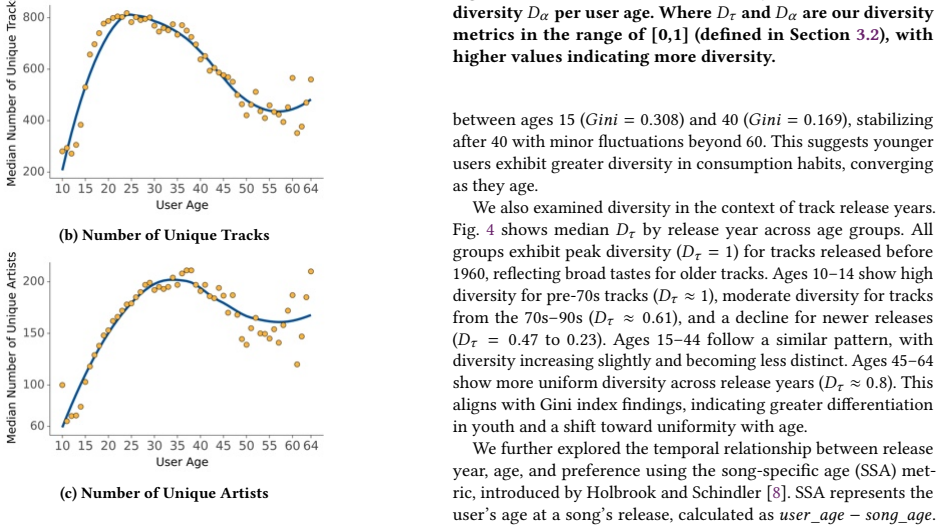
- [§3.2, §3.3, Fig. 1, Fig. 2, Fig. 3] The central diversity measure U_O = |S|/R conflates taste breadth with listening volume. Fig. 1 shows median annual playcounts falling from 2,318 at age 19 to 560 at age 58, while unique tracks peak at 805 (age 22) and then decline. A user who halves playcounts while keeping the same unique-track set doubles U_O. The rise in U_O between ages 15 and 40 is therefore not by itself evidence of 'broader listening preferences' (Section 3.3). The same confound propagates to the Gini index in Fig. 3, which measures dispersion of this ratio across users, not overlap or distance between users' musical tastes. The statement in Section 4 that 'inter-user diversity decreases (Fig. 3)' is not supported by the presented evidence. Please report at least one volume-independent diversity measure (e.g., entropy, Simpson diversity, or unique tracks conditioned on playcount) and, for inter-user diversity, a
- [§3.3, Figs. 1–5] The paper uses 'significantly' in describing the diversity increase between ages 15 and 40, but no confidence intervals, significance tests, or effect sizes are reported for any of the median trends. The regression lines in Fig. 1 are fitted without stating the procedure or uncertainty. Because the main claims are about monotone age trends in a noisy, long-tailed dataset, bootstrap confidence intervals on the medians by age would be a minimal and necessary addition.
- [§3.1, §4.1] The entire analysis depends on the adjusted age variable M = M + year difference from a fixed reference date. The paper itself lists 'improbable user ages' as a limitation. The static age is retrieved in 2013–2014, and age at each event is computed by adding the year difference; if the static age is misreported or systematically biased, all age-trend conclusions are affected. A sensitivity analysis is needed: report the distribution of static ages before cleaning, show the effect of excluding users with suspicious or inconsistent ages, and check whether the results hold when restricting to users whose activity is consistent with a single reported age.
minor comments (4)
- [§3.1] The equation for the adjusted age is garbled: 'ω𝑁 (𝑁𝑀 ,𝐿 𝐿 )' and related symbols appear corrupted. The quartile-based outlier formula also has a typo ('𝑂1 ↑ 1.5 · 𝑃𝑂𝑄' should presumably be Q1 − 1.5·IQR).
- [Table 1 and §3.1] The text says 'Table 1 shows the number of users in each age group post-cleaning,' but Table 1 only gives global counts. Please include per-age-group user counts or remove the cross-reference.
- [Fig. 1 caption] The caption lists '(b) Number of Unique Artists' and '(c) Number of Unique Tracks,' while the main text describes the subfigures in the opposite order. Please make the caption consistent with the panels.
- [§4] The 'algorithmic confounding' paragraph is speculative and not tied to any data or prior result in the paper. It may be better framed as future work.
Circularity Check
No significant circularity; empirical study with independent metrics and contextual self-citation only.
full rationale
This is an empirical longitudinal measurement study, not a derivation. The central claims (intra-user diversity increases, inter-user dispersion decreases, SSA peaks shift) are summaries of observed medians computed from the LFM-2b dataset. The diversity metrics U_O and U_S are defined in Section 3.2 independently of the age variable and of the conclusions; the age adjustment M = M + ω(...) is a straightforward arithmetic shift. No parameter is fitted to a subset of data and then 'predicted' on a closely related quantity; the reported trends are direct aggregates. The only self-citation (Ferwerda et al., 2017, by two of the present authors) is used in Sections 1 and 4 to motivate the gap and to contextualize genre-based findings, not as a load-bearing proof or uniqueness theorem. The potential confounding of U_O by playcount volume (the skeptic's point) is a substantive validity concern about what the metric measures, but it is not circularity: the paper does not define the conclusion in terms of the metric's inputs, nor does any equation reduce to itself. No circular step can be exhibited.
Assumptions & free parameters
free parameters (6)
- Reference date for age adjustment =
October 31, 2013
- Activity percentile threshold for user inclusion =
20th percentile of listening events per age group
- Outlier threshold multiplier =
1.5 IQR
- Age range restriction =
10-64 years
- Age bin width =
5 years
- Playcount log-normalization scaling =
log10 scaled to [0, 3.903]
assumptions (4)
- domain assumption The static age field in LFM-2b is accurate enough for computing adjusted ages
- domain assumption Spotify API provides complete release-year metadata for all tracks
- domain assumption Unique tracks / playcounts and unique artists / unique tracks are valid diversity proxies
- domain assumption Observed listening behavior reflects underlying preference rather than platform artifacts
Cite this review
Pith. "Pith review of Soundtracks of Our Lives: How Age Influences Musical Preferences." pith.science (2026). https://pith.science/paper/A75PTMOJ
@misc{pith2026250908337,
  author       = {Pith},
  title        = {Pith review of: Soundtracks of Our Lives: How Age Influences Musical Preferences},
  year         = {2026},
  howpublished = {\url{https://pith.science/paper/A75PTMOJ}},
  note         = {Machine review of arXiv:2509.08337}
}
read the original abstract
The majority of research in recommender systems, be it algorithmic improvements, context-awareness, explainability, or other areas, evaluates these systems on datasets that capture user interaction over a relatively limited time span. However, recommender systems can very well be used continuously for extended time. Similarly so, user behavior may evolve over that extended time. Although media studies and psychology offer a wealth of research on the evolution of user preferences and behavior as individuals age, there has been scant research in this regard within the realm of user modeling and recommender systems. In this study, we investigate the evolution of user preferences and behavior using the LFM-2b dataset, which, to our knowledge, is the only dataset that encompasses a sufficiently extensive time frame to permit real longitudinal studies and includes age information about its users. We identify specific usage and taste preferences directly related to the age of the user, i.e., while younger users tend to listen broadly to contemporary popular music, older users have more elaborate and personalized listening habits. The findings yield important insights that open new directions for research in recommender systems, providing guidance for future efforts.
Figures


Figures from the paper (2 more)


Reference graph
Works this paper leans on
-
[1]
Joeran Beel, Stefan Langer, Andreas Nürnberger, and Marcel Genzmehr. 2013. The Impact of Demographics (Age and Gender) and Other User-Characteristics on Evaluating Recommender Systems. In Research and Advanced Technology for Digital Libraries (Lecture Notes in Computer Science) , Trond Aalberg, Christos Papatheodorou, Milena Dobreva, Giannis Tsakonas, and...
-
[2]
Andy Bennett and Jodie Taylor. 2012. Popular music and the aesthetics of ageing. Popular Music 31, 2 (May 2012), 231–243. https://doi.org/10.1017/ S0261143012000013 Publisher: Cambridge University Press
work page 2012
-
[3]
Arielle Bonneville-Roussy, Peter Rentfrow, Kate Xu, and Je" Potter. 2013. Music Through the Ages: Trends in Musical Engagement and Preferences From Adoles- cence Through Middle Adulthood. Journal of personality and social psychology 105 (July 2013). https://doi.org/10.1037/a0033770
-
[4]
Arielle Bonneville-Roussy, David Stillwell, Michal Kosinski, and John Rust
-
[5]
Bruce Ferwerda, Marko Tkalcic, and Markus Schedl. 2017. Personality Traits and Music Genre Preferences: How Music Taste Varies Over Age Groups. In RecTemp 2017 Temporal Reasoning in Recommender Systems . CEUR Workshop Proceedings
work page 2017
-
[6]
Jill Harrison and John Ryan. 2010. Musical taste and ageing. Ageing & Society 30, 4 (May 2010), 649–669. https://doi.org/10.1017/S0144686X09990778 Publisher: Cambridge University Press
-
[7]
Jan Hemming. 2013. Is there a peak in popular music preference at a certain song-speci$c age? A replication of Holbrook & Schindler’s 1989 study. https: //journals.sagepub.com/doi/10.1177/1029864913493800
-
[8]
Morris B. Holbrook and Robert M. Schindler. 1989. Some Exploratory Findings on the Development of Musical Tastes. Journal of Consumer Research 16, 1 (1989), 119–124. https://www.jstor.org/stable/2489308 Publisher: Oxford University Press
arXiv 1989
Show all 20 references
-
[9]
Noam Koenigstein, Gideon Dror, and Yehuda Koren. 2011. Yahoo! music recom- mendations: modeling music ratings with temporal dynamics and item taxonomy. In Proceedings of the !fth ACM conference on Recommender systems. ACM, Chicago Illinois USA, 165–172. https://doi.org/10.1145...
2011
-
[10]
Song-Speci$c Age
Reinhard Kopiez, Jan Weigang, Friedrich Platz, and Nina Düvel. 2021. Farewell to Holbrook & Schindler’s (1989) "Song-Speci$c Age"? -Little Evidence for Lifelong In%uence of Age-Speci$c Musical Preferences. Music & Science 4 (April 2021), 1–20. https://doi.org/10.1177/20592043211001794
2021 doi
-
[11]
Xiangyu Ma. 2021. What are the temporal dynamics of taste? Poetics 84 (Feb. 2021), 101514. https://doi.org/10.1016/j.poetic.2020.101514
2021
-
[12]
Lorenzo Porcaro, Carlos Castillo, and Emilia Gómez. 2021. Diversity by Design in Music Recommender Systems. Transactions of the International Society for Music Information Retrieval (Nov 2021). https://doi.org/10.5334/tismir.106
2021 doi
-
[13]
Markus Schedl and Christine Bauer. 2019. Online Music Listening Culture of Kids and Adolescents: Listening Analysis and Music Recommendation Tailored to the Young. http://arxiv.org/abs/1912.11564 arXiv:1912.11564 [cs]
2019 arXiv
-
[14]
Markus Schedl, Stefan Brandl, Oleg Lesota, Emilia Parada-Cabaleiro, David Penz, and Navid Rekabsaz. 2022. LFM-2b: A Dataset of Enriched Music Listening Events for Recommender Systems Research and Fairness Analysis. In Proceedings of the 2022 Conference on Human Information Int...
2022
-
[15]
Markus Schedl and David Hauger. 2015. Tailoring Music Recommendations to Users by Considering Diversity, Mainstreaminess, and Novelty. In Proceedings of the 38th International ACM SIGIR Conference on Research and Development in Information Retrieval. ACM, Santiago Chile, 947–9...
2015
-
[16]
Markus Schedl, Peter Knees, Brian McFee, Dmitry Bogdanov, and Marius Kamin- skas. 2015. Music Recommender Systems. In Recommender Systems Handbook , Francesco Ricci, Lior Rokach, and Bracha Shapira (Eds.). Springer US, Boston, MA, 453–492. https://doi.org/10.1007/978-1-4899-7637-6_13
2015 doi
-
[17]
Markus Schedl, Hamed Zamani, Ching-Wei Chen, Yashar Deldjoo, and Mehdi Elahi. 2018. Current challenges and visions in music recommender systems research. International Journal of Multimedia Information Retrieval 7, 2 (June 2018), 95–116. https://doi.org/10.1007/s13735-018-0154-2
2018 doi
-
[18]
Lawrence Spear, Ashlee Milton, Garrett Allen, Amifa Raj, Michael Green, Michael D Ekstrand, and Maria Soledad Pera. 2021. Baby Shark to Barracuda: Analyzing Children’s Music Listening Behavior. In Fifteenth ACM Conference on Recommender Systems . ACM, Amsterdam Netherlands, 63...
2021
-
[19]
João Vinagre, Alípio Mário Jorge, Marie Al-Ghossein, Albert Bifet, and Paolo Cremonesi. 2022. Preface to the special issue on dynamic recommender systems and user models. User Modeling and User-Adapted Interaction 32, 4 (Sept. 2022), 503–507. https://doi.org/10.1007/s11257-022-09341-y
2022 doi
-
[2017]
Conceptualization and empirical investigation
Age trends in musical preferences in adulthood: 1. Conceptualization and empirical investigation. Musicae Scientiae 21, 4 (Dec. 2017), 369–389. https://doi.org/10.1177/1029864917691571 Publisher: SAGE Publications Ltd
2017 doi
Reviewed August 4, 2026 · model on record in the stance chip above.
Discussion (0). Sign in to comment.