SKYLINK: Scalable and Resilient Link Management in LEO Satellite Network
Pith reviewed 2026-05-21 22:58 UTC · model grok-4.3
The pith
SKYLINK lets each satellite independently split traffic using local observations to cut delay and drops in large LEO networks.
A machine-rendered reading of the paper's core claim, the machinery that carries it, and where it could break.
Core claim
We model the LEO satellite network as a time-varying graph and introduce SKYLINK, a novel fully distributed learning strategy that enables each satellite to independently decide how to distribute its incoming traffic to neighboring nodes in real time. The objective is to minimize the weighted sum of average delay and packet drop rate under dynamic link capacities and traffic. For 25.4 million users, SKYLINK reduces this weighted sum by 29 percent relative to bent-pipe routing and by 92 percent relative to Dijkstra, lowers drop rates by 74 to 99 percent versus baselines, raises throughput by up to 46 percent, and maintains constant computational complexity independent of constellation size.
What carries the argument
The fully distributed learning strategy that lets each satellite adaptively distribute incoming traffic to neighbors using only local observations of time-varying link capacities and traffic.
If this is right
- Computational cost stays fixed as the number of satellites and users scales to millions.
- The network handles link failures and dynamic conditions through local adaptations without global recomputation.
- Packet drop rates fall substantially while throughput rises compared with centralized or static routing baselines.
- Communication overhead remains low because no global network state is exchanged.
Where Pith is reading between the lines
- The same local-decision structure could apply directly to routing in other highly mobile systems such as drone swarms.
- Reduced need for centralized controllers might further lower end-to-end latency in remote coverage areas.
- Hardware-in-the-loop tests on actual satellite processors would check whether propagation delays affect the quality of local observations.
Load-bearing premise
Satellites can make effective real-time routing decisions using only local observations of time-varying link capacities and traffic without needing global state or coordination.
What would settle it
A large-scale simulation or deployment in which traffic patterns contain long-range dependencies invisible to local observations, causing SKYLINK's delay and drop advantages to disappear or reverse.
Figures


read the original abstract
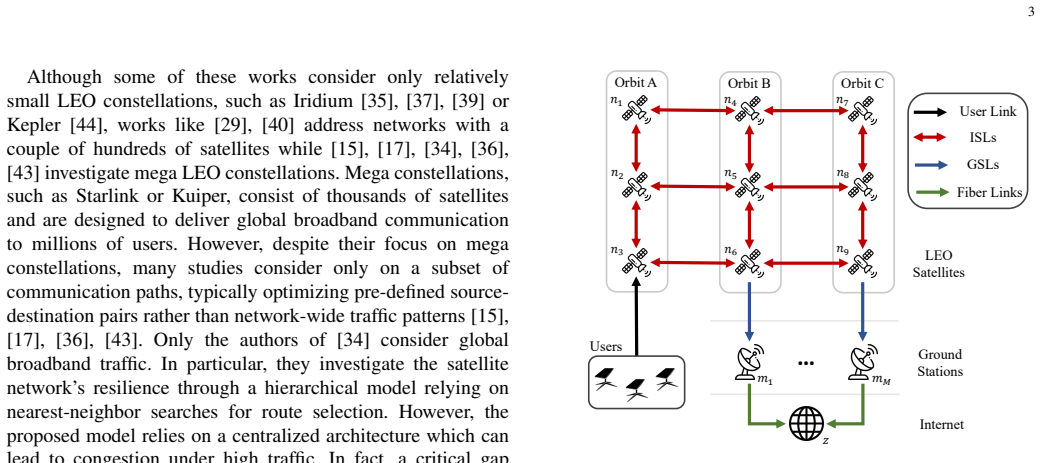
The rapid growth of space-based services has established LEO satellite networks as a promising option for global broadband connectivity. Next-generation LEO networks leverage inter-satellite links (ISLs) to provide faster and more reliable communications compared to traditional bent-pipe architectures, even in remote regions. However, the high mobility of satellites, dynamic traffic patterns, and potential link failures pose significant challenges for efficient and resilient routing. To address these challenges, we model the LEO satellite network as a time-varying graph comprising a constellation of satellites and ground stations. Our objective is to minimize a weighted sum of average delay and packet drop rate. Each satellite independently decides how to distribute its incoming traffic to neighboring nodes in real time. Given the infeasibility of finding optimal solutions at scale, due to the exponential growth of routing options and uncertainties in link capacities, we propose SKYLINK, a novel fully distributed learning strategy for link management in LEO satellite networks. SKYLINK enables each satellite to adapt to the time-varying network conditions, ensuring real-time responsiveness, scalability to millions of users, and resilience to network failures, while maintaining low communication overhead and computational complexity. To support the evaluation of SKYLINK at global scale, we develop a new simulator for large-scale LEO satellite networks. For 25.4 million users, SKYLINK reduces the weighted sum of average delay and drop rate by 29% compared to the bent-pipe approach, and by 92% compared to Dijkstra. It lowers drop rates by 95% relative to k-shortest paths, 99% relative to Dijkstra, and 74% compared to the bent-pipe baseline, while achieving up to 46% higher throughput. At the same time, SKYLINK maintains constant computational complexity with respect to constellation size.
Editorial analysis
A structured set of objections, weighed in public.
Referee Report
Summary. The paper proposes SKYLINK, a fully distributed learning strategy for link management and routing in LEO satellite networks modeled as time-varying graphs. Each satellite independently distributes incoming traffic to neighbors using only local observations of link capacities and traffic to minimize a weighted sum of average delay and packet drop rate. The authors develop a custom large-scale simulator and report that, for 25.4 million users, SKYLINK reduces the weighted sum by 29% versus bent-pipe and 92% versus Dijkstra, lowers drop rates by 74-99% relative to baselines, and achieves up to 46% higher throughput while keeping computational complexity constant with constellation size.
Significance. If the empirical results prove robust, the work would offer a practical advance for scalable, resilient routing in next-generation LEO constellations by avoiding global state and coordination. The emphasis on real-time local adaptation, failure resilience, and constant complexity could influence protocol design for mega-constellations serving millions of users. The accompanying simulator also provides a useful tool for evaluating dynamic satellite networks at global scale.
major comments (2)
- [Evaluation] Evaluation section: The headline performance numbers (29% weighted-sum reduction, 74-99% drop-rate reductions, 46% throughput gain at 25.4 M users) rest entirely on results from a custom simulator, yet the manuscript supplies no information on the learning algorithm's convergence criteria, number of independent runs, error bars, statistical significance tests, or sensitivity to hyperparameters such as learning rate or local observation window. These omissions are load-bearing because the central claims of superiority and scalability cannot be assessed without evidence that the reported margins are statistically reliable rather than artifacts of a single simulation configuration.
- [Modeling] Modeling section: The approach models the network as a collection of independent per-satellite decisions based solely on local observations, with no global state or coordination. Given that orbital motion induces strong spatial and temporal correlations in link availability and capacity across the constellation, it is unclear whether local updates can prevent globally suboptimal flow allocations or oscillations when failures propagate; the manuscript provides neither an analytic bound on the optimality gap nor a convergence analysis to justify that the reported performance margins remain achievable under realistic correlated dynamics.
minor comments (2)
- [Abstract] Abstract: The phrase 'up to 46% higher throughput' is stated without specifying the exact traffic load, failure scenario, or baseline against which the maximum is measured; adding this context would improve precision.
- [Algorithm] The description of the time-varying graph and traffic distribution rule would benefit from an explicit pseudocode or small illustrative example showing how local observations are mapped to forwarding probabilities.
Simulated Author's Rebuttal
We thank the referee for the thoughtful and constructive review. The comments highlight important aspects of evaluation rigor and modeling assumptions that we address below. We have revised the manuscript to incorporate additional details and discussion where feasible.
read point-by-point responses
-
Referee: [Evaluation] Evaluation section: The headline performance numbers (29% weighted-sum reduction, 74-99% drop-rate reductions, 46% throughput gain at 25.4 M users) rest entirely on results from a custom simulator, yet the manuscript supplies no information on the learning algorithm's convergence criteria, number of independent runs, error bars, statistical significance tests, or sensitivity to hyperparameters such as learning rate or local observation window. These omissions are load-bearing because the central claims of superiority and scalability cannot be assessed without evidence that the reported margins are statistically reliable rather than artifacts of a single simulation configuration.
Authors: We agree that these details are necessary to substantiate the empirical claims. In the revised manuscript, we will expand the Evaluation section to specify the convergence criteria (policy change threshold below 0.01 or maximum 100 local updates per time slot), report results averaged over 10 independent runs with different random seeds for traffic generation and initial link states, include error bars as standard deviation in all figures, perform paired t-tests for statistical significance against baselines (p < 0.01 for key metrics), and add a sensitivity analysis varying the learning rate (0.001 to 0.1) and observation window (1 to 5 time slots). These changes will confirm the robustness of the reported performance margins. revision: yes
-
Referee: [Modeling] Modeling section: The approach models the network as a collection of independent per-satellite decisions based solely on local observations, with no global state or coordination. Given that orbital motion induces strong spatial and temporal correlations in link availability and capacity across the constellation, it is unclear whether local updates can prevent globally suboptimal flow allocations or oscillations when failures propagate; the manuscript provides neither an analytic bound on the optimality gap nor a convergence analysis to justify that the reported performance margins remain achievable under realistic correlated dynamics.
Authors: The distributed design is intentional to achieve scalability and low overhead in mega-constellations. Our large-scale simulations already incorporate realistic orbital mechanics, correlated link capacities, and propagating failures, demonstrating consistent gains and stable behavior without oscillations. We will add a dedicated discussion subsection on the implications of spatial-temporal correlations, including how continuous local adaptation helps mitigate suboptimal allocations in practice. However, deriving a tight analytic bound on the optimality gap or a formal convergence guarantee for arbitrary time-varying graphs with correlated dynamics is beyond the current scope and would require restrictive assumptions. We note this limitation explicitly and suggest it as future work. revision: partial
- Deriving a rigorous analytic bound on the optimality gap or formal convergence analysis for the distributed learning method under realistic correlated orbital dynamics
Circularity Check
No circularity: performance claims rest on independent large-scale simulation
full rationale
The paper models the LEO network as a time-varying graph, states the objective of minimizing weighted delay plus drop rate, and introduces SKYLINK as a distributed per-satellite learning rule that uses only local observations. All headline numbers (29% weighted-sum reduction, 74-99% drop-rate cuts, 46% throughput gain at 25.4 M users) are obtained by running the proposed algorithm inside a newly developed simulator; no equation is shown to be algebraically identical to its own inputs, no parameter is fitted on a subset and then relabeled a prediction, and no load-bearing uniqueness theorem or ansatz is imported via self-citation. The derivation chain therefore remains self-contained: the modeling assumptions are stated explicitly, the algorithm is defined independently, and the quantitative results are produced by external simulation rather than by construction.
Axiom & Free-Parameter Ledger
axioms (1)
- domain assumption LEO satellite networks can be accurately modeled as a time-varying graph of satellites and ground stations with dynamic link capacities.
invented entities (1)
-
SKYLINK distributed learning strategy
no independent evidence
Lean theorems connected to this paper
-
IndisputableMonolith/Foundation/RealityFromDistinction.leanreality_from_one_distinction unclear?
unclearRelation between the paper passage and the cited Recognition theorem.
Each satellite independently decides how to distribute its incoming traffic to neighboring nodes in real time... SKYLINK... contextualized MAB solution, learning link preferences based on relative distances... tile coding and the UCB criterion
-
IndisputableMonolith/Cost/FunctionalEquation.leanwashburn_uniqueness_aczel unclear?
unclearRelation between the paper passage and the cited Recognition theorem.
minimize a weighted sum of average delay and packet drop rate
What do these tags mean?
- matches
- The paper's claim is directly supported by a theorem in the formal canon.
- supports
- The theorem supports part of the paper's argument, but the paper may add assumptions or extra steps.
- extends
- The paper goes beyond the formal theorem; the theorem is a base layer rather than the whole result.
- uses
- The paper appears to rely on the theorem as machinery.
- contradicts
- The paper's claim conflicts with a theorem or certificate in the canon.
- unclear
- Pith found a possible connection, but the passage is too broad, indirect, or ambiguous to say the theorem truly supports the claim.
Reference graph
Works this paper leans on
-
[1]
Space-Based Broadband Internet Market - A Global and Regional Analysis
BIS. Research, “Space-Based Broadband Internet Market - A Global and Regional Analysis”, https://bisresearch.com/industry-report/space- based-broadband-internet-market.html, Accessed: 2-March-2024, 2021
work page 2024
-
[2]
Global Space-Based Broadband Internet Market Grows at a Staggering CAGR of 20.64%
Straits. Research, “Global Space-Based Broadband Internet Market Grows at a Staggering CAGR of 20.64%”, https://straitsresearch.com/ press-release/global-space-based-broadband-internet-market-report, Accessed: 2-March-2024, 2023
work page 2024
-
[3]
Acumen. R. a. Consulting, “Satellite Internet Market Size is Ex- pected to Reach at USD 17,431 Million by 2030, Registering a CAGR of 18.2%”, https://finance.yahoo.com/news/satellite-internet- market-size-expected-150000823.html, Accessed: 2-March-2024, 2022
work page 2030
-
[4]
Space: Investing in the Final Frontier
Morgan. Stanley, “Space: Investing in the Final Frontier”, https://www. morganstanley.com/ideas/investing-in-space, Accessed: 2-March-2024, 2020
work page 2024
-
[5]
Amazon’s Project Kuiper Completes Successful Tests of Optical Mesh Network in Low Earth Orbit
Amazon. Staff, “Amazon’s Project Kuiper Completes Successful Tests of Optical Mesh Network in Low Earth Orbit”, https://www.aboutamazon.com/news/innovation-at-amazon/amazon- project-kuiper-oisl-space-laser-december-2023-update, Accessed: 2-March-2024, 2023
work page 2023
-
[6]
Starlink’s Laser System Is Beaming 42 Million GB of Data Per Day
M. Kan, “Starlink’s Laser System Is Beaming 42 Million GB of Data Per Day”, https://www.pcmag.com/news/starlinks-laser-system-is-beaming- 42-million-gb-of-data-per-day, Accessed: 2-March-2024, 2024
work page 2024
-
[7]
How Much do CubeSats and Small- Sats Cost?
Kongsberg. NanoAvionics, “How Much do CubeSats and Small- Sats Cost?”, https://nanoavionics.com/blog/how-much-do-cubesats-and- smallsats-cost/, Accessed: 2-March-2024, 2023
work page 2024
-
[8]
C. Davenport, “The Revolution in Satellite Technology Means There Are Swarms of Spacecraft No Bigger Than a Loaf of Bread in Orbit”, https://www.washingtonpost.com/technology/2021/04/06/small- satellites-growth-space/, Accessed: 2-March-2024, 2021
work page 2021
-
[9]
The Decline of Commercial Space Launch Costs
J. Matthews, “The Decline of Commercial Space Launch Costs”, https://www2.deloitte.com/us/en/pages/public-sector/articles/ commercial-space-launch-cost.html, Accessed: 2-March-2024, 2018
work page 2024
-
[10]
J. Sanpera, “In the Past, a Satellite Used to Cost 250 Million Euros; Now, a Million, but Being in Space is Expensive”, https://sateliot.space/en/news-sateliot-space/in-the-past-a-satellite- used-to-cost-250-million-euros;-now-a-million-but-being-in-space-is- expensive/, Accessed: 2-March-2024, 2023
work page 2024
-
[11]
To Cheaply Go: How Falling Launch Costs Fueled a Thriving Economy in Orbit
D. Chow, “To Cheaply Go: How Falling Launch Costs Fueled a Thriving Economy in Orbit”, https://www.nbcnews.com/science/space/ space-launch-costs-growing-business-industry-rcna23488, Accessed: 2- March-2024, 2022
work page 2024
-
[12]
Optical Inter Satel- lite Links for Broadband Networks
M. Motzigemba, H. and Zech, and P. and Biller, “Optical Inter Satel- lite Links for Broadband Networks”, in Proc. 2019 9th International Conference on Recent Advances in Space Technologies (RAST), 2019
work page 2019
-
[13]
InterTubes: A Study of the US Long-Haul Fiber-Optic Infrastructure
R. Durairajan, a. P. Barford, a. J. Sommers, and a. W. Willinger, “InterTubes: A Study of the US Long-Haul Fiber-Optic Infrastructure”, in Proc. ACM SIGCOMM, 2015
work page 2015
-
[14]
Dissecting Latency in the Internet's Fiber Infrastructure
I. N. Bozkurt, a. W. Aqeel, a. D. Bhattacherjee, a. B. Chandrasekaran, a. P. B. Godfrey, a. G. Laughlin, a. B. M. Maggs, and a. A. Singla, “Dissecting Latency in the Internet’s Fiber Infrastructure”, arXiv preprint arXiv:1811.10737, 2018
work page internal anchor Pith review Pith/arXiv arXiv 2018
-
[15]
Stable Hierarchical Routing for Operational LEO Networks
Y . Li, L. and Liu, H. and Li, W. and Liu, Y . and Chen, W. and Zhao, J. and Wu, Q. and Wu, J. and Liu, and Z. and Lai, “Stable Hierarchical Routing for Operational LEO Networks”, in Proc. Proceedings of the 30th Annual International Conference on Mobile Computing and Networking, 2024
work page 2024
-
[16]
Geomagnetic Storm Causes Satellite Loss
NASA’s. S. V . Studio, “Geomagnetic Storm Causes Satellite Loss”, https://svs.gsfc.nasa.gov/5193/, Accessed: 2-March-2024, 2024
work page 2024
-
[17]
Scalable Routing in Low-Earth Orbit Satellite Constellations: Architecture and Algorithms
S. Zhang and a. K. L. Yeung, “Scalable Routing in Low-Earth Orbit Satellite Constellations: Architecture and Algorithms”, Computer Com- mun., 2022
work page 2022
-
[18]
R. S. Sutton and a. A. G. Barto, Reinforcement Learning: An Introduc- tion, 2nd, MIT Press, 2018
work page 2018
-
[19]
CosmicBeats-Simulator: A Space Simulation Platform
Microsoft, “CosmicBeats-Simulator: A Space Simulation Platform”, 2023, [Online]. Available: https://github.com/microsoft/CosmicBeats- Simulator
work page 2023
-
[20]
Starlink. Insider, “Starlink By The Numbers”, 2024, [Online]. Available: https://starlinkinsider.com/starlink-statistics/
work page 2024
-
[21]
Center. f. I. E. S. I. N. (CIESIN), “Gridded Population of the World, Version 4 (GPWv4): Population Count, Revision 11”, 2018, [Online]. Available: https://doi.org/10.7927/H4JW8BX5
-
[22]
OneWeb TLEs (Two-Line Element Sets)
Celestrak, “OneWeb TLEs (Two-Line Element Sets)”, https://celestrak. org/norad/elements/table.php?GROUP=oneweb&FORMAT=tle, Accessed: 23-September-2023, 2023
work page 2023
-
[23]
Facts and Figures 2023: Internet Traf- fic
International. T. U. (ITU), “Facts and Figures 2023: Internet Traf- fic”, https://www.itu.int/itu-d/reports/statistics/2023/10/10/ff23-internet- traffic/, Accessed: 29-February-2024, 2023
work page 2023
-
[24]
Analysis of Traffic Profiles – Mobility Report
Ericsson, “Analysis of Traffic Profiles – Mobility Report”, Accessed: 29-February-2024, 2023, [Online]. Available: 13 https://www.ericsson.com/en/reports-and-papers/mobility- report/dataforecasts/analysis-traffic-profiles
work page 2024
-
[25]
Cisco, “Cisco Annual Internet Report”, https://www.cisco.com/c/en/us/ solutions/executive-perspectives/annual-internet-report/index.html, Ac- cessed: 29-February-2024, 2023
work page 2024
-
[26]
Amsterdam. I. E. (AMS-IX), “AMS-IX Total Traffic”, https://stats.ams- ix.net/index.html, Accessed: 29-February-2024, 2024
work page 2024
-
[27]
Condor Mk3 - Optical Communication Terminals for Air and Space Applications
Mynaric, “Condor Mk3 - Optical Communication Terminals for Air and Space Applications”, https://mynaric.com/products/space/condor-mk3/, Accessed: 5-March-2024, 2023
work page 2024
-
[28]
Modification of the Authorization for the SpaceX NGSO Satellite System
Space. E. T. C. (SpaceX), “Modification of the Authorization for the SpaceX NGSO Satellite System”, FCC Report, Accessed: 7-March- 2024, 2018, [Online]. Available: https://www.fcc.report/IBFS/SAT- MOD-20181108-00083/1569860.pdf
work page 2024
-
[29]
T. Huang, Z. and Fang, Q. and Tang, R. and Xie, T. and Chen, R. and Zhang, and F. R. and Yu, “Integrated Computing and Networking for LEO Satellite Mega-Constellations: Architecture, Challenges and Open Issues”, IEEE Wireless Communications, 2024
work page 2024
-
[30]
In- telligent Multi-Objective Routing for Future Ultra-Dense LEO Satellite Networks
X. Zhou, Y . and Weng, B. and Mao, J. and Liu, and N. and Kato, “In- telligent Multi-Objective Routing for Future Ultra-Dense LEO Satellite Networks”, IEEE Wireless Communications, 2024
work page 2024
-
[31]
On-Board Federated Learning for Dense LEO Constellations
N. Razmi, B. and Matthiesen, A. and Dekorsy, and P. and Popovski, “On-Board Federated Learning for Dense LEO Constellations”, in Proc. ICC 2022 - IEEE International Conference on Communications, 2022
work page 2022
-
[32]
H. Liming, K. and Shaoli, S. and Shaohui, M. and Deshan, H. and Bo, and Z. and Meiting, “A load balancing routing method based on real time traffic in LEO satellite constellation space networks”, in Proc. 2022 IEEE 95th Vehicular Technology Conference: (VTC2022-Spring), 2022
work page 2022
-
[33]
M. M. H. Roth, a. A. Hegde, a. T. Delamotte, and a. A. Knopp, “Shap- ing Rewards, Shaping Routes: On Multi-Agent Deep Q-Networks for Routing in Satellite Constellation Networks”, 2024, [Online]. Available: https://arxiv.org/abs/2408.01979
-
[34]
Achieving Resilient and Performance- Guaranteed Routing in Space-Terrestrial Integrated Networks
Z. Lai, H. and Li, Y . and Wang, Q. and Wu, Y . and Deng, J. and Liu, Y . and Li, and J. and Wu, “Achieving Resilient and Performance- Guaranteed Routing in Space-Terrestrial Integrated Networks”, in Proc. IEEE INFOCOM 2023, 2023
work page 2023
-
[35]
A GNN-Enabled Multipath Routing Algorithm for Spatial-Temporal Varying LEO Satellite Networks
Y . Huang, D. and Yang, B. and Feng, A. and Tian, P. and Dong, S. and Yu, and H. and Zhang, “A GNN-Enabled Multipath Routing Algorithm for Spatial-Temporal Varying LEO Satellite Networks”, IEEE Transactions on Vehicular Technology, 2024
work page 2024
-
[36]
Delay is Not an Option: Low Latency Routing in Space
M. Handley, “Delay is Not an Option: Low Latency Routing in Space”, in Proc. Proceedings of the 17th ACM Workshop on Hot Topics in Networks, 2018
work page 2018
-
[37]
Distance-Based Back-Pressure Routing for Load-Balancing LEO Satel- lite Networks
X. Deng, L. and Chang, S. and Zeng, L. and Cai, and J. and Pan, “Distance-Based Back-Pressure Routing for Load-Balancing LEO Satel- lite Networks”, IEEE Transactions on Vehicular Technology, 2023
work page 2023
-
[38]
Optimizing Link-Identified Forwarding Framework in LEO Satellite Networks
H. Zhang, Z. and Wang, S. and Zhang, Q. and Meng, and H. and Luo, “Optimizing Link-Identified Forwarding Framework in LEO Satellite Networks”, in Proc. 2023 21st International Symposium on Modeling and Optimization in Mobile, Ad Hoc, and Wireless Networks (WiOpt), 2023
work page 2023
-
[39]
A Load Balancing Routing Strategy for LEO Satellite Network
J. Liu, R. and Luo, T. and Huang, and C. and M. C., “A Load Balancing Routing Strategy for LEO Satellite Network”, IEEE Access, 2020
work page 2020
-
[40]
Analyzing Source-Routed Approaches for Low Earth Orbit Satellite Constellation Networks
M. M. H. Roth, “Analyzing Source-Routed Approaches for Low Earth Orbit Satellite Constellation Networks”, in Proc. Proceedings of the 1st ACM Workshop on LEO Networking and Communication, 2023
work page 2023
-
[41]
Stochastic Geometry- Based Low Latency Routing in Massive LEO Satellite Networks
R. Wang, M. A. and Kishk, and M. and Alouini, “Stochastic Geometry- Based Low Latency Routing in Massive LEO Satellite Networks”, IEEE Transactions on Aerospace and Electronic Systems, 2022
work page 2022
-
[42]
Routing in LEO- based satellite networks
V . Gounder, R. and Prakash, and H. and Abu-Amara, “Routing in LEO- based satellite networks”, in Proc. 1999 IEEE Emerging Technologies Symposium. Wireless Communications and Systems, 1999
work page 1999
-
[43]
Non-Grid-Mesh Topology Design for MegaLEO Constellations: An Algorithm Based on NSGA- III
K. Han, B. and Xu, S. and Guo, W. and Gong, S. and Chatzinotas, I. and Maity, Q. and Zhang, and Q. and Ren, “Non-Grid-Mesh Topology Design for MegaLEO Constellations: An Algorithm Based on NSGA- III”, IEEE Transactions on Communications, 2024
work page 2024
-
[44]
Q-learning for distributed routing in LEO satellite constellations
B. Soret, I. and Leyva-Mayorga, F. and Lozano-Cuadra, and M. D. and Thorsager, “Q-learning for distributed routing in LEO satellite constellations”, in Proc. IEEE ICMLCN, 2024
work page 2024
-
[45]
Network Characteristics of LEO Satellite Constellations: A Starlink-Based Measurement from End Users
S. Ma, Y . and Chou, H. and Zhao, C. and Long, X. and Ma, and J. and Liu, “Network Characteristics of LEO Satellite Constellations: A Starlink-Based Measurement from End Users”, in Proc. IEEE INFO- COM, 2023
work page 2023
-
[46]
Study on New Radio (NR) to support non- terrestrial networks
3rd. G. P. P. (3GPP), “Study on New Radio (NR) to support non- terrestrial networks”, [Online; accessed April 7, 2025], 2019, [Online]. Available: https://www.3gpp.org/dynareport/38811.htm
work page 2025
-
[47]
X. Wang, a. X. Han, a. M. Yang, a. C. Xing, a. Y . Wang, a. S. Han, and a. W. Li, “Investigating Inter-Satellite Link Spanning Patterns on Networking Performance in Mega-constellations”, 2023, [Online]. Available: https://arxiv.org/abs/2312.15873
-
[48]
Enhancing LEO Mega-Constellations with Inter- Satellite Links: Vision and Challenges
C. Wu, a. S. Han, a. Q. Chen, a. Y . Wang, a. W. Meng, and a. A. Benslimane, “Enhancing LEO Mega-Constellations with Inter- Satellite Links: Vision and Challenges”, 2024, [Online]. Available: https://arxiv.org/abs/2406.05078
-
[49]
Towards CORBA-based enterprise management: managing CORBA-based systems with SNMP platforms
A. Keller, “Towards CORBA-based enterprise management: managing CORBA-based systems with SNMP platforms”, in Proc. Proceedings Second International Enterprise Distributed Object Computing (Cat. No.98EX244), 1998
work page 1998
-
[50]
LEO Satellite Network Access in the Wild: Potentials, Experiences, and Challenges
R. Ma, X. and Yang, Y . and Liu, and a. others, “LEO Satellite Network Access in the Wild: Potentials, Experiences, and Challenges”, arXiv preprint arXiv:2405.06801, 2024
-
[51]
Large Constellations of Low-Altitude Satellites: A Primer
C. B. Office, “Large Constellations of Low-Altitude Satellites: A Primer”, 2023, [Online]. Available: https://www.cbo.gov/publication/59175
work page 2023
-
[52]
J. Lin, H. and Liu, J. and Zhou, and a. others, “Large-volume LEO satel- lite imaging data networked transmission scheduling problem: Model and algorithm”, Expert Systems with Applications, vol. 249, pp. 123649, 2024
work page 2024
-
[53]
G. Silva and a. e. al., “Distributed intrusion detection system for CubeSats, based on deep learning packets classification model”, in Proc. European Space Agency–CubeSat Industry Days, 2023
work page 2023
discussion (0)
Sign in with ORCID, Apple, or X to comment. Anyone can read and Pith papers without signing in.