REVIEW 4 major objections 5 minor 45 references
Modular PE-Structured Learning for Cross-Task Wireless Communications
T0 review · 4 major / 5 minor · reviewed 2026-08-04 · deepseek-v4-flash
Pith's one-line read The paper claims that permutation-equivariance structure, captured in reusable Transformer-style modules, lets a single small DNN learn multiple wireless policies—precoding, coordinated beamforming, power allocation, and channel estimation—
desk verdict A promising modular PE framework with strong sample-complexity claims, but the architecture equations as written have a load-bearing dimension inconsistency that needs fixing before the generalizability results stand. read the letter →
The pith
A machine-rendered reading of the paper's core claim, the machinery that carries it, and where it could break.
The reading
What carries the argument
The load-bearing object is the permutation-equivariance (PE) property itself: a function whose output transforms the same way its input does when elements of a set are reordered. The paper classifies eight PE properties by whether the underlying sets are normal or nested, single or paired, and independently or jointly permuted, then orders their hypothesis spaces by inclusion. The design engine is Proposition 1, which says the composed network's hypothesis space is the largest among its layers, so matching a policy's PE class reduces to picking modules with the right hypothesis spaces. Three modules carry the construction: NATT (nested attention with local and global branches), NATT(P.S.) (i
What would settle it
Numerically check equivariance: take a fixed channel instance for a claimed policy class, apply a permutation from the claimed class (e.g., permuting UEs and antennas for MU-MIMO precoding), recompute the optimal or WMMSE precoding, and apply the inverse permutation; if the transformed outputs differ materially from the unpermuted output on any instance, the assigned PE property is false and the hypothesis-space argument breaks.
Extended reading notes
Core claim
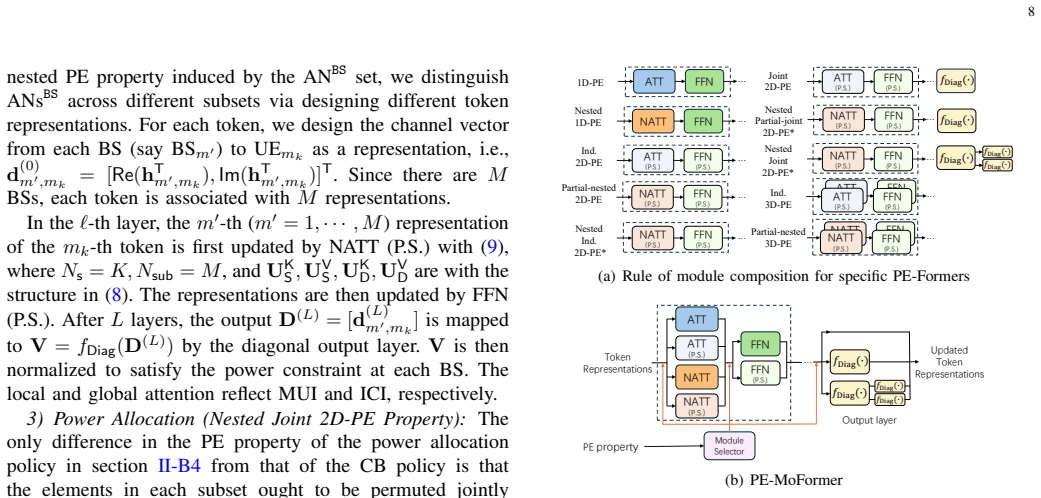
The central claim is that the sample and model complexity of learning wireless policies collapses when a network's hypothesis space is made to match the policy's permutation-equivariance class exactly. The paper builds a taxonomy of PE properties on normal and nested sets, orders the corresponding hypothesis spaces by inclusion, and proves that a composed network's hypothesis space is controlled by its layer with the largest hypothesis space. From this it designs three reusable modules—a nested attention layer, a parameter-shared version, and a diagonal output layer—and assembles them with existing 1D- and 2D-Former blocks into PE-MoFormer. The reported result is that this single network, wi
Load-bearing premise
The paper assumes the PE property assigned to each wireless policy is the true symmetry of the optimal policy—for instance, that the SE-maximizing MU-MIMO precoder really is partial-nested 2D-PE equivariant—without proving it for these nonconvex problems.
Editorial extensions
If this is right
- Multi-task wireless models can be assembled from small PE-matched modules instead of pre-training giant Transformers, cutting total parameters from tens or hundreds of millions to thousands.
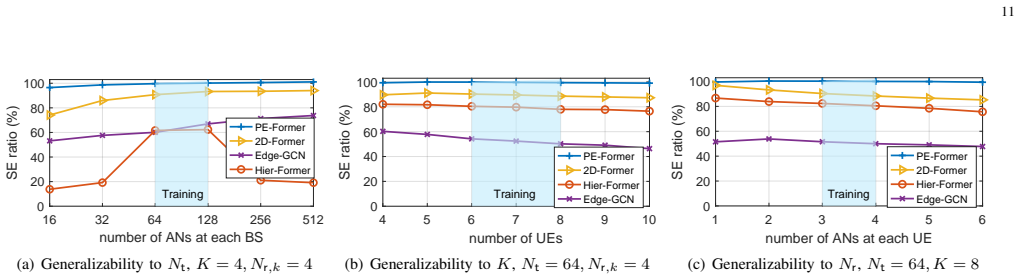
- PE-matched models inherit size-generalizability, so a single trained network serves varying numbers of antennas, users, and cells without retraining.
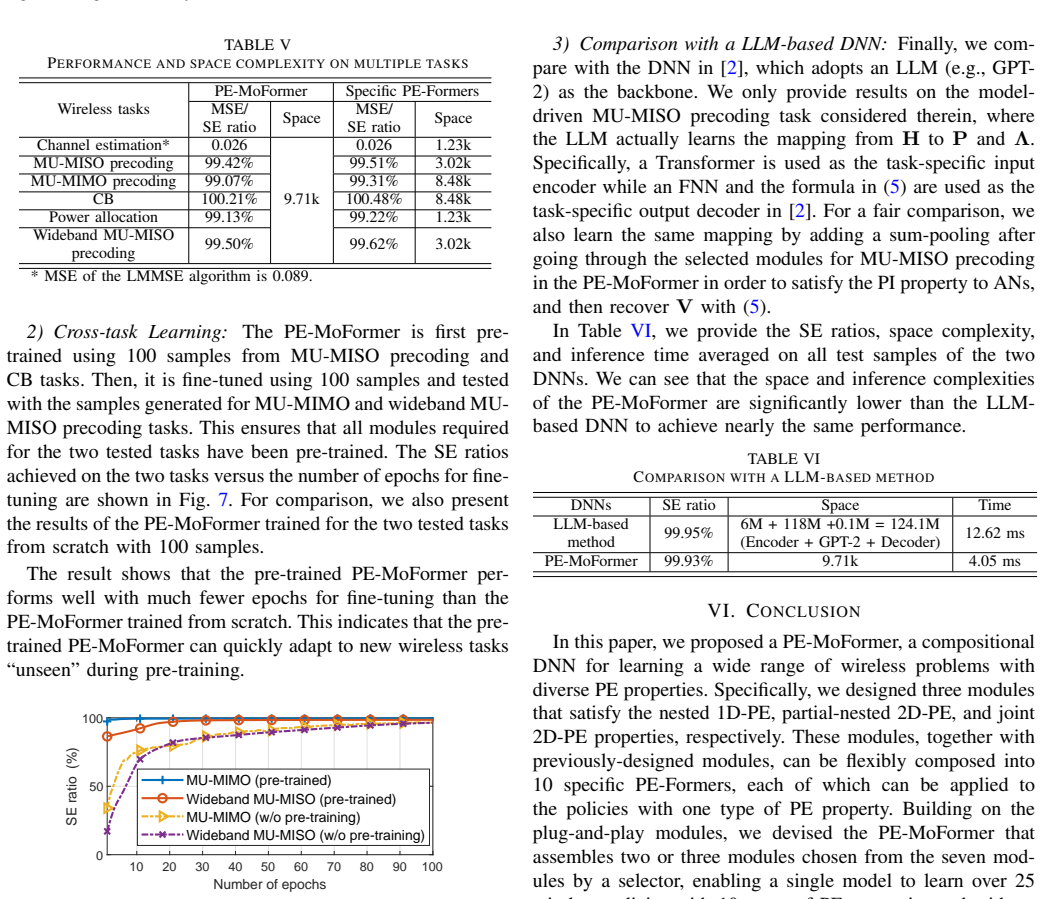
- Pre-training on a few tasks then fine-tuning on 100 samples adapts the model to previously unseen tasks in far fewer epochs, making edge deployment practical.
- The composition rule extends to higher-dimensional PE properties, such as wideband and IRS-aided precoding, by sharing modules along an additional set dimension.
- Matching the hypothesis space exactly removes both the sample hunger of an overly large hypothesis space and the approximation error of an overly small one, yielding 95% WMMSE-SE performance with under 40 samples on the tested precoding tasks.
Reading between the lines
- Beyond the paper, the PE-identification step could be automated or numerically verified per policy, turning the design rule into a general recipe for any set-structured optimization policy outside wireless, such as scheduling, routing, or multi-agent coordination.
- The hypothesis-space ordering suggests a practical diagnostic: when a learned policy underperforms with few samples, first ask whether the model's symmetry class is too large (estimation error) or too small (approximation error), then swap modules accordingly.
- The diagonal-output-layer trick is a generic mechanism for forcing joint permutation equivariance on top of independent-permutation-equivariant features; it may transfer to other attention-based or graph-based architectures.
- A testable extension would vary the set and number of pretraining tasks to map how much transfer gain the shared PE modules actually contribute, isolating the effect of structural sharing from the effect of shared feature representations.
Editorial analysis
A structured set of objections, weighed in public.
Referee Report
Summary. The manuscript proposes a modular framework for building permutation-equivariant Transformers for wireless resource allocation and estimation. It catalogues several PE property types, assigns PE properties to a range of policies, designs three new modules (NATT, NATT(P.S.), and a diagonal output layer) alongside four previously introduced modules, proves module-level equivariance in the appendices, and assembles these into task-specific PE-Formers and a cross-task PE-MoFormer. Simulations on five resource-allocation tasks plus channel estimation report roughly 99% SE ratios and an MSE of 0.026 with 100 training samples per task and 9.71k total parameters, together with size, SNR, and channel generalization experiments.
Significance. The paper's conceptual contribution is valuable: making hypothesis-space inclusion relations explicit and deriving a composition rule from them is more principled than ad hoc multi-task Transformers. If the construction is made self-consistent and the empirical claims are confirmed, the 100-sample/9.71k-parameter result would be an important counterpoint to the large-model trend in wireless learning. The module-level proofs in Appendices A-C are a strength, as is the breadth of the simulation suite and the comparison against an LLM-based baseline. However, the current manuscript contains a central architectural inconsistency and several under-proved PE identifications, so the significance is conditional on revision.
major comments (4)
- [§III.B, Eq. (8)] Eq. (8) is inconsistent with Eq. (6). In Eq. (6), U_K and U_V multiply token representations d_i^{(ℓ-1)} of dimension J^{(ℓ-1)} N_t, so they must have size J^{(ℓ-1)} N_t × J^{(ℓ-1)} N_t. Eq. (8) instead presents U_K as a K×K block matrix with blocks U_K^1, U_K^2 in R^{J^{(ℓ)}×J^{(ℓ)}}, making U_K of size K J^{(ℓ)} × K J^{(ℓ)}. These dimensions agree only if K J^{(ℓ)} = J^{(ℓ-1)} N_t, which is false for the stated hyperparameters (N_t=64, K=8, J=[32,32,32]). This is load-bearing: the size-generalizability claims in Figs. 5/6 and Table V require weight matrices independent of N_t and K. If the implementation uses a different parameter-sharing scheme than Eq. (8), the paper omits the core construction needed to reproduce the results; if it uses Eq. (8), the attention equation must be rewritten. Please provide a self-consistent definition of all weight dimensions, including for NATT(P.S.) an
- [§IV.C2, §IV.C3] Full-architecture equivariance for the CB and power-allocation PE-Formers is asserted rather than proven. The module-level proofs in Appendices B and C cover NATT and NATT(P.S.) for a single nested set of tokens, but the CB design gives each token multiple representations (one per BS) and then applies f_Diag after an MLK-dimensional update. Eq. (10) defines f_Diag for square matrices only, and it is not shown that the described multi-representation pipeline satisfies the nested partial-joint 2D-PE property (2e) or the nested joint 2D-PE property (2f). Since these two tasks are central to the cross-task claim, please provide a precise definition of the layer dimensions and a proof (or an explicit reduction to the module-level proofs) that the composed architecture has the claimed PE property.
- [§II.B, §II.B.2, §II.B.4] The PE property assignments for MU-MIMO precoding, CB, and power allocation are load-bearing but are introduced with 'by using the method in [21]' without a proof or even a sketch. For nonconvex optimization problems, one must show that there exists an optimal policy (or a canonical selection from the optimal set) that is equivariant under the claimed permutations. If the actual SE-maximizing policy is not equivariant under the stated nested permutations, the hypothesis-space constraint would exclude the target function and the reported sample efficiency would not transfer. Please include a concise derivation for each of the three multi-cell/multi-antenna cases, or explicitly state and justify the assumptions under which the claimed PE properties hold.
- [§V, Tables IV-VI, Figs. 4-7] All empirical results are single point estimates with no error bars, confidence intervals, or repeated-seed statistics. This matters for the paper's central quantitative claims: Table V reports differences such as 99.42% vs. 99.51% between PE-MoFormer and specific PE-Formers, and Fig. 7 compares learning curves over epochs. Without variance information, these differences may be within run-to-run noise. Please report means and standard deviations over at least several independent trials, or otherwise provide error bars/confidence bands for the main figures and tables.
minor comments (5)
- [§III.B, Eq. (6)] The text immediately after Eq. (6) says d_k^{(ℓ)} ∈ R^{J^{(ℓ)} N_t}, but the output c_k^{(ℓ)} of the ATT sub-layer has dimension J^{(ℓ-1)} N_t, not J^{(ℓ)} N_t. Clarify the layer indexing and define J^{(0)} explicitly (the input representation is 2N_t, suggesting J^{(0)}=2).
- [Appendix C] Typo: 'parial-nested' should be 'partial-nested'.
- [Table I] The table heading says 'over 25 wireless policies,' but the table lists a smaller number of rows. Clarify whether some rows represent multiple policies/instances.
- [Fig. 2] The hypothesis-space diagram is informative but many labels are very small; enlarge the fonts for readability.
- [§IV.B, Proposition 3] The conditions Π U_K^S = U_K^S Π etc. should specify the dimension and role of Π; as written it is ambiguous whether Π is the permutation on the token index or on the feature/antenna index, which is important for the proof.
Circularity Check
No significant circularity: the PE-module design is derived from explicit equivariance definitions and tested on held-out data; self-citations are independent structural results.
full rationale
The derivation chain is not circular. The paper starts from formal definitions of PE properties (Section II.A) and constructs modules with explicit parameter-sharing rules (Eqs. (6)-(9), Section IV.B), with equivariance proofs in Appendices B and C. The composition rule is justified by Proposition 1 (proved in Appendix A), not by fitting. The PE assignments of wireless policies (e.g., MU-MIMO precoding as partial-nested 2D-PE, CB as nested partial-joint 2D-PE) are obtained by applying the structural method of [21]; that prior work is parameter-free and externally checkable, and the present paper states the set structures explicitly, so the citation is independent support rather than a self-citation circle. The modules inherited from [9] are recapped with their block structure in Eq. (8); the cited proof of their equivariance is a checkable construction, not an unverified premise adopted solely on authority. The empirical claims—99% SE ratios, MSE 0.026, size/SNR/channel generalization—are measured on test data generated separately from the 100-sample training sets, so they do not reduce to fitted parameters or to the PE definitions by construction. I note two non-circular weaknesses: the paper asserts without reported results that PE-MoFormer generalization is 'almost the same' as specific PE-Formers (Section V.C), and Remark 5 promises a sum-to-min-rate fine-tuning result 'according to our simulation' that is not shown; additionally, Eq. (6) and Eq. (8) use inconsistent matrix dimensions (J^{(ℓ-1)}N_t vs. K J^{(ℓ)}), which threatens the size-generalizability construction. These are correctness/evidence issues, not instances of the paper's predictions being equivalent to its inputs by construction.
Assumptions & free parameters
assumptions (5)
- domain assumption The optimal policies of the considered wireless optimization problems satisfy the claimed PE properties (e.g., ind. 2D-PE for MU-MISO precoding, partial-nested 2D-PE for MU-MIMO precoding, nested partial-joint 2D-PE for CB).
- standard math The hypothesis space of a composed DNN is determined by the layer with the largest hypothesis space (Proposition 1).
- standard math Universal approximation of FNNs (Cybenko) so that the hypothesis space of an FNN is all continuous functions.
- domain assumption WMMSE provides an appropriate reference (near-optimal) for SE, so SE ratio is a valid performance measure.
- standard math The parameter-sharing structure (8) (identical diagonal/off-diagonal blocks) yields the required PE properties.
Cite this review
Pith. "Pith review of Modular PE-Structured Learning for Cross-Task Wireless Communications." pith.science (2026). https://pith.science/paper/LXY22J57
@misc{pith2026250908614,
  author       = {Pith},
  title        = {Pith review of: Modular PE-Structured Learning for Cross-Task Wireless Communications},
  year         = {2026},
  howpublished = {\url{https://pith.science/paper/LXY22J57}},
  note         = {Machine review of arXiv:2509.08614}
}
read the original abstract
Recent trends in learning wireless policies attempt to develop deep neural networks (DNNs) for handling multiple tasks with a single model. Existing approaches often rely on large models, which are hard to pre-train and fine-tune at the wireless edge. In this work, we challenge this paradigm by leveraging the structured knowledge of wireless problems -- specifically, permutation equivariant (PE) properties. We design three types of PE-aware modules, two of which are Transformer-style sub-layers. These modules can serve as building blocks to assemble compact DNNs applicable to the wireless policies with various PE properties. To guide the design, we analyze the hypothesis space associated with each PE property, and show that the PE-structured module assembly can boost the learning efficiency. Inspired by the reusability of the modules, we propose PE-MoFormer, a compositional DNN capable of learning a wide range of wireless policies -- including but not limited to precoding, coordinated beamforming, power allocation, and channel estimation -- with strong generalizability, low sample and space complexity. Simulations demonstrate that the proposed modular PE-based framework outperforms relevant large model in both learning efficiency and inference time, offering a new direction for structured cross-task learning for wireless communications.
Figures


Figures from the paper (4 more)


Reference graph
Works this paper leans on
-
[21]
Multidimensional graph neural networks for wireless communications,
S. Liu, J. Guo, and C. Yang, “Multidimensional graph neural networks for wireless communications,”IEEE Trans. Wireless Commun., vol. 23, no. 4, pp. 3057–3073, Apr. 2024
2024
-
[1]
A survey of large language models,
W. X. Zhao, K. Zhou, J. Liet al., “A survey of large language models,” arXiv:2303.18223, 2023
arXiv 2023
-
[2]
Large language model enabled multi-task physical layer network,
T. Zheng and L. Dai, “Large language model enabled multi-task physical layer network,”arXiv:2412.20772, 2025
arXiv 2025
-
[3]
LLM4WM: Adapting LLM for wireless multi-tasking,
X. Liu, S. Gao, B. Liuet al., “LLM4WM: Adapting LLM for wireless multi-tasking,”arXiv: 2501.12983, 2025
arXiv 2025
-
[4]
WirelessGPT: A generative pre- trained multi-task learning framework for wireless communication,
T. Yang, P. Zhang, M. Zhenget al., “WirelessGPT: A generative pre- trained multi-task learning framework for wireless communication,” arXiv:2502.06877, 2025
arXiv 2025
-
[5]
F. Jiang, C. Pan, L. Donget al., “A comprehensive survey of large AI models for future communications: Foundations, applications and challenges,”arXiv: 2505.03556, 2025
arXiv 2025
-
[6]
From multilayer perceptron to GPT: A reflection on deep learning research for wireless physical layer,
M. Akrout, A. Mezghani, E. Hossainet al., “From multilayer perceptron to GPT: A reflection on deep learning research for wireless physical layer,”IEEE Commun. Mag., vol. 62, no. 7, pp. 34–41, Jul. 2024
2024
-
[7]
Understanding the performance of learn- ing precoding policies with graph and convolutional neural networks,
B. Zhao, J. Guo, and C. Yang, “Understanding the performance of learn- ing precoding policies with graph and convolutional neural networks,” IEEE Trans. Commun., vol. 72, no. 9, pp. 5657–5673, Sept. 2024
2024
Show all 45 references
-
[8]
Graph neural networks for scalable ra- dio resource management: Architecture design and theoretical analysis,
Y . Shen, Y . Shi, J. Zhanget al., “Graph neural networks for scalable ra- dio resource management: Architecture design and theoretical analysis,” IEEE J. Sel. Areas Commun., vol. 39, no. 1, pp. 101–115, Jan. 2021
2021
-
[9]
Learning precoding in multi-user multi- antenna systems: Transformer or graph transformer?
Y . Duan, J. Guo, and C. Yang, “Learning precoding in multi-user multi- antenna systems: Transformer or graph transformer?”arXiv:2503.02998, 2025
2025 arXiv
-
[10]
Attention is all you need,
A. Vaswani, N. Shazeer, N. Parmaret al., “Attention is all you need,” NeurIPS, 2017
2017
-
[11]
Transformer-empowered 6G intelli- gent networks: From massive MIMO processing to semantic communi- cation,
Y . Wang, Z. Gao, D. Zhenget al., “Transformer-empowered 6G intelli- gent networks: From massive MIMO processing to semantic communi- cation,”IEEE Wirel. Commun., vol. 30, no. 6, pp. 127–135, Dec. 2023
2023
-
[12]
Accurate channel prediction based on Transformer: Making mobility negligible,
H. Jiang, M. Cui, D. W. K. Nget al., “Accurate channel prediction based on Transformer: Making mobility negligible,”IEEE J. Sel. Areas Commun., vol. 40, no. 9, pp. 2717–2732, Sept. 2022
2022
-
[13]
Linformer: A linear-based lightweight Transformer architecture for time-aware MIMO channel prediction,
Y . Jin, Y . Wu, Y . Gaoet al., “Linformer: A linear-based lightweight Transformer architecture for time-aware MIMO channel prediction,” IEEE Trans. Wireless Commun., early access, Apr. 2025
2025
-
[14]
Pay less but get more: A dual-attention- based channel estimation network for massive MIMO systems with low- density pilots,
B. Zhou, X. Yang, S. Maet al., “Pay less but get more: A dual-attention- based channel estimation network for massive MIMO systems with low- density pilots,”IEEE Trans. Wireless Commun., Jun. 2024
2024
-
[15]
Transformer-assisted parametric CSI feedback for mmWave massive MIMO systems,
H. Ju, S. Jeong, S. Kimet al., “Transformer-assisted parametric CSI feedback for mmWave massive MIMO systems,”IEEE Trans. Wireless Commun., vol. 23, no. 12, pp. 18 774–18 787, Dec. 2024
2024
-
[16]
KANsformer for scalable beamforming,
X. Xie, Y . Lu, C.-Y . Chiet al., “KANsformer for scalable beamforming,” IEEE Trans. Veh. Technol., early access, Mar. 2025
2025
-
[17]
Joint spectrum, precoding, and phase shifts design for RIS-Aided multiuser MIMO THz systems,
A. Mehrabian and V . W. S. Wong, “Joint spectrum, precoding, and phase shifts design for RIS-Aided multiuser MIMO THz systems,”IEEE Trans. Commun., vol. 72, no. 8, pp. 5087–5101, Aug. 2024
2024
-
[18]
Channel characteristics-based domain adaptation for multiuser MISO beamforming with Transformer and spiking neural networks,
X. Ge and X. Dai, “Channel characteristics-based domain adaptation for multiuser MISO beamforming with Transformer and spiking neural networks,”IEEE Trans. on Green Commun. Networking, early access, Feb., 2025
2025
-
[19]
Adaptive TTD configurations for near- field communications: An unsupervised Transformer approach,
H. Ting, Z. Wang, and Y . Liu, “Adaptive TTD configurations for near- field communications: An unsupervised Transformer approach,”IEEE Trans. Wireless Commun., vol. 24, no. 1, pp. 277–292, Jan. 2025
2025
-
[20]
HPE Transformer: Learning to optimize multi-group multicast beamforming under nonconvex QoS constraints,
Y . Li and Y . Liu, “HPE Transformer: Learning to optimize multi-group multicast beamforming under nonconvex QoS constraints,”IEEE Trans. Commun., Sept. 2024
2024
-
[22]
RE-MIMO: Recurrent and permutation equivariant neural MIMO detection,
K. Pratik, B. D. Rao, and M. Welling, “RE-MIMO: Recurrent and permutation equivariant neural MIMO detection,”IEEE Trans. Signal Process., vol. 69, pp. 459–473, Dec. 2021
2021
-
[23]
Learning power allocation for multi-cell-multi- user systems with heterogeneous graph neural networks,
J. Guo and C. Yang, “Learning power allocation for multi-cell-multi- user systems with heterogeneous graph neural networks,”IEEE Trans. Wireless Commun., vol. 21, no. 2, pp. 884–897, Feb. 2022
2022
-
[24]
Computation offloading and quan- tization schemes for federated satellite-ground graph networks,
Y . Gong, D. Yu, X. Chenget al., “Computation offloading and quan- tization schemes for federated satellite-ground graph networks,”IEEE Trans. Wireless Commun., vol. 23, no. 10, pp. 14 140–14 154, Jun. 2024
2024
-
[25]
ENGNN: A general edge-update empowered GNN architecture for radio resource management in wireless networks,
Y . Wang, Y . Li, Q. Shiet al., “ENGNN: A general edge-update empowered GNN architecture for radio resource management in wireless networks,”IEEE Trans. Wireless Commun., vol. 23, no. 6, pp. 5330– 5344, June 2024
2024
-
[26]
Improving learning efficiency for wire- less resource allocation with symmetric prior,
C. Sun, J. Wu, and C. Yang, “Improving learning efficiency for wire- less resource allocation with symmetric prior,”IEEE Wirel. Commun., vol. 29, no. 2, pp. 162–168, Apr. 2022
2022
-
[27]
Scalable hybrid beamforming for multi- user MISO systems: A graph neural network approach,
S. Wan, Z. Wang, and Y . Zhou, “Scalable hybrid beamforming for multi- user MISO systems: A graph neural network approach,”IEEE Trans. Wireless Commun., vol. 23, no. 10, pp. 13 694–13 706, Oct. 2024
2024
-
[28]
GNN-based beamforming for sum-rate maximization in MU-MISO networks,
Y . Li, Y . Lu, B. Aiet al., “GNN-based beamforming for sum-rate maximization in MU-MISO networks,”IEEE Trans. Wireless Commun., vol. 23, no. 8, pp. 9251–9264, Aug. 2024
2024
-
[29]
Recursive GNNs for learning precoding policies with size-generalizability,
J. Guo and C. Yang, “Recursive GNNs for learning precoding policies with size-generalizability,”IEEE Trans. Mach. Learn. Commun. and Netw., vol. 2, pp. 1558–1579, Oct. 2024
2024
-
[30]
Set Transformer: A framework for attention-based permutation-invariant neural networks,
J. Lee, Y . Lee, J. Kimet al., “Set Transformer: A framework for attention-based permutation-invariant neural networks,”PMLR ICML, 2019
2019
-
[31]
Transfer learning with reconstruction loss,
W. Cui and W. Yu, “Transfer learning with reconstruction loss,”IEEE Trans. Mach. Learn. Commun. Netw., vol. 2, pp. 407–423, Apr. 2024
2024
-
[32]
Deep plug-and-play prior for multitask channel reconstruction in massive MIMO systems,
W. Wan, W. Chen, S. Wanget al., “Deep plug-and-play prior for multitask channel reconstruction in massive MIMO systems,”IEEE Trans. Commun., vol. 72, no. 7, pp. 4149–4162, Jul. 2024
2024
-
[33]
A survey on multi-task learning,
Y . Zhang and Q. Yang, “A survey on multi-task learning,”IEEE Trans. Knowl. Data Eng., vol. 34, no. 12, pp. 5586–5609, Dec. 2022
2022
-
[34]
Deep sets,
M. Zaheer, S. Kottur, S. Ravanbakhshet al., “Deep sets,”NeurIPS, 2017
2017
-
[35]
An iteratively weighted MMSE approach to distributed sum-utility maximization for a MIMO interfering broadcast channel,
Q. Shi, M. Razaviyayn, Z.-Q. Luoet al., “An iteratively weighted MMSE approach to distributed sum-utility maximization for a MIMO interfering broadcast channel,”IEEE Trans. Signal Process., vol. 59, no. 9, pp. 4331–4340, Apr. 2011
2011
-
[36]
Optimal multiuser trans- mit beamforming: A difficult problem with a simple solution structure,
E. Bj ¨ornson, M. Bengtsson, and B. Ottersten, “Optimal multiuser trans- mit beamforming: A difficult problem with a simple solution structure,” IEEE Signal Process. Mag., vol. 31, no. 4, pp. 142–148, Jun. 2014
2014
-
[37]
Approximation by superpositions of a sigmoidal function,
G. Cybenko, “Approximation by superpositions of a sigmoidal function,” Springer Mathematics of control, signals and systems, vol. 2, no. 4, pp. 303–314, Dec. 1989. 14
1989
-
[38]
Edge-wise gated graph neural network for user association in massive URLLC,
X. Liu, C. She, Y . Liet al., “Edge-wise gated graph neural network for user association in massive URLLC,”IEEE GC Wkshps., 2021
2021
-
[39]
A deep learning-based framework for low complexity multiuser MIMO precoding design,
M. Zhang, J. Gao, and C. Zhong, “A deep learning-based framework for low complexity multiuser MIMO precoding design,”IEEE Trans. Wireless Commun., vol. 21, no. 12, pp. 11 193–11 206, Dec. 2022
2022
-
[40]
Precoding and power optimization in cell-free massive MIMO systems,
E. Nayebi, A. Ashikhmin, T. L. Marzettaet al., “Precoding and power optimization in cell-free massive MIMO systems,”IEEE Trans. Wireless Commun., vol. 16, no. 7, pp. 4445–4459, Jul. 2017
2017
-
[41]
Graph embedding-based wireless link scheduling with few training samples,
M. Lee, G. Yu, and G. Y . Li, “Graph embedding-based wireless link scheduling with few training samples,”IEEE Trans. Wireless Commun., vol. 20, no. 4, pp. 2282–2294, Apr. 2021
2021
-
[42]
High-generalization real-time beamforming design for dynamic wireless environments in cell-free systems,
G. Chen, Z. Wang, Q. Fenget al., “High-generalization real-time beamforming design for dynamic wireless environments in cell-free systems,”IEEE WCNC, 2025
2025
-
[43]
Coordinated beamforming for MISO interference channel: Complexity analysis and efficient algo- rithms,
Y .-F. Liu, Y .-H. Dai, and Z.-Q. Luo, “Coordinated beamforming for MISO interference channel: Complexity analysis and efficient algo- rithms,”IEEE Trans. Signal Process., vol. 59, no. 3, pp. 1142–1157, Mar. 2011
2011
-
[44]
Learning beamforming for RIS-aided systems with permutation equivariant graph neural networks,
B. Zhao and C. Yang, “Learning beamforming for RIS-aided systems with permutation equivariant graph neural networks,”IEEE VTC, 2023
2023
-
[45]
Learning to beamform for integrated sensing and communication: A graph neural network with implicit projection approach,
Y . Zhao, Y . Zhou, Z. Wanget al., “Learning to beamform for integrated sensing and communication: A graph neural network with implicit projection approach,”IEEE Trans. Wireless Commun., early access, Mar. 2025
2025
Reviewed August 4, 2026 · model on record in the stance chip above.
Discussion (0). Sign in to comment.