REVIEW 3 major objections 5 minor 19 references
Decays and annihilation of galactic dark matter: determine $D$-, $J_s$-, $J_p$- and $J_d$-factors with dark matter profiles inferred from GravSphere fit to stellar observations
T0 review · 3 major / 5 minor · reviewed 2026-08-04 · deepseek-v4-flash
Pith's one-line read Dark matter decay and annihilation rates in dwarf galaxies follow a simple power law in three observables.
desk verdict Useful update: Jp/Jd factors with DM velocity anisotropy for 20 dSphs, plus scaling relations; Jd is conditional on a Maxwellian shape assumption that the paper does not test. read the letter →
The pith
A machine-rendered reading of the paper's core claim, the machinery that carries it, and where it could break.
The reading
What carries the argument
The central objects are the line-of-sight integrals D = ∫dΩ dl ρ(r), J_s = ∫dΩ dl ρ²(r), and the velocity-weighted generalizations J_p = ∫dΩ dl ρ²(r)⟨v_rel²⟩, J_d = ∫dΩ dl ρ²(r)⟨v_rel⁴⟩. Assuming a Maxwellian velocity distribution with a radially dependent anisotropy β(r), the velocity averages close analytically: J_p = ∫dΩ dl ρ² 2σ_r²(3−2β) and J_d = ∫dΩ dl ρ² 4σ_r⁴(15−20β+8β²). These formulas turn an astrophysical measurement of ρ(r), σ_r(r), β(r) into particle-physics-relevant factors, and the paper evaluates them for 20 dSphs using Jeans-equation fits to stellar observations.
What would settle it
Compare the Maxwellian-based J_p/J_d prediction with the velocity distribution in a realistic N-body simulation of a dwarf-scale halo: if the simulated ⟨v_rel²⟩ differs from 2σ_r²(3−2β) by more than the quoted uncertainties, the velocity-integration step fails. Alternatively, a future dwarf galaxy whose scaling-relation prediction for D or J_s is off by more than 3σ from the Jeans-model integral would falsify the claim that three observables suffice.
Extended reading notes
Core claim
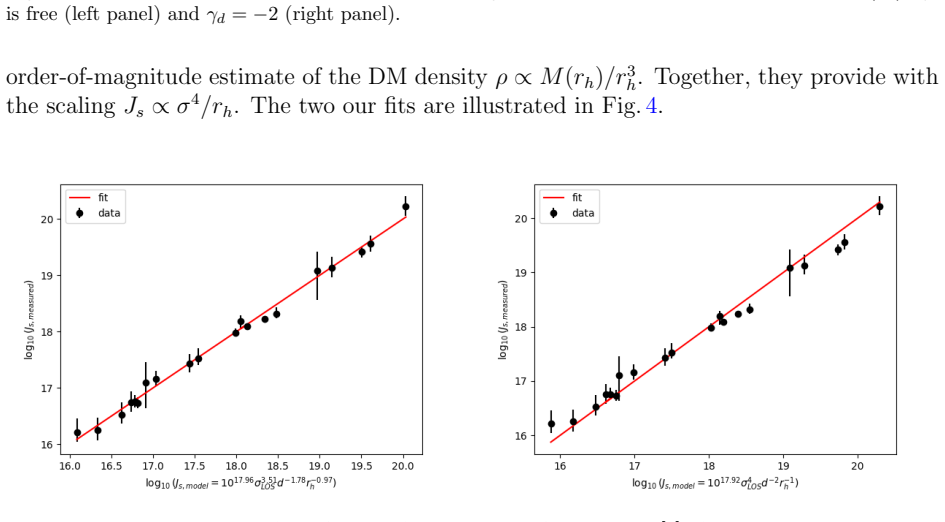
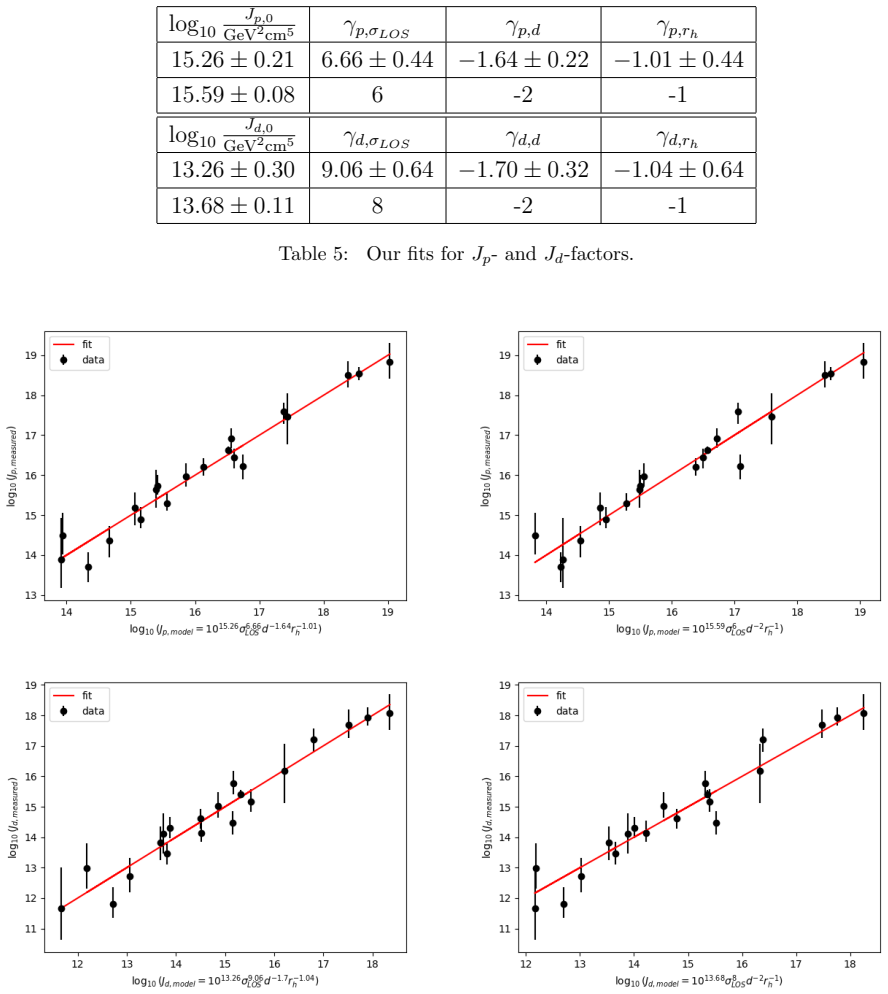
The central claim is that for a set of 20 dwarf spheroidal galaxies, the phase-space distribution of dark matter reconstructed from stellar kinematics determines the decay D-factor and annihilation J_s-, J_p-, J_d-factors, and that these integrals are captured by empirical scaling relations. When the angular integration is matched to the galaxy half-light radius, the exponents follow the dimensional pattern M(r_h) ∝ σ² r_h and ρ ∝ σ²/r_h², giving log10 D = 16.63 ± 0.01 (σ/5 km/s)² (d/100 kpc)⁻² (r_h/100 pc), log10 J_s = 17.92 ± 0.04 (σ/5 km/s)⁴ (d/100 kpc)⁻² (r_h/100 pc)⁻¹, with analogous expressions J_p = 15.59 ± 0.08 and J_d = 13.68 ± 0.11 with σ powers 6 and 8. The paper also shows that t
Load-bearing premise
The dark matter velocity distribution is assumed to be Maxwellian with an anisotropy profile of fixed functional form; this velocity distribution is not directly observable, and the derived J_p and J_d factors depend on it.
Editorial extensions
If this is right
- Any dwarf galaxy with measured distance, half-light radius, and line-of-sight velocity dispersion can be assigned D, J_s, J_p, J_d factors through the scaling relations, without redoing the full dynamical analysis.
- Bounds on dark matter decay and annihilation from gamma-ray, neutrino, and cosmic-ray observations of dwarf galaxies can be recast using these updated factors; for decay and s-wave annihilation the change relative to previous scaling fits is within 1–2σ.
- The first scaling relations for p-wave and d-wave annihilation factors make it possible to constrain models where s-wave annihilation is helicity- or symmetry-suppressed.
- For the majority of the 20 galaxies, ignorance of dark matter velocity anisotropy does not dramatically alter J_p and J_d; the main exceptions are Sextans, NGC 6822, Carina, and Fornax, where the choice of anisotropy changes individual factors by a factor 2.5–3.
Reading between the lines
- An untested extension is applying the same scaling relations to ultra-faint dwarfs or dwarf irregulars with sparse data; the functional form may hold, but the fitted normalizations could shift for systems outside the original sample.
- The anisotropy dependence of J_p and J_d suggests a way to break the degeneracy: combining stellar proper-motion measurements with realistic simulations of dark matter velocity distributions could replace the flat priors on β∞, r0, n with physically motivated distributions.
- Because the scaling relations use only observables, they could be used as a fast Monte Carlo prior in joint analyses of many dwarf galaxies, turning the D/J factors into analytic functions of data with propagated uncertainties.
Editorial analysis
A structured set of objections, weighed in public.
Referee Report
Summary. The paper computes the astrophysical D-factor (decay) and Js-, Jp-, Jd-factors (s-, p-, d-wave annihilation) for 20 dwarf spheroidal galaxies using the DM density profiles, velocity dispersions, and velocity-anisotropy parameters obtained in the companion paper by the same authors (Ref. [1]) from GravSphere Jeans fits. The new elements are the velocity-dependent Jp and Jd factors, which include a possible anisotropy in DM velocities, and empirical power-law scaling relations in line-of-sight stellar velocity dispersion, distance, and half-light radius. The authors compare their D and Js results with Pace & Strigari, report agreement within 1--2 sigma, and propose fixed-exponent scalings D ~ sigma^2 d^-2 rh, Js ~ sigma^4 d^-2 rh^-1, Jp ~ sigma^6 d^-2 rh^-1, and Jd ~ sigma^8 d^-2 rh^-1.
Significance. If the results hold, the paper offers a practical way to estimate indirect-detection geometrical factors for dwarf spheroidals without rerunning full Jeans fits, and it is one of the first systematic treatments of p- and d-wave J-factors with anisotropic DM velocities. The line-of-sight integral reduction in Eqs. (7)--(9) is clean and the explicit tables and reproducibility link to the input profiles are strengths. The central limitation is that Jd depends on the assumed Maxwellian form of the DM velocity distribution, and the robustness checks in the paper only vary the DM velocity anisotropy, not the distributional shape. The paper is therefore a useful step, but the Jd scaling relation should be presented as conditional on the Maxwellian closure unless the shape sensitivity is quantified.
major comments (3)
- [Section 3, Eq. (9); Section 5, Table 2] The derivation of Jd assumes the DM velocity distribution is exactly Maxwellian, as in Eq. (1). For fixed density and anisotropy, the d-wave integral depends on the fourth velocity moment: <vrel^4> = 2<v^4> + 4Σσ_i^4 + 2<v^2>^2, so a non-Maxwellian DF with the same ρ(r) and β(r) can change Jd. The robustness check in Table 2 varies only βDM (isotropic, prior, stellar-like), not the functional form of f(v,r). Since N-body halos generally have non-Gaussian velocity distributions, the quoted errors on Jd do not include the dominant shape uncertainty. Please quantify this by repeating the Jd calculation with a family of non-Maxwellian velocity distributions matched to the same ρ, β, σ_r (e.g., a q-Gaussian or a two-component Gaussian with modified kurtosis) and report the spread relative to Table 2. This is essential because the headline Jd ∝ sigma^8 scaling in Table 5 is obtained from the G
- [Section 2, Eq. (2); Table 2] The quoted 1σ error bars for Jp and Jd are Monte Carlo spreads under the fixed flat priors β∞∈[0,0.56], r0∈[0,3.10] kpc, n∈[0.73,1.36], β0=0. These priors are not derived from data. The alternative-anisotropy check in Table 2 is limited to two scenarios, and for four galaxies (Sextans, NGC 6822, Carina, Fornax) the βDM=β* choice changes Jp/Jd by factors of 2.5--3. The conclusion that the effect is 'well within 1σ' is therefore a statement about the chosen conditional errors, not a bound on the systematic uncertainty in the DM velocity anisotropy. The abstract and conclusions should explicitly state that all Jp/Jd results are conditional on the adopted anisotropy priors and Maxwellian shape, or the analysis should explore a wider prior set.
- [Section 4, Tables 3--5] The paper does not report any goodness-of-fit statistic or residual scatter for the scaling relations. For the fixed 0.5° aperture, the free-exponent fits are not fully consistent with the fixed 'geometrical' exponents: Table 3 gives γ_rh = 0.08±0.27 for D versus the expected 1, and Table 5 gives γ_σLOS = 6.66±0.44 for Jp versus 6 and γ_σLOS = 9.06±0.64 for Jd versus 8. The normalization-only, fixed-exponent fits may therefore have substantial intrinsic scatter. The claim that the fixed-exponent relations 'describe' the computed factors requires a reported RMS scatter in log10(factor) or a chi-square/dof for each fit. Without this, the empirical approximation quality cannot be judged, especially for Jp and Jd.
minor comments (5)
- [Section 4, text near Fig. 3] The sentence 'the error bars in the J-factors become smaller' appears in the paragraph discussing the D-factor fits in Table 3; it should likely read 'D-factors'.
- [Abstract] Typo: 'it's half-radius' should be 'its half-radius'.
- [Eq. (10) paragraph] Typo: 'power-low form' should be 'power-law form'.
- [Section 4, θmax definition] When stating θmax = αc/2 ≈ rh/d, note that rh/d is in radians; the text omits the conversion to degrees. Please specify the angular units explicitly.
- [Section 1, line-of-sight integration range] The definition l± = d cosθ ± sqrt((250 kpc)^2 - (d sinθ)^2) assumes a spherical integration boundary of 250 kpc. This is fine, but it would help to state explicitly that the profile is truncated at 250 kpc consistently with GravSphere.
Circularity Check
No significant circularity: the D/J factors are computed by direct integrals from externally fitted profiles, and the scaling relations are explicit empirical fits, not disguised predictions.
full rationale
The derivation chain is transparent and does not reduce to its inputs by construction. The paper takes DM density profiles, velocity dispersions, and anisotropy parameters from the companion paper Ref. [1] (same authors) as inputs, but these are produced by the publicly available GravSphere code from stellar observations and are externally falsifiable. The D-, Js-, Jp-, and Jd-factors are then computed from the defining integrals (3)-(6), with the velocity integrals evaluated analytically under the stated Maxwellian assumption, yielding Eqs. (8)-(9). The scaling relations are explicitly introduced as "empirical scaling approximations" and are fitted to the computed factors (Tabs. 3-5); the fixed-exponent variants are motivated by dimensional/Newtonian arguments (M(rh) proportional to sigma^2 rh), not by circularly assuming the target quantity. The comparison to Pace & Strigari (Ref. [2]) is an external benchmark, and the D/Js central values agree within 1-2 sigma, providing independent support. The paper does not invoke a uniqueness theorem from the authors' prior work, and the Maxwellian velocity-distribution ansatz is openly attributed to Ref. [1] rather than smuggled in as an established result. Section 5 explicitly acknowledges the unmeasurable DM velocity anisotropy and tests alternative assumptions (beta=0, beta=beta*), which are model variations rather than circular reductions. No equation is equivalent to another by construction, and no fitted parameter is renamed as a prediction. Hence no circularity is present; the main caveats are model assumptions, not circular logic.
Assumptions & free parameters
free parameters (6)
- DM velocity anisotropy priors (beta_inf, r0, n) =
beta_inf in [0, 0.56], r0 in [0, 3.10] kpc, n in [0.73, 1.36], beta0 = 0
- Fitting parameters of D-factor scaling (log10 D0, gamma_sigmaLOS, gamma_d, gamma_rh) =
17.70 +/- 0.12, 2.33 +/- 0.27, -1.17 +/- 0.13, 0.08 +/- 0.27
- Fitting parameters of Js-factor scaling (log10 J0, gamma_sigmaLOS, gamma_d, gamma_rh) =
17.96 +/- 0.07, 3.51 +/- 0.15, -1.78 +/- 0.08, -0.97 +/- 0.15
- Fitting parameters of Jp-factor scaling =
log10 Jp0 = 15.26 +/- 0.21, gamma_p_sigmaLOS = 6.66 +/- 0.44, gamma_p_d = -1.64 +/- 0.22, gamma_p_rh = -1.01 +/- 0.44
- Fitting parameters of Jd-factor scaling =
log10 Jd0 = 13.26 +/- 0.30, gamma_d_sigmaLOS = 9.06 +/- 0.64, gamma_d_d = -1.70 +/- 0.32, gamma_d_rh = -1.04 +/- 0.64
- Integration maximal angle for scaling fits (theta_max = alpha_c/2 ~ rh/d) =
alpha_c/2
assumptions (5)
- domain assumption Spherical symmetry of the DM halo and Jeans equation for DM particles
- domain assumption Maxwellian velocity distribution for DM, Eq. (1)
- ad hoc to paper Anisotropy profile form, Eq. (2)
- domain assumption DM halo extends to 250 kpc and factors saturate well inside this radius
- domain assumption Solid angle integration over 0.5 deg (or theta_max = alpha_c/2)
Cite this review
Pith. "Pith review of Decays and annihilation of galactic dark matter: determine $D$-, $J_s$-, $J_p$- and $J_d$-factors with dark matter profiles inferred from GravSphere fit to stellar observations." pith.science (2026). https://pith.science/paper/UWQDJ5ET
@misc{pith2026250909012,
  author       = {Pith},
  title        = {Pith review of: Decays and annihilation of galactic dark matter: determine $D$-, $J_s$-, $J_p$- and $J_d$-factors with dark matter profiles inferred from GravSphere fit to stellar observations},
  year         = {2026},
  howpublished = {\url{https://pith.science/paper/UWQDJ5ET}},
  note         = {Machine review of arXiv:2509.09012}
}
abstract
Dark matter mass density profiles and velocity distributions for a set of dwarf spheroidal galaxies (dSphs) have recently been obtained (F.Bezrukov, D.Gorbunov, E.Koreshkova arXiv:2412.20585) by performing a multi-parametric fit to the stellar observations with the help of the GravSphere which solves the Jeans equation. We use these results to calculate the geometrical factors for estimation of the fluxes of cosmic rays expected from decay ($D$-factor) and annihilation ($J_s$-, $J_p$- and $J_d$-factors for $s$-, $p$- and $d$- wave processes) of dark matter particles in galaxies. The general novelty is the account for a possible anisotropy in velocities of dark matter particles. On the basis of this analysis we present empirical scaling approximations to these factors as functions of typical observables: distance to the galaxy $d$, it's half-radius $r_h$ and line-of-sight stellar velocity dispersion $\sigma_{LOS}$. They can be applied to any galaxy, and for $D$- and $J_s$-factors we refine the estimates of (Andrew B. Pace, Louis E. Strigari arXiv:1802.06811): the shifts in the central values remain within 1-2$\sigma$ error bars.
Figures


Figures from the paper (2 more)
Reference graph
Works this paper leans on
-
[1]
F. Bezrukov, D. Gorbunov, and E. Koreshkova, “Refining lower bounds on sterile neutrino dark matter mass from estimates of phase space densities in dwarf galaxies,” arXiv:2412.20585 [hep-ph]
-
[2]
Scaling Relations for Dark Matter Annihilation and Decay Profiles in Dwarf Spheroidal Galaxies,
A. B. Pace and L. E. Strigari, “Scaling Relations for Dark Matter Annihilation and Decay Profiles in Dwarf Spheroidal Galaxies,” Mon. Not. Roy. Astron. Soc.482 no. 3, (2019) 3480–3496, arXiv:1802.06811 [astro-ph.GA]
arXiv 2019
-
[3]
R. A. Krivonos, V. V. Barinov, A. A. Mukhin, and D. S. Gorbunov, “Strong Limits on keV-Scale Galactic Sterile Neutrino Dark Matter with Stray Light from NuSTAR after 11 Years of Operation,” Phys. Rev. Lett.133 no. 26, (2024) 261002, arXiv:2405.17861 [hep-ph]
arXiv 2024
-
[4]
Heavy decaying dark matter and IceCube high energy neutrinos,
M. Kachelriess, O. E. Kalashev, and M. Y. Kuznetsov, “Heavy decaying dark matter and IceCube high energy neutrinos,” Phys. Rev. D98 no. 8, (2018) 083016, arXiv:1805.04500 [astro-ph.HE]
arXiv 2018
-
[5]
Constraining heavy dark matter with cosmic-ray antiprotons,
A. Cuoco, J. Heisig, M. Korsmeier, and M. Kr¨ amer, “Constraining heavy dark matter with cosmic-ray antiprotons,” JCAP 04 (2018) 004, arXiv:1711.05274 [hep-ph]
arXiv 2018
-
[6]
Indirect Searches for Decaying Dark Matter,
A. Ibarra, D. Tran, and C. Weniger, “Indirect Searches for Decaying Dark Matter,” Int. J. Mod. Phys. A 28 (2013) 1330040, arXiv:1307.6434 [hep-ph]
arXiv 2013
-
[7]
A review of indirect searches for particle dark matter,
J. M. Gaskins, “A review of indirect searches for particle dark matter,” Contemp. Phys. 57 no. 4, (2016) 496–525, arXiv:1604.00014 [astro-ph.HE]
arXiv 2016
-
[8]
Status, Challenges and Directions in Indirect Dark Matter Searches,
C. P´ erez de los Heros, “Status, Challenges and Directions in Indirect Dark Matter Searches,” Symmetry 12 no. 10, (2020) 1648, arXiv:2008.11561 [astro-ph.HE]
arXiv 2020
Show all 19 references
-
[9]
How to break the density-anisotropy degeneracy in spherical stellar systems,
J. I. Read and P. Steger, “How to break the density-anisotropy degeneracy in spherical stellar systems,” Mon. Not. Roy. Astron. Soc.471 no. 4, (2017) 4541–4558, arXiv:1701.04833 [astro-ph]
2017 arXiv
-
[10]
The case for a cold dark matter cusp in draco,
J. I. Read, M. G. Walker, and P. Steger, “The case for a cold dark matter cusp in draco,” Mon. Not. Roy. Astron. Soc.481 no. 1, (2018) 860–877, arXiv:1805.06934 [astro-ph.GA]
2018 arXiv
-
[11]
Andromeda xxi – a dwarf galaxy in a low-density dark matter halo,
M. L. M. Collins et al., “Andromeda xxi – a dwarf galaxy in a low-density dark matter halo,” Mon. Not. Roy. Astron. Soc.505 no. 4, (2021) 5686–5701, arXiv:2102.11890 [astro-ph.GA]
2021 arXiv
-
[12]
https://github.com/koreshk/Estimation-of-phase-space-density-in-dwarf-galaxies
-
[13]
Constraining dark matter models from a combined analysis of milky way satellites with the fermi large area telescope,
M. Ackermann et al., “Constraining dark matter models from a combined analysis of milky way satellites with the fermi large area telescope,” Physical Review Letters107 no. 24, (Dec., 2011)
2011
-
[14]
Dwarf galaxy annihilation and decay emission profiles for dark matter experiments,
A. Geringer-Sameth, S. M. Koushiappas, and M. Walker, “Dwarf galaxy annihilation and decay emission profiles for dark matter experiments,” Astrophys. J. 801 no. 2, (2015) 74, arXiv:1408.0002 [astro-ph.CO]
2015 arXiv
-
[15]
Dark matter annihilation and decay from non-spherical dark halos in galactic dwarf satellites,
K. Hayashi, K. Ichikawa, S. Matsumoto, M. Ibe, M. N. Ishigaki, and H. Sugai, “Dark matter annihilation and decay from non-spherical dark halos in galactic dwarf satellites,” Mon. Not. Roy. Astron. Soc.461 no. 3, (2016) 2914–2928, arXiv:1603.08046 [astro-ph.GA]
2016 arXiv
-
[16]
Diversity of Dark Matter Density Profiles in the Galactic Dwarf Spheroidal Satellites,
K. Hayashi, M. Chiba, and T. Ishiyama, “Diversity of Dark Matter Density Profiles in the Galactic Dwarf Spheroidal Satellites,” Astrophys. J.904 no. 1, (2020) 45, arXiv:2007.13780 [astro-ph.GA]
2020 arXiv
-
[17]
The dark matter content of Milky Way dwarf spheroidal galaxies: Draco, Sextans and Ursa Minor,
H. Yang et al., “The dark matter content of Milky Way dwarf spheroidal galaxies: Draco, Sextans and Ursa Minor,” arXiv:2507.02284 [astro-ph.GA]
-
[18]
Leo I: the classical dwarf spheroidal galaxy with the highest dark-matter density,
R. Pascale, C. Nipoti, F. Calura, and A. Della Croce, “Leo I: the classical dwarf spheroidal galaxy with the highest dark-matter density,” arXiv:2506.13847 [astro-ph.GA]
-
[19]
Legacy analysis of dark matter annihilation from the Milky Way dwarf spheroidal galaxies with 14 years of Fermi-LAT data,
A. McDaniel, M. Ajello, C. M. Karwin, M. Di Mauro, A. Drlica-Wagner, and M. A. S´ anchez-Conde, “Legacy analysis of dark matter annihilation from the Milky Way dwarf spheroidal galaxies with 14 years of Fermi-LAT data,” Phys. Rev. D109 no. 6, (2024) 063024, arXiv:2311.04982 [a...
2024 arXiv
Reviewed August 4, 2026 · model on record in the stance chip above.
Discussion (0). Sign in to comment.