REVIEW 4 major objections 5 minor 1 cited by
Unraveling the emission mechanism powering long period radio transients from interacting white dwarf binaries via kinetic plasma simulations
T0 review · 4 major / 5 minor · reviewed 2026-08-04 · deepseek-v4-flash
Pith's one-line read Kinetic plasma simulations show the cyclotron maser instability can efficiently produce the radio pulses observed from white dwarf–M dwarf binaries.
desk verdict First nonlinear kinetic test of ECMI for WD–MD ULPTs: mechanism viability holds, but the polarization match with the observed sources rests on pair-plasma symmetry that remains untested for real electron–ion plasmas. read the letter →
The pith
A machine-rendered reading of the paper's core claim, the machinery that carries it, and where it could break.
The reading
What carries the argument
The central mechanism is the electron cyclotron maser instability (ECMI): resonant amplification of electromagnetic waves near the electron cyclotron frequency by mildly relativistic electrons whose pitch-angle distribution has a loss-cone anisotropy. The paper models this with two-dimensional kinetic particle-in-cell simulations that initialize and continuously reinject a Dory–Guest–Harris loss-cone distribution along a uniform magnetic field, letting the maser evolve through linear and nonlinear growth to saturation. The efficiency, spectral width, and Stokes parameters of the saturated radiation are the quantities that connect the simulation to the observed pulses; the orbital-motion-driv
What would settle it
Run the same ECMI simulation with a realistic electron-ion mass ratio (mi/me = 1836) and an electron-proton Dory–Guest–Harris injection. If the saturated radiation becomes predominantly circular (|S3|/S0 ≳ 0.5) rather than the Π ≈ 0.6–0.8 reported here, the claim of consistency with the linearly polarized long-period radio transients is falsified, even though the energy conversion efficiency might remain at the same level.
Extended reading notes
Core claim
The central claim is that the electron cyclotron maser instability (ECMI) is a viable radio-emission mechanism for interacting white dwarf–M dwarf binaries, in the mildly relativistic regime relevant to these systems. Using two-dimensional particle-in-cell simulations that sustain a loss-cone anisotropy by continuous particle reinjection, the authors show that the instability saturates by converting roughly 10^-3 to 10^-2 of the background magnetic energy into coherent radiation, peaks at the fundamental electron cyclotron frequency, and has a narrow bandwidth Δω ≈ 0.2ωg. The simulated radiation is predominantly linearly polarized (Π ≈ 0.6–0.8, circular component C ≈ 0.2), which the authors
Load-bearing premise
The polarization comparison rests on the electron-positron symmetry of the simulated plasma; in a real white-dwarf magnetosphere, where no pair-production mechanism is identified at these field strengths, the circular components may not cancel and the claimed match to the observed linear polarization could fail.
Editorial extensions
If this is right
- A conversion efficiency of 10^-3 to 10^-2 is enough for the unipolar-inductor model to account for the radio luminosity of systems like ILTJ1101+5521 with a white-dwarf magnetic moment consistent with the observed emission frequency.
- ECMI-driven emission is intrinsically narrow (Δω ≈ 0.2ωg) and peaked at the fundamental cyclotron frequency, matching the narrowband pulses of long-period radio transients.
- The maser can produce substantially linear polarization (Π ≈ 0.6–0.8) in the pair-plasma limit, consistent with the observed polarization of both sources, provided this polarization survives at realistic electron-ion mass ratios.
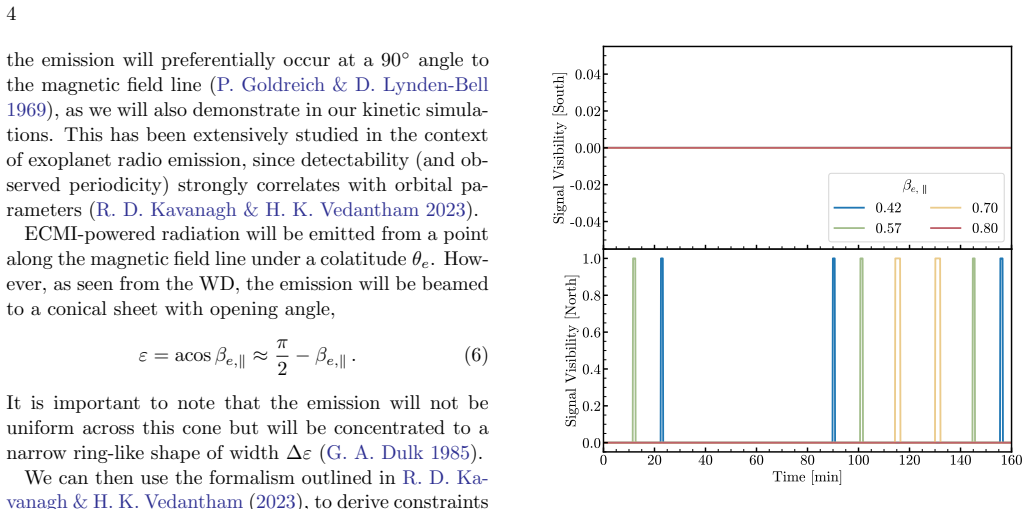
- The emission geometry produces minute-long pulses with hour-long periods for mildly relativistic bulk velocities (γ ≲ 1.6), explaining the observed duty cycle without needing a spin-powered lighthouse.
Reading between the lines
- The pair-plasma symmetry that yields linear polarization is untested at realistic electron-ion mass ratios; a simulation with mi/me = 1836 could show predominantly circular emission, which would invalidate the claimed polarization match even if the efficiency result stands.
- The paper does not identify a mechanism that would populate a white-dwarf magnetosphere with electron-positron pairs at B* ≈ 10^6–10^8 G, far below the pair-creation threshold; if such pairs are absent, the linear-polarization result would not transfer directly to these systems.
- A future measurement of strong circular polarization (|C| ≳ 0.5) from a WD–MD transient would discriminate against the pair-plasma ECMI and favour an electron-ion plasma or a different emission mechanism.
- The same driven-ECMI framework could be applied to other interacting white-dwarf binaries and exoplanet systems, using the measured 10^-3 to 10^-2 efficiency as a calibration for the magnetic field and orbital parameters needed to produce detectable radio emission.
Editorial analysis
A structured set of objections, weighed in public.
Referee Report
Summary. The paper proposes that the long-period radio transients from white dwarf–M dwarf binaries (e.g., ILTJ1101+5521 and GLEAM-X J0704-37) are produced by the relativistic electron cyclotron maser instability (ECMI), driven by a unipolar-inductor interaction between the binary components. After deriving constraints on the WD magnetic moment, emission location, and plasma magnetization, the authors run 2D particle-in-cell simulations in a pair plasma with a continuously injected Dory–Guest–Harris loss-cone distribution. They report X-mode dominance, saturated efficiencies ξ ≈ 10^-3–10^-2, spectral peaking near the cyclotron frequency with bandwidth Δω ≈ 0.2ωg, and strong linear polarization (Π ≈ 0.6–0.8, C ≈ 0.2), which they claim is consistent with the observed polarization of the two sources. The paper concludes that the ECMI can efficiently operate in the WD-MD context and explain the observed radio emission properties.
Significance. If the central claim holds, this would provide the first quantitative kinetic-plasma support for ECMI as the emission mechanism in the newly discovered class of ultra-long-period radio transients, analogous to planetary radio emission. The paper's strengths are its concrete parameter estimates from the unipolar-inductor model, the first nonlinear PIC study of ECMI in this astrophysical regime, and the explicit calculation of saturation efficiency and polarization. The simulations appear credible and are presented with enough detail to be reproduced. However, the observational comparison rests on a pair-plasma assumption that is not justified for WD magnetospheres, and there are internal inconsistencies in the spectral analysis and in the use of the efficiency parameter in the luminosity argument. These issues are load-bearing rather than cosmetic.
major comments (4)
- [Section 4.1 and Section 5] The comparison of simulated polarization (Π≈0.6–0.8, C≈0.2) with observations is made for a pair plasma (mi/me=1, Section 3). The paper itself states that the strong linear polarization results from electron–positron symmetry in the cancellation of circular components, and that 'the details of the polarization will change with varying electron-ion mass ratio.' For WD magnetospheres with B*~10^6–10^8 G, no pair-production mechanism is identified, so the physical plasma is electron-ion. The planetary ECMI literature cited in the paper predominantly gives circular polarization. Thus the claimed agreement with the strongly linearly polarized observed pulses is not established. This is load-bearing because the polarization match is a central part of the claim to explain observed emission properties. Electron-ion simulations (mi/me≫1) or a quantitative argument for why the pair result carries
- [Section 2, Eq. (2) vs. Section 4, Eq. (19)] The luminosity check sets L_radio = ξ ˙E_diss, calling ξ the 'radio emission conversion efficiency.' The simulation defines ξ = ∫(δB^2+δE^2)/∫B0^2, i.e., wave energy normalized by the background magnetic energy. These are different quantities. The simulations do not measure the fraction of the dissipated orbital power that is converted into radiation; they measure a steady-state energy ratio in a driven box. Using the simulated ξ in Eq. (2) requires an additional, unstated assumption connecting B0^2 energy to ˙E_diss. Without this mapping (or a diagnostic of injected-power-to-radiation efficiency), the luminosity consistency claim is not directly supported by the simulations.
- [Section 4, Fig. 4] The text states that the authors compute the Fourier transform of ξ(t) and that 'the spectra peak at ω = ωg,' interpreting this as fundamental ECMI emission. However, ξ is quadratic in the field amplitude; for a monochromatic field at ωg, the Fourier transform of ξ(t) peaks at 2ωg. The figure caption itself acknowledges this: 'a component at ωg in the field spectrum appears at ω = 2ωg in ξ.' The text and caption are therefore internally inconsistent. The claimed peak at ωg and bandwidth Δω≈0.2ωg do not follow from the plotted quantity. The field power spectrum (e.g., Fourier transform of E_y(t) and E_z(t)) should be shown to support the spectral characterization, which is also used to infer the magnetic field via Eq. (5).
- [Section 2, Eqs. (2) and (5)] The luminosity consistency for ILTJ1101+5521 requires μ near the upper bound μ≲10^34 G cm^3 from Eq. (5), ξ near 10^-2, and ζ_φ(ΔΩ/Ω) near unity. The text does not discuss this near-maximal parameter combination. Since ζ_φ < 1 is required to avoid flux-tube expansion (Section 2), the combination may be in tension. A quantitative statement about the allowed parameter space for the observed sources (including distance uncertainties and orbital period) is needed to support the conclusion that the observed luminosity is naturally explained without fine-tuning.
minor comments (5)
- [Section 3] The boundary treatment is underspecified: the simulations use periodic boundary conditions, but particles are re-sampled near the left boundary to maintain the anisotropy. Clarify how the injection is implemented and whether it creates a discontinuity with the periodic right boundary.
- [Section 4.1] The use of the Hilbert transform to define the time-averaged Stokes parameters should specify the averaging window and whether the results are stationary in time; the maps in Fig. 5 vary in space, so a description of how the volume-averaged values are obtained would help.
- [Eq. (15)] The notation for the Dory–Guest–Harris distribution is ambiguous: it appears as p⊥^2(α) exp(...). State explicitly the functional form of the loss-cone pitch-angle factor.
- [Section 4, Fig. 4 caption] The caption's explanation that the ξ spectrum has a peak at 2ωg for a field component at ωg contradicts the main text's claim of a peak at ωg; this should be corrected as part of the spectral analysis.
- [Abstract / Conclusion] The statement that the ECMI 'can explain the observed radio emission properties' is stronger than what the current pair-plasma simulations support, given the acknowledged mass-ratio dependence; consider softening the wording to 'can be consistent with' under the pair-plasma approximation.
Circularity Check
No circularity: simulation outputs are computed from specified PIC inputs; observed values are not used as inputs, and the acknowledged pair-plasma limitation is an external-validity gap, not a circular reduction.
full rationale
The derivation is self-contained. The PIC simulation (Section 3) is initialized from the Dory-Guest-Harris distribution (Eq. 15) with explicitly listed parameters (Table 1); the efficiency ξ (Eq. 19), growth rate Γlin (Eq. 20), frequency spectrum (Fig. 4), and Stokes parameters (Eqs. 21–27) are all computed outputs. Observed luminosities and polarization fractions are compared after the fact (Section 4.1), not fed into any fit. The luminosity estimate in Section 2 is an order-of-magnitude consistency bound based on the unipolar-inductor model, not a parameter fit to the simulation. The paper explicitly flags the main limitation: Section 4.1 states "the details of the polarization will change with varying electron-ion mass ratio," and Section 5 states "In order to be fully predictive especially in terms of the radio polarization, several steps are necessary." These are external-validity caveats, not circular steps. The self-citations to Most & Philippov (2020, 2022, 2023a, 2023b) for flux-tube flaring and for excluding a synchrotron-maser route in WD contexts are used as motivation/bounds; the central claim of ECMI viability rests on the kinetic simulations themselves, so those citations are not load-bearing. The selection of favorable astrophysical values (µ, ξ, ζφ) is a parameter-choice/robustness concern, not a definitional tautology. No equation is shown to reduce by construction to its own input, and no fitted quantity is renamed as a prediction.
Assumptions & free parameters
free parameters (4)
- Electron thermal temperature Tth =
Fiducial 52 keV; 12 to 341 keV scanned
- Pitch-angle cutoff αc (loss-cone anisotropy) =
Fiducial 0.5 rad; 0.1, 0.5, 0.9 scanned
- Plasma magnetization σ0 = B0²/(4π n0 me c²) =
8
- Magnetic moment μ and conversion efficiency ξ in the luminosity consistency check =
μ ≈ 10^34 G cm³, ξ ≈ 10^-2, ζφ(ΔΩ/Ω) ≈ 1
assumptions (5)
- domain assumption The electron distribution in the flux tube is a Dory-Guest-Harris loss cone (Eq. 15), sustained by continuous particle injection.
- ad hoc to paper The plasma is electron-positron (mi/me = 1, Sec. 3 Methods).
- domain assumption The unipolar inductor circuit model applies: the WD dipole field threads the M dwarf and dissipates orbital energy with ζφ < 1 (Eq. 1, after Goldreich and Lynden-Bell 1969; Lai 2012; Willes and Wu 2004).
- domain assumption Resistance is dominated by Spitzer conductivity of the WD atmosphere in an arc-like dissipation region (Eqs. 7 to 9, Willes and Wu 2004).
- domain assumption A uniform background field in a 2D periodic box captures the ECMI adequately for the claims made.
Cite this review
Pith. "Pith review of Unraveling the emission mechanism powering long period radio transients from interacting white dwarf binaries via kinetic plasma simulations." pith.science (2026). https://pith.science/paper/ZAGD6NPO
@misc{pith2026250909057,
  author       = {Pith},
  title        = {Pith review of: Unraveling the emission mechanism powering long period radio transients from interacting white dwarf binaries via kinetic plasma simulations},
  year         = {2026},
  howpublished = {\url{https://pith.science/paper/ZAGD6NPO}},
  note         = {Machine review of arXiv:2509.09057}
}
read the original abstract
Recent observations of long period radio transients, such as GLEAM-X J0704-37 and ILTJ1101 + 5521, have revealed a previously unrecognized population of galactic radio transient sources associated with white dwarf - M dwarf binaries. It is an open question how to produce coherent radio emission in these systems, though a model driven by binary interaction seems likely given the nature and correlation of the emission with the binaries' orbital period. Using kinetic plasma simulations, we demonstrate that the relativistic electron cyclotron maser instability (ECMI) is a viable mechanism for generating radio pulses in white dwarf - M dwarf systems, akin to planetary radio emission, such as that from the Jupiter-Io system. We quantify the relativistic ECMI in the nonlinear regime under conditions relevant for white dwarf radio emission for the first time. Our simulations demonstrate that the ECMI can intrinsically produce partially linearly polarized emission relevant to explaining the observed emission spectrum of the two galactic sources, though the precise details will depend on the plasma composition. Our work paves the way for a systematic and fully nonlinear computational modeling of radio emission from interacting white dwarf sources.
Figures


Figures from the paper (2 more)


Forward citations
Cited by 1 Pith paper
-
Pulsar electrodynamics inferred from frequency-dependent circular polarization diversity
Wave mode coupling reproduces diverse frequency evolutions of circular polarization in pulsar single pulses, constraining multiplicity to 1-100 and Lorentz factor to 3-100, though the model fails to quantitatively fit...
Reference graph
Works this paper leans on
-
[1]
Babul, A.-N., & Sironi, L. 2020, Mon. Not. Roy. Astron. Soc., 499, 2884, doi: 10.1093/mnras/staa2612
- [2]
-
[3]
Beloborodov, A. M. 2020, Astrophys. J., 896, 142, doi: 10.3847/1538-4357/ab83eb
-
[4]
Beloborodov, A. M. 2025, https://arxiv.org/abs/2503.16054
arXiv 2025
-
[5]
Bigg, E. K. 1964, Nature, 203, 1008, doi: 10.1038/2031008a0
-
[6]
Bilbao, P., Silva, T., & Silva, L. O. 2025, Science Advances, 11, eadt8912, doi: 10.1126/sciadv.adt8912
-
[7]
Bilbao, P. J., & Silva, L. O. 2023, PhRvL, 130, 165101, doi: 10.1103/PhysRevLett.130.165101
-
[8]
K., & Langdon, A
Birdsall, C. K., & Langdon, A. B. 1991, Plasma Physics via Computer Simulation
1991
Show all 69 references
-
[9]
K., Bassa, C
Bloot, S., Vedantham, H. K., Bassa, C. G., et al. 2025, https://arxiv.org/abs/2507.05078
2025 arXiv
-
[10]
Buckley, D. A. H., Meintjes, P. J., Potter, S. B., Marsh, T. R., & G¨ ansicke, B. T. 2017, Nature Astronomy, 1, 0029, doi: 10.1038/s41550-016-0029
2017 doi
-
[11]
R., et al
Callingham, J. R., et al. 2024, Nature Astron., 8, 1359, doi: 10.1038/s41550-024-02405-6
2024 doi
-
[12]
Chanmugam, G., & Dulk, G. A. 1982, ApJL, 255, L107, doi: 10.1086/183779
1982 doi
-
[13]
Chu, K. R. 2004, Rev. Mod. Phys., 76, 489, doi: 10.1103/RevModPhys.76.489
2004 doi
-
[14]
Connerney, J. E. P., Baron, R., Satoh, T., & Owen, T. 1993, Science, 262, 1035, doi: 10.1126/science.262.5136.1035 Dall’Osso, S., Israel, G. L., & Stella, L. 2006, Astron. Astrophys., 447, 785, doi: 10.1051/0004-6361:20052843 de Ruiter, I., et al. 2025, Nature Astron., 9, 672,...
1993
-
[15]
A., Shin, K., Law, C., et al
Dong, F. A., Shin, K., Law, C., et al. 2025, ApJL, 988, L29, doi: 10.3847/2041-8213/adeaab
2025 doi
-
[16]
A., Guest, G
Dory, R. A., Guest, G. E., & Harris, E. G. 1965, PhRvL, 14, 131, doi: 10.1103/PhysRevLett.14.131
1965 doi
-
[17]
Dulk, G. A. 1985, ARA&A, 23, 169, doi: 10.1146/annurev.aa.23.090185.001125
1985
-
[18]
Ferrario, L., de Martino, D., & G¨ ansicke, B. T. 2015, SSRv, 191, 111, doi: 10.1007/s11214-015-0152-0
2015 doi
-
[19]
1969, ApJ, 156, 59, doi: 10.1086/149947
Goldreich, P., & Lynden-Bell, D. 1969, ApJ, 156, 59, doi: 10.1086/149947
1969 doi
-
[20]
2024, scipy/scipy: SciPy 1.13.1, v1.13.1 Zenodo, doi: 10.5281/zenodo.11255513
Gommers, R., Virtanen, P., Haberland, M., et al. 2024, scipy/scipy: SciPy 1.13.1, v1.13.1 Zenodo, doi: 10.5281/zenodo.11255513
2024 doi
-
[21]
R., Millman, K
Harris, C. R., Millman, K. J., van der Walt, S. J., et al. 2020, Nature, 585, 357, doi: 10.1038/s41586-020-2649-2 12 Horv´ ath, C., Rea, N., Hurley-Walker, N., et al. 2025, https://arxiv.org/abs/2507.15352
2020
-
[22]
J., Bahramian, A., et al
Hurley-Walker, N., McSweeney, S. J., Bahramian, A., et al. 2024, ApJL, 976, L21, doi: 10.3847/2041-8213/ad890e
2024 doi
-
[23]
2017, ApJ, 840, 52, doi: 10.3847/1538-4357/aa6d6f
Iwamoto, M., Amano, T., Hoshino, M., & Matsumoto, Y. 2017, ApJ, 840, 52, doi: 10.3847/1538-4357/aa6d6f
2017 doi
-
[24]
2024, Phys
Hoshino, M. 2024, Phys. Rev. Lett., 132, 035201, doi: 10.1103/PhysRevLett.132.035201
2024 doi
-
[25]
D., & Vedantham, H
Kavanagh, R. D., & Vedantham, H. K. 2023, MNRAS, 524, 6267, doi: 10.1093/mnras/stad2035
2023 doi
-
[26]
Kuznetsov, A. A. 2011, A&A, 526, A161, doi: 10.1051/0004-6361/201015760
2011 doi
-
[27]
A., & Vlasov, V
Kuznetsov, A. A., & Vlasov, V. G. 2012, A&A, 539, A141, doi: 10.1051/0004-6361/201118716
2012 doi
-
[28]
2024, A&A, 681, A113, doi: 10.1051/0004-6361/202346600
Labaj, M., Ben´ aˇ cek, J., & Karlick´ y, M. 2024, A&A, 681, A113, doi: 10.1051/0004-6361/202346600
2024 doi
-
[29]
2012, Astrophys
Lai, D. 2012, Astrophys. J. Lett., 757, L3, doi: 10.1088/2041-8205/757/1/L3
2012 doi
-
[30]
H., Omura, Y., & Lee, L
Lee, K. H., Omura, Y., & Lee, L. C. 2011, Physics of Plasmas, 18, 092110, doi: 10.1063/1.3626562
2011 doi
-
[31]
2021, ApJL, 909, L5, doi: 10.3847/2041-8213/abe708
Li, C., Chen, Y., Ni, S., et al. 2021, ApJL, 909, L5, doi: 10.3847/2041-8213/abe708
2021 doi
-
[32]
Lysak, R. L. 2023, Reviews of Modern Plasma Physics, 7, 6, doi: 10.1007/s41614-022-00111-2
2023 doi
-
[33]
2006, ApJ, 652, 1297, doi: 10.1086/508606
Lyubarsky, Y. 2006, ApJ, 652, 1297, doi: 10.1086/508606
2006 doi
- [34]
-
[35]
2022, Astrophys
Spitkovsky, A., & Hakobyan, H. 2022, Astrophys. J. Lett., 932, L20, doi: 10.3847/2041-8213/ac7156
2022 doi
- [36]
-
[37]
B., Hewitt, R
Melrose, D. B., Hewitt, R. G., & Dulk, G. A. 1984, J. Geophys. Res., 89, 897, doi: 10.1029/JA089iA02p00897
1984 doi
-
[38]
D., Margalit, B., & Sironi, L
Metzger, B. D., Margalit, B., & Sironi, L. 2019, Mon. Not. Roy. Astron. Soc., 485, 4091, doi: 10.1093/mnras/stz700
2019 doi
-
[39]
2024, Journal of Geophysical Research (Planets), 129, e2023JE008130, doi: 10.1029/2023JE00813010.22541/essoar.168394732
Moirano, A., Mura, A., Hue, V., et al. 2024, Journal of Geophysical Research (Planets), 129, e2023JE008130, doi: 10.1029/2023JE00813010.22541/essoar.168394732. 26574509/v1
2024
-
[40]
R., & Philippov, A
Most, E. R., & Philippov, A. A. 2020, Astrophys. J. Lett., 893, L6, doi: 10.3847/2041-8213/ab8196
2020 doi
-
[41]
R., & Philippov, A
Most, E. R., & Philippov, A. A. 2022, Mon. Not. Roy. Astron. Soc., 515, 2710, doi: 10.1093/mnras/stac1909
2022 doi
-
[42]
R., & Philippov, A
Most, E. R., & Philippov, A. A. 2023a, Astrophys. J. Lett., 956, L33, doi: 10.3847/2041-8213/acfdae
-
[43]
R., & Philippov, A
Most, E. R., & Philippov, A. A. 2023b, Phys. Rev. Lett., 130, 245201, doi: 10.1103/PhysRevLett.130.245201
-
[44]
2020, ApJL, 891, L25, doi: 10.3847/2041-8213/ab7750
Ni, S., Chen, Y., Li, C., et al. 2020, ApJL, 891, L25, doi: 10.3847/2041-8213/ab7750
2020 doi
-
[45]
Piro, A. L. 2012, Astrophys. J., 755, 80, doi: 10.1088/0004-637X/755/1/80
2012 doi
-
[46]
2019, Mon
Plotnikov, I., & Sironi, L. 2019, Mon. Not. Roy. Astron. Soc., 485, 3816, doi: 10.1093/mnras/stz640
2019 doi
-
[47]
2025, Astrophys
Qu, Y., & Zhang, B. 2025, Astrophys. J., 981, 34, doi: 10.3847/1538-4357/adb1b5
2025 doi
-
[48]
Reid, H. A. S., & Ratcliffe, H. 2014, Research in Astronomy and Astrophysics, 14, 773, doi: 10.1088/1674-4527/14/7/003
2014 doi
-
[49]
Rodriguez, A. C. 2025, Astron. Astrophys., 695, L8, doi: 10.1051/0004-6361/202553684
2025 doi
-
[50]
2018, Journal of Geophysical Research (Space Physics), 123, 9560, doi: 10.1029/2018JA025948
Saur, J., Janser, S., Schreiner, A., et al. 2018, Journal of Geophysical Research (Space Physics), 123, 9560, doi: 10.1029/2018JA025948
2018 doi
-
[51]
R., Belloni, D., G¨ ansicke, B
Schreiber, M. R., Belloni, D., G¨ ansicke, B. T., Parsons, S. G., & Zorotovic, M. 2021, Nature Astronomy, 5, 648, doi: 10.1038/s41550-021-01346-8
2021 doi
-
[52]
Sironi, L., Plotnikov, I., N¨ attil¨ a, J., & Beloborodov, A. M. 2021, Phys. Rev. Lett., 127, 035101, doi: 10.1103/PhysRevLett.127.035101
2021 doi
-
[53]
2025, https://arxiv.org/abs/2503.19884
Skiathas, D., Kalapotharakos, C., Wadiasingh, Z., et al. 2025, https://arxiv.org/abs/2503.19884
2025
-
[54]
B., Haynes, R
Slee, O. B., Haynes, R. F., & Wright, A. E. 1984, MNRAS, 208, 865, doi: 10.1093/mnras/208.4.865
1984 doi
-
[55]
2024a, Phys
Sobacchi, E., Iwamoto, M., Sironi, L., & Piran, T. 2024a, Phys. Rev. Res., 6, 043213, doi: 10.1103/PhysRevResearch.6.043213
-
[56]
2024b, Astron
Sobacchi, E., Iwamoto, M., Sironi, L., & Piran, T. 2024b, Astron. Astrophys., 690, A332, doi: 10.1051/0004-6361/202451725
-
[57]
2005, in American Institute of Physics Conference Series, Vol
Spitkovsky, A. 2005, in American Institute of Physics Conference Series, Vol. 801, Astrophysical Sources of High Energy Particles and Radiation, ed. T. Bulik, B. Rudak, & G. Madejski, 345–350, doi: 10.1063/1.2141897
2005 doi
-
[58]
1953, Physical Review, 89, 977, doi: 10.1103/PhysRev.89.977
Spitzer, L., & H¨ arm, R. 1953, Physical Review, 89, 977, doi: 10.1103/PhysRev.89.977
1953 doi
-
[59]
H., Hospodarsky, G
Sulaiman, A. H., Hospodarsky, G. B., Elliott, S. S., et al. 2020, Geophys. Res. Lett., 47, e88432, doi: 10.1029/2020GL088432 The Matplotlib Development Team. 2024, Matplotlib: Visualization with Python, v3.9.2 Zenodo, doi: 10.5281/zenodo.13308876
2020 doi
-
[60]
Treumann, R. A. 2006, A&A Rv, 13, 229, doi: 10.1007/s00159-006-0001-y
2006 doi
-
[61]
Twiss, R. Q. 1958, Australian Journal of Physics, 11, 564, doi: 10.1071/PH580564 13
1958 doi
-
[62]
2025, Phys
Vanthieghem, A., & Levinson, A. 2025, Phys. Rev. Lett., 134, 035201, doi: 10.1103/PhysRevLett.134.035201
2025 doi
-
[63]
2025, Nature, 642, 583, doi: 10.1038/s41586-025-09077-w
Wang, Z., Rea, N., Bao, T., et al. 2025, Nature, 642, 583, doi: 10.1038/s41586-025-09077-w
2025 doi
-
[64]
Warwick, J. W. 1964, Annual Review of Astronomy and Astrophysics, vol. 2, p. 1, 2, 1
1964
-
[65]
J., & Wu, K
Willes, A. J., & Wu, K. 2004, Mon. Not. Roy. Astron. Soc., 348, 285, doi: 10.1111/j.1365-2966.2004.07363.x
2004
- [66]
- [67]
-
[68]
2002, MNRAS, 331, 221, doi: 10.1046/j.1365-8711.2002.05190.x
Wu, K., Cropper, M., Ramsay, G., & Sekiguchi, K. 2002, MNRAS, 331, 221, doi: 10.1046/j.1365-8711.2002.05190.x
2002
-
[69]
F., & Hakobyan, H
Zhong, Y., Spitkovsky, A., Mahlmann, J. F., & Hakobyan, H. 2024, Astrophys. J., 973, 147, doi: 10.3847/1538-4357/ad6840
2024 doi
Reviewed August 4, 2026 · model on record in the stance chip above.
Discussion (0). Sign in to comment.