REVIEW 3 major objections 5 minor 1 cited by
Multiwavelength observations of a new black-widow millisecond pulsar PSR J1544-2555
T0 review · 3 major / 5 minor · reviewed 2026-08-04 · deepseek-v4-flash
Pith's one-line read This paper establishes that the gamma-ray source 4FGL J1544.2−2554 is a new black-widow millisecond pulsar, PSR J1544−2555, a 2.39-ms radio pulsar in a 2.7-hour orbit with a low-mass, strongly heated companion.
desk verdict A genuinely new, securely confirmed black-widow MSP with a solid timing package; the spot-model interpretation is the main conditional and should be flagged, but the discovery itself is not in doubt. read the letter →
The pith
A machine-rendered reading of the paper's core claim, the machinery that carries it, and where it could break.
The reading
What carries the argument
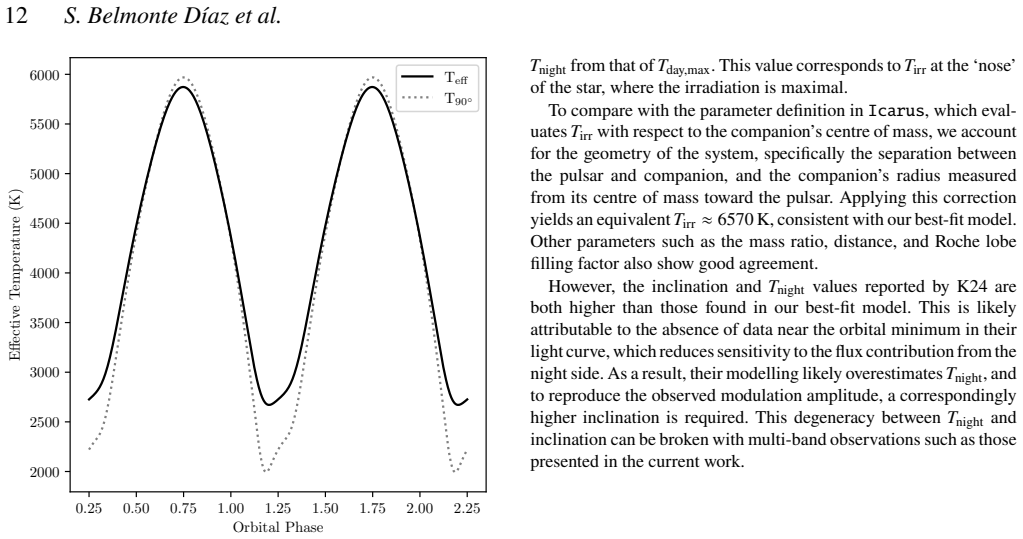
The argument is carried by a joint radio and gamma-ray timing solution that spans 16 years, where orbital period variations are modeled as a Gaussian process with a Matérn covariance function, plus a binary light-curve synthesis model that treats the companion as a tidally locked, irradiated star with an optional localized Gaussian hot spot. The timing solution fixes the spin, orbital, and astrometric parameters, while the light-curve model converts the observed optical modulation into inclination, companion mass, temperatures, and distance. The spot model is the key new element that captures the light-curve asymmetry and shifts the inferred inclination from about 48 to 65 degrees.
What would settle it
Measure the companion's radial velocity curve with high-resolution spectroscopy: the spot model predicts a semi-amplitude of roughly 450–500 km/s, while the simpler heating models predict 300–400 km/s; a measured value near 400 km/s with small uncertainty would rule out the spot model's inclination and mass, and a value far outside 300–500 km/s would call the entire light-curve interpretation into question.
Extended reading notes
Core claim
PSR J1544−2555 is a genuine black-widow millisecond pulsar: a 2.390-ms pulsar in a 0.1135-day (about 2.7-hour) circular orbit with a companion of roughly 0.06–0.12 solar masses. The identification rests on three independently consistent pillars: radio pulsations detected in a targeted search, a 16-year gamma-ray timing solution with high significance that includes orbital period variations characteristic of spider pulsars, and optical light curves showing a strongly irradiated, tidally locked companion. The optical asymmetry is best matched by a model with a localized hot spot near the companion's pole, and a slightly bluer color at the minimum suggests possible non-thermal emission from an
Load-bearing premise
The derived distance, companion mass, inclination, and X-ray luminosity all depend on the light-curve modeling assumption that the companion is tidally locked and that the asymmetric light curve is produced by a single localized Gaussian hot spot; if that geometry is wrong, those numbers shift substantially, although the pulsar's existence and binary nature do not.
Editorial extensions
If this is right
- PSR J1544−2555 becomes a new member of the black-widow pulsar population, adding to the census of compact spider binaries that can constrain neutron-star masses and the equation of state of dense matter.
- The discovery demonstrates that optical periodicity searches of unidentified gamma-ray sources can efficiently select black-widow candidates that are then confirmed by short, targeted radio observations.
- The 16-year timing solution, including orbital period variations, provides a new data point for studying the orbital dynamics and companion-driven mechanisms common to spider pulsars.
- The inferred non-thermal X-ray emission, with an X-ray to spin-down luminosity ratio of about 1.4 times 10 to the minus 3, is consistent with the range seen in other millisecond pulsars and supports an intra-binary shock origin.
Reading between the lines
- If the spot model is correct, the light-curve distance of about 2 kpc conflicts with the dispersion-measure distance of about 1 kpc; this discrepancy, if not a modeling artifact, implies that electron-density models along this line of sight underestimate the distance or that the system has unusual properties, which would affect the derived spin-down luminosity and gamma-ray efficiency.
- A single-epoch radial velocity measurement of the companion would immediately break the degeneracy between the spot model and the simpler heating models, providing a direct test of the paper's favored geometry and a way to measure the neutron star mass.
- The bluer color at the orbital minimum, if confirmed as synchrotron emission from an intra-binary shock, would make this system a useful laboratory for studying how pulsar winds interact with low-mass companions; a deeper X-ray spectrum could verify this interpretation.
- The successful optical-first discovery path could be applied to the hundreds of remaining unidentified gamma-ray sources in the catalog, potentially yielding more black widows and redbacks without the need for wide-field radio pulsation surveys.
Editorial analysis
A structured set of objections, weighed in public.
Referee Report
Summary. The paper reports the discovery of PSR J1544−2555, a black-widow millisecond pulsar associated with the Fermi-LAT source 4FGL J1544.2−2554. ULTRACAM photometry revealed a ~2.7-hour optical modulation; follow-up MeerKAT observations detected 2.39-ms radio pulsations. A joint radio and gamma-ray timing solution, spanning 16 years of Fermi-LAT data, yields a precise orbital ephemeris with H=627.8 and shows orbital-period variations typical of spider pulsars. eROSITA X-ray data indicate non-thermal emission, and Icarus light-curve modeling favors a spot model over direct-heating and heat-redistribution models, giving a distance of ~2.0 kpc, an inclination of ~65°, and a companion mass of ~0.095 M_sun. The authors acknowledge that the lack of radial-velocity measurements leaves the neutron-star mass unconstrained and that the spot model is one of several possible interpretations.
Significance. If the discovery claims hold, this is a valuable new addition to the small population of black-widow pulsars and a demonstration of an effective discovery path from Fermi unIDs through optical variability to radio confirmation. The core detection is robust: the 2.4-ms radio pulsations, the 2.7-hour optical modulation, and the gamma-ray pulsations are mutually independent and jointly establish the binary nature. The timing solution spans 16 years with high significance and is a clear strength. The optical light-curve modeling is more speculative, but the paper's main discovery does not depend on it. The paper also makes useful comparisons with the independent K24 study and places the source in the context of spider-pulsar populations.
major comments (3)
- [§6.2] The claim that the spot model 'exhibits a significantly improved goodness of fit' and is favored over the DH, C, and D+C models is not supported by any reported model-comparison statistic. The text mentions 'slightly better Bayesian evidence' for the heat-redistribution models but gives no Δln Z, BIC, or equivalent. Since the spot model changes the derived distance from ~1 kpc to ~2 kpc, the inclination from 46–50° to 65°, and the companion mass, the evidence for this extra four-parameter model is load-bearing for Table 4 and §5. Please report the Bayesian evidence (or AIC/BIC) for all four models, along with posterior predictive checks or residuals, so the reader can judge whether the improvement is not just overfitting the light-curve asymmetry.
- [§5] The X-ray luminosity L_X ≈ 4.0×10^31 erg/s is computed using the spot-model distance of 2.0 kpc, but the timing-derived DM distance is 1.02–1.06 kpc (Table 3). At 1.04 kpc the same flux would give L_X ≈ 1.0×10^31 erg/s, changing the stated X-ray efficiency by a factor of four. This is a systematic uncertainty that should be stated explicitly. Please give L_X for both the spot-model distance and the DM-based distance, or at least note that the quoted efficiency is conditional on the spot-model distance.
- [§6.1–6.2] The distance prior is built from the YMW16 DM distance of 1.02 kpc and the Galactic MSP distribution, yet the spot-model posterior is 1.7–2.0 kpc (Table 4). The paper notes this exceeds the DM distances but does not discuss whether this indicates a problem with the spot model, the DM distance, or the Galactic electron-density model. Since the distance enters the X-ray luminosity and other derived quantities, a short quantitative discussion (e.g., a posterior predictive check or a comparison of the DM distance with the modeled distance under different assumptions) would strengthen the interpretation.
minor comments (5)
- [§2, Figure 1] The caption says '0.25 corresponds to the pulsar's superior conjunction'; please define the phase convention explicitly in the text (phase 0 = ascending node) so the reader can connect the optical and radio ephemerides.
- [§6.2] The abbreviation 'K24' is used for Karpova et al. (2024); please define it at first use in the text or in the comparison section, since it is not a standard abbreviation.
- [§7] Typo: 'disentagle' should be 'disentangle'.
- [§5] The 'detection likelihood around 20' is not defined; please state whether this is a binned Poisson likelihood, a maximum-likelihood ratio, or another statistic, and give the corresponding significance in Gaussian sigma if possible.
- [§6.1] The tidal-locking assumption (ω=1) is stated but not tested. Since no radial velocities are available, the derived masses and inclinations depend on this assumption. A brief comment on how non-synchronous rotation would affect the results would be useful.
Circularity Check
No significant circularity: the pulsar discovery and timing chain are externally validated by independent radio and gamma-ray detections.
full rationale
The paper's central claim—the discovery of PSR J1544−2555 as a black-widow MSP—is established by independent measurements: ULTRACAM optical variability gives an orbital period; MeerKAT detects 2.4-ms radio pulsations; a radio timing campaign yields an ephemeris; Fermi-LAT gamma-ray photons are then folded to find pulsations with H=627.8. The radio timing guides the gamma-ray search, but the gamma-ray detection is a separate signal, not constructed from the radio data. The optical light-curve modeling uses the radio P_orb and x as fixed inputs, which is appropriate, and the spot model is one of four models compared; the claim that it fits best is an empirical statement, not an imported uniqueness theorem. The only internal dependency is in §5, where the X-ray luminosity is computed using the distance (2.0 kpc) obtained from the spot model; this is a derived quantity presented as a consistency check ('within the typical range'), not a prediction fitted to the X-ray data. Self-citations to Icarus (Breton et al. 2011), Voisin et al. (2020c), and Thongmeearkom et al. (2024) are methodological references to published, externally used tools, and they are not load-bearing in a circular way. Therefore no derivation step reduces to its own input.
Assumptions & free parameters
free parameters (9)
- E(B-V) colour excess =
0.21 (+0.04/-0.08)
- Kc (companion radial velocity amplitude) =
470 +/- 20 km/s
- Distance (d) =
2.0 (+0.1/-0.3) kpc
- Orbital inclination (i) =
65 (+6/-5) degrees
- Base temperature (Tbase) =
1700 (+600/-500) K
- Irradiation temperature (Tirr) =
6700 +/- 300 K
- Roche-lobe filling factor (fRL) =
0.65 (+0.05/-0.1)
- Spot parameters (longitude, colatitude, radius, temperature) =
phi=-130 deg, theta=30 deg, R=8 deg, T=6600 K
- OPV hyperparameters (amplitude h, length scale l, smoothness nu) =
h=2 (+2/-1) s, l=1920 (+4510/-670) d, nu>2.6
assumptions (5)
- domain assumption Companion is tidally locked (omega=1)
- domain assumption Companion is fully convective, gravity darkening exponent beta=0.08
- domain assumption Orbit is circular
- ad hoc to paper Orbital period variations can be modeled as a Gaussian process with Matérn covariance
- domain assumption Gamma-ray photon weights are computed using the 4FGL-DR4 spectral and spatial model
Cite this review
Pith. "Pith review of Multiwavelength observations of a new black-widow millisecond pulsar PSR J1544-2555." pith.science (2026). https://pith.science/paper/WGXPIDL5
@misc{pith2026250909605,
  author       = {Pith},
  title        = {Pith review of: Multiwavelength observations of a new black-widow millisecond pulsar PSR J1544-2555},
  year         = {2026},
  howpublished = {\url{https://pith.science/paper/WGXPIDL5}},
  note         = {Machine review of arXiv:2509.09605}
}
abstract
We report the discovery of a new black-widow millisecond pulsar, PSR J1544-2555, associated with the Fermi-LAT source 4FGL J1544.2-2554. Optical, radio, and gamma-ray observations confirmed its nature as a compact spider binary system. Optical photometry from ULTRACAM revealed a \(\sim\)2.7-hour orbital period, guiding MeerKAT observations that detected \(\sim\)2.4-ms radio pulsations. Subsequent timing campaigns using the Murriyang Parkes Telescope, the Effelsberg 100-m Radio Telescope, and the Nan\c{c}ay Radio Telescope allowed us to obtain a preliminary timing solution, which enabled us to find gamma-ray pulsations. The final timing solution, spanning 16 years of Fermi-LAT gamma-ray data, also displays orbital period variations typical of spider pulsars. X-ray observations from eROSITA indicate non-thermal emission, but the relatively low count rate prohibits the search for X-ray pulsations. Optical light curve modelling using Icarus suggests the asymmetry is best explained by a spot model, where uneven heating creates localised temperature variations on the companion. While the optical spectra we obtained are compatible with the physical properties we infer for the companion star, they were not of sufficient signal-to-noise to allow for radial velocity measurements, thus limiting constraints on the neutron star's mass. The observed bluer colour near the light curve minimum suggests possible non-thermal emission from intra-binary shocks, supported by the presence of an X-ray source. This discovery exemplifies the proven capability of the Fermi-LAT catalogue in identifying millisecond pulsar candidates and highlights the role of optical surveys in detecting variable sources suitable for radio follow-up.
Figures


Figures from the paper (6 more)


Forward citations
Cited by 1 Pith paper
-
Timing Gamma-ray Pulsars using Gibbs Sampling
A Gibbs sampling technique marginalizes over photon-to-Gaussian assignments to fit timing and noise models to discrete gamma-ray arrival times while accounting for pulse-profile uncertainty.
Reference graph
Works this paper leans on
-
[1]
Abdo A. A., et al., 2010, @doi [The Astrophysical Journal Supplement Series] 10.1088/0067-0049/188/2/405 , 188, 405
-
[2]
Abdo A. A., et al., 2013, @doi [ ] 10.1088/0067-0049/208/2/17 , https://ui.adsabs.harvard.edu/abs/2013ApJS..208...17A 208, 17
-
[3]
Abdollahi S., et al., 2020, @doi [ ] 10.3847/1538-4365/ab6bcb , https://ui.adsabs.harvard.edu/abs/2020ApJS..247...33A 247, 33
-
[4]
Alpar M. A., Cheng A. F., Ruderman M. A., Shaham J., 1982, @doi [ ] 10.1038/300728a0 , https://ui.adsabs.harvard.edu/abs/1982Natur.300..728A 300, 728
doi:10.1038/300728a0 1982
-
[5]
Applegate J. H., Shaham J., 1994, @doi [ ] 10.1086/174906 , https://ui.adsabs.harvard.edu/abs/1994ApJ...436..312A 436, 312
doi:10.1086/174906 1994
-
[6]
M., et al., 2009, Science, 324, 1411
Archibald A. M., et al., 2009, Science, 324, 1411
2009
-
[7]
Arons J., Tavani M., 1993, @doi [ ] 10.1086/172198 , https://ui.adsabs.harvard.edu/abs/1993ApJ...403..249A 403, 249
doi:10.1086/172198 1993
-
[8]
Arzoumanian Z., Fruchter A. S., Taylor J. H., 1994, @doi [ ] 10.1086/187346 , https://ui.adsabs.harvard.edu/abs/1994ApJ...426L..85A 426, L85
Show all 106 references
-
[9]
B., et al., 2009, @doi [ ] 10.1088/0004-637X/697/2/1071 , https://ui.adsabs.harvard.edu/abs/2009ApJ...697.1071A 697, 1071
Atwood W. B., et al., 2009, @doi [ ] 10.1088/0004-637X/697/2/1071 , https://ui.adsabs.harvard.edu/abs/2009ApJ...697.1071A 697, 1071
2009 doi
-
[10]
J., Omodei N., Wilson-Hodge C., eds, Proceedings of the 4th Fermi Symposium, Monterey, California, 2012
Atwood W., et al., 2013, in Brandt T. J., Omodei N., Wilson-Hodge C., eds, Proceedings of the 4th Fermi Symposium, Monterey, California, 2012. eConf C121028. p. 8
2013
-
[11]
C., Kulkarni S
Backer D. C., Kulkarni S. R., Heiles C., Davis M. M., Goss W. M., 1982, @doi [ ] 10.1038/300615a0 , https://ui.adsabs.harvard.edu/abs/1982Natur.300..615B 300, 615
1982 doi
-
[12]
C., Kulkarni S
Backer D. C., Kulkarni S. R., Taylor J. H., 1983, @doi [ ] 10.1038/301314a0 , https://ui.adsabs.harvard.edu/abs/1983Natur.301..314B 301, 314
1983 doi
-
[13]
H., Lott B., The Fermi-LAT collaboration 2023, @doi [arXiv e-prints] 10.48550/arXiv.2307.12546 , https://ui.adsabs.harvard.edu/abs/2023arXiv230712546B p
Ballet J., Bruel P., Burnett T. H., Lott B., The Fermi-LAT collaboration 2023, @doi [arXiv e-prints] 10.48550/arXiv.2307.12546 , https://ui.adsabs.harvard.edu/abs/2023arXiv230712546B p. arXiv:2307.12546
-
[14]
Barr E., 2020, Peasoup: C++/CUDA GPU pulsar searching library , Astrophysics Source Code Library, record ascl:2001.014
2020
- [15]
-
[16]
Bhattacharya D., van den Heuvel E., 1991, @doi [Physics Reports] https://doi.org/10.1016/0370-1573(91)90064-S , 203, 1
1991 doi
-
[17]
Bickel P., Kleijn B., Rice J., 2008, @doi [ ] 10.1086/590399 , https://ui.adsabs.harvard.edu/abs/2008ApJ...685..384B 685, 384
2008 doi
-
[18]
P., Rappaport S
Breton R. P., Rappaport S. A., van Kerkwijk M. H., Carter J. A., 2011, @doi [ApJ] 10.1088/0004-637X/748/2/115 , 748, 115
2011 doi
-
[19]
P., et al., 2013, @doi [ ] 10.1088/0004-637X/769/2/108 , 769, 108
Breton R. P., et al., 2013, @doi [ ] 10.1088/0004-637X/769/2/108 , 769, 108
2013 doi
-
[20]
Bruel P., 2019, @doi [ ] 10.1051/0004-6361/201834555 , https://ui.adsabs.harvard.edu/abs/2019A&A...622A.108B 622, A108
2019 doi
- [21]
-
[22]
Buchner J., et al., 2014, @doi [A&A] 10.1051/0004-6361/201322971 , 564, A125
2014 doi
-
[23]
Burgay M., et al., 2024, @doi [ ] 10.1051/0004-6361/202451530 , https://ui.adsabs.harvard.edu/abs/2024A&A...691A.315B 691, A315
2024 doi
-
[24]
Camilo F., Ransom S., Ray P., Kerr M., Ferrara E., 2017, Parkes observations for project P814 semester 2016OCTS, @doi 10.4225/08/5AD1D14F79493
2017 doi
-
[25]
L., 2004, arXiv
Castelli F., Kurucz R. L., 2004, arXiv
2004
-
[26]
J., et al., 2021, @doi [Monthly Notices of the Royal Astronomical Society] 10.1093/mnras/staa3484 , https://ui.adsabs.harvard.edu/abs/2021MNRAS.502..915C 502, 915
Clark C. J., et al., 2021, @doi [Monthly Notices of the Royal Astronomical Society] 10.1093/mnras/staa3484 , https://ui.adsabs.harvard.edu/abs/2021MNRAS.502..915C 502, 915
2021 doi
-
[27]
J., et al., 2023a, @doi [Nature Astronomy] 10.1038/s41550-022-01874-x , https://ui.adsabs.harvard.edu/abs/2023NatAs...7..451C 7, 451
Clark C. J., et al., 2023a, @doi [Nature Astronomy] 10.1038/s41550-022-01874-x , https://ui.adsabs.harvard.edu/abs/2023NatAs...7..451C 7, 451
-
[28]
J., et al., 2023b, @doi [Monthly Notices of the Royal Astronomical Society] 10.1093/mnras/stac3742 , https://ui.adsabs.harvard.edu/abs/2023MNRAS.519.5590C 519, 5590
Clark C. J., et al., 2023b, @doi [Monthly Notices of the Royal Astronomical Society] 10.1093/mnras/stac3742 , https://ui.adsabs.harvard.edu/abs/2023MNRAS.519.5590C 519, 5590
-
[29]
A., et al., 2024, @doi [arXiv e-prints] 10.48550/arXiv.2412.08688 , https://ui.adsabs.harvard.edu/abs/2024arXiv241208688C p
Corcoran K. A., et al., 2024, @doi [arXiv e-prints] 10.48550/arXiv.2412.08688 , https://ui.adsabs.harvard.edu/abs/2024arXiv241208688C p. arXiv:2412.08688
2024 doi
- [30]
-
[31]
Corongiu A., et al., 2021, @doi [ ] 10.1093/mnras/staa3463 , https://ui.adsabs.harvard.edu/abs/2021MNRAS.502..935C 502, 935
2021 doi
-
[32]
H., 1991, @doi [ ] 10.1086/169585 , https://ui.adsabs.harvard.edu/abs/1991ApJ...366..501D 366, 501
Damour T., Taylor J. H., 1991, @doi [ ] 10.1086/169585 , https://ui.adsabs.harvard.edu/abs/1991ApJ...366..501D 366, 501
1991 doi
-
[33]
S., et al., 2007, @doi [Monthly Notices of the Royal Astronomical Society] 10.1111/j.1365-2966.2007.11881.x , 378, 825
Dhillon V. S., et al., 2007, @doi [Monthly Notices of the Royal Astronomical Society] 10.1111/j.1365-2966.2007.11881.x , 378, 825
2007
-
[34]
S., et al., 2021, @doi [Monthly Notices of the Royal Astronomical Society] 10.1093/mnras/stab2130 , 507, 350
Dhillon V. S., et al., 2021, @doi [Monthly Notices of the Royal Astronomical Society] 10.1093/mnras/stab2130 , 507, 350
2021 doi
-
[35]
R., 1988, @doi [ ] 10.1086/185340 , https://ui.adsabs.harvard.edu/abs/1988ApJ...335L..61D 335, L61
Djorgovski S., Evans C. R., 1988, @doi [ ] 10.1086/185340 , https://ui.adsabs.harvard.edu/abs/1988ApJ...335L..61D 335, L61
1988 doi
-
[36]
P., Bridges M., 2009, @doi [MNRAS] 10.1111/J.1365-2966.2009.14548.X/2/M_MNRAS0398-1601-M32.GIF , 398, 1601
Feroz F., Hobson M. P., Bridges M., 2009, @doi [MNRAS] 10.1111/J.1365-2966.2009.14548.X/2/M_MNRAS0398-1601-M32.GIF , 398, 1601
2009
-
[37]
A., Jagannathan P., Mooley K
Frail D. A., Jagannathan P., Mooley K. P., Intema H. T., 2016, @doi [ ] 10.3847/0004-637X/829/2/119 , https://ui.adsabs.harvard.edu/abs/2016ApJ...829..119F 829, 119
2016 doi
-
[38]
A., et al., 2018, @doi [ ] 10.1093/mnras/stx3281 , https://ui.adsabs.harvard.edu/abs/2018MNRAS.475..942F 475, 942
Frail D. A., et al., 2018, @doi [ ] 10.1093/mnras/stx3281 , https://ui.adsabs.harvard.edu/abs/2018MNRAS.475..942F 475, 942
2018 doi
-
[39]
S., Stinebring D
Fruchter A. S., Stinebring D. R., Taylor J. H., 1988, @doi [ ] 10.1038/333237a0 , https://ui.adsabs.harvard.edu/abs/1988Natur.333..237F 333, 237
1988 doi
-
[40]
Gaia Collaboration Vallenari A., Brown A. G. A., Prusti T., de Bruijne J. H. J., et al., 2023, @doi [ ] 10.1051/0004-6361/202243940 , https://ui.adsabs.harvard.edu/abs/2023A&A...674A...1G 674, A1
2023 doi
-
[41]
M., Schlafly E., Zucker C., Speagle J
Green G. M., Schlafly E., Zucker C., Speagle J. S., Finkbeiner D., 2019, @doi [The Astrophysical Journal] 10.3847/1538-4357/AB5362 , 887, 93
2019 doi
-
[42]
Guillemot L., Cognard I., van Straten W., Theureau G., G \'e rard E., 2023, @doi [ ] 10.1051/0004-6361/202347018 , https://ui.adsabs.harvard.edu/abs/2023A&A...678A..79G 678, A79
2023 doi
-
[43]
Y., Kaspi V
He C., Ng C. Y., Kaspi V. M., 2013, @doi [ ] 10.1088/0004-637X/768/1/64 , https://ui.adsabs.harvard.edu/abs/2013ApJ...768...64H 768, 64
2013 doi
-
[44]
B., Edwards R
Hobbs G. B., Edwards R. T., Manchester R. N., 2006, @doi [Monthly Notices of the Royal Astronomical Society] 10.1111/j.1365-2966.2006.10302.x , https://ui.adsabs.harvard.edu/abs/2006MNRAS.369..655H 369, 655
2006
-
[45]
F., Bailes M., Barr E
Jankowski F., van Straten W., Keane E. F., Bailes M., Barr E. D., Johnston S., Kerr M., 2017, @doi [Monthly Notices of the Royal Astronomical Society] 10.1093/mnras/stx2476 , 473, 4436
2017 doi
-
[46]
M., Kulkarni S
Johnston H. M., Kulkarni S. R., 1991, @doi [ ] 10.1086/169715 , https://ui.adsabs.harvard.edu/abs/1991ApJ...368..504J 368, 504
1991 doi
-
[47]
Jonas J., MeerKAT Team 2016, in MeerKAT Science: On the Pathway to the SKA. p. 1
2016
- [48]
-
[49]
J., et al., 2010, @doi [ ] 10.1111/j.1365-2966.2010.17325.x , https://ui.adsabs.harvard.edu/abs/2010MNRAS.409..619K 409, 619
Keith M. J., et al., 2010, @doi [ ] 10.1111/j.1365-2966.2010.17325.x , https://ui.adsabs.harvard.edu/abs/2010MNRAS.409..619K 409, 619
2010
-
[50]
R., et al., 2022, @doi [MNRAS] 10.1093/MNRAS/STAC379 , 512, 3001
Kennedy M. R., et al., 2022, @doi [MNRAS] 10.1093/MNRAS/STAC379 , 512, 3001
2022 doi
-
[51]
Kerr M., 2011, @doi [ ] 10.1088/0004-637X/732/1/38 , http://adsabs.harvard.edu/abs/2011ApJ...732...38K 732, 38
2011 doi
- [52]
-
[53]
Kong A. K. H., et al., 2012, @doi [ ] 10.1088/2041-8205/747/1/L3 , https://ui.adsabs.harvard.edu/abs/2012ApJ...747L...3K 747, L3
2012 doi
-
[54]
Lazaridis K., et al., 2011, @doi [Monthly Notices of the Royal Astronomical Society] 10.1111/j.1365-2966.2011.18610.x , https://ui.adsabs.harvard.edu/abs/2011MNRAS.414.3134L 414, 3134
2011
-
[55]
Levin L., et al., 2013, @doi [Monthly Notices of the Royal Astronomical Society] 10.1093/MNRAS/STT1103 , 434, 1387
2013 doi
-
[56]
Li K.-L., Kong A. K. H., Hou X., Mao J., Strader J., Chomiuk L., Tremou E., 2016, @doi [ ] 10.3847/1538-4357/833/2/143 , https://ui.adsabs.harvard.edu/abs/2016ApJ...833..143L 833, 143
2016 doi
-
[57]
Linares M., Miles-P \'a ez P., Rodr \' guez-Gil P., Shahbaz T., Casares J., Fari \ n a C., Karjalainen R., 2017, @doi [Monthly Notices of the Royal Astronomical Society] 10.1093/mnras/stw3057 , https://ui.adsabs.harvard.edu/abs/2017MNRAS.465.4602L 465, 4602
2017 doi
-
[58]
Linares M., Shahbaz T., Casares J., 2018, @doi [ ] 10.3847/1538-4357/aabde6 , https://ui.adsabs.harvard.edu/abs/2018ApJ...859...54L 859, 54
2018 doi
-
[59]
R., 1976, @doi [ ] 10.1007/BF00648343 , https://ui.adsabs.harvard.edu/abs/1976Ap&SS..39..447L 39, 447
Lomb N. R., 1976, @doi [ ] 10.1007/BF00648343 , https://ui.adsabs.harvard.edu/abs/1976Ap&SS..39..447L 39, 447
1976 doi
-
[60]
Lu C., Ren L., Lin J., Huang W., Yang H., Tam P. H. T., 2024, @doi [The Astrophysical Journal] 10.3847/1538-4357/ad8e39 , 978, 106
2024 doi
-
[61]
B., Lucy B
Lucy L. B., Lucy B. L., 1967, ZA, 65, 89
1967
-
[62]
G., et al., 1990, @doi [ ] 10.1038/347650a0 , https://ui.adsabs.harvard.edu/abs/1990Natur.347..650L 347, 650
Lyne A. G., et al., 1990, @doi [ ] 10.1038/347650a0 , https://ui.adsabs.harvard.edu/abs/1990Natur.347..650L 347, 650
1990 doi
-
[63]
A., et al., 2020, @doi [ ] 10.3847/1538-4365/abb82a , https://ui.adsabs.harvard.edu/abs/2020ApJS..251....6M 251, 6
Magnier E. A., et al., 2020, @doi [ ] 10.3847/1538-4365/abb82a , https://ui.adsabs.harvard.edu/abs/2020ApJS..251....6M 251, 6
2020 doi
-
[64]
N., et al., 2001, @doi [ ] 10.1046/j.1365-8711.2001.04751.x , https://ui.adsabs.harvard.edu/abs/2001MNRAS.328...17M 328, 17
Manchester R. N., et al., 2001, @doi [ ] 10.1046/j.1365-8711.2001.04751.x , https://ui.adsabs.harvard.edu/abs/2001MNRAS.328...17M 328, 17
2001
-
[65]
Mata S \'a nchez D., et al., 2023, @doi [Monthly Notices of the Royal Astronomical Society] 10.1093/mnras/stad203 , https://ui.adsabs.harvard.edu/abs/2023MNRAS.520.2217M 520, 2217
2023 doi
- [66]
-
[67]
Morello V., et al., 2018, @doi [Monthly Notices of the Royal Astronomical Society] 10.1093/mnras/sty3328 , 483, 3673
2018 doi
-
[68]
J., Pletsch H
Nieder L., Allen B., Clark C. J., Pletsch H. J., 2020a, @doi [ ] 10.3847/1538-4357/abaf53 , https://ui.adsabs.harvard.edu/abs/2020ApJ...901..156N 901, 156
-
[69]
Nieder L., et al., 2020b, @doi [ ] 10.3847/2041-8213/abbc02 , https://ui.adsabs.harvard.edu/abs/2020ApJ...902L..46N 902, L46
-
[70]
B., et al., 1995, @doi [ ] 10.1086/133562 , https://ui.adsabs.harvard.edu/abs/1995PASP..107..375O 107, 375
Oke J. B., et al., 1995, @doi [ ] 10.1086/133562 , https://ui.adsabs.harvard.edu/abs/1995PASP..107..375O 107, 375
1995 doi
-
[71]
A., Wolf C., Bessell M
Onken C. A., Wolf C., Bessell M. S., Chang S.-W., Luvaul L. C., Tonry J. L., White M. C., Da Costa G. S., 2024, @doi [ ] 10.1017/pasa.2024.53 , https://ui.adsabs.harvard.edu/abs/2024PASA...41...61O 41, e061
2024 doi
-
[72]
\"O zel F., Freire P., 2016, @doi [ ] 10.1146/annurev-astro-081915-023322 , https://ui.adsabs.harvard.edu/abs/2016ARA&A..54..401O 54, 401
2016 doi
-
[73]
Papitto A., et al., 2013, @doi [ ] 10.1038/nature12470 , https://ui.adsabs.harvard.edu/abs/2013Natur.501..517P 501, 517
2013 doi
-
[74]
Parkinson P. M. S., Xu H., Yu P. L. H., Salvetti D., Marelli M., Falcone A. D., 2016, @doi [The Astrophysical Journal] 10.3847/0004-637X/820/1/8 , 820, 8
2016 doi
-
[75]
I., Bogdanov S., Halpern J
Perez K. I., Bogdanov S., Halpern J. P., Gajjar V., 2023, @doi [ ] 10.3847/1538-4357/acdc23 , https://ui.adsabs.harvard.edu/abs/2023ApJ...952..150P 952, 150
2023 doi
-
[76]
A., 2019, @doi [ ] 10.1088/1538-3873/ab215d , https://ui.adsabs.harvard.edu/abs/2019PASP..131h4503P 131, 084503
Perley D. A., 2019, @doi [ ] 10.1088/1538-3873/ab215d , https://ui.adsabs.harvard.edu/abs/2019PASP..131h4503P 131, 084503
2019 doi
-
[77]
J., et al., 2012, @doi [Science] 10.1126/science.1229054 , https://ui.adsabs.harvard.edu/abs/2012Sci...338.1314P 338, 1314
Pletsch H. J., et al., 2012, @doi [Science] 10.1126/science.1229054 , https://ui.adsabs.harvard.edu/abs/2012Sci...338.1314P 338, 1314
2012 doi
-
[78]
J., Breton R
Polzin E. J., Breton R. P., Bhattacharyya B., Scholte D., Sobey C., Stappers B. W., 2020, @doi [Monthly Notices of the Royal Astronomical Society] 10.1093/mnras/staa596 , https://ui.adsabs.harvard.edu/abs/2020MNRAS.494.2948P 494, 2948
2020 doi
-
[79]
Predehl P., et al., 2021, @doi [ ] 10.1051/0004-6361/202039313 , https://ui.adsabs.harvard.edu/abs/2021A&A...647A...1P 647, A1
2021 doi
-
[80]
Ransom S., 2011, PRESTO: PulsaR Exploration and Search TOolkit , Astrophysics Source Code Library, record ascl:1107.017
2011
-
[81]
E., Williams C
Rasmussen C. E., Williams C. K. I., 2006, Gaussian Processes for Machine Learning
2006
-
[82]
S., et al., 2012, in A
Ray P. S., et al., 2012, in A. M., ed., Proceedings of the 2011 Fermi Symposium, Rome, Italy. eConf C110509. p. 8 ( @eprint arXiv 1205.3089 )
2012 arXiv
-
[83]
S., et al., 2020, @doi [Research Notes of the American Astronomical Society] 10.3847/2515-5172/ab7eb5 , https://ui.adsabs.harvard.edu/abs/2020RNAAS...4...37R 4, 37
Ray P. S., et al., 2020, @doi [Research Notes of the American Astronomical Society] 10.3847/2515-5172/ab7eb5 , https://ui.adsabs.harvard.edu/abs/2020RNAAS...4...37R 4, 37
2020 doi
-
[84]
Roberts M. S. E., 2012, @doi [Proceedings of the International Astronomical Union] 10.1017/S174392131202337X , 8, 127–132
2012 doi
-
[85]
Roberts M. S. E., Burgay M., D’Amico N., Esposito P., Pellizzoni A., Possenti A., 2011, in AIP Conference Proceedings. AIP, pp 127--130, @doi 10.1063/1.3615095
2011 doi
-
[86]
W., Shaw M
Romani R. W., Shaw M. S., 2011, @doi [ ] 10.1088/2041-8205/743/2/L26 , https://ui.adsabs.harvard.edu/abs/2011ApJ...743L..26R 743, L26
2011 doi
-
[87]
W., Filippenko A
Romani R. W., Filippenko A. V., Cenko S. B., 2014, @doi [ApJL] 10.1088/2041-8205/793/1/L20 , 793, L20
2014 doi
-
[88]
W., Filippenko A
Romani R. W., Filippenko A. V., Cenko S. B., 2015, @doi [ ] 10.1088/0004-637X/804/2/115 , https://ui.adsabs.harvard.edu/abs/2015ApJ...804..115R 804, 115
2015 doi
-
[89]
W., Kandel D., Filippenko A
Romani R. W., Kandel D., Filippenko A. V., Brink T. G., Zheng W., 2021, @doi [ ] 10.3847/2041-8213/abe2b4 , https://ui.adsabs.harvard.edu/abs/2021ApJ...908L..46R 908, L46
2021 doi
-
[90]
W., Kandel D., Filippenko A
Romani R. W., Kandel D., Filippenko A. V., Brink T. G., Zheng W., 2022, @doi [ ] 10.3847/2041-8213/ac8007 , https://ui.adsabs.harvard.edu/abs/2022ApJ...934L..17R 934, L17
2022 doi
-
[91]
W., 2017, @doi [ApJ] 10.3847/1538-4357/AA7A02 , 845, 42
Sanchez N., Romani R. W., 2017, @doi [ApJ] 10.3847/1538-4357/AA7A02 , 845, 42
2017 doi
-
[92]
D., 1982, @doi [ ] 10.1086/160554 , https://ui.adsabs.harvard.edu/abs/1982ApJ...263..835S 263, 835
Scargle J. D., 1982, @doi [ ] 10.1086/160554 , https://ui.adsabs.harvard.edu/abs/1982ApJ...263..835S 263, 835
1982 doi
-
[93]
S., 1970, , https://ui.adsabs.harvard.edu/abs/1970SvA....13..562S 13, 562
Shklovskii I. S., 1970, , https://ui.adsabs.harvard.edu/abs/1970SvA....13..562S 13, 562
1970
-
[94]
A., et al., 2023, @doi [ ] 10.3847/1538-4357/acee67 , https://ui.adsabs.harvard.edu/abs/2023ApJ...958..191S 958, 191
Smith D. A., et al., 2023, @doi [ ] 10.3847/1538-4357/acee67 , https://ui.adsabs.harvard.edu/abs/2023ApJ...958..191S 958, 191
2023 doi
-
[95]
W., et al., 2014, @doi [ ] 10.1088/0004-637X/790/1/39 , https://ui.adsabs.harvard.edu/abs/2014ApJ...790...39S 790, 39
Stappers B. W., et al., 2014, @doi [ ] 10.1088/0004-637X/790/1/39 , https://ui.adsabs.harvard.edu/abs/2014ApJ...790...39S 790, 39
2014 doi
-
[96]
Strader J., et al., 2019, @doi [ ] 10.3847/1538-4357/aafbaa , https://ui.adsabs.harvard.edu/abs/2019ApJ...872...42S 872, 42
2019 doi
-
[97]
D., ed., Society of Photo-Optical Instrumentation Engineers (SPIE) Conference Series Vol
Tarenghi M., 1986, in Barr L. D., ed., Society of Photo-Optical Instrumentation Engineers (SPIE) Conference Series Vol. 628, Advanced technology optical telescopes III. pp 213--220, @doi 10.1117/12.963532
1986 doi
-
[98]
Thongmeearkom T., et al., 2024, @doi [Monthly Notices of the Royal Astronomical Society] 10.1093/mnras/stae787 , https://ui.adsabs.harvard.edu/abs/2024MNRAS.530.4676T 530, 4676
2024 doi
-
[99]
P., Summers C., 2020a, @doi [ ] 10.1093/mnras/stz3430 , https://ui.adsabs.harvard.edu/abs/2020MNRAS.492.1550V 492, 1550
Voisin G., Breton R. P., Summers C., 2020a, @doi [ ] 10.1093/mnras/stz3430 , https://ui.adsabs.harvard.edu/abs/2020MNRAS.492.1550V 492, 1550
-
[100]
J., Breton R
Voisin G., Clark C. J., Breton R. P., Dhillon V. S., Kennedy M. R., Mata-S \'a nchez D., 2020b, @doi [Monthly Notices of the Royal Astronomical Society] 10.1093/mnras/staa953 , https://ui.adsabs.harvard.edu/abs/2020MNRAS.494.4448V 494, 4448
-
[101]
R., Breton R
Voisin G., Kennedy M. R., Breton R. P., Clark C. J., Mata-Sánchez D., 2020c, @doi [MNRAS] 10.1093/mnras/staa2876 , 499, 1758
-
[102]
Wijnands R., van der Klis M., 1998, @doi [ ] 10.1038/28557 , https://ui.adsabs.harvard.edu/abs/1998Natur.394..344W 394, 344
1998 doi
-
[103]
M., Manchester R
Yao J. M., Manchester R. N., Wang N., 2017, @doi [The Astrophysical Journal] 10.3847/1538-4357/835/1/29 , 835, 29
2017 doi
-
[104]
S., 2019, @doi [ ] 10.1093/mnras/stz2475 , https://ui.adsabs.harvard.edu/abs/2019MNRAS.489.5547Z 489, 5547
Zharikov S., Kirichenko A., Zyuzin D., Shibanov Y., Deneva J. S., 2019, @doi [ ] 10.1093/mnras/stz2475 , https://ui.adsabs.harvard.edu/abs/2019MNRAS.489.5547Z 489, 5547
2019 doi
-
[105]
H., Breton R
van Kerkwijk M. H., Breton R. P., Kulkarni S. R., 2011, @doi [ ] 10.1088/0004-637X/728/2/95 , https://ui.adsabs.harvard.edu/abs/2011ApJ...728...95V 728, 95
2011 doi
-
[106]
write newline
" write newline "" before.all 'output.state := FUNCTION fin.entry write newline FUNCTION new.block output.state before.all = 'skip after.block 'output.state := if FUNCTION new.sentence output.state after.block = 'skip output.state before.all = 'skip after.sentence 'output.stat...
Reviewed August 4, 2026 · model on record in the stance chip above.
Discussion (0). Sign in to comment.