REVIEW 4 major objections 4 minor 35 references
Monodromies of surfaces in 3-manifolds, right-veeringness, and primeness of links
T0 review · 4 major / 4 minor · reviewed 2026-08-04 · deepseek-v4-flash
Pith's one-line read This paper proves that alternative links are visually prime: if a non-prime link has an alternative diagram, the decomposition of the link as a connected sum is visible in that diagram.
desk verdict Strong new framework and likely-true visual primeness theorem, but the proof of Theorem 6.2 has a real gap in the final reduction that needs fixing. read the letter →
The pith
A machine-rendered reading of the paper's core claim, the machinery that carries it, and where it could break.
The reading
What carries the argument
The load-bearing object is the partial monodromy φΣ: A(Σ) → A(Σ), a partially defined self-map on the set of isotopy classes of properly embedded arcs of an incompressible surface, defined by product disks. The key identity is the Murasugi-sum composition formula φ = Φ1 ∘ Φ2, where Φi is the extension by the identity of the summand monodromy to the summed surface. Right-veeringness (every arc that goes to the other side satisfies a ≤ φ(a) in the boundary order) and left-veeringness are the veering properties that make the fixed-arc criterion work: in a tree-guided Murasugi sum with oppositely veering summands, fixed arcs restrict to fixed arcs (Theorem 4.2), and a surface built from strictly
What would settle it
Find a non-prime link that admits an alternative diagram with no honest decomposition circle; equivalently, run a computer search over alternative diagrams of connected sums up to moderate crossing number and check whether every such diagram has a visible decomposition circle. A single counterexample would falsify Theorem 6.2, and a Murasugi sum of two strictly right-veering incompressible surfaces along an essential region that has an essential fixed arc would falsify Proposition 3.13 and Theorem 4.2.
Extended reading notes
Core claim
The paper's central claim is that monodromy data is available not only for fibered links but for all incompressible surfaces. The authors define the partial monodromy φΣ of an incompressible surface Σ in a 3-manifold as the partial self-map of the arc set A(Σ) that sends an arc a to the arc φ(a) on the other side of a product disk, if such a disk exists. For a Murasugi sum Σ of Σ1 and Σ2, they prove φ = Φ1 ∘ Φ2, where Φi extends φi by the identity, recovering the classical fibered composition formula as a special case. From this composition law they derive a primeness criterion (Proposition 3.10 and Theorem 4.2): in a tree-guided Murasugi sum of right-veering and left-veering summands, any f
Load-bearing premise
The proof of Theorem 6.2 relies on an unproven geometric assertion: a fixed essential arc in a vertex surface of the tree can be assumed to decompose that surface into a disk plus some of the boundary-connected-sum arcs; if the arc instead winds through the summands in a more complicated way, the constructed honest decomposition circle might not exist.
Editorial extensions
If this is right
- Alternative links are visually prime: any alternative diagram of a non-prime link contains an honest decomposition circle (Theorem 6.2).
- This recovers visual primeness of alternating links and positive links, and positive braids, as special cases; it also recovers the homogeneous-braid visual primeness result, since homogeneous braid diagrams are alternative.
- Strongly quasipositive surfaces in S^3 are right-veering; they are strictly right-veering exactly when they are irreducible (Proposition 5.1).
- A family of incompressible surfaces closed under positive Hopf plumbing is right-veering unless it contains a surface with an essential 0-framed unknotted annulus (Theorem 5.3).
- All arborescent links are prime, and the tight/right-veering characterization of contact structures is reproved with minimal contact geometry (Corollary 5.5).
Reading between the lines
- If the tree decomposition of alternative diagrams is the template, one can test Cromwell's conjecture more broadly by seeking tree decompositions of arbitrary diagrams into veering pieces; the paper's approach suggests that visual primeness is a veering phenomenon, not a fiberedness phenomenon.
- The partial-monodromy formalism may transfer other open-book tools—for instance, detecting homotopy ribbonness or considering arc complexes—to non-fibered surfaces, since the arc set is the only bookkeeping needed.
- The right-veering characterization (Theorem 5.3) offers a concrete search target: in any family of surfaces closed under positive Hopf plumbing, the first obstruction to right-veeringness is an essential 0-framed unknotted annulus; one could look for such annuli in families arising from other diagram classes.
- The proof of Proposition 5.1 converts a left-veering arc into a sobering arc with no interior intersections by positive Hopf plumbings; this suggests a constructive algorithm to exhibit overtwisted disks from non-right-veering open books, which could be made explicit.
Signed reviews
Editorial analysis
A structured set of objections, weighed in public.
Referee Report
Summary. The paper develops a theory of partial monodromies for arbitrary incompressible surfaces in 3-manifolds, generalizing the monodromy of fiber surfaces in open books. The main technical results are a composition formula for partial monodromies under Murasugi sums (Lemma 3.1), a primeness criterion for fixed arcs in tree-guided Murasugi sums (Theorem 4.2), a proof that strongly quasipositive surfaces are right-veering without contact geometry (Proposition 5.1), and a characterization of right-veering families closed under positive stabilization (Theorem 5.3). These tools are applied to prove that alternative link diagrams are visually prime (Theorem 6.2), subsuming previous visual-primeness results for alternating, positive, and homogeneous braid diagrams. The paper is ambitious and contains several substantial contributions, but the proof of the headline application has significant gaps.
Significance. If the results are correct, this is a meaningful step forward: the partial-monodromy framework extends open-book technology to all incompressible surfaces, and the visual-primeness theorem for alternative links would be a notable advance on Cromwell's conjecture. The paper also gives a new, topological proof that strongly quasipositive surfaces are right-veering and offers an alternative route to the Honda–Kazez–Matić tightness characterization. The composition formula and the primeness criteria are likely to be useful tools. However, the main application rests on a proof that is incomplete at a load-bearing point, and there is a false statement in the definitional discussion of alternative diagrams, so the significance is conditional on a successful revision.
major comments (4)
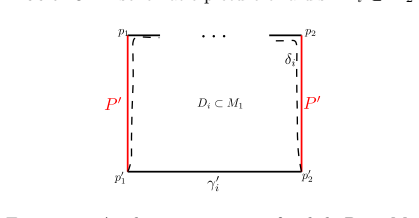
- [§6, proof of Theorem 6.2] The assertion “Then, by Proposition 3.7, a′ cuts out a disk D together with a subcollection of the sj” does not follow. Proposition 3.7 only states that a fixed arc in a boundary connected sum restricts to fixed arcs in each summand; it does not describe how those restrictions assemble globally. An essential fixed arc could in principle pass through several summands and connecting bands, with each restriction boundary-parallel, without cutting off a single disk together with some s_j. The required outermost-arc/innermost-disk argument is absent. Since the honest decomposition circle is eventually constructed from this structure, this gap is load-bearing.
- [§6, proof of Theorem 6.2] The step “b′ is obtained from b by a free isotopy along the boundary, so b′ is also fixed in Σv′” is unjustified. Fixedness (Definition 2.6) is defined for isotopy classes of arcs with endpoints fixed pointwise, and a free isotopy slides endpoints along ∂Σ, changing the arc class. The partial monodromy is not shown to be invariant under such endpoint-sliding. Therefore the conclusion that b′ is fixed in Σv′ does not follow from the fixedness of b. This affects the construction of c = b′, which is one of the two ways the proof aims to produce an honest decomposition circle.
- [§6, Definition 6.1 and following paragraph] The statement “Dv is alternating if and only if it is positive or negative” is false. The closure of the positive 3-braid (σ1σ2)^4 is special (all Seifert circles are non-separating) and positive, but it is the (3,4) torus knot, which is not alternating. Thus the claimed equivalence between alternating and positive/negative special diagrams is not correct. This matters because the definition of alternative links in the paper is justified by this equivalence, and the equivalence to Kauffman's original definition is used to assert that the class studied is genuinely the class of alternative links. The authors need to correct this statement or adjust the definition of alternative diagrams accordingly.
- [§6, proof of Theorem 6.2] The sentence “Since b′ ⊂ D, the discussion in Remark 2.5 implies that b′ is fixed in Σv” is not justified. Remark 2.5 explains how a partial monodromy can be recovered from a cutting system of arcs; it does not state that an arbitrary arc contained in a disk cut out by fixed arcs is itself fixed. A product disk witnessing fixedness of b′ would need to be constructed separately. This step is used to conclude that b′ is fixed in both Σv and Σv′, so it is essential to the proof.
minor comments (4)
- [§2.3, first paragraph] The first line reads “For 3-manifolds M1 and M3”; this appears to be a typo for M1 and M2.
- [§3.2, proof of Proposition 3.10] The phrase “W.l.o.g. the endpoints of a are not on ∂Σ1 ∩ ∂Σ2 (if not, isotope them in the boundary, do the argument, and isotope back)” is another instance where endpoint-sliding is used without justifying invariance of fixedness. This may be repairable, but it needs an explicit argument.
- [§5, statement of Theorem 5.3 and Remark 5.4] The introduction advertises a characterization (“if and only if”) of right-veering families, but Theorem 5.3 as stated gives only a sufficient condition in terms of 0-framed unknotted annuli; the full characterization appears only in Remark 5.4 via property (2). The presentation would be clearer if the theorem statement matched the stronger characterization or if the remark were clearly flagged as the converse.
- [§6, proof of Lemma 6.5] In the proof of Lemma 6.5(i), the statement “A split union of links is prime if and only if all of the individual links are” is a standard fact, but the wording could be misinterpreted: a split union with two nontrivial components is not prime, and the equivalence should be stated with the convention for prime links. Please clarify the convention.
Circularity Check
No significant circularity: a minor self-cited combinatorial lemma is used, but the main results are derived from stated geometric hypotheses rather than assumed.
full rationale
The paper's derivation chain is not circular. The partial monodromy and the composition formula (Lemma 3.1) are proved from product-disk geometry rather than assumed; the formula is not a definitional identity. Proposition 3.10's proof uses Lemma 3.12, cited to the authors' own [FLO24, Lemma 3.7], but this is a parameter-free chord-combinatorics statement whose assumptions do not include the target results; under the review rules it counts as independent support. Theorem 4.2 is an induction on trees using Proposition 3.10; Proposition 5.1 is obtained by an explicit positive-plumbing construction, not by fitting or renaming. Theorem 6.2's base case is Lemma 6.4, attributed to external work [Men84, Oza02, BG24], and the rest reduces fixed arcs to vertex surfaces via Theorem 4.2. The only concerns are proof-completeness, not circularity: the assertion in the proof of Theorem 6.2 that a fixed essential arc a' in a boundary-connected-sum vertex surface cuts out a disk with a subcollection of the s_j is not fully justified by the cited Proposition 3.7, and the boundary-isotopy step preserving fixedness is terse. These are gaps or missing details; they do not make the conclusion equal to an input by construction. No fitted parameter is renamed a prediction, and no uniqueness theorem from the authors' prior work is imported to force the choice. The score reflects one minor self-citation in a key lemma, but with independent content.
Assumptions & free parameters
assumptions (6)
- domain assumption Product disks exist for incompressible surfaces and define the partial monodromy uniquely (Remark 2.2)
- domain assumption Murasugi sums preserve incompressibility (Gabai [Gab83b, Gab85])
- standard math The chord lemma [FLO24, Lemma 3.7]
- domain assumption Rudolph's characterization of strongly quasipositive surfaces as full subsurfaces of positive torus link fibers
- domain assumption Special alternating links are visually prime [Men84, Oza02, BG24] (Lemma 6.4)
- domain assumption Goodman's sobering arcs yield overtwisted disks, and Eliashberg's classification of overtwisted contact structures
Cite this review
Pith. "Pith review of Monodromies of surfaces in 3-manifolds, right-veeringness, and primeness of links." pith.science (2026). https://pith.science/paper/DN6RDIY3
@misc{pith2026250909615,
  author       = {Pith},
  title        = {Pith review of: Monodromies of surfaces in 3-manifolds, right-veeringness, and primeness of links},
  year         = {2026},
  howpublished = {\url{https://pith.science/paper/DN6RDIY3}},
  note         = {Machine review of arXiv:2509.09615}
}
abstract
Extending the notion of monodromies associated with open books of $3$-manifolds, we consider monodromies for all incompressible surfaces in $3$-manifolds as partial self-maps of the arc set of the surfaces. We use them to develop a primeness criterion for incompressible surfaces constructed as iterative Murasugi sums in irreducible $3$-manifolds. We also consider a suitable notion of right-veeringness for monodromies of incompressible surfaces. We show strongly quasipositive surfaces are right-veering, thereby generalizing the corresponding result for open books and providing a proof that does not draw on contact geometry. In fact, we characterize when all elements of a family of incompressible surfaces that is closed under positive stabilization are right-veering. The latter also offers a new perspective on the characterization of tight contact structures via right-veeringness as first established by Honda, Kazez, and Mati\'c. As an application to links in $S^3$, we prove visual primeness of a large class of links, the so-called alternative links. This subsumes all prior visual primeness results related to Cromwell's conjecture. The application is enabled by the fact that all links in $S^3$ arise as the boundary of incompressible surfaces, whereas classical open book theory is restricted to fibered links -- those links that arise as the boundary of the page of an open book.
Figures


Figures from the paper (26 more)




Reference graph
Works this paper leans on
-
[1]
Baader: Hopf plumbing and minimal diagrams, Comment
S. Baader: Hopf plumbing and minimal diagrams, Comment. Math. Helv. 80 (2005), no. 3, 631--642. ZB 1076.57005
arXiv 2005
-
[2]
J. Baldwin: Surfaces in 3-manifolds up to positive H opf plumbing , 2025, Blog post available at https://floerhomologyproblems.blogspot.com/2025/05/surfaces-in-3-manifolds-up-to-positive.html?m=1
2025
-
[3]
M. Boileau and S. Orevkov: Quasipositivity of an analytic curve in a pseudoconvex 4-ball, C. R. Acad. Sci., Paris, S \'e r. I, Math. 332 (2001), no. 9, 825--830. ZB 1020.32020
arXiv 2001
-
[4]
Bonahon and L
F. Bonahon and L. C. Siebenmann: New geometric splittings of classical knots and the classification and symmetries of arborescent knots, 2016, available at https://dornsife.usc.edu/francis-bonahon/preprints-available/
2016
-
[5]
J. Boninger and J. E. Greene: Special alternating knots are band prime, Int. Math. Res. Not. 2024 (2024), no. 10, 8758--8763. ZB 1554.57004
arXiv 2024
-
[6]
A. J. Casson and C. M. Gordon: A loop theorem for duality spaces and fibred ribbon knots, Invent. Math. 74 (1983), 119--137. ZB 0538.57003
arXiv 1983
-
[7]
P. R. Cromwell: Homogeneous links, J. Lond. Math. Soc., II. Ser. 39 (1989), no. 3, 535--552. ZB 0685.57004
arXiv 1989
-
[8]
: Positive braids are visually prime, Proc. Lond. Math. Soc. (3) 67 (1993), no. 2, 384--424. ZB 0818.57004
arXiv 1993
Show all 35 references
-
[9]
Eliashberg: Classification of overtwisted contact structures on 3-manifolds, Invent
Y. Eliashberg: Classification of overtwisted contact structures on 3-manifolds, Invent. Math. 98 (1989), no. 3, 623--637. ZB 0684.57012
1989
-
[10]
u and B. \
T. Etg\"u and B. \"Ozba g c : Partial open book decompositions and the contact class in sutured F loer homology , Turkish J. Math. 33 (2009), no. 3, 295--312. ZB 1177.57023
2009
-
[11]
Feller, L
P. Feller, L. Lewark, and M. Orbegozo Rodriguez : Homogeneous braids are visually prime, 2024, accepted for publication by J. Topol. arXiv 2408.15730
2024
-
[12]
Futer and F
D. Futer and F. Gu\'eritaud: Angled decompositions of arborescent link complements, Proc. Lond. Math. Soc. (3) 98 (2009), no. 2, 325--364. ZB 1163.57003
2009
-
[13]
Gabai: Foliations and the topology of 3 -manifolds , J
D. Gabai: Foliations and the topology of 3 -manifolds , J. Differential Geom. 18 (1983), no. 3, 445--503. ZB 0533.57013
1983
-
[14]
Math., vol
: The M urasugi sum is a natural geometric operation , Low-dimensional topology ( S an F rancisco, C alif., 1981), Contemp. Math., vol. 20, Amer. Math. Soc., Providence, RI, 1983, pp. 131--143. ZB 0524.57004
1981
-
[15]
II , Combinatorial methods in topology and algebraic geometry ( R ochester, N
: The M urasugi sum is a natural geometric operation. II , Combinatorial methods in topology and algebraic geometry ( R ochester, N . Y ., 1982), Contemp. Math., vol. 44, Amer. Math. Soc., Providence, RI, 1985, pp. 93--100. ZB 0584.57003
1982
-
[16]
: Foliations and the topology of 3 -manifolds. II , J. Differential Geom. 26 (1987), no. 3, 461--478. ZB 0627.57012
1987
-
[17]
Giroux: Contact geometry: From dimension three to higher dimensions , Proceedings of the international congress of mathematicians, ICM 2002, Beijing, China, August 20--28, 2002
E. Giroux: Contact geometry: From dimension three to higher dimensions , Proceedings of the international congress of mathematicians, ICM 2002, Beijing, China, August 20--28, 2002. Vol. II: Invited lectures, Beijing: Higher Education Press; Singapore: World Scientific/distribu...
2002
-
[18]
Goodman: Overtwisted open books from sobering arcs, Algebr
N. Goodman: Overtwisted open books from sobering arcs, Algebr. Geom. Topol. 5 (2005), 1173--1195. ZB 1090.57020
2005
-
[19]
Hedden: Notions of positivity and the O zsv\'ath- S zab\'o concordance invariant , J
M. Hedden: Notions of positivity and the O zsv\'ath- S zab\'o concordance invariant , J. Knot Theory Ramifications 19 (2010), no. 5, 617--629. ZB 1195.57029
2010
-
[20]
Honda, W
K. Honda, W. H. Kazez, and G. Mati\'c: Right-veering diffeomorphisms of compact surfaces with boundary, Invent. Math. 169 (2007), no. 2, 427--449. ZB 1167.57008
2007
-
[21]
: The contact invariant in sutured F loer homology , Invent. Math. 176 (2009), no. 3, 637--676. ZB 1171.57031
2009
-
[22]
Ito: A note on HOMFLY polynomial of positive braid links , Int
T. Ito: A note on HOMFLY polynomial of positive braid links , Int. J. Math. 33 (2022), no. 4, 18. ZB 1487.57006 , Id/No 2250031
2022
-
[23]
L. H. Kauffman: Formal knot theory, Math. Notes (Princeton), vol. 30, Princeton University Press, Princeton, NJ, 1983. ZB 0537.57002
1983
-
[24]
W. W. Menasco: Closed incompressible surfaces in alternating knot and link complements, Topology 23 (1984), no. 1, 37--44. ZB 0525.57003
1984
-
[25]
Ozawa: Closed incompressible surfaces in the complements of positive knots, Comment
M. Ozawa: Closed incompressible surfaces in the complements of positive knots, Comment. Math. Helv. 77 (2002), no. 2, 235--243. ZB 1035.57003
2002
-
[26]
Rudolph: Algebraic functions and closed braids, Topology 22 (1983), 191--202
L. Rudolph: Algebraic functions and closed braids, Topology 22 (1983), 191--202. ZB 0505.57003
1983
-
[27]
: Braided surfaces and Seifert ribbons for closed braids , Comment. Math. Helv. 58 (1983), 1--37. ZB 0522.57017
1983
-
[28]
III : A characterization of quasipositive Seifert surfaces , Topology 31 (1992), no
: Constructions of quasipositive knots and links. III : A characterization of quasipositive Seifert surfaces , Topology 31 (1992), no. 2, 231--237. ZB 0763.57008
1992
-
[29]
IV : Quasipositive annuli , J
: Constructions of quasipositive knots and links. IV : Quasipositive annuli , J. Knot Theory Ramifications 1 (1992), no. 4, 451--466. ZB 0773.57006
1992
-
[30]
: Positive links are strongly quasipositive, Proceedings of the K irbyfest ( B erkeley, CA , 1998), Geom. Topol. Monogr., vol. 2, Geom. Topol. Publ., Coventry, 1999, pp. 555--562. ZB 0962.57004
1998
-
[31]
Seifert: \"U ber das G eschlecht von K noten , Math
H. Seifert: \"U ber das G eschlecht von K noten , Math. Ann. 110 (1935), no. 1, 571--592. ZB 0010.13303
1935
-
[32]
J. R. Stallings: Constructions of fibred knots and links, Algebraic and geometric topology ( P roc. S ympos. P ure M ath., S tanford U niv., S tanford, C alif., 1976), P art 2, Proc. Sympos. Pure Math., vol. XXXII, Amer. Math. Soc., Providence, RI, 1978, pp. 55--60. ZB 0394.57007
1976
-
[33]
W. P. Thurston: Hyperbolic Structures on 3-manifolds, II : Surface groups and 3-manifolds which fiber over the circle , 1998. arXiv math/9801045
1998 arXiv
-
[34]
Wand: Detecting tightness via open book decompositions, Interactions between low-dimensional topology and mapping class groups, Geom
A. Wand: Detecting tightness via open book decompositions, Interactions between low-dimensional topology and mapping class groups, Geom. Topol. Monogr., vol. 19, Geom. Topol. Publ., Coventry, 2015, pp. 291--317. ZB 1335.53104
2015
-
[35]
write newline
" write newline "" before.all 'output.state := FUNCTION output.nonempty.mrnumber duplicate missing pop "" 'skip if duplicate empty 'pop " " swap * " " * write if FUNCTION fin.entry add.period write newline INTEGERS nameptr namesleft numnames FUNCTION format.language language e...
Reviewed August 4, 2026 · model on record in the stance chip above.
Discussion (0). Continue with ORCID to comment.