Glorbit: A Modular, Web-Based Platform for AI Based Periorbital Measurement in Low-Resource Settings
Pith reviewed 2026-05-18 21:32 UTC · model grok-4.3
The pith
A browser-based AI app automates periorbital measurements for use in low-resource clinical settings.
A machine-rendered reading of the paper's core claim, the machinery that carries it, and where it could break.
Core claim
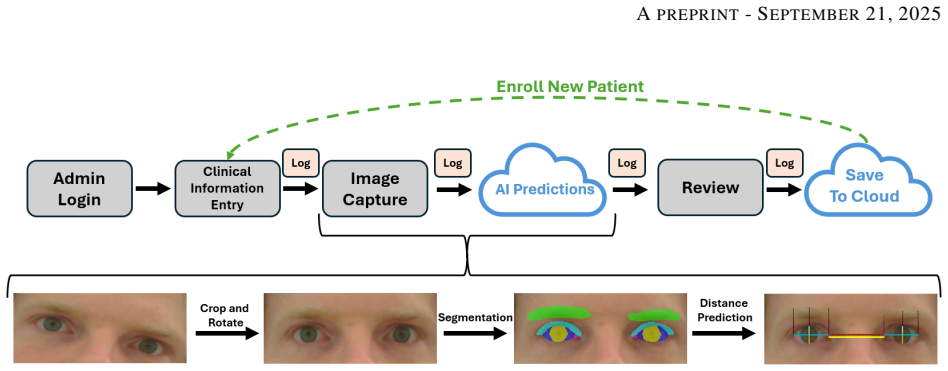
Glorbit integrates a DeepLabV3 segmentation model into a modular pipeline with secure, site-specific Google Cloud storage. The app supports offline mode, local preprocessing, and cloud upload via Firebase-authenticated logins. In a simulated enrollment study of 15 volunteers, the full workflow of metadata entry, image capture, segmentation, and upload completed without error on all sessions. The application ran on laptops, tablets, and mobile phones across major browsers, with an average session time of 101.7 seconds and usability scores of 4.8 to 5.0 on a 1-5 scale for intuitiveness, workflow clarity, output confidence, and clinical utility.
What carries the argument
The modular pipeline that embeds the DeepLabV3 segmentation model to automate image analysis while handling offline operation, local preprocessing, and authenticated cloud storage in a web browser.
Load-bearing premise
Performance seen with healthy volunteers in a controlled simulated study will hold for patients with actual eyelid disorders under varied real-world lighting and camera conditions.
What would settle it
A study that directly compares Glorbit measurements to expert manual measurements on patients with ptosis, using different lighting conditions and consumer cameras to check for consistent accuracy.
Figures


read the original abstract
Periorbital measurements such as margin reflex distances (MRD1/2), palpebral fissure height, and scleral show are essential in diagnosing and managing conditions like ptosis and eyelid disorders. We developed Glorbit, a lightweight, browser-based application for automated periorbital distance measurement using artificial intelligence, designed for use in low-resource clinical settings. The app integrates a DeepLabV3 segmentation model into a modular pipeline with secure, site-specific Google Cloud storage. Glorbit supports offline mode, local preprocessing, and cloud upload via Firebase-authenticated logins. We evaluated usability, cross-platform compatibility, and deployment readiness through a simulated enrollment study of 15 volunteers. The app completed the full workflow -- metadata entry, image capture, segmentation, and upload -- on all tested sessions without error. Glorbit successfully ran on laptops, tablets, and mobile phones across major browsers. The segmentation model succeeded on all images. Average session time was 101.7 seconds (standard deviation: 17.5). Usability survey scores (1-5 scale) were uniformly high: intuitiveness and efficiency (5.0), workflow clarity (4.8), output confidence (4.9), and clinical utility (4.9). Glorbit provides a functional, scalable solution for standardized periorbital measurement in diverse environments. It supports secure data collection and may enable future development of real-time triage tools and multimodal AI-driven oculoplastics. Tool available at: https://glorbit.app
Editorial analysis
A structured set of objections, weighed in public.
Referee Report
Summary. The manuscript introduces Glorbit, a modular web-based platform that integrates a DeepLabV3 segmentation model for automated periorbital measurements (MRD1/2, palpebral fissure height, scleral show). Designed for low-resource settings, the app includes offline mode, local preprocessing, Firebase-authenticated cloud upload to site-specific Google Cloud storage, and cross-platform support. The authors report a simulated enrollment study with 15 healthy volunteers in which the full workflow completed without error on all sessions, average session time was 101.7 s (SD 17.5), and usability scores (1-5 scale) were high (intuitiveness/efficiency 5.0, workflow clarity 4.8, output confidence 4.9, clinical utility 4.9). The tool is positioned as a scalable solution supporting future real-time triage and multimodal AI applications in oculoplastics.
Significance. A functional, browser-based tool with secure data handling and offline capability could meaningfully improve access to standardized periorbital assessment in low-resource clinics. The modular architecture and demonstrated cross-platform compatibility are practical strengths that lower deployment barriers. However, the current evaluation establishes only workflow feasibility and user acceptance on healthy volunteers; without demonstrated measurement accuracy, the platform's utility for clinical decision-making remains prospective rather than established.
major comments (2)
- [Simulated Enrollment Study] Simulated Enrollment Study (abstract and results): The study reports 100% workflow completion and high usability scores but supplies no quantitative accuracy metrics for the periorbital distances (e.g., mean absolute error versus manual caliper or expert annotation) or segmentation performance (Dice/IoU). This omission is load-bearing for the central claim that Glorbit delivers reliable AI-based periorbital measurement.
- [Abstract and Evaluation] Abstract and Evaluation sections: All testing used 15 healthy volunteers under simulated conditions; no images or data from patients with ptosis or other eyelid disorders are presented, nor is any assessment under varied real-world lighting, camera quality, or device conditions. This directly limits support for the stated clinical utility in the target population.
minor comments (3)
- [Abstract] Abstract: The claim that 'the segmentation model succeeded on all images' would be strengthened by reporting at least basic performance statistics or noting their absence.
- [Methods] Methods: Training details for the DeepLabV3 model (dataset size, composition, augmentation, or fine-tuning procedure) are not described; these should be added to allow reproducibility.
- [Results] Results: A table summarizing per-session metrics and usability scores by device/browser would improve clarity and allow readers to assess consistency across platforms.
Simulated Author's Rebuttal
We thank the referee for the constructive feedback on our manuscript. We address each major comment below and will make revisions to clarify the scope and limitations of the presented evaluation.
read point-by-point responses
-
Referee: [Simulated Enrollment Study] Simulated Enrollment Study (abstract and results): The study reports 100% workflow completion and high usability scores but supplies no quantitative accuracy metrics for the periorbital distances (e.g., mean absolute error versus manual caliper or expert annotation) or segmentation performance (Dice/IoU). This omission is load-bearing for the central claim that Glorbit delivers reliable AI-based periorbital measurement.
Authors: The simulated enrollment study was designed to assess workflow completion, usability, session time, and cross-platform compatibility in a controlled setting with healthy volunteers. It did not include quantitative validation of the AI segmentation accuracy or periorbital measurement precision against reference standards such as manual measurements or expert annotations. We did not intend to claim that the current results establish measurement reliability; the focus was on demonstrating a functional, deployable platform. We will revise the abstract and results to explicitly note that accuracy metrics are not reported in this study and that dedicated validation studies are required for clinical use. This revision will better align the claims with the evidence presented. revision: partial
-
Referee: [Abstract and Evaluation] Abstract and Evaluation sections: All testing used 15 healthy volunteers under simulated conditions; no images or data from patients with ptosis or other eyelid disorders are presented, nor is any assessment under varied real-world lighting, camera quality, or device conditions. This directly limits support for the stated clinical utility in the target population.
Authors: We concur that the evaluation is restricted to healthy volunteers in simulated conditions and lacks testing on patients with periorbital disorders or under heterogeneous real-world imaging conditions. The manuscript presents Glorbit as a platform intended to facilitate such applications in low-resource settings, with the current work establishing feasibility and high user acceptance. We will update the abstract, evaluation, and discussion sections to more precisely describe the study population and conditions, and to qualify statements regarding clinical utility as prospective. These changes will help readers understand the current evidence base and the need for subsequent studies. revision: yes
Circularity Check
No circularity: paper describes app implementation and usability test without equations or self-referential derivations
full rationale
The manuscript details the creation of a browser-based tool integrating an existing DeepLabV3 model for periorbital segmentation, along with a simulated usability evaluation on 15 healthy volunteers that reports workflow completion, session times, and survey scores. No mathematical derivations, fitted parameters renamed as predictions, or load-bearing self-citations appear in the provided text. The central claims rest on direct implementation description and empirical test outcomes that do not reduce to their own inputs by construction.
Axiom & Free-Parameter Ledger
invented entities (1)
-
Glorbit platform
no independent evidence
Lean theorems connected to this paper
-
IndisputableMonolith/Foundation/AbsoluteFloorClosure.leanreality_from_one_distinction unclear?
unclearRelation between the paper passage and the cited Recognition theorem.
We developed Glorbit, a lightweight, browser-based application for automated periorbital distance measurement using artificial intelligence... The app integrates a DeepLabV3 segmentation model into a modular pipeline
-
IndisputableMonolith/Cost/FunctionalEquation.leanwashburn_uniqueness_aczel unclear?
unclearRelation between the paper passage and the cited Recognition theorem.
A trained DeepLabV3 model achieved mean absolute errors consistently below established intergrader variability thresholds
What do these tags mean?
- matches
- The paper's claim is directly supported by a theorem in the formal canon.
- supports
- The theorem supports part of the paper's argument, but the paper may add assumptions or extra steps.
- extends
- The paper goes beyond the formal theorem; the theorem is a base layer rather than the whole result.
- uses
- The paper appears to rely on the theorem as machinery.
- contradicts
- The paper's claim conflicts with a theorem or certificate in the canon.
- unclear
- Pith found a possible connection, but the passage is too broad, indirect, or ambiguous to say the theorem truly supports the claim.
Reference graph
Works this paper leans on
-
[1]
Christopher D. Conrady and Bhupendra C. Patel. Crouzon syndrome. In StatPearls. StatPearls Publishing, 2025
work page 2025
-
[2]
Kirthi Koka and Bhupendra C. Patel. Ptosis correction. In StatPearls. StatPearls Publishing, 2025
work page 2025
-
[3]
Colleen MacLachlan and Howard C. Howland. Normal values and standard deviations for pupil diameter and interpupillary distance in subjects aged 1 month to 19 years. Ophthalmic & Physiological Optics: The Journal of the British College of Ophthalmic Opticians (Optometrists), 22(3):175–182, 2002
work page 2002
-
[4]
Arie Y . Nemet. Accuracy of marginal reflex distance measurements in eyelid surgery.The Journal of Craniofacial Surgery, 26(7):e569–571, 2015
work page 2015
-
[5]
A. A. Cruz, R. P. Coelho, A. Baccega, M. C. Lucchezi, A. D. Souza, and E. E. Ruiz. Digital image processing measurement of the upper eyelid contour in graves disease and congenital blepharoptosis. Ophthalmology, 105(5):913–918, 1998
work page 1998
-
[6]
A. A. Cruz and M. C. Lucchezi. Quantification of palpebral fissure shape in severe congenital blepharoptosis. Ophthalmic Plastic and Reconstructive Surgery, 15(4):232–235, 1999
work page 1999
-
[7]
Bodnar, Michael Neimkin, and John B
Zachary M. Bodnar, Michael Neimkin, and John B. Holds. Automated ptosis measurements from facial pho- tographs. JAMA ophthalmology, 134(2):146–150, 2016
work page 2016
-
[8]
Vincent M. Hussey and Jeremiah P. Tao. Oculofacial plastic surgeon distribution by county in the united states,
-
[9]
8 A PREPRINT - S EPTEMBER 21, 2025
Orbit (Amsterdam, Netherlands), 41(6):687–690, 2022. 8 A PREPRINT - S EPTEMBER 21, 2025
work page 2022
-
[10]
Nahass, Emma Koehler, Nicholas Tomaras, Danny Lopez, Madison Cheung, Alexander Palacios, Jeffrey C
George R. Nahass, Emma Koehler, Nicholas Tomaras, Danny Lopez, Madison Cheung, Alexander Palacios, Jeffrey C. Peterson, Sasha Hubschman, Kelsey Green, Chad A. Purnell, Pete Setabutr, Ann Q. Tran, and Darvin Yi. Open-source periorbital segmentation dataset for ophthalmic applications. Ophthalmology Science, page 100757, 2025
work page 2025
-
[11]
George R. Nahass, Ghasem Yazdanpanah, Madison Cheung, Alex Palacios, Jeffery Peterson, Kevin Heinze, Sasha Hubschman, Chad A. Purnell, Pete Setabutr, Ann Q. Tran, and Darvin Yi. State-of-the-art periorbital distance prediction and disease classification using periorbital features, 2024
work page 2024
-
[12]
Owen, Theodore Spaide, Colin Froines, Randy Lu, Megan Lacy, Marian Blazes, Emily Li, Cecilia S
Alexandra Van Brummen, Julia P. Owen, Theodore Spaide, Colin Froines, Randy Lu, Megan Lacy, Marian Blazes, Emily Li, Cecilia S. Lee, Aaron Y . Lee, and Matthew Zhang. PeriorbitAI: Artificial intelligence automation of eyelid and periorbital measurements. American journal of ophthalmology, 230:285–296, 2021
work page 2021
-
[13]
Real-time facial surface geometry from monocular video on mobile GPUs, 2019
Yury Kartynnik, Artsiom Ablavatski, Ivan Grishchenko, and Matthias Grundmann. Real-time facial surface geometry from monocular video on mobile GPUs, 2019
work page 2019
-
[14]
HIPAA business associate agreement - 2025 update, 2025
work page 2025
-
[15]
Artificial intelligence to automate assessment of ocular and periocular measurements
Khizar Rana, Mark Beecher, Carmelo Caltabiano, Carmelo Macri, Yang Zhao, Johan Verjans, and Dinesh Selva. Artificial intelligence to automate assessment of ocular and periocular measurements. European Journal of Ophthalmology, page 11206721241249773, 2024. Publisher: SAGE Publications
work page 2024
-
[16]
Hung-Chang Chen, Shin-Shi Tzeng, Yen-Chang Hsiao, Ruei-Feng Chen, Erh-Chien Hung, and Oscar K. Lee. Smartphone-based artificial intelligence–assisted prediction for eyelid measurements: Algorithm development and observational validation study. JMIR mHealth and uHealth, 9(10):e32444, 2021. Company: JMIR mHealth and uHealth Distributor: JMIR mHealth and uHe...
work page 2021
-
[17]
Y . Guo, J. Liu, Y . Ruan, A. C. Rokohl, X. Hou, S. Li, R. Jia, K. R. Koch, and L. M. Heindl. A novel approach quantifying the periorbital morphology: A comparison of direct, 2-dimensional, and 3-dimensional technologies. Journal of Plastic, Reconstructive & Aesthetic Surgery, 74(8):1888–1899, 2021
work page 2021
-
[18]
Comparing the effectiveness of smartphone applications in the measurement of interpupillary distance
Kenneth D Han, Muhammed Jaafar, Isabella M Stoakes, Phillip C Hoopes, and Majid Moshirfar. Comparing the effectiveness of smartphone applications in the measurement of interpupillary distance. Cureus, 15(7):e42744, 2025
work page 2025
-
[19]
BonLook: Prescription eyeglasses, sunglasses & contacts, 2025
work page 2025
-
[20]
EyeQue PDCheck - innovative vision solutions, 2024
work page 2024
-
[21]
The accuracy of the PlusoptiX for mea- suring pupillary distance
Eric Singman, Noelle Matta, Jing Tian, and David Silbert. The accuracy of the PlusoptiX for mea- suring pupillary distance. Strabismus, 22(1):21–25, 2024. Publisher: Taylor & Francis _eprint: https://doi.org/10.3109/09273972.2013.877941
-
[22]
GlassesOn - 6over6.com, 2025
work page 2025
-
[23]
OpenFace: An open source facial behavior analysis toolkit
Tadas Baltrusaitis, Peter Robinson, and Louis-Philippe Morency. OpenFace: An open source facial behavior analysis toolkit. In 2016 IEEE Winter Conference on Applications of Computer Vision (WACV), pages 1–10. IEEE, 2016
work page 2016
-
[24]
Face++ - face++ cognitive services, 2025
work page 2025
-
[25]
Out-of-distribution detection in medical image analysis: A survey, 2024
Zesheng Hong, Yubiao Yue, Yubin Chen, Lele Cong, Huanjie Lin, Yuanmei Luo, Mini Han Wang, Weidong Wang, Jialong Xu, Xiaoqi Yang, Hechang Chen, Zhenzhang Li, and Sihong Xie. Out-of-distribution detection in medical image analysis: A survey, 2024
work page 2024
-
[26]
Homa Rashidisabet, Abhishek Sethi, Ponpawee Jindarak, James Edmonds, R. V . Paul Chan, Yannek I. Leiderman, Thasarat Sutabutr Vajaranant, and Darvin Yi. Validating the generalizability of ophthalmic artificial intelligence models on real-world clinical data. Translational Vision Science & Technology, 12(11):8, 2023
work page 2023
-
[27]
Gustav Mårtensson, Daniel Ferreira, Tobias Granberg, Lena Cavallin, Ketil Oppedal, Alessandro Padovani, Irena Rektorova, Laura Bonanni, Matteo Pardini, Milica G. Kramberger, John-Paul Taylor, Jakub Hort, Jón Snædal, Jaime Kulisevsky, Frederic Blanc, Angelo Antonini, Patrizia Mecocci, Bruno Vellas, Magda Tsolaki, Iwona Kłoszewska, Hilkka Soininen, Simon Lo...
work page 2020
-
[28]
Ece Ozkan and Xavier Boix. Multi-domain improves classification in out-of-distribution and data-limited scenarios for medical image analysis. Scientific Reports, 14(1):24412, 2024. Publisher: Nature Publishing Group
work page 2024
-
[29]
Davood Karimi and Ali Gholipour. Improving calibration and out-of-distribution detection in deep models for medical image segmentation. IEEE transactions on artificial intelligence, 4(2):383–397, 2023. 9 A PREPRINT - S EPTEMBER 21, 2025
work page 2023
-
[30]
Zhuoting Zhu, Yueye Wang, Ziyi Qi, Wenyi Hu, Xiayin Zhang, Siegfried K. Wagner, Yujie Wang, An Ran Ran, Joshua Ong, Ethan Waisberg, Mouayad Masalkhi, Alex Suh, Yih Chung Tham, Carol Y . Cheung, Xiaohong Yang, Honghua Yu, Zongyuan Ge, Wei Wang, Bin Sheng, Yun Liu, Andrew G. Lee, Alastair K. Denniston, Peter van Wijngaarden, Pearse A. Keane, Ching-Yu Cheng,...
work page 2025
-
[31]
Oculomics – the eyes talk a great deal
Santosh G Honavar. Oculomics – the eyes talk a great deal. Indian Journal of Ophthalmology, 70(3):713, 2022
work page 2022
-
[32]
Emily J. Patterson, Alistair D. Bounds, Siegfried K. Wagner, Richard Kadri-Langford, Robin Taylor, and Dan Daly. Oculomics: A crusade against the four horsemen of chronic disease. Ophthalmology and Therapy , 13(6):1427–1451, 2024
work page 2024
-
[33]
Alex Suh, Gilad Hampel, Aditya Vinjamuri, Joshua Ong, Sharif Amit Kamran, Ethan Waisberg, Phani Paladugu, Nasif Zaman, Prithul Sarker, Alireza Tavakkoli, and Andrew G. Lee. Oculomics analysis in multiple sclerosis: Current ophthalmic clinical and imaging biomarkers. Eye, 38(14):2701–2710, 2024. Publisher: Nature Publishing Group
work page 2024
-
[34]
Yukun Zhou, Mark A. Chia, Siegfried K. Wagner, Murat S. Ayhan, Dominic J. Williamson, Robbert R. Struyven, Timing Liu, Moucheng Xu, Mateo G. Lozano, Peter Woodward-Court, Yuka Kihara, Andre Altmann, Aaron Y . Lee, Eric J. Topol, Alastair K. Denniston, Daniel C. Alexander, and Pearse A. Keane. A foundation model for generalizable disease detection from ret...
work page 2023
-
[35]
Boris Babenko, Ilana Traynis, Christina Chen, Preeti Singh, Akib Uddin, Jorge Cuadros, Lauren P. Daskivich, April Y . Maa, Ramasamy Kim, Eugene Yu-Chuan Kang, Yossi Matias, Greg S. Corrado, Lily Peng, Dale R. Webster, Christopher Semturs, Jonathan Krause, Avinash V . Varadarajan, Naama Hammel, and Yun Liu. A deep learning model for novel systemic biomarke...
work page 2023
-
[36]
Delia Cabrera DeBuc. AI for identification of systemic biomarkers from external eye photos: a promising field in the oculomics revolution. The Lancet Digital Health, 5(5):e249–e250, 2023. Publisher: Elsevier
work page 2023
-
[37]
Boris Babenko, Akinori Mitani, Ilana Traynis, Naho Kitade, Preeti Singh, April Y . Maa, Jorge Cuadros, Greg S. Corrado, Lily Peng, Dale R. Webster, Avinash Varadarajan, Naama Hammel, and Yun Liu. Detection of signs of disease in external photographs of the eyes via deep learning. Nature Biomedical Engineering, 6(12):1370–1383, 2022
work page 2022
-
[38]
Sasank Isola and Yasir Al Khalili. Protected health information. In StatPearls. StatPearls Publishing, 2025. 10
work page 2025
discussion (0)
Sign in with ORCID, Apple, or X to comment. Anyone can read and Pith papers without signing in.