High-sensitivity molecular spectroscopy of SrOH using magneto-optical trapping
Pith reviewed 2026-05-18 17:09 UTC · model grok-4.3
The pith
A magneto-optical trap identifies two new repumping transitions in SrOH that enable a deeper optical cycle and trap 4.5 times more molecules while mapping mass-ratio-sensitive vibrational states.
A machine-rendered reading of the paper's core claim, the machinery that carries it, and where it could break.
Core claim
A magneto-optical trap is used to locate weak optical transitions and rovibronic states in SrOH. Two new repumping transitions are identified and added to a deeper optical cycle, yielding 32400(4700) trapped molecules, a 4.5-fold increase over the previous cycle. The energy spacing between the X^{2}Σ^{+}(200) and X^{2}Σ^{+}(03^{1}0) vibrational manifolds is determined, confirming numerous low-frequency rovibrational transitions sensitive to temporal variations of the proton-to-electron mass ratio.
What carries the argument
The magneto-optical trap acting as a spectroscopic probe to detect and close weak repumping transitions within an extended molecular optical cycle.
Load-bearing premise
The measured increase in trapped molecule number is produced by the newly added repumping transitions and not by unrelated changes in laser intensity, loading rates, or other trap parameters.
What would settle it
Repeating the trapping experiment with the same new lasers turned off but all other conditions held fixed, or obtaining an independent spectroscopic measurement of a different energy spacing between the X^{2}Σ^{+}(200) and X^{2}Σ^{+}(03^{1}0) manifolds.
Figures
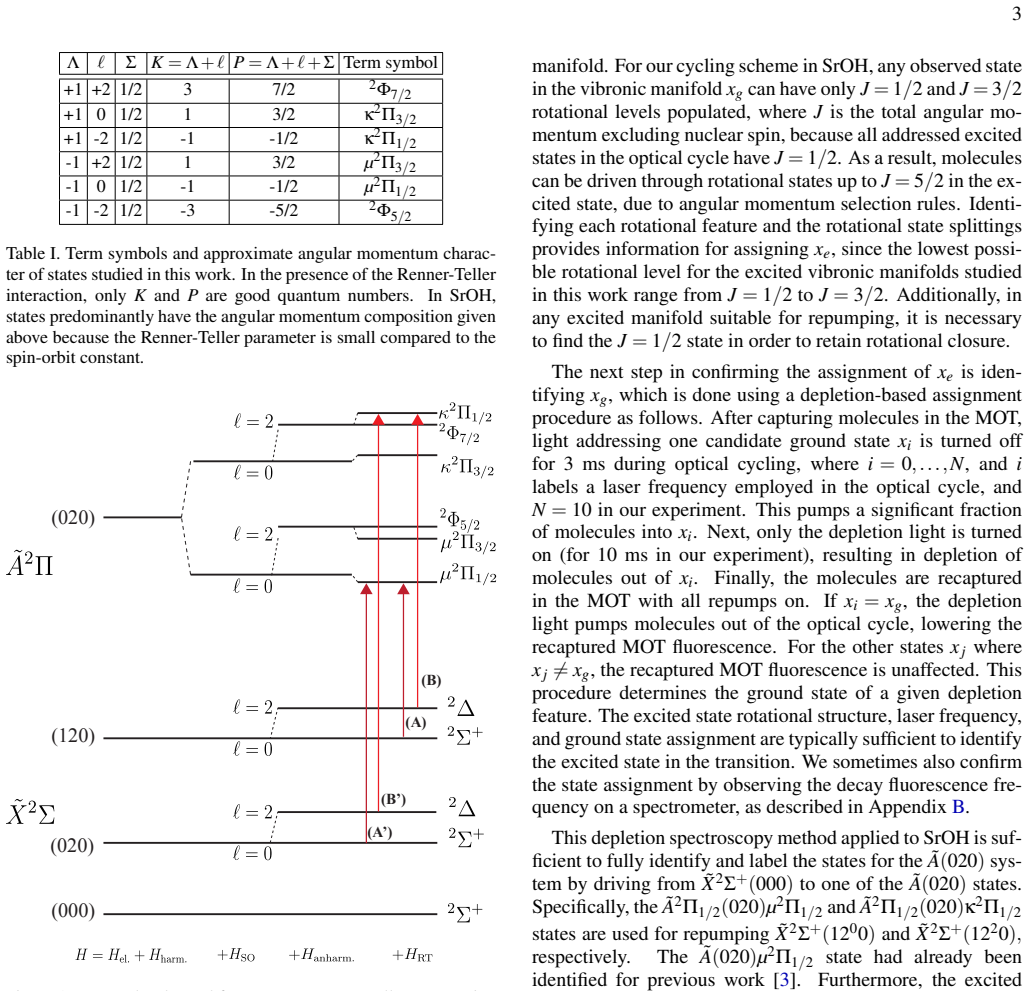


read the original abstract
Polyatomic molecules are projected to be powerful tools in searches for physics beyond the Standard Model (BSM), including new CP-violating (CPV) interactions and ultralight dark matter (UDM) particles. Certain degrees of freedom present in polyatomic molecules enhance the sensitivity of these searches, as well as reject systematic errors, but necessitate extensive high-precision spectroscopy to identify pathways for optical cycling and quantum state readout. Here we show how a magneto-optical trap (MOT) can be used to locate weak optical transitions and identify rovibronic states for optical cycling and quantum control. We demonstrate this spectroscopic approach with strontium monohydroxide (SrOH), which is a candidate for both CPV and UDM searches. We identify two new repumping transitions in SrOH and implement them in a deeper optical cycle to achieve 32400(4700) trapped molecules, a 4.5-fold increase over the previous, shallower cycle. In addition, we determine the energy spacing between the $X^{2}\Sigma^{+}(200)$ and $X^{2}\Sigma^{+}(03^10)$ vibrational manifolds of SrOH, confirming the existence of numerous low-frequency rovibrational transitions that are sensitive to temporal variations of the proton-to-electron mass ratio, a predicted effect of the existence of UDM.
Editorial analysis
A structured set of objections, weighed in public.
Referee Report
Summary. The manuscript describes the application of a magneto-optical trap (MOT) as a tool for high-sensitivity spectroscopy in the polyatomic molecule SrOH. The authors identify two new repumping transitions, incorporate them into a deeper optical cycle, and report achieving 32400(4700) trapped molecules—a 4.5-fold increase relative to prior shallower cycles. They additionally measure the energy spacing between the X^{2}Σ^{+}(200) and X^{2}Σ^{+}(03^{1}0) vibrational manifolds, which they link to the existence of low-frequency rovibrational transitions potentially sensitive to temporal variations of the proton-to-electron mass ratio.
Significance. If the reported increase in trapped population is unambiguously attributable to the new repumpers, the work provides a concrete experimental demonstration of MOT-enabled discovery of weak transitions for improved optical cycling in polyatomic molecules. This is relevant for precision searches for CP violation and ultralight dark matter. The provision of specific quantitative results (trapped number with uncertainty and a measured energy spacing) constitutes a strength, as does the experimental nature of the central claims.
major comments (1)
- [Abstract] Abstract: The central claim attributes the 4.5-fold increase to 32400(4700) trapped molecules directly to implementation of the two new repumping transitions in a deeper cycle. This attribution is load-bearing, yet the manuscript provides no explicit control data (e.g., a parameter table or blocked-repumper run) confirming that laser intensities, detunings, magnetic-field gradient, beam overlap, molecular flux, and detection efficiency remained unchanged between the two configurations. Without such documentation, alternative explanations for the gain cannot be excluded.
minor comments (1)
- [Notation] Notation throughout: The vibrational labels X^{2}Σ^{+}(200) and X^{2}Σ^{+}(03^{1}0) would benefit from a short parenthetical definition or citation to standard SrOH spectroscopic conventions on first use, to aid readers outside the immediate subfield.
Simulated Author's Rebuttal
We thank the referee for their positive evaluation of the work's significance and for the detailed feedback on the abstract. We address the major comment below and will revise the manuscript to strengthen the presentation of our results.
read point-by-point responses
-
Referee: [Abstract] Abstract: The central claim attributes the 4.5-fold increase to 32400(4700) trapped molecules directly to implementation of the two new repumping transitions in a deeper cycle. This attribution is load-bearing, yet the manuscript provides no explicit control data (e.g., a parameter table or blocked-repumper run) confirming that laser intensities, detunings, magnetic-field gradient, beam overlap, molecular flux, and detection efficiency remained unchanged between the two configurations. Without such documentation, alternative explanations for the gain cannot be excluded.
Authors: We agree that explicit documentation of unchanged experimental parameters would eliminate ambiguity and strengthen the attribution of the increase to the new repumpers. The original manuscript did not include a dedicated parameter table or blocked-repumper comparison run. In the revised version we will add a table (or supplementary section) listing the key parameters—laser intensities, detunings, magnetic-field gradient, beam overlap, molecular flux, and detection settings—for both the prior and new cycles, together with data acquired with the additional repumpers blocked. This will directly confirm that the 4.5-fold gain arises from the deeper optical cycle. revision: yes
Circularity Check
No circularity: results are direct experimental measurements
full rationale
The paper presents experimental spectroscopy and MOT trapping results for SrOH, including identification of repumping transitions and measurement of vibrational energy spacings. These are obtained via direct observation of fluorescence, trap populations, and spectral lines rather than any derivation, fitting procedure, or ansatz that reduces to the paper's own inputs by construction. No load-bearing self-citations, uniqueness theorems, or renamed empirical patterns appear in the reported chain. The central claims remain externally falsifiable through independent replication of the apparatus and measurements.
Axiom & Free-Parameter Ledger
axioms (1)
- standard math Standard quantum mechanics and selection rules for molecular transitions apply to SrOH.
Lean theorems connected to this paper
-
IndisputableMonolith/Cost/FunctionalEquation.leanwashburn_uniqueness_aczel unclear?
unclearRelation between the paper passage and the cited Recognition theorem.
We identify two new repumping transitions in SrOH and implement them in a deeper optical cycle to achieve 32400(4700) trapped molecules, a 4.5-fold increase over the previous, shallower cycle.
-
IndisputableMonolith/Foundation/RealityFromDistinction.leanreality_from_one_distinction unclear?
unclearRelation between the paper passage and the cited Recognition theorem.
we determine the energy spacing between the X^{2}Σ^{+}(200) and X^{2}Σ^{+}(03^{1}0) vibrational manifolds
What do these tags mean?
- matches
- The paper's claim is directly supported by a theorem in the formal canon.
- supports
- The theorem supports part of the paper's argument, but the paper may add assumptions or extra steps.
- extends
- The paper goes beyond the formal theorem; the theorem is a base layer rather than the whole result.
- uses
- The paper appears to rely on the theorem as machinery.
- contradicts
- The paper's claim conflicts with a theorem or certificate in the canon.
- unclear
- Pith found a possible connection, but the passage is too broad, indirect, or ambiguous to say the theorem truly supports the claim.
Reference graph
Works this paper leans on
-
[1]
DLIF spectroscopy to identify excited vibronic states Ambiguity in observed excited-state vibronic labels is re- moved using dispersed laser-induced fluorescence (DLIF) spectroscopy. DLIF measurements can also reduce the un- certainty of a previously unobserved vibronic state in the ˜X 2Σ+ manifold before attempting high-resolution measure- ments. Before ...
-
[2]
Repumping ˜X2Σ+(1200)throughB(02 00) Initially, one potential pathway for repumping ˜X 2Σ+(1200) involved driving it through theBstate with the ˜X 2Σ+(1200)– ˜B2Σ+(0200)transition, since the excited state had already been observed in Ref. [34]. As we scan the frequency of a narrow-band dye laser around the ˜X 2Σ+(1200)– ˜B2Σ+(0200) band at 627 nm, resonan...
-
[3]
Impact of photon budget on MOT lifetime Data on the MOT lifetimes as a function of MOT light beam power and closure of the optical cycle is consistent with the MOT lifetime continuing to be limited by decays to unad- dressed states. With all 12 repumpers, the lifetime can be extended to 210(35) ms, beyond the previous best lifetime with 10 repumpers of 99...
-
[4]
To calculate the number accu- rately, we use the following process
Determination of trapped molecule number The MOT fluorescence is directly proportional to the num- ber of trapped molecules,N m. To calculate the number accu- rately, we use the following process. We start by considering the number of counts on the imaging cameraNc =Sγ det,where Sis the sensitivity of the camera at the detection wavelength of 611 nm andγ ...
-
[5]
Determining the photon budget As can be seen in Equation E1, the overall computed num- ber of trapped molecules,Nm, depends inversely on the photon budget,N b. In previous work [3], uncertainty inN m was dom- inated by the estimate ofN b, derived from measurements of vibronic branching fractions relevant to the optical cycle [39]. Here, we describe a dire...
- [6]
- [7]
-
[8]
Z. D. Lasner, A. Frenett, H. Sawaoka, L. Anderegg, B. Augen- braun, H. Lampson, M. Li, A. Lunstad, J. Mango, A. Nasir, T. Ono, T. Sakamoto, and J. M. Doyle, Phys. Rev. Lett.134, 083401 (2025)
work page 2025
-
[9]
L. Anderegg, L. W. Cheuk, Y . Bao, S. Burchesky, W. Ketterle, K.-K. Ni, and J. M. Doyle, Science365, 1156 (2019)
work page 2019
-
[10]
N. B. Vilas, P. Robichaud, C. Hallas, G. K. Li, L. Anderegg, and J. M. Doyle, Nature628, 282 (2024)
work page 2024
- [11]
-
[12]
K. K. Ni, T. Rosenband, and D. D. Grimes, Chemical Science 9, 6830 (2018)
work page 2018
- [13]
- [14]
-
[15]
A. V . Gorshkov, S. R. Manmana, G. Chen, E. Demler, M. D. Lukin, and A. M. Rey, Phys. Rev. A84, 033619 (2011)
work page 2011
- [16]
-
[17]
Z. Zeng, S. Deng, S. Yang, and B. Yan, Phys. Rev. Lett.133 (2024)
work page 2024
-
[18]
L. Christakis, J. S. Rosenberg, R. Raj, S. Chi, A. Morningstar, D. A. Huse, Z. Z. Yan, and W. S. Bakr, Nature614, 64 (2023)
work page 2023
-
[19]
C. M. Holland, Y . Lu, S. J. Li, C. L. Welsh, and L. W. Cheuk, Phys. Rev. X15(2025)
work page 2025
- [20]
-
[21]
L. R. B. Picard, A. J. Park, G. E. Patenotte, S. Gebretsadkan, D. Wellnitz, A. M. Rey, and K.-K. Ni, Nature637, 821 (2025)
work page 2025
- [22]
-
[23]
J. J. Burau, P. Aggarwal, K. Mehling, and J. Ye, Phys. Rev. Lett. 130, 193401 (2023)
work page 2023
-
[24]
K. Gaul, N. R. Hutzler, P. Yu, A. M. Jayich, M. Iliaš, and A. Borschevsky, Phys. Rev. A109, 042819 (2024)
work page 2024
-
[25]
T. S. Roussy, L. Caldwell, T. Wright, W. B. Cairncross, Y . Shagam, K. B. Ng, N. Schlossberger, S. Y . Park, A. Wang, J. Ye, and E. A. Cornell, Science381, 46 (2023)
work page 2023
-
[26]
V . Andreev, D. G. Ang, D. DeMille, J. M. Doyle, G. Gabrielse, 13 Num. repumpers (i) Lasers added ˜ℓi ˜ℓi +ℓ ′ γ=1/ ˜ℓi +ℓ ′ 3 (000), (100), (200) 1.04(4)×10 −3 1.07(4)×10 −3 933(35) 5 . . . ,(010;N=1,2) 6.03(36)×10 −4 6.4(4)×10 −4 1522(82) 7 . . . ,(02 0 0),(02 2 0) 2.22(29)×10 −4 2.56(30)×10 −4 4603(226) 8 . . . ,(300) 1.52(27)×10 −4 1.86(28)×10 −4 6509...
work page 2018
-
[27]
B. L. Augenbraun, Z. D. Lasner, A. Frenett, H. Sawaoka, C. Miller, T. C. Steimle, and J. M. Doyle, New J. Phys.22, 022003 (2020)
work page 2020
-
[28]
Y . Hao, P. Navrátil, E. B. Norrgard, M. Iliaš, E. Eliav, R. G. Timmermans, V . V . Flambaum, and A. Borschevsky, Phys. Rev. A102(2020)
work page 2020
-
[29]
T. A. Isaev, S. Hoekstra, and R. Berger, Phys. Rev. A82, 052521 (2010)
work page 2010
-
[30]
D. Hanneke, B. Kuzhan, and A. Lunstad, Quantum Sci. Tech- nol.6, 014005 (2021)
work page 2021
-
[31]
E. G. M. Ferreira, The Astronomy and Astrophysics Review29, 7 (2020)
work page 2020
- [32]
-
[33]
L. R. Liu, J. D. Hood, Y . Yu, J. T. Zhang, N. R. Hutzler, T. Rosenband, and K.-K. Ni, Science360, 900 (2018)
work page 2018
-
[34]
T. K. Langin, V . Jorapur, Y . Zhu, Q. Wang, and D. DeMille, Phys. Rev. Lett.127(2021)
work page 2021
-
[36]
For the repumping transitions driven in this work, the light was produced by a Ti:Sapph laser with a wavelengths of∼700- 712 nm and intensity ofI∼900 mW/cm 2
-
[37]
The light is generated by a continuous-wave 899 Coherent Ring dye laser with Rhodamine 640 as the gain medium pumped by 10 W of 532 nm light. When populating states ˜X2Σ+(120,20) via cycling on a diagonal line to deplete (transitions (A) and (A’) in Figure 1), homebuilt ECDLs were used
-
[38]
P. I. Presunka and J. A. Coxon, J. Chem. Phys.101, 201 (1994)
work page 1994
- [39]
-
[40]
D. A. Fletcher, M. A. Anderson, W. L. Barclay, and L. M. Zi- urys, J. Chem. Phys.102, 4334 (1995)
work page 1995
-
[41]
P. I. Presunka and J. A. Coxon, Chem. Phys.190, 97 (1995)
work page 1995
- [42]
-
[43]
J. Nakagawa, R. F. Wormsbecher, and D. O. Harris, J. Mol. Spectrosc.97, 37 (1983)
work page 1983
- [44]
-
[45]
C. Hallas, G. K. Li, N. B. Vilas, P. Robichaud, L. Anderegg, and J. M. Doyle, (2024), arXiv:2509.01618 [Atomic Physics]
-
[46]
G. K. Li, C. Hallas, and J. M. Doyle, New J. Phys.27(2025)
work page 2025
-
[47]
I. Kozyryev, L. Baum, K. Matsuda, B. L. Augenbraun, L. An- deregg, A. P. Sedlack, and J. M. Doyle, Phys. Rev. Lett.118 (2017)
work page 2017
- [48]
-
[49]
G. Ferrari, P. Cancio, R. Drullinger, G. Giusfredi, N. Poli, M. Prevedelli, C. Toninelli, and G. M. Tino, Phys. Rev. Lett. 91(2003)
work page 2003
-
[50]
Shore, Analytic rwa solutions with loss, inThe Theory of Coherent Atomic Excitation, V ol
B. Shore, Analytic rwa solutions with loss, inThe Theory of Coherent Atomic Excitation, V ol. 1 (John Wiley & Sons, Inc, 1990)
work page 1990
-
[51]
H. J. Williams, S. Truppe, M. Hambach, L. Caldwell, N. J. Fitch, E. A. Hinds, B. E. Sauer, and M. R. Tarbutt, New J. Phys. 19(2017)
work page 2017
discussion (0)
Sign in with ORCID, Apple, or X to comment. Anyone can read and Pith papers without signing in.