REVIEW 3 major objections 9 minor 40 references
Effects of harmonic magnetic field boundary conditions in mean-field solar dynamo
T0 review · 3 major / 9 minor · reviewed 2026-08-04 · deepseek-v4-flash
Pith's one-line read The solar dynamo's excitation threshold, cycle period, and surface magnetic field are all set by the jump in turbulent magnetic diffusivity between the convection zone and the corona, with a large jump restoring the classical vacuum boundar
desk verdict Useful boundary-condition parameter study, but the coronal diffusivity jump is calibrated rather than derived, so treat the solar inferences as model-dependent. read the letter →
The pith
A machine-rendered reading of the paper's core claim, the machinery that carries it, and where it could break.
The reading
What carries the argument
The central object is the harmonic (Helmholtz) boundary condition for the external magnetic field, ∇²B + k²B = 0, imposed between the dynamo domain's top (r_e = 0.99R) and a source surface at 2.5R where the field becomes radial. Matching the tangential mean electric field at r_e yields a boundary condition (Eq. 17) that encodes the coronal turbulent diffusivity η_T^+ relative to the convective η_T through the ratio η_T^+/η_T, with spherical-Bessel mode coefficients determined by the source surface. This single dimensionless ratio is the mechanism that gates the dynamo's critical alpha threshold, oscillation period, surface toroidal field amplitude, and the free energy and helicity of the cor
What would settle it
A demonstration—via a realistic coronal model or a three-dimensional MHD simulation with a wind—that the dynamo's critical alpha and cycle period are unaffected by changes in the coronal-to-convective turbulent diffusivity ratio would falsify the central claim. Observational counter-evidence could come from a solar-type star with a strong (≳100 G) axisymmetric surface toroidal field whose coronal free energy is far below the predicted 0.3 R^3 B^2 scaling.
Extended reading notes
Core claim
The paper establishes that harmonic magnetic field boundary conditions—which allow a nonzero toroidal field to thread the stellar surface—do not by themselves change the distributed solar dynamo's instability threshold. The controlling factor is the jump in turbulent diffusivity between the convection zone and the corona, quantified by η_T^+/η_T. When this ratio is large (≥10^2 to 10^3), the dynamo threshold and wave properties approach the vacuum boundary-condition limit; when the ratio is near unity, the critical alpha-effect amplitude drops by a factor of about 1.5, the dynamo period lengthens to roughly 30–40 years, and the surface toroidal field can reach hundreds of gauss. The paper fu
Load-bearing premise
The corona is treated as a homogeneous turbulent diffusive medium with a single effective diffusivity in the boundary condition; if the real corona's coupling to the dynamo cannot be represented by this diffusive harmonic approximation, the ratio η_T^+/η_T loses its physical meaning and the predicted threshold and period changes do not transfer to the Sun.
Editorial extensions
If this is right
- If η_T^+/η_T ≳ 10^3, vacuum boundary conditions are effectively restored; the model reproduces the observed weak surface toroidal field and roughly 22-year solar cycle.
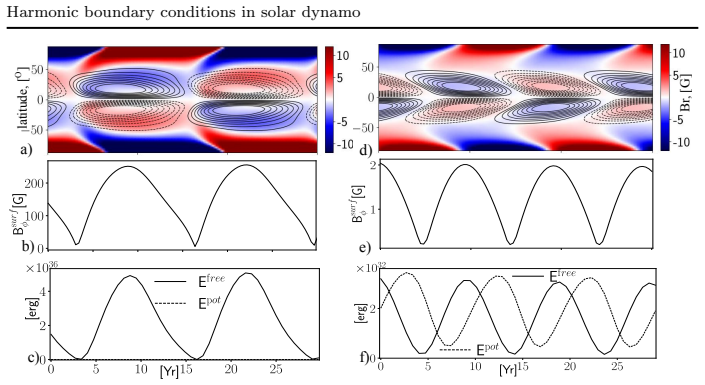
- If η_T^+/η_T is near unity, the dynamo is easier to excite (lower alpha threshold), cycles lengthen, and the surface toroidal field can exceed hundreds of gauss, supplying free energy for superflares in fast rotators.
- The coronal free energy scales quadratically with the surface toroidal field: E_free ∼ 0.3 R^3 |B_surf^φ|^2, linking direct surface measurements to coronal energy budgets.
- The harmonic boundary condition allows a magnetic helicity flux from the dynamo domain into the corona, producing a radial helicity inversion around cycle minima that matches solar wind observations.
- Variations in coronal diffusive properties provide a dynamical feedback loop between the convection-zone dynamo and coronal activity without needing a full wind model.
Reading between the lines
- If the coronal diffusivity ratio is itself modulated by magnetic activity, the mechanism offers a route to cycle-to-cycle modulation or grand-minima-like episodes by purely coronal changes, an extension the paper does not explore.
- The scaling E_free ∼ 0.3 R^3 |B_surf^φ|^2 could be tested on young solar analogs with Zeeman–Doppler imaging, translating measured surface toroidal fields into coronal free-energy predictions.
- A natural next step—flagged by the author's own caution—is to replace the homogeneous coronal diffusivity with a realistic wind or Alfvén-wave model; until then, the threshold and period variations are conditional on the harmonic-diffusion approximation.
- The predicted difference in instability threshold (about 1.5 in critical alpha) between low and high diffusivity ratios could be probed in convection simulations that include a coronal layer with a controlled diffusivity contrast.
Editorial analysis
A structured set of objections, weighed in public.
Referee Report
Summary. The paper studies an axisymmetric mean-field α^2Ω dynamo of the distributed type with harmonic outer boundary conditions following Bonanno (2016). The corona is modeled as a diffusive layer with scalar turbulent diffusivity η_T^+ between r=0.99R and 2.5R, with a source surface at 2.5R. Eigenvalue and nonlinear runs are used to explore the ratio η_T^+/η_T and the harmonic parameter ξ=kR. The paper reports that increasing the diffusivity contrast lowers the dynamo threshold, shortens the cycle period, reduces the surface toroidal field toward vacuum-like values, and changes coronal free energy and helicity. The ratio η_T^+/η_T≈1000 is calibrated to match observed surface toroidal field strengths of ~1–2 G. The eigenvalue code is made available in Zenodo.
Significance. If correct, the paper provides a simple parameterization linking coronal diffusive properties to dynamo excitation, cycle period, surface toroidal field, and coronal free energy. The strength of the paper is that it cleanly demonstrates, in a distributed dynamo model, a strong sensitivity to the top-boundary condition parameter η_T^+/η_T, which was not seen in bottom-dominated models; the eigenmode and nonlinear results are presented systematically. The eigenvalue code availability is a positive feature. The principal weakness is that the corona is modeled as a homogeneous scalar diffusive medium without derivation, and the paper explicitly defers justification to future work. The quantitative solar predictions are therefore conditional on this parameterization, and the authors' own caveat in Section 4 should be taken seriously in assessing the paper's scope.
major comments (3)
- [§3.2 (Fig. 3, Fig. 5, Fig. 6)] The nonlinear runs compare different η_T^+/η_T using the same C_α = 0.042 for all cases. According to Fig. 3(a), the critical C_α varies significantly with η_T^+/η_T: for η_T^+/η_T = 10 the run is much more supercritical than for η_T^+/η_T = 1000. The reported differences in period, surface toroidal amplitude, and free energy may therefore be partly due to different supercriticality rather than to the boundary condition itself. The central claim that the diffusivity contrast controls these quantities requires runs at fixed relative supercriticality (e.g., C_α = f × C_crit(η_T^+/η_T)) or a systematic scan in C_α for at least two ratios.
- [§2.2, Eq. (17), and §4] The model for the corona as a homogeneous scalar turbulent diffusive medium with coefficient η_T^(+) is assumed without derivation from coronal physics. The paper later calibrates η_T^+/η_T ≈ 1000 to reproduce the observed surface toroidal field, and the final section explicitly concedes that the model 'has to be further justified by using more realistic coronal models.' Since the threshold, period, surface field, and free-energy variations are all carried by this ratio, the solar inferences are conditional on the physical validity of Eq. (17). The paper should present this as a proof-of-concept parameter study and clearly separate the assumptions from the solar conclusions.
- [§2.2 (Eq. 17), Abstract] The statement that for η_T^+ >> η_T and ξ,k = 0 one returns to vacuum boundary conditions is built into the structure of Eq. (17) through the scaling of the right-hand side, rather than being an independent physical result. The finite-ratio dependence is a genuine numerical output, but the abstract's phrasing—that the model 'shows' this restoration—overstates the novelty. The asymptotic limit should be presented as an algebraic property of the matching condition, and the real content is the quantitative dependence at finite ratios.
minor comments (9)
- [§3.2] The phrase 'the same amplitude of the αeffect' should be 'α-effect'.
- [Fig. 5(a) caption] The caption 'surface radial magnetic field magnetic helicity density' is garbled; it should read 'surface radial magnetic field and magnetic helicity density'.
- [§4] 'Bawcock-Leighton' is a typo for 'Babcock-Leighton'.
- [§4] The phrase 'the solar corona is probably close to the ideal dielectric state' is imprecise; the intended meaning appears to be that the corona is nearly current-free and highly diffusive relative to the convection zone.
- [§3.1] 'we put no restriction' should be 'we place no restriction'.
- [Fig. 3 caption] 'convective convective envelope' has a duplicated word.
- [Code Availability] 'zenode archive' should be 'Zenodo archive'.
- [Eqs. (14)–(16)] The notation γ^(n) and ζ^(n) is used before it is defined; please define these coefficients explicitly when they are first introduced.
- [§2.2] In the vacuum boundary condition discussion, 'we have B=0' should specify that the toroidal component B vanishes; the poloidal field is matched to a potential field in the standard vacuum case.
Circularity Check
Boundary-condition limit restores vacuum by construction and the solar diffusivity ratio is fitted to the observed surface field, but the finite-ratio parametric results are genuine numerical outputs.
-
self definitional
[Section 2.2, Eq. (17); Abstract]
"For the case η+ T ≫ ηT and ξ, k = 0, we return to the case of the vacuum boundary conditions."
The boundary condition (17) is a Robin-type matching condition in which η_T^+ is the coronal diffusivity parameter. Its η_T^+ → ∞ limit is, by construction, the vacuum (B=0) boundary condition. The abstract's headline claim that a few-orders-of-magnitude jump 'restores' vacuum behavior is therefore a restatement of the definition of the boundary condition, not an independent prediction of the dynamo calculation.
-
fitted input called prediction
[Section 4 (Discussion)]
"For the Sun, the ratio η+ T /ηT = 1000 fits the weak, ∼1−2 G toroidal magnetic field on the surface."
The ratio is calibrated so that the model reproduces the observed weak surface toroidal field (Figure 6a is used to select the parameter). The later statements that the model 'agrees with' surface-field observations and yields solar-like cycle properties for this ratio are therefore conditioned on a parameter chosen to force that agreement; the surface-field amplitude is not predicted from first principles.
full rationale
The paper's central parametric results—variation of the dynamo threshold, period, and wave geometry with η_T^+/η_T, and the E_free ∝ B_surf^2 scaling—are genuine numerical outputs of an eigenvalue solver and nonlinear mean-field runs, and the model is benchmarked against helioseismic data and coronal energy estimates. However, two elements reduce to inputs: (i) the vacuum-limit behavior is an identity of Eq. (17), and (ii) the solar value of the ratio is fitted to the observed surface toroidal field rather than derived. The paper is transparent about both ('fits', 'has to be further justified by more realistic coronal models'), so the circularity is partial and localized. Score 4 reflects that the main parametric study retains independent content while the two highlighted steps are circular by construction or by calibration.
Assumptions & free parameters
free parameters (4)
- coronal-to-convective turbulent diffusivity ratio eta_T^+/eta_T =
1000 for the solar case; scanned from 1 to 1000
- dimensionless alpha-effect amplitude C_alpha =
0.042 in nonlinear runs; critical values extracted in eigenvalue runs
- harmonic wavenumber parameter xi = kR =
assumed (kR)^2 << 1; numerical value not reported in Results
- source-surface radius x_s =
2.5
assumptions (5)
- domain assumption The mean-field induction equation with the alpha-effect closure from P08 and Brandenburg et al. (2023) describes the large-scale solar dynamo.
- domain assumption The external coronal magnetic field satisfies the Helmholtz equation Delta B + k^2 B = 0 and becomes purely radial at r = 2.5R.
- ad hoc to paper The corona can be assigned a homogeneous effective turbulent diffusivity eta_T^(+) and the boundary condition in Eq (17), continuity of the tangential electromotive force, is the correct sewing condition.
- domain assumption Turbulent transport coefficients are computed from mixing-length theory with a MESA background and specified Pr_T and Pm_T.
- domain assumption Axisymmetry and the azimuthal averaging ansatz (Eq 3) are valid for the large-scale dynamo problem.
Cite this review
Pith. "Pith review of Effects of harmonic magnetic field boundary conditions in mean-field solar dynamo." pith.science (2026). https://pith.science/paper/T66QHIT6
@misc{pith2026250909985,
  author       = {Pith},
  title        = {Pith review of: Effects of harmonic magnetic field boundary conditions in mean-field solar dynamo},
  year         = {2026},
  howpublished = {\url{https://pith.science/paper/T66QHIT6}},
  note         = {Machine review of arXiv:2509.09985}
}
abstract
We consider effects of the harmonic magnetic field boundary conditions at the top of the dynamo domain on the dynamo stability inside the solar convection zone. These boundary conditions allow us to quantify the helical properties of the coronal magnetic field that stems from the dynamo region. In sewing the tangential component of the mean electric field we are able to take into account the effect the diffusive properties of the stellar corona on the dynamo instability. The model shows that effect of the vacuum boundary conditions can be restored if we introduce a few orders of magnitude jump of the coronal magnetic field turbulent diffusion over its typical value at the top of the dynamo domain. The parameters of this jump define the critical instability threshold of the $\alpha$ effect in the $\alpha^{2}\Omega$ dynamo.
Figures


Figures from the paper (4 more)



Reference graph
Works this paper leans on
-
[1]
barticle Blackman , E.G. , Brandenburg , A. : 2003 , Doubly Helical Coronal Ejections from Dynamos and Their Role in Sustaining the Solar Cycle . 584 , L99 . https://doi.org/10.1086/368374 . 2003ApJ...584L..99B . barticle
-
[2]
: 2016 , Stellar Dynamo Models with Prominent Surface Toroidal Fields
barticle Bonanno , A. : 2016 , Stellar Dynamo Models with Prominent Surface Toroidal Fields . 833 , L22 . https://doi.org/10.3847/2041-8213/833/2/L22 . 2016ApJ...833L..22B . barticle
-
[3]
: 2001 , Chebyshev and Fourier Spectram Methods , Second edition edn
bbook Boyd , J.P. : 2001 , Chebyshev and Fourier Spectram Methods , Second edition edn. Dover, New York , 688 . bbook
2001
-
[4]
: 2005 , The Case for a Distributed Solar Dynamo Shaped by Near-Surface Shear
barticle Brandenburg , A. : 2005 , The Case for a Distributed Solar Dynamo Shaped by Near-Surface Shear . Astrophys. J. 625 , 539 . barticle
2005
-
[5]
: 2018 , Advances in mean-field dynamo theory and applications to astrophysical turbulence
barticle Brandenburg , A. : 2018 , Advances in mean-field dynamo theory and applications to astrophysical turbulence . Journal of Plasma Physics 84 , 735840404 . https://doi.org/10.1017/S0022377818000806 . \#abs/2018JPlPh..84d7304B . barticle
-
[6]
barticle Brandenburg , A. , Subramanian , K. , Balogh , A. , Goldstein , M.L. : 2011 , Scale Dependence of Magnetic Helicity in the Solar Wind . 734 , 9 . https://doi.org/10.1088/0004-637X/734/1/9 . 2011ApJ...734....9B . barticle
-
[7]
barticle Brandenburg , A. , Elstner , D. , Masada , Y. , Pipin , V.V. : 2023 , Turbulent Processes and Mean-Field Dynamo . 219 , 55 . https://doi.org/10.1007/s11214-023-00999-3 . 2023SSRv..219...55B . barticle
-
[8]
barticle Duvall , T.L. Jr. , Scherrer , P.H. , Svalgaard , L. , Wilcox , J.M. : 1979 , Average photospheric poloidal and toroidal magnetic field components near solar minimum . 61 , 233 . https://doi.org/10.1007/BF00150408 . 1979SoPh...61..233D . barticle
Show all 40 references
-
[9]
, Fournier , Y
bchapter Elstner , D. , Fournier , Y. , Arlt , R. : 2020 , Various scenarios for the equatorward migration of sunspots . In: Kosovichev , A. , Strassmeier , S. , Jardine , M. (eds.) Solar and Stellar Magnetic Fields: Origins and Manifestations , IAU Symposium 354 , 134 . https...
2020 doi
-
[10]
, Subramanian , K
barticle Gopalakrishnan , K. , Subramanian , K. : 2023 , Magnetic Helicity Fluxes from Triple Correlators . 943 , 66 . https://doi.org/10.3847/1538-4357/aca808 . 2023ApJ...943...66G . barticle
2023 doi
-
[11]
, Millman , K.J
barticle Harris , C.R. , Millman , K.J. , van der Walt , S.J. , Gommers , R. , Virtanen , P. , Cournapeau , D. , Wieser , E. , Taylor , J. , Berg , S. , Smith , N.J. , Kern , R. , Picus , M. , Hoyer , S. , van Kerkwijk , M.H. , Brett , M. , Haldane , A. , del R \' i o , J.F. ,...
2020
-
[12]
, Nandy , D
barticle Hazra , G. , Nandy , D. , Kitchatinov , L.L. , Choudhuri , A.R. : 2023 , Mean Field Models of Flux Transport Dynamo and Meridional Circulation in the Sun and Stars . 219 , 39 . https://doi.org/10.1007/s11214-023-00982-y . 2023SSRv..219...39H . barticle
2023 doi
-
[13]
: 2007 , Matplotlib: A 2D graphics environment
barticle Hunter , J.D. : 2007 , Matplotlib: A 2D graphics environment . Computing in Science & Engineering 9 , 90 . https://doi.org/10.1109/MCSE.2007.55 . barticle
2007 doi
-
[14]
, Brandenburg , A
barticle Jakab , P. , Brandenburg , A. : 2021 , The effect of a dynamo-generated field on the Parker wind . 647 , A18 . https://doi.org/10.1051/0004-6361/202038564 . 2021A&A...647A..18J . barticle
2021 doi
-
[15]
, Mazur , M.V
barticle Kitchatinov , L.L. , Mazur , M.V. , Jardine , M. : 2000 , Magnetic field escape from a stellar convection zone and the dynamo-cycle period . 359 , 531 . 2000A\ barticle
2000
-
[16]
, Rogachevskii , I
barticle Kleeorin , N. , Rogachevskii , I. : 1999 , Magnetic helicity tensor for an anisotropic turbulence . Phys. Rev.E 59 , 6724 . barticle
1999
-
[17]
, Rogachevskii , I
barticle Kleeorin , N. , Rogachevskii , I. : 2022 , Turbulent magnetic helicity fluxes in solar convective zone . 515 , 5437 . https://doi.org/10.1093/mnras/stac2141 . 2022MNRAS.515.5437K . barticle
2022 doi
-
[18]
, Stenflo , J.O
barticle Knaack , R. , Stenflo , J.O. : 2005 , Spherical harmonic decomposition of solar magnetic fields . 438 , 349 . https://doi.org/10.1051/0004-6361:20052765 . 2005AA...438..349K . barticle
2005 doi
-
[19]
, Pipin , V.V
barticle Kosovichev , A.G. , Pipin , V.V. : 2019 , Dynamo Wave Patterns inside of the Sun Revealed by Torsional Oscillations . 871 , L20 . https://doi.org/10.3847/2041-8213/aafe82 . 2019ApJ...871L..20K . barticle
2019 doi
-
[20]
, R\"adler , K.-H
bbook Krause , F. , R\"adler , K.-H. : 1980 , Mean-Field Magnetohydrodynamics and Dynamo Theory , Berlin: Akademie-Verlag , 271 . bbook
1980
-
[21]
, Hoeksema , J.T
bchapter Lo , L. , Hoeksema , J.T. , Scherrer , P.H. : 2010 , Three Cycles of the Solar Toroidal Magnetic Field and This Peculiar Minimum . In: Cranmer , S.R. , Hoeksema , J.T. , Kohl , J.L. (eds.) SOHO-23: Understanding a Peculiar Solar Minimum , Astronomical Society of the P...
2010
-
[22]
, Kosovichev , A.G
barticle Mandal , K. , Kosovichev , A.G. , Pipin , V.V. : 2024 , Helioseismic Properties of Dynamo Waves in the Variation of Solar Differential Rotation . 973 , 36 . https://doi.org/10.3847/1538-4357/ad5f2c . 2024ApJ...973...36M . barticle
2024 doi
-
[23]
, Candelaresi , S
barticle Mitra , D. , Candelaresi , S. , Chatterjee , P. , Tavakol , R. , Brandenburg , A. : 2010 , Equatorial magnetic helicity flux in simulations with different gauges . Astronomische Nachrichten 331 , 130 . https://doi.org/10.1002/asna.200911308 . 2010AN....331..130M . barticle
2010 doi
-
[24]
, Brandenburg , A
barticle Moss , D. , Brandenburg , A. : 1992 , The influence of boundary conditions on the excitation of disk dynamo modes . 256 , 371 . 1992A\ barticle
1992
-
[25]
, Pipin , V.V
barticle Obridko , V.N. , Pipin , V.V. , Sokoloff , D. , Shibalova , A.S. : 2021 , Solar large-scale magnetic field and cycle patterns in solar dynamo . 504 , 4990 . https://doi.org/10.1093/mnras/stab1062 . 2021MNRAS.504.4990O . barticle
2021 doi
-
[26]
, Notsu , Y
barticle Okamoto , S. , Notsu , Y. , Maehara , H. , Namekata , K. , Honda , S. , Ikuta , K. , Nogami , D. , Shibata , K. : 2021 , Statistical Properties of Superflares on Solar-type Stars: Results Using All of the Kepler Primary Mission Data . 906 , 72 . https://doi.org/10.384...
2021 doi
-
[27]
: 1955 , Hydromagnetic Dynamo Models
barticle Parker , E.N. : 1955 , Hydromagnetic Dynamo Models . Astrophys. J. 122 , 293 . barticle
1955
-
[28]
, Cantiello , M
barticle Paxton , B. , Cantiello , M. , Arras , P. , Bildsten , L. , Brown , E.F. , Dotter , A. , Mankovich , C. , Montgomery , M.H. , Stello , D. , Timmes , F.X. , Townsend , R. : 2013 , Modules for Experiments in Stellar Astrophysics (MESA): Planets, Oscillations, Rotation, ...
2013 doi
-
[29]
, Brun , A.S
barticle Perri , B. , Brun , A.S. , Strugarek , A. , R \'e ville , V. : 2021 , Dynamical Coupling of a Mean-field Dynamo and Its Wind: Feedback Loop over a Stellar Activity Cycle . 910 , 50 . https://doi.org/10.3847/1538-4357/abe2ac . 2021ApJ...910...50P . barticle
2021 doi
-
[30]
, Bertello , L
barticle Pevtsov , A.A. , Bertello , L. , Nagovitsyn , Y.A. , Tlatov , A.G. , Pipin , V.V. : 2021 , Long-term studies of photospheric magnetic fields on the Sun . Journal of Space Weather and Space Climate 11 , 4 . https://doi.org/10.1051/swsc/2020069 . 2021JSWSC..11....4P . barticle
2021
-
[31]
: 2008 , The mean electro-motive force and current helicity under the influence of rotation, magnetic field and shear
barticle Pipin , V.V. : 2008 , The mean electro-motive force and current helicity under the influence of rotation, magnetic field and shear . Geophysical and Astrophysical Fluid Dynamics 102 , 21 . 2008GApFD.102...21P . barticle
2008
-
[32]
: 2023 , Spatio-temporal non-localities in a solar-like mean-field dynamo
barticle Pipin , V.V. : 2023 , Spatio-temporal non-localities in a solar-like mean-field dynamo . 522 , 2919 . https://doi.org/10.1093/mnras/stad1150 . 2023MNRAS.522.2919P . barticle
2023 doi
-
[33]
, Kosovichev , A.G
barticle Pipin , V.V. , Kosovichev , A.G. : 2011 , The Asymmetry of Sunspot Cycles and Waldmeier Relations as a Result of Nonlinear Surface-shear Shaped Dynamo . ApJ 741 , 1 . https://doi.org/10.1088/0004-637X/741/1/1 . 2011ApJ...741....1P . barticle
2011 doi
-
[34]
, Kosovichev , A.G
barticle Pipin , V.V. , Kosovichev , A.G. : 2019 , On the Origin of Solar Torsional Oscillations and Extended Solar Cycle . 887 , 215 . https://doi.org/10.3847/1538-4357/ab5952 . 2019ApJ...887..215P . barticle
2019 doi
-
[35]
, Yang , S
botherref Pipin , V.V. , Yang , S. , Kosovichev , A.G. : 2025, Helicity Fluxes and Hemispheric Helicity Rule of Active Regions Emerging from the Convection Zone Dynamo . arXiv e-prints, arXiv:2508.00309. https://doi.org/10.48550/arXiv.2508.00309 . 2025arXiv250800309P . botherref
-
[36]
, Jardine , M
barticle See , V. , Jardine , M. , Vidotto , A.A. , Donati , J.-F. , Boro Saikia , S. , Bouvier , J. , Fares , R. , Folsom , C.P. , Gregory , S.G. , Hussain , G. , Jeffers , S.V. , Marsden , S.C. , Morin , J. , Moutou , C. , do Nascimento , J.D. , Petit , P. , Waite , I.A. : 2...
2016 doi
-
[37]
, Kaszynski , A
barticle Sullivan , C.B. , Kaszynski , A. : 2019 , PyVista : 3D plotting and mesh analysis through a streamlined interface for the Visualization Toolkit ( VTK ) . Journal of Open Source Software 4 , 1450 . https://doi.org/10.21105/joss.01450 . https://doi.org/10.21105/joss.014...
2019 doi
-
[38]
, Lehmann , L.T
barticle Vidotto , A.A. , Lehmann , L.T. , Jardine , M. , Pevtsov , A.A. : 2018 , The magnetic field vector of the Sun-as-a-star - II. Evolution of the large-scale vector field through activity cycle 24 . 480 , 477 . https://doi.org/10.1093/mnras/sty1926 . \#abs/2018MNRAS.480....
2018 doi
-
[39]
, Gommers , R
barticle Virtanen , P. , Gommers , R. , Oliphant , T.E. , Haberland , M. , Reddy , T. , Cournapeau , D. , Burovski , E. , Peterson , P. , Weckesser , W. , Bright , J. , van der Walt , S.J. , Brett , M. , Wilson , J. , Millman , K.J. , Mayorov , N. , Nelson , A.R.J. , Jones , E...
2020
-
[40]
: 2024 , The Sun's Non-Potential Corona over Solar Cycle 24
barticle Yeates , A.R. : 2024 , The Sun's Non-Potential Corona over Solar Cycle 24 . 299 , 83 . https://doi.org/10.1007/s11207-024-02328-5 . 2024SoPh..299...83Y . barticle
2024 doi
Reviewed August 4, 2026 · model on record in the stance chip above.
Discussion (0). Continue with ORCID to comment.