Carryless Pairing: Additive Pairing in the Fibonacci Basis
Pith reviewed 2026-05-18 17:29 UTC · model grok-4.3
The pith
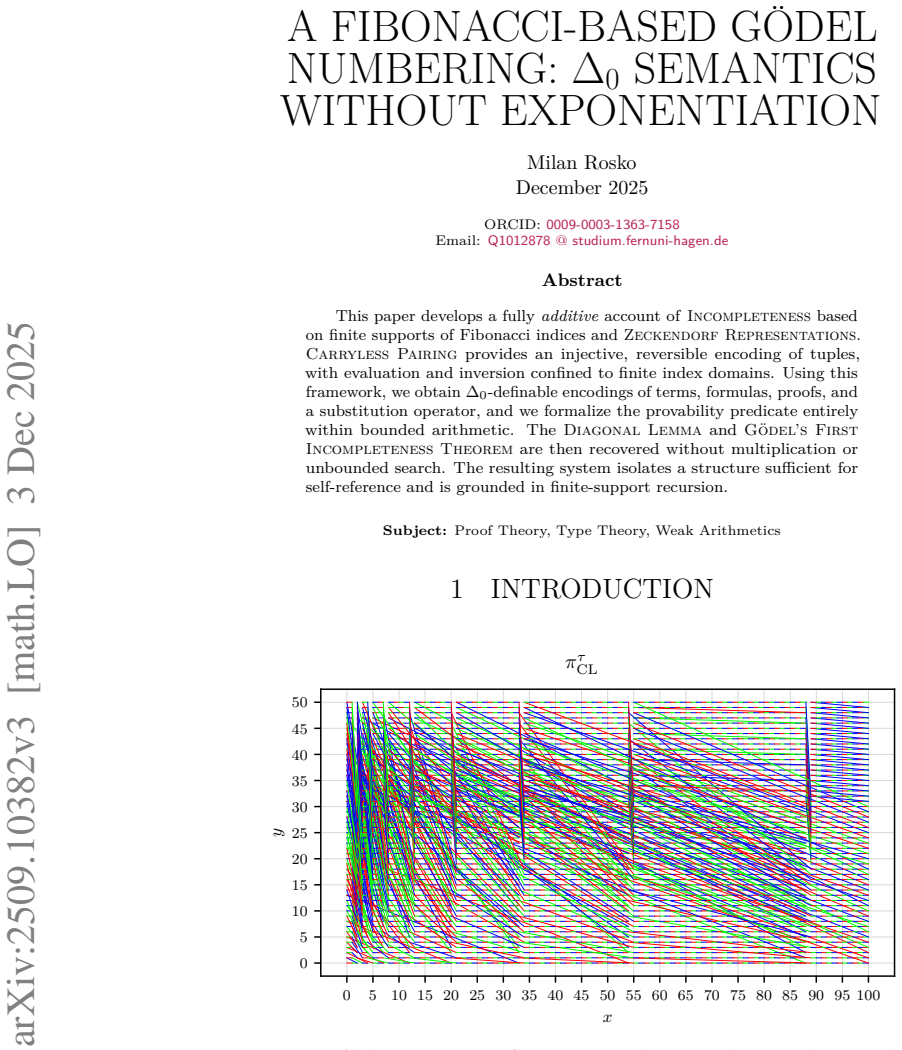
A carryless pairing map encodes pairs of natural numbers into one by placing their Zeckendorf supports into two disjoint Fibonacci index bands separated by a delimiter from the first number.
A machine-rendered reading of the paper's core claim, the machinery that carries it, and where it could break.
Core claim
The map π_CL is defined by computing a delimiter from x to separate two bands of indices; the Zeckendorf support of y is placed in the first band and the support of x in the second, producing a code whose index set has no consecutive elements and is therefore already Zeckendorf normal. The map is injective, and both evaluation and partial inversion are performed by support operations alone.
What carries the argument
The delimiter computed from x that separates the two bands of Zeckendorf indices, ensuring the combined support remains free of consecutive indices.
If this is right
- Different input pairs always produce different outputs because the map is injective.
- Decoding recovers x and y by locating the delimiter and reading the two separated supports.
- Image membership can be decided by checking the band structure and delimiter without full inversion.
- All steps remain within additive support manipulations on the Fibonacci indices.
Where Pith is reading between the lines
- The band-separation technique might extend to representations in other linear recurrence bases.
- The additive-only operations could reduce computational cost in contexts where multiplication is restricted.
- Formal mechanization in Rocq opens a path to verified pairing primitives inside proof assistants.
Load-bearing premise
The delimiter computed from x always produces two bands whose supports remain disjoint and free of consecutive indices after placement of y's Zeckendorf support.
What would settle it
An explicit pair x and y such that the index set of π_CL(x, y) contains at least one pair of consecutive Fibonacci numbers.
Figures


read the original abstract
We define a pairing map $\pi_{\mathsf{CL}} : \mathbb{N}^2\to\mathbb{N}$ that encodes $x$ and $y$ into two disjoint bands of Zeckendorf indices separated by a delimiter computed from $x$. The construction is "carryless" by design: the combined support has no consecutive indices, so each produced code is already in Zeckendorf-normal form, and both evaluation and inversion proceed by additive support operations alone, without multiplication, factorization, or positional digit interleaving. The map is injective not surjective, image membership is decidable by the same support machinery used for decoding. The core correctness theorems are mechanized in Rocq.
Editorial analysis
A structured set of objections, weighed in public.
Referee Report
Summary. The paper defines a pairing map π_CL : ℕ² → ℕ that encodes x and y into two disjoint bands of Zeckendorf indices separated by a delimiter computed from x. The construction is carryless: the combined support has no consecutive indices, so each code is already in Zeckendorf form, and both evaluation and inversion use only additive support operations. The map is injective (not surjective), image membership is decidable via support operations, and the core correctness theorems are mechanized in Rocq.
Significance. If the mechanized results hold, the construction supplies a parameter-free, additive pairing function in the Fibonacci basis that avoids multiplication, factorization, and positional interleaving. The Rocq mechanization of injectivity and decoding provides independent, machine-checked evidence for the delimiter construction and the preservation of Zeckendorf normality, which strengthens the contribution for constructive mathematics and formal verification.
minor comments (2)
- [Abstract] Abstract: the description of the delimiter is high-level; a brief formula or pseudocode for its computation from x would improve immediate readability.
- The manuscript would benefit from a short worked example (e.g., π_CL(3,5)) showing the Zeckendorf supports, delimiter placement, and resulting code before the formal definitions.
Simulated Author's Rebuttal
We thank the referee for the positive assessment of the carryless pairing construction, the recognition of its significance for constructive mathematics and formal verification, and the recommendation for minor revision. No specific major comments were raised.
Circularity Check
No significant circularity: direct definition with mechanized Rocq proofs
full rationale
The paper defines π_CL directly via Zeckendorf supports, bands, and a delimiter computed from x, then states that injectivity, decoding correctness, and image-membership decidability are mechanized in Rocq. Mechanized proofs constitute independent evidence under the review criteria. No equation reduces the claimed properties to a fitted parameter, self-citation chain, or ansatz; the construction is self-contained and the central claims rest on the formal verification rather than on any internal renaming or load-bearing self-reference.
Axiom & Free-Parameter Ledger
axioms (2)
- standard math Every natural number has a unique Zeckendorf representation as a sum of non-consecutive Fibonacci numbers.
- domain assumption A delimiter position derived from x can always be chosen so that the supports of x and y remain disjoint and non-adjacent.
Lean theorems connected to this paper
-
IndisputableMonolith/Constants.leanphi_golden_ratio echoes?
echoesECHOES: this paper passage has the same mathematical shape or conceptual pattern as the Recognition theorem, but is not a direct formal dependency.
every natural number admits a unique decomposition as a sum of non-consecutive Fibonacci numbers... Z(n) is finite and has no adjacent elements (Theorem 2.3, Definition 2.4)
-
IndisputableMonolith/Cost/FunctionalEquation.leanwashburn_uniqueness_aczel echoes?
echoesECHOES: this paper passage has the same mathematical shape or conceptual pattern as the Recognition theorem, but is not a direct formal dependency.
the combined support has no consecutive indices, so each produced code is already in Zeckendorf-normal form... π_CL is injective (Lemma 3.6, Theorem 3.7)
What do these tags mean?
- matches
- The paper's claim is directly supported by a theorem in the formal canon.
- supports
- The theorem supports part of the paper's argument, but the paper may add assumptions or extra steps.
- extends
- The paper goes beyond the formal theorem; the theorem is a base layer rather than the whole result.
- uses
- The paper appears to rely on the theorem as machinery.
- contradicts
- The paper's claim conflicts with a theorem or certificate in the canon.
- unclear
- Pith found a possible connection, but the passage is too broad, indirect, or ambiguous to say the theorem truly supports the claim.
Reference graph
Works this paper leans on
-
[1]
Samuel R. Buss. Bounded Arithmetic. Bibliopolis, Naples, 1986. ISBN 88-7088-149-0. Ph.D. thesis published as a book; foundational for bounded arithmetic and _0 -definability
work page 1986
- [2]
-
[3]
Kurt G \"o del. \"U ber formal unentscheidbare s \"a tze der principia mathematica und verwandter systeme i. Monatshefte f \"u r Mathematik und Physik , 38 0 (1): 0 173--198, 1931. doi:10.1007/BF01700692. Gödel's original incompleteness paper introducing Gödel numbering
-
[4]
On formally undecidable propositions of Principia Mathematica and related systems i
Kurt G \"o del. On formally undecidable propositions of Principia Mathematica and related systems i. In Martin Davis, editor, The Undecidable: Basic Papers on Undecidable Propositions, Unsolvable Problems and Computable Functions, pages 5--38. Raven Press, New York, 1965. English translation of Gödel's 1931 paper
work page 1965
-
[5]
James P. Jones. Universal Diophantine equation. The Journal of Symbolic Logic, 47 0 (3): 0 549--571, 1982. doi:10.2307/2273588. Constructs a universal Diophantine equation of degree 4
-
[6]
C. G. Lekkerkerker. Voorstelling van natuurlijke getallen door een som van getallen van fibonacci. Zuivere Wiskunde, 1951
work page 1951
-
[7]
Yuri V. Matiyasevich. Enumerable sets are diophantine. Soviet Mathematics Doklady, 11: 0 354--358, 1970
work page 1970
-
[8]
Characterizing integers among rational numbers with a universal-existential formula
Bjorn Poonen. Characterizing integers among rational numbers with a universal-existential formula. American Journal of Mathematics, 131 0 (3): 0 675--682, 2009. doi:10.1353/ajm.0.0055. Discusses undecidability in number theory and Diophantine equations; relevant to degree bounds
- [9]
-
[10]
J. Barkley Rosser. Extensions of some theorems of G \"o del and Church . Journal of Symbolic Logic, 1 0 (3): 0 87--91, 1936
work page 1936
-
[11]
Ray J. Solomonoff. A formal theory of inductive inference. part i. Information and Control, 7 0 (1): 0 1--22, 1964. doi:10.1016/S0019-9958(64)90223-2
-
[12]
Repr \'e sentation des nombres naturels par une somme de nombres de Fibonacci ou de nombres de Lucas
Edouard Zeckendorf. Repr \'e sentation des nombres naturels par une somme de nombres de Fibonacci ou de nombres de Lucas . Bulletin de la Soci \'e t \'e Royale des Sciences de Li \`e ge , 41 0 (4-6): 0 179--182, 1972. Often cited for Zeckendorf's theorem on unique Fibonacci representations
work page 1972
discussion (0)
Sign in with ORCID, Apple, or X to comment. Anyone can read and Pith papers without signing in.