Primordial Black Holes (PBHs) and The Signatures of Cosmic Non-Gaussianity
Pith reviewed 2026-05-18 16:58 UTC · model grok-4.3
The pith
The exact sudden-decay relation in the curvaton scenario yields the full non-Gaussian probability distribution of curvature perturbations from which primordial black hole abundances are computed directly.
A machine-rendered reading of the paper's core claim, the machinery that carries it, and where it could break.
Core claim
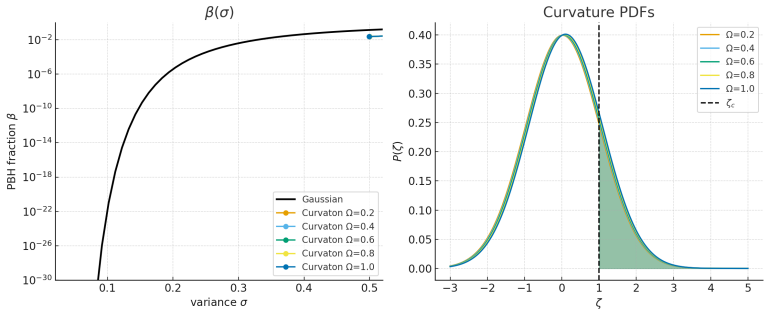
In the curvaton scenario the curvature perturbation is derived from the exact sudden-decay relation, the full probability density function is obtained through an explicit branchwise change of variables from the Gaussian curvaton-field fluctuation, and the primordial black-hole formation fraction is evaluated from the exact non-perturbative tail; the same model supplies a self-consistent fluctuation spectrum that replaces scale-by-scale variance matching and generates the induced gravitational-wave background.
What carries the argument
The exact sudden-decay relation between the curvaton field value and the curvature perturbation, which enables an explicit branchwise change of variables that maps the Gaussian field distribution onto the complete non-Gaussian curvature perturbation probability density function.
If this is right
- The primordial black hole mass function follows directly from the exact non-perturbative tail without perturbative truncation or additional fitting.
- Induced gravitational wave spectra are generated from the linear curvaton two-point function within the same self-consistent model.
- Predictions differ measurably from both the pure Gaussian case and the exact local quadratic benchmark.
- Current conservative constraints on primordial black holes can be confronted with mass functions computed once for the entire spectrum.
Where Pith is reading between the lines
- The branchwise method could be extended to other sources of non-Gaussianity such as multi-field inflation to obtain similarly exact tails.
- Precision measurements of the stochastic gravitational wave background by future detectors could distinguish this curvaton signature from other early-universe scenarios.
- The exact tail calculation may tighten or relax existing limits on curvaton parameters once applied to updated observational envelopes.
Load-bearing premise
The curvaton decays suddenly so that the curvature perturbation is given directly by the field value before decay without any gradual transition or smoothing corrections.
What would settle it
A numerical simulation or observation showing that the actual mapping from curvaton field to curvature perturbation deviates substantially from the sudden-decay formula on the relevant scales would invalidate the exact tail used for the black-hole fraction.
Figures




read the original abstract
Primordial black-hole formation depends exponentially on the far tail of the primordial curvature-perturbation distribution. That sensitivity makes the small-scale collapse problem a sharp probe of primordial non-Gaussianity. We study the curvaton scenario by deriving the curvature perturbation from the exact sudden-decay relation, obtaining the full probability density function through an explicit branchwise change of variables from the Gaussian curvaton-field fluctuation, and evaluating the primordial black-hole formation fraction from the exact non-perturbative tail. The derivation is written step by step, with the support of the distribution, the Jacobian, the normalization, and the small-fluctuation expansion displayed in analytic form. We place the exact curvaton prediction beside the Gaussian benchmark and beside an exact local quadratic benchmark in which the non-Gaussian probability density is also computed without an Edgeworth truncation. We then replace the scale-by-scale variance-matching ansatz by a self-consistent curvaton fluctuation model in which the dimensionless field fluctuation spectrum is specified once, the smoothed curvaton variance is computed directly, the exact collapse fraction follows with no further fitting on each scale, and the induced gravitational-wave background is generated from the linear curvaton two-point spectrum implied by the same model. The resulting mass functions are confronted with a conservative current constraint envelope motivated by recent primordial-black-hole reviews, and the induced gravitational-wave spectra are displayed against the PTA, LISA, and DECIGO sensitivity windows. The final figures are generated from a single mathematically consistent numerical pipeline.
Editorial analysis
A structured set of objections, weighed in public.
Referee Report
Summary. The manuscript studies the curvaton scenario for primordial black hole formation by deriving the curvature perturbation from the exact sudden-decay relation. It obtains the full probability density function of the curvature perturbation through a branchwise change of variables from Gaussian field fluctuations and evaluates the PBH formation fraction from the exact non-perturbative tail. The results are compared to Gaussian and local quadratic non-Gaussian cases. A self-consistent model is used where the dimensionless field fluctuation spectrum is specified once, allowing direct computation of smoothed variances and collapse fractions without additional per-scale fitting. The induced gravitational wave background is generated from the linear spectrum, and the mass functions are compared to constraints with GW spectra shown against observational windows.
Significance. If the central derivations hold, the work provides a non-perturbative analytic treatment of non-Gaussianity in the curvaton model for PBH formation, valuable due to the exponential sensitivity of PBH abundance to the tail. The explicit step-by-step analytic forms for the Jacobian, normalization, support, and small-fluctuation expansion, together with the self-consistent fluctuation model that avoids per-scale variance matching, are strengths. Confrontation with current constraints and display of induced GW spectra against PTA/LISA/DECIGO windows add observational relevance.
major comments (1)
- [Derivation of the curvature perturbation from the exact sudden-decay relation] The central construction obtains the PDF of ζ by an explicit change of variables using the sudden-decay mapping ζ = (2/3) ln(1 + (3/2)σ/σ_d) (or equivalent) inserted directly before the Jacobian and support calculation. This assumes instantaneous decay. Realistic models with finite decay rate Γ introduce smoothing from integrated decay dynamics that suppresses the extreme positive tail controlling the PBH collapse fraction. This premise is load-bearing for the claim of an 'exact non-perturbative tail' and the resulting PBH mass functions.
minor comments (3)
- [Self-consistent curvaton fluctuation model] The self-consistent model reduces per-scale fitting but still treats the dimensionless field fluctuation spectrum as a free parameter whose value is chosen once; clarify how this choice is motivated or varied to test robustness of the final mass functions and GW spectra.
- [Probability density function derivation] Ensure that the support of the distribution and the branchwise handling in the change-of-variables step are illustrated with an explicit equation or figure for the reader to follow the normalization.
- [Results and figures] The figures displaying mass functions against the conservative constraint envelope and GW spectra against sensitivity windows are useful; verify that all curves are labeled with the corresponding model (exact curvaton, Gaussian benchmark, quadratic) for clarity.
Simulated Author's Rebuttal
We thank the referee for the careful reading and constructive comments. We address the major comment below and indicate the revisions we will implement.
read point-by-point responses
-
Referee: The central construction obtains the PDF of ζ by an explicit change of variables using the sudden-decay mapping ζ = (2/3) ln(1 + (3/2)σ/σ_d) (or equivalent) inserted directly before the Jacobian and support calculation. This assumes instantaneous decay. Realistic models with finite decay rate Γ introduce smoothing from integrated decay dynamics that suppresses the extreme positive tail controlling the PBH collapse fraction. This premise is load-bearing for the claim of an 'exact non-perturbative tail' and the resulting PBH mass functions.
Authors: We agree that the sudden-decay approximation is central to our analytic derivation and that a finite decay width would introduce smoothing that could suppress the far positive tail. Our manuscript explicitly adopts the sudden-decay relation as a standard analytic limit in the curvaton literature, allowing the exact branchwise change-of-variables PDF to be derived without truncation. We will revise the text to add a dedicated paragraph in Section 2 (or the discussion) that (i) states the approximation explicitly, (ii) cites literature on finite-Γ effects, and (iii) notes that the reported tail represents the limiting case of maximal non-Gaussian enhancement. This clarifies the scope without altering the central derivations. revision: yes
- Quantitative evaluation of the tail suppression under a finite decay rate Γ, which would require a separate integration over the decay dynamics outside the present sudden-decay framework.
Circularity Check
Derivation proceeds via explicit change-of-variables from stated sudden-decay relation; self-consistent spectrum replaces per-scale fitting without reducing to input by construction
full rationale
The central steps derive the full PDF of ζ from Gaussian σ fluctuations by applying the exact sudden-decay mapping ζ = (2/3) ln(1 + (3/2)σ/σ_d) followed by Jacobian and support calculation. This is a direct mathematical transformation, not a redefinition or fit. The self-consistent curvaton model specifies the dimensionless field fluctuation spectrum once, computes smoothed variances directly, and obtains the collapse fraction with no further per-scale fitting; the resulting mass functions and induced GW spectra are generated from this single pipeline and confronted with external constraints. No self-citations, uniqueness theorems, or ansatzes smuggled via prior work are invoked as load-bearing. The sudden-decay premise is an explicit model assumption whose consequences are computed rather than presupposed, so the derivation chain remains self-contained against the stated benchmarks.
Axiom & Free-Parameter Ledger
free parameters (1)
- dimensionless field fluctuation spectrum
axioms (2)
- domain assumption Curvaton field fluctuations are Gaussian
- domain assumption Sudden decay approximation holds
Lean theorems connected to this paper
-
IndisputableMonolith/Cost/FunctionalEquation.leanwashburn_uniqueness_aczel unclear?
unclearRelation between the paper passage and the cited Recognition theorem.
Solving Eq. (15) gives e^{3ζ_χ} = Y(ζ) ≡ 1/Ω (e^{3ζ} + (Ω-1)e^{-ζ}); combining with e^{3ζ_χ} = (1 + δχ/χ̄)^2 yields the mapping δχ(ζ) = χ̄ (±√(Y(ζ)−1)) and the change-of-variables PDF P_ζ(ζ) = Σ_s P_χ(δχ_s(ζ)) |dδχ_s/dζ|.
What do these tags mean?
- matches
- The paper's claim is directly supported by a theorem in the formal canon.
- supports
- The theorem supports part of the paper's argument, but the paper may add assumptions or extra steps.
- extends
- The paper goes beyond the formal theorem; the theorem is a base layer rather than the whole result.
- uses
- The paper appears to rely on the theorem as machinery.
- contradicts
- The paper's claim conflicts with a theorem or certificate in the canon.
- unclear
- Pith found a possible connection, but the passage is too broad, indirect, or ambiguous to say the theorem truly supports the claim.
Reference graph
Works this paper leans on
-
[1]
K. Ando, M. Kawasaki, and H. Nakatsuka. Formation of primordial black holes in an axion-like curvaton model.Phys. Rev. D, 98(8):083508, 2018
work page 2018
-
[2]
N. Bartolo, S. Matarrese, and A. Riotto. Non-gaussianity from inflation.Phys. Rev. D, 65:103505, 2002
work page 2002
-
[3]
R. Bean and J. Magueijo. Could supermassive black holes be quintessential primor- dial black holes?Phys. Rev. D, 66:063505, 2002
work page 2002
-
[4]
J. S. Bullock and J. R. Primack. Non-gaussian fluctuations and primordial black holes from inflation.Phys. Rev. D, 55:7423–7439, 1997
work page 1997
-
[5]
C. T. Byrnes, E. J. Copeland, and A. M. Green. Primordial black holes as a tool for constraining non-gaussianity.Phys. Rev. D, 86:043512, 2012
work page 2012
-
[6]
B. Carr, K. Kohri, Y. Sendouda, and J. Yokoyama. Constraints on primordial black holes.Rept. Prog. Phys., 84(11):116902, 2021
work page 2021
-
[7]
B. Carr, F. Kuhnel, and M. Sandstad. Primordial black holes as dark matter.Phys. Rev. D, 94(8):083504, 2016
work page 2016
-
[8]
B. J. Carr and S. W. Hawking. Black holes in the early universe.Mon. Not. Roy. Astron. Soc., 168:399–415, 1974
work page 1974
-
[9]
X. Chen. Primordial non-gaussianities from inflation models.Adv. Astron., 2010:638979, 2010
work page 2010
-
[10]
L. S. Collaboration and V. Collaboration. Observation of gravitational waves from a binary black hole merger.Phys. Rev. Lett., 116(6):061102, 2016
work page 2016
-
[11]
N. Collaboration. The nanograv 15-year data set: Evidence for a gravitational-wave background.Astrophys. J. Lett., 951(1):L8, 2023
work page 2023
-
[12]
P. Collaboration. Planck 2018 results. x. constraints on inflation.Astron. Astrophys., 641:A10, 2020
work page 2018
-
[13]
K. Enqvist, A. Jokinen, S. Kasuya, and A. Mazumdar. Non-gaussianity from pre- heating.Phys. Rev. Lett., 94:161301, 2005
work page 2005
-
[14]
K. Enqvist, S. Nurmi, O. Taanila, and T. Takahashi. Non-gaussian fingerprints of self-interacting curvaton.JCAP, 11:034, 2013
work page 2013
-
[15]
J. Garcia-Bellido and E. Ruiz Morales. Primordial black holes from single field models of inflation.Phys. Dark Univ., 18:47–54, 2017
work page 2017
-
[16]
A. M. Green and B. J. Kavanagh. Primordial black holes as a dark matter candidate. J. Phys. G, 48(4):043001, 2021
work page 2021
-
[17]
A. M. Green and A. R. Liddle. Constraints on the density perturbation spectrum from primordial black holes.Phys. Rev. D, 56:6166–6174, 1997
work page 1997
- [18]
- [19]
-
[20]
P. Ivanov. Nonlinear metric perturbations and production of primordial black holes. Phys. Rev. D, 57:7145–7154, 1998
work page 1998
-
[21]
A. S. Josan, A. M. Green, and K. A. Malik. Generalised constraints on the curvature perturbation from primordial black holes.Phys. Rev. D, 79:103520, 2009
work page 2009
-
[22]
M. Kawasaki and Y. Tada. Can primordial black holes as dark matter and second order gravitational waves be probed by pulsar timing array?JCAP, 08:041, 2013
work page 2013
-
[23]
K. Kohri, C.-M. Lin, and T. Matsuda. Primordial black holes from the inflating curvaton. 2012
work page 2012
-
[24]
E. Komatsu and D. N. Spergel. Acoustic signatures in the primary microwave back- ground bispectrum.Phys. Rev. D, 63:063002, 2001
work page 2001
-
[25]
M. LoVerde, A. Miller, S. Shandera, and L. Verde. Effects of scale-dependent non- gaussianity on cosmological structures.JCAP, 04:014, 2008
work page 2008
-
[26]
D. H. Lyth and Y. Rodriguez. The inflationary prediction for primordial non- gaussianity.Phys. Rev. Lett., 95:121302, 2005
work page 2005
-
[27]
D. H. Lyth, C. Ungarelli, and D. Wands. The primordial density perturbation in the curvaton scenario.Phys. Rev. D, 67:023503, 2003
work page 2003
-
[28]
T. Moroi and T. Takahashi. Effects of the curvaton on the spectrum of cosmological perturbations.Phys. Lett. B, 522:215–221, 2001
work page 2001
- [29]
- [30]
-
[31]
J. C. Niemeyer and K. Jedamzik. Dynamics of primordial black hole formation. Phys. Rev. D, 59:124013, 1999
work page 1999
- [32]
-
[33]
D. Seery and J. E. Lidsey. Primordial non-gaussianities in single field inflation. JCAP, 06:003, 2005
work page 2005
-
[34]
S. Shandera, A. L. Erickcek, P. Scott, and J. Y. Galarza. Number counts and non- gaussianity. 2012
work page 2012
-
[35]
M. Shibata and M. Sasaki. Black hole formation in the friedmann universe: Formu- lation and computation in numerical relativity.Phys. Rev. D, 60:084002, 1999
work page 1999
-
[36]
S. Young and C. T. Byrnes. Primordial black holes in non-gaussian regimes.JCAP, 08:052, 2013
work page 2013
-
[37]
S. Young and C. T. Byrnes. Signatures of non-gaussianity in the isocurvature modes of primordial black holes.JCAP, 04:034, 2015. 15
work page 2015
discussion (0)
Sign in with ORCID, Apple, or X to comment. Anyone can read and Pith papers without signing in.