Design and Validation of a MATLAB-based GUI for Coarray Domain Analysis of Sparse Linear Arrays
Pith reviewed 2026-05-18 16:31 UTC · model grok-4.3
The pith
A MATLAB GUI computes difference coarrays, weight functions, and hole status for sparse linear arrays.
A machine-rendered reading of the paper's core claim, the machinery that carries it, and where it could break.
Core claim
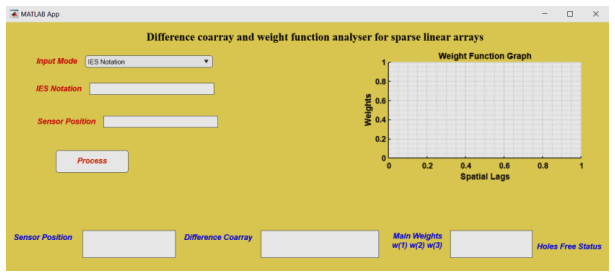
The authors have built and validated a MATLAB GUI that accepts arbitrary sparse linear array geometries, derives the full set of pairwise position differences that form the difference coarray, displays the associated weight function, and determines whether that coarray is free of holes.
What carries the argument
The difference coarray formed by all pairwise differences of sensor locations, together with the weight function that tallies the multiplicity of each difference.
If this is right
- Array designers can test candidate sparse geometries for a continuous virtual aperture without performing manual difference calculations.
- The interface immediately flags gaps in the coarray that would degrade resolution in direction-of-arrival tasks.
- Rapid visual iteration over array layouts becomes possible while keeping coarray continuity as the explicit design goal.
- Numerical examples in the paper confirm that the tool reproduces known coarray statistics for common sparse configurations.
Where Pith is reading between the lines
- Linking the GUI to an optimizer could turn it into an automated search tool for arrays that maximize hole-free coarray length under given sensor-count constraints.
- The same coarray inspection logic could be extended to planar or volumetric sparse arrays if the interface were generalized beyond one dimension.
- Wider adoption might shift practical radar and sonar design workflows toward explicit coarray criteria rather than pattern sidelobe minimization alone.
Load-bearing premise
Coarray-domain quantities such as the weight function and hole-free status supply design information that cannot be obtained with equal clarity from conventional radiation-pattern plots.
What would settle it
Apply the GUI to a published nested array whose coarray and weight function are already known from analytic formulas and check whether the displayed results match those formulas exactly.
Figures


read the original abstract
This work presents a first-of-its-kind graphical user interface (GUI)-based simulator developed using MATLAB App designer for the comprehensive analysis of sparse linear arrays (SLAs) in the difference coarray (DCA) domain. Sparse sensor arrays have emerged as a critical solution in enhancing signal detection, direction of arrival (DOA) estimation, and beamforming in fields such as wireless communication, radar, sonar, and integrated sensing systems. They offer several advantages over traditional uniform arrays, including reduced system complexity, lower deployment costs, and improved mitigation of mutual coupling effects. The tool enables users to input array configurations, compute DCAs, visualize weight function graphs, and assess the hole-free status of arrays, as applicable for coarray processing. Unlike conventional simulators that focus on radiation pattern visualization (array pattern, main lobe and sidelobe characteristics, azimuth cut, rectangular view, polar view etc.), this tool addresses the behavior of SLAs from a coarray domain perspective. Numerical validations demonstrate the tool's correctness, effectiveness, and its potential to foster further research in sparse arrays. This simulator could also be used as a teaching aid to drive home complicated topics and attract young minds towards the fascinating field of sparse array design.
Editorial analysis
A structured set of objections, weighed in public.
Referee Report
Summary. The paper describes the design and implementation of a MATLAB GUI (using App Designer) for analyzing sparse linear arrays (SLAs) in the difference coarray (DCA) domain. The tool accepts user-specified array configurations, computes difference coarrays and weight functions (lag multiplicities), checks hole-free status, and visualizes results, positioning itself as a complement to conventional radiation-pattern simulators for applications in DOA estimation, beamforming, and sparse-array design in radar/sonar/wireless systems. Numerical validations are asserted to confirm correctness and utility as a research/teaching aid.
Significance. If the implementation accurately reproduces standard coarray operations, the GUI could lower the barrier to exploring DCA properties (e.g., virtual array aperture and hole-free conditions) that are central to sparse-array performance but often require custom scripting. This addresses a practical gap in educational and design tools focused on coarray-domain metrics rather than array-factor plots alone. The contribution is primarily in software packaging and accessibility rather than new theory or algorithms.
major comments (2)
- [Numerical Validations] Section on Numerical Validations (or equivalent results section): the manuscript states that 'numerical validations demonstrate the tool's correctness' yet supplies no concrete sensor-position vectors, resulting lag sets, weight-function values, or explicit comparisons to analytically known hole-free or non-hole-free arrays. Without these, the central claim that the GUI correctly implements standard DCA definitions (p_i - p_j) and weight functions cannot be verified from the text.
- [Abstract / Introduction] Abstract and tool-description sections: the premise that coarray-domain analysis supplies insights 'distinct from and superior to' conventional radiation-pattern visualization is asserted but not demonstrated with a side-by-side example on the same SLA (e.g., a minimum-redundancy array) showing how weight-function or hole-free output informs design decisions differently from sidelobe levels.
minor comments (2)
- [Figures] Figure captions and GUI screenshots should explicitly state the exact array configuration (sensor positions) used for each displayed weight function or hole-free result so readers can reproduce the output independently.
- [Tool Features] Clarify whether the hole-free check implements the standard definition (consecutive lags from 0 to the maximum without gaps) or a user-tunable threshold; the current description leaves the decision rule ambiguous.
Simulated Author's Rebuttal
We thank the referee for the constructive comments on our manuscript describing the MATLAB GUI for coarray-domain analysis of sparse linear arrays. The feedback highlights opportunities to strengthen verifiability and demonstration of the tool's unique value. We have addressed both major comments through targeted revisions that add explicit examples while preserving the manuscript's focus on software accessibility.
read point-by-point responses
-
Referee: [Numerical Validations] Section on Numerical Validations (or equivalent results section): the manuscript states that 'numerical validations demonstrate the tool's correctness' yet supplies no concrete sensor-position vectors, resulting lag sets, weight-function values, or explicit comparisons to analytically known hole-free or non-hole-free arrays. Without these, the central claim that the GUI correctly implements standard DCA definitions (p_i - p_j) and weight functions cannot be verified from the text.
Authors: We agree that the absence of explicit numerical data in the text limits independent verification. In the revised manuscript we will expand the Numerical Validations section with concrete examples, including sensor-position vectors for a 4-element minimum-redundancy array ([0, 1, 4, 6]), the full set of difference coarray lags, the corresponding weight-function values, and direct comparison against analytically known hole-free results. These additions will allow readers to confirm that the GUI correctly computes p_i - p_j and lag multiplicities. revision: yes
-
Referee: [Abstract / Introduction] Abstract and tool-description sections: the premise that coarray-domain analysis supplies insights 'distinct from and superior to' conventional radiation-pattern visualization is asserted but not demonstrated with a side-by-side example on the same SLA (e.g., a minimum-redundancy array) showing how weight-function or hole-free output informs design decisions differently from sidelobe levels.
Authors: We acknowledge that a direct comparative demonstration would better substantiate the claimed complementarity. The revised Introduction will include a side-by-side example on a minimum-redundancy array that presents both the conventional radiation pattern (with sidelobe levels) and the coarray-domain outputs (weight function and hole-free status). The accompanying discussion will illustrate how the coarray metrics reveal virtual-array aperture and DOA-resolution potential that are not apparent from pattern sidelobes alone. revision: yes
Circularity Check
No circularity: standard coarray operations implemented in GUI without derivations or self-referential fits
full rationale
The manuscript describes a MATLAB App Designer GUI that accepts user-supplied sensor positions, computes difference coarrays via the standard definition {p_i - p_j}, generates weight functions as lag multiplicities, and checks hole-free status. These are direct implementations of established coarray-domain operations rather than any derived predictions, fitted parameters, or theorems justified by self-citation. No equations appear that reduce by construction to the tool's own outputs, and the numerical validations are asserted demonstrations of correctness for the implemented standard methods, not load-bearing self-referential steps. The central claim is the existence and utility of the GUI itself, which remains independent of any circular reduction.
Axiom & Free-Parameter Ledger
axioms (1)
- domain assumption Standard definitions of difference coarray, weight function, and hole-free arrays from array signal processing literature
Lean theorems connected to this paper
-
IndisputableMonolith/Cost/FunctionalEquation.leanwashburn_uniqueness_aczel unclear?
unclearRelation between the paper passage and the cited Recognition theorem.
The tool enables users to input array configurations, compute DCAs, visualize weight function graphs, and assess the hole-free status of arrays... Unlike conventional simulators that focus on radiation pattern visualization, this tool addresses the behavior of SLAs from a coarray domain perspective.
-
IndisputableMonolith/Foundation/AlexanderDuality.leanalexander_duality_circle_linking unclear?
unclearRelation between the paper passage and the cited Recognition theorem.
Appendix A.2: dca = unique(sort(d)); ... Appendix A.4: if(length(dca)==(2*max(a)+1)) ... hole-free
What do these tags mean?
- matches
- The paper's claim is directly supported by a theorem in the formal canon.
- supports
- The theorem supports part of the paper's argument, but the paper may add assumptions or extra steps.
- extends
- The paper goes beyond the formal theorem; the theorem is a base layer rather than the whole result.
- uses
- The paper appears to rely on the theorem as machinery.
- contradicts
- The paper's claim conflicts with a theorem or certificate in the canon.
- unclear
- Pith found a possible connection, but the passage is too broad, indirect, or ambiguous to say the theorem truly supports the claim.
Reference graph
Works this paper leans on
-
[1]
R. A. Monzingo, R. L. Haupt, and T. W. Miller, Introduction to Adaptive Arrays . IET Digital Library, 2011. doi: 10.1049/SBEW046E, 10.1049/SBEW046E
-
[2]
Gross, Smart Antennas for Wireless Communications: With MATLAB
F. Gross, Smart Antennas for Wireless Communications: With MATLAB. McGraw Hill Professional, 2005
work page 2005
-
[3]
S. Haykin, J. P. Reilly, V. Kezys, and E. Vertatschitsch, ‘Some aspects of array signal processing’, IEE Proc. F - Radar Signal Process., vol. 139, no. 1, pp. 1–26, Feb. 1992, doi: 10.1049/ip-f-2.1992.0001
- [4]
-
[5]
C.-L. Liu and P. P. Vaidyanathan, ‘Cramér –Rao bounds for coprime and other sparse arrays, which find more sources than sensors’, Digit. Signal Process., vol. 61, pp. 43–61, Feb. 2017, doi: 10.1016/j.dsp.2016.04.011
-
[6]
P. Raiguru, D. C. Panda, and R. K. Mishra, ‘Multi-Source Detection Performance of Some Linear Sparse Arrays’, IETE J. Res., vol. 0, no. 0, pp. 1–12, Mar. 2022, doi: 10.1080/03772063.2022.2038701
-
[7]
Raiguru et al., ‘Hole-Free DCA for Augmented Co -Prime Array’, Circuits Syst
P. Raiguru et al., ‘Hole-Free DCA for Augmented Co -Prime Array’, Circuits Syst. Signal Process. , vol. 41, no. 5, pp. 2977–2987, May 2022, doi: 10.1007/s00034-021-01909-0
-
[8]
P. Pal and P. P. Vaidyanathan, ‘Coprime sampling and the music algorithm’, in 2011 Digital Signal Processing and Signal Processing Education Meeting (DSP/SPE), Jan. 2011, pp. 289–294. doi: 10.1109/DSP-SPE.2011.5739227
-
[9]
P. P. Vaidyanathan and P. Pal, ‘Sparse Sensing With Co-Prime Samplers and Arrays’, IEEE Trans. Signal Process., vol. 59, no. 2, pp. 573–586, Feb. 2011, doi: 10.1109/TSP.2010.2089682
-
[10]
Piya Pal, P. Pal, P.P. Vaidyanathan, and P. P. Vaidyanathan, ‘Nested Arrays: A Novel Approach to Array Processing With Enhanced Degrees of Freedom’, IEEE Trans. Signal Process. , vol. 58, no. 8, Art. no. 8, Aug. 2010, doi: 10.1109/tsp.2010.2049264
-
[11]
M. Yang, L. Sun, X. Yuan, and B. Chen, ‘Improved nested array with hole -free DCA and more degrees of freedom’, Electron. Lett., vol. 52, no. 25, pp. 2068–2070, 2016, doi: 10.1049/el.2016.3197
-
[12]
Z. Peng, Y. Ding, S. Ren, H. Wu, and W. Wang, ‘Coprime Nested Arrays for DOA Estimation: Exploiting the Nesting Property of Coprime Array’, IEEE Signal Process. Lett., vol. 29, pp. 444–448, 2022, doi: 10.1109/LSP.2021.3139577
-
[13]
S. Wandale and K. Ichige, ‘A Generalized Extended Nested Array Design via Maximum Inter -Element Spacing Criterion’, IEEE Signal Process. Lett., vol. 30, pp. 31–35, 2023, doi: 10.1109/LSP.2023.3238912
-
[14]
P. Kulkarni and P. P. Vaidyanathan, ‘Weight-Constrained Sparse Arrays For Direction of Arrival Estimation Under High Mutual Coupling’, IEEE Trans. Signal Process., vol. 72, pp. 4444–4462, 2024, doi: 10.1109/TSP.2024.3461720
-
[15]
A. Patwari and P. Kunchala, ‘Novel Sparse Linear Array Based on a New Suboptimal Number Sequence with a Hole - free Difference Co-array’, Prog. Electromagn. Res. Lett., vol. 116, pp. 23–30, 2024, doi: 10.2528/pierl23102706
-
[16]
Z. Zheng, W. -Q. Wang, Y. Kong, and Y. D. Zhang, ‘MISC Array: A New Sparse Array Design Achieving Increased Degrees of Freedom and Reduced Mutual Coupling Effect’, IEEE Trans. Signal Process., vol. 67, no. 7, pp. 1728–1741, Apr. 2019, doi: 10.1109/TSP.2019.2897954
-
[17]
C. Liu and P. P. Vaidyanathan, ‘Super Nested Arrays: Linear Sparse Arrays With Reduced Mutual Coupling —Part I: Fundamentals’, IEEE Trans. Signal Process. , vol. 64, no. 15, pp. 3997 –4012, Aug. 2016, doi: 10.1109/TSP.2016.2558159
-
[18]
R. Cohen and Y. C. Eldar, ‘Sparse Array Design via Fractal Geometries’, IEEE Trans. Signal Process., vol. 68, pp. 4797– 4812, 2020, doi: 10.1109/TSP.2020.3016772
-
[19]
Patwari, ‘Sparse Linear Antenna Arrays: A Review’, in Antenna Systems , IntechOpen, 2021
A. Patwari, ‘Sparse Linear Antenna Arrays: A Review’, in Antenna Systems , IntechOpen, 2021. doi: 10.5772/intechopen.99444
-
[20]
M. G. Amin, Sparse Arrays for Radar, Sonar, and Communications. John Wiley & Sons, 2023
work page 2023
-
[21]
M. Pesavento, M. Trinh -Hoang, and M. Viberg, ‘Three More Decades in Array Signal Processing Research: An optimization and structure exploitation perspective’, IEEE Signal Process. Mag. , vol. 40, no. 4, pp. 92 –106, Jun. 2023, doi: 10.1109/MSP.2023.3255558
-
[22]
A. M. Elbir, K. V. Mishra, S. A. Vorobyov, and R. W. Heath, ‘Twenty -Five Years of Advances in Beamforming: From convex and nonconvex optimization to learning techniques’, IEEE Signal Process. Mag. , vol. 40, no. 4, pp. 118 –131, Jun. 2023, doi: 10.1109/MSP.2023.3262366
-
[23]
W. Liu, M. Haardt, M. S. Greco, C. F. Mecklenbräuker, and P. Willett, ‘Twenty -Five Years of Sensor Array and Multichannel Signal Processing: A review of progress to date and potential research directions’, IEEE Signal Process. Mag., vol. 40, no. 4, pp. 80–91, Jun. 2023, doi: 10.1109/MSP.2023.3258060
-
[24]
R. Rajamaki and V. Koivunen, ‘Symmetric Sparse Linear Array for Active Imaging’, Jul. 2018, Accessed: May 02, 2019. [Online]. Available: /documents/symmetric-sparse-linear-array-active-imaging
work page 2018
-
[25]
R. Rajamäki and V. Koivunen, ‘Sparse Symmetric Linear Arrays With Low Redundancy and a Contiguous Sum Co - Array’, IEEE Trans. Signal Process., vol. 69, pp. 1697–1712, 2021, doi: 10.1109/TSP.2021.3057982
-
[26]
N. Mohsen, A. Hawbani, X. Wang, M. Agrawal, and L. Zhao, ‘Optimized Sparse Nested Arrays for DoA Estimation of Non-circular Signals’, Signal Process., vol. 204, p. 108819, Mar. 2023, doi: 10.1016/j.sigpro.2022.108819
-
[27]
P. Gupta and M. Agrawal, ‘Design And Analysis of the Sparse Array for DoA Estimation of Noncircular Signals’, IEEE Trans. Signal Process., vol. 67, no. 2, pp. 460–473, Jan. 2019, doi: 10.1109/TSP.2018.2883035
-
[28]
M. Yang, L. Sun, X. Yuan, and B. Chen, ‘A New Nested MIMO Array With Increased Degrees of Freedom and Hole - Free Difference Coarray’, IEEE Signal Process. Lett. , vol. 25, no. 1, pp. 40 –44, Jan. 2018, doi: 10.1109/LSP.2017.2766294
-
[29]
A. Patwari and R. R. Gudheti, ‘Novel MRA -Based Sparse MIMO and SIMO Antenna Arrays for Automotive Radar Applications’, Prog. Electromagn. Res., vol. 86, pp. 103–119, 2020, doi: 10.2528/PIERB19121602
-
[30]
M. Ebrahimi, M. Modarres-Hashemi, and E. Yazdian, ‘Optimal placement of sensors to enhance degrees of freedom in monostatic collocated MIMO radar’, Digit. Signal Process. , vol. 142, p. 104224, Oct. 2023, doi: 10.1016/j.dsp.2023.104224
-
[31]
‘Array Factor’. Accessed: Jan. 09, 2025. [Online]. Available: https://in.mathworks.com/matlabcentral/fileexchange/38332-array-factor
work page 2025
-
[32]
Barkhausen-Institut/AntennaArraySimulator. (Sep. 30, 2024). Python. Barkhausen Institut gGmbH. Accessed: Jan. 09,
work page 2024
-
[33]
Available: https://github.com/Barkhausen-Institut/AntennaArraySimulator
[Online]. Available: https://github.com/Barkhausen-Institut/AntennaArraySimulator
-
[34]
‘GitHub - zinka/arraytool: Python based package for phased array antenna design and analysis’. Accessed: Jan. 09, 2025. [Online]. Available: https://github.com/zinka/arraytool/tree/master
work page 2025
-
[35]
M. T. Yalcinkaya, P. Sen, M. Ramzan, and G. P. Fettweiss, ‘Highly Portable Open Source Array & Phased Antenna Simulator’, in IEEE EUROCON 2023 - 20th International Conference on Smart Technologies , Jul. 2023, pp. 450 –454. doi: 10.1109/EUROCON56442.2023.10198953
-
[36]
A. Harrison, RadarBook/software. (Jan. 07, 2025). Jupyter Notebook. Accessed: Jan. 09, 2025. [Online]. Available: https://github.com/RadarBook/software
work page 2025
-
[37]
arrayfactor: Array Factor Calculator. Python. [Microsoft :: Windows]. Available: https://pypi.org/project/arrayfactor/
-
[38]
M. Ebrahimi and M. Karimi, ‘Optimally Dense Nonredundant Sparse Sensor Array Designs’, IEEE Sens. J., vol. 24, no. 18, pp. 28952–28959, Sep. 2024, doi: 10.1109/JSEN.2024.3431272
-
[39]
S. Wandale and K. Ichige, ‘xMISC: Improved Sparse Linear Array via Maximum Inter-Element Spacing Concept’, IEEE Signal Process. Lett., vol. 30, pp. 1327–1331, 2023, doi: 10.1109/LSP.2023.3316018
-
[40]
P. Zhao, Q. Wu, G. Hu, L. Wang, and L. Wan, ‘Generalized Hole -Free Sparse Antenna Array Design With Even/Odd Maximum Interelement Spacing’, IEEE Antennas Wirel. Propag. Lett. , vol. 24, no. 3, pp. 716 –720, Mar. 2025, doi: 10.1109/LAWP.2024.3514150
-
[41]
D. Zhu, S. Wang, and G. Li, ‘Multiple -Fold Redundancy Arrays With Robust Difference Coarrays: Fundamental and Analytical Design Method’, IEEE Trans. Antennas Propag. , vol. 69, no. 9, pp. 5570 –5584, Sep. 2021, doi: 10.1109/TAP.2021.3083819
-
[42]
S. HOU, X. ZHAO, Z. LIU, Y. PENG, and N. WANG, ‘Ternary redundant sparse linear array design with high robustness’, J. Northwest. Polytech. Univ., vol. 41, pp. 125–135, Feb. 2023, doi: 10.1051/jnwpu/20234110125
discussion (0)
Sign in with ORCID, Apple, or X to comment. Anyone can read and Pith papers without signing in.