REVIEW 4 major objections 6 minor 13 references
Applying Hurlbert's Linear Optimization Technique to Establish Bounds on Pebbling Numbers
T0 review · 4 major / 6 minor · reviewed 2026-08-04 · deepseek-v4-flash
Pith's one-line read The paper shows that a weight-function linear optimization lemma turns graph pebbling into a linear program, yielding the upper bounds π(P)≤10 for the Petersen graph and π(B4)≤66 for the fourth weak Bruhat graph, plus a tree formula.
desk verdict Expository re-derivation of known pebbling bounds, with a false tree formula and a gap in the key lemma; not a research contribution. read the letter →
The pith
A machine-rendered reading of the paper's core claim, the machinery that carries it, and where it could break.
The reading
What carries the argument
A strategy is a triple (T,r,ω) consisting of a rooted subtree T, a root r, and a weight function that assigns 0 to the root and doubles at each step toward the root: ω(parent)=2ω(child). The Weight Function Lemma is the load-bearing identity: it says r-unsolvable configurations lie inside the half-space ω(C)≤ω(T), where T is the canonical one-pebble-everywhere configuration. When several strategies are combined, the intersection of these half-spaces bounds the total number of pebbles; the numbers κ (minimum summed weight across vertices) and χ (total weight of the canonical configurations) make the bound explicit.
What would settle it
A single r-unsolvable configuration on B4 with 66 pebbles would disprove π(B4)≤66; a direct check of the claimed κ=6 and χ=395 for the strategies in Figure 21 would reveal whether the arithmetic or the strategy weights are wrong. At the lemma level, an r-unsolvable configuration satisfying ω(C)>ω(T) for any valid weight function would invalidate the Weight Function Lemma and, with it, the method.
Extended reading notes
Core claim
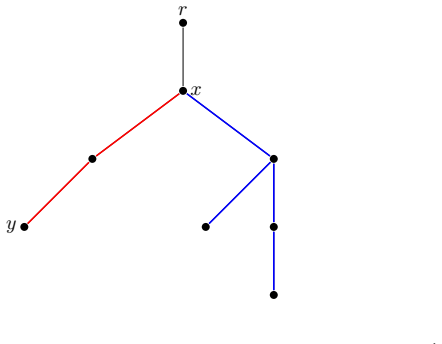
The central claim is the Weight Function Lemma (Lemma 4.4 in the paper): for any strategy S(T,r,ω) on a subtree T rooted at r, if C is an r-unsolvable configuration on the whole graph, then the weighted sum ω(C) is at most ω(T), where T denotes the configuration that puts one pebble on each vertex of T except the root. The paper's proof works by removing a pendant path P_y from T, applying the lemma to the remaining subtree and to the path separately, and combining the inequalities; the path case is the base case established earlier. From this lemma the paper derives the linear-optimization corollary: if several strategies are chosen, any r-unsolvable configuration must satisfy each weight i
Load-bearing premise
The argument rests on the Weight Function Lemma—that an r-unsolvable configuration on a rooted subtree always has total weight no greater than the configuration with one pebble on every non-root vertex—and the paper's proof of that lemma depends on a step (moving one pebble toward the root preserves unsolvability) that is stated without full justification.
Editorial extensions
If this is right
- The Petersen graph's pebbling number is exactly 10: the one-pebble-on-nine-vertices configuration gives the lower bound, and the three-strategy linear program gives the matching upper bound.
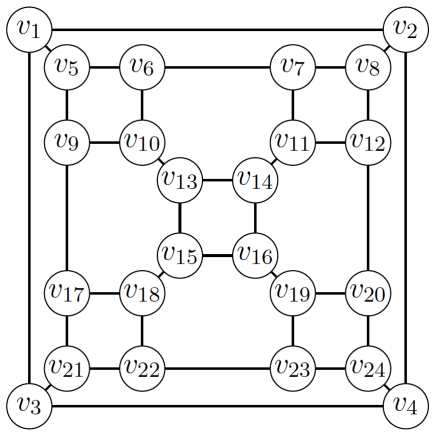
- The fourth weak Bruhat graph B4, whose 24 vertices are the permutations of four elements, has pebbling number at most 66.
- For any tree T, the pebbling number relative to a root is π(T,r)=Σ_P 2^{e_P}−|P|+1 over an edge-disjoint path decomposition, which generalizes the path formula π(P_n)=2^{n−1}.
- Any graph for which one can exhibit a finite set of rooted weight strategies inherits an integer upper bound on its pebbling number, obtained by rounding down χ/κ + 1.
Reading between the lines
- The κ/χ recipe is a small linear program; for any graph one can automate the search for good strategies, and the 24-vertex Bruhat graph is a natural testbed for whether adding more strategies tightens the bound below 66.
- For graphs with large automorphism groups, orbit-symmetric weight functions may be the efficient choice; the Petersen and Bruhat examples both use highly symmetric strategy sets.
- The tree formula provides a benchmark: on any tree, one can compare the exact formula against the linear-optimization upper bound; trees where they match identify strategy sets that are optimal, and trees where they differ show where the method loses sharpness.
- Extending the same weight-inequality to pebbling variants such as cover pebbling or optimal pebbling would only require reinterpreting the canonical configuration, since the lemma encodes the cost of moving pebbles toward the root.
Editorial analysis
A structured set of objections, weighed in public.
Referee Report
Summary. The paper is an expository account of Hurlbert's linear-optimization technique for pebbling numbers, with applications to the Petersen graph, the fourth weak Bruhat graph B4, and trees. After introducing the pebbling game and standard background (Section 2-3), the paper restates a Weight Function Lemma (Lemma 4.4) and uses it to claim upper bounds π(P)≤10 for the Petersen graph (Lemma 4.7), π(B4)≤66 (Theorem 4.8), and a general formula for the pebbling number of a rooted tree (Theorem 4.9). The Petersen bound is already classical; the B4 bound is attributed to Flocco-Pulaj-Yerger [5]; and the tree formula is a version of Chung's theorem. The paper's technical core is the proof of Lemma 4.4 and the computations of the derived constants κ and χ in the applications.
Significance. If the central claims were correct, the paper would provide worked illustrations of Hurlbert's technique rather than new theorems: the Petersen number is long known, the B4 bound appears in the cited literature, and the tree formula is standard. The manuscript does offer an accessible summary of the pebbling game and a fairly faithful restatement of the weight-function framework; for a reader unfamiliar with the method, the exposition of Definition 4.3 and Corollary 4.5 is useful. However, the load-bearing proof of Lemma 4.4 is incomplete, Theorem 4.9 is false as stated, and the numerical constants in the applications are asserted, not derived. There is no machine-checked proof or reproducible code that would compensate for these gaps. The paper therefore does not meet the bar for publication in a serious journal.
major comments (4)
- [Sec. 4.1, Lemma 4.4] The proof contains the unjustified step "Because C is unsolvable, C_x must also be unsolvable" after a pebble is moved from Py−x to x. A configuration obtained from an unsolvable configuration by a single move toward the root can become solvable; no argument is given to rule this out. The construction of T' is also not rigorously defined ('removing Py from T and reattaching the vertex x'), and the induction over 'r-unsolvable configurations of largest weight on T'' is not formalized. Since Lemma 4.4 is the engine for every upper bound in Section 4.3, this gap is load-bearing.
- [Sec. 4.3, Theorem 4.9] Theorem 4.9 is false as stated because the path decomposition P is not uniquely or canonically defined. For T=K_{1,3} rooted at the center r, take P={leaf1-r-leaf2, leaf3-r}. This is an edge-disjoint path cover, and the theorem gives π(T,r)=2^2+2^1−2+1=5. But the true value is π(K_{1,3},r)=4: any four pebbles are r-solvable, and three pebbles on a leaf (plus no pebbles elsewhere) are r-unsolvable. The lower-bound construction in the proof also fails here: placing 2^{2}−1=3 pebbles on leaf1 permits two pebbles to be moved directly to r, so that configuration is solvable, not unsolvable.
- [Sec. 4.3, Lemmas 4.7 and Theorem 4.8] The claimed upper bounds are not actually computed in the manuscript. For the Petersen graph, the proof simply states κ=4 and χ=36 from Figure 19; for B4, it states κ=6 and χ=395 from Figure 21. No verification is provided that the drawings define strategies satisfying Definition 4.3, nor is the arithmetic of the vertex weights shown. Since the text itself says the Petersen strategies come from Hurlbert [7] and the B4 strategies from [5], the paper's original contribution is reduced to asserting constants chosen to match the known or cited bounds. These assertions are not independently checkable from the figures as printed.
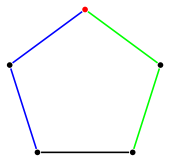
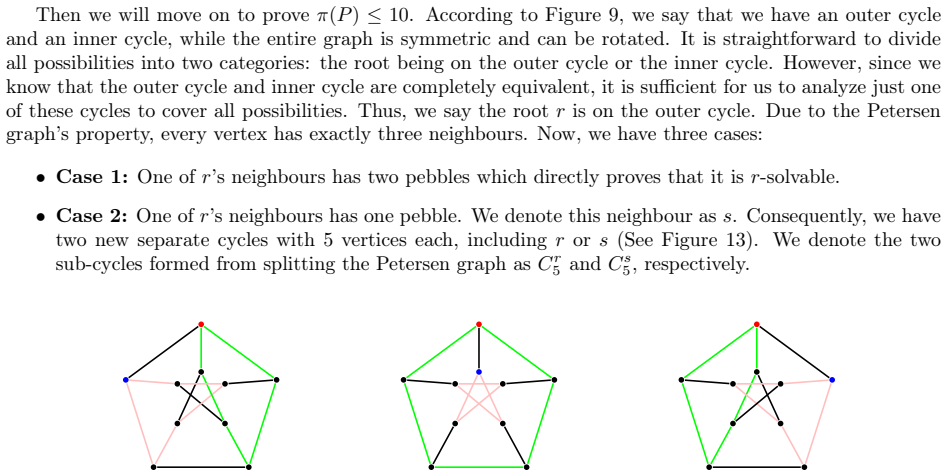
- [Sec. 3.2, Lemma 3.6 and Petersen proof] The proof of π(C5)≤5 claims to have examined all possible configurations but presents only two figures and a verbal case split; it is not exhaustive. The subsequent Petersen-graph argument in Case 2 relies on the assertion that if C(C_r^5)≤4 and C(C_s^5)≥6, then 'even without moving the pebble from s' one can place another pebble on s; this is not justified. These gaps weaken the paper's independent derivation of π(P)=10, although the result itself is known.
minor comments (6)
- [Table 15] The tree formula uses undefined symbols q_i and m; it is also inconsistent with Theorem 4.9, which uses a path decomposition P. Please align notation and give definitions.
- [Sec. 4.2] The linear optimization problem is not formally defined. The symbol z_{G,r} is described by 'with a witnessing weight function', but it is not specified over which set of strategies the maximum is taken or how the optimization is performed. This makes the statement of Corollary 4.5 ambiguous.
- [References] References [2] and [11] list the same paper by Clark and Milans; also, the duplicate 'B. Clark and K. Milans' / 'Milans, B. Clark' should be consolidated.
- [Definition 4.3] The definition states ω(v+)=2ω(v) 'for every v∈V(G)', but the weight function is defined on the subtree T; it should be 'for every v∈V(T)'.
- [Section 3.1] There is a typo: 'C(v) denotes the number of pebbles placed on vertex r' should read 'on vertex v'.
- [Section 4.1, Lemma 4.1] The induction base case is written as 'fork=2' and the statement of the lemma uses n; please harmonize the variable names.
Circularity Check
No significant circularity: the bounds are conditional on an external weight-function lemma and displayed strategies, not on the target values by construction.
full rationale
The paper's derivation chain is: the Weight Function Lemma (Lemma 4.4, imported from Hurlbert [7]) gives ω(C) ≤ ω(T) for r-unsolvable configurations; summing this over strategies gives κ|C| ≤ χ, and hence π(G) ≤ ⌊χ/κ⌋ + 1. In the applications, κ and χ are computed from explicit strategies displayed in Figure 19 (Petersen) and Figure 21 (Bruhat graph). Nothing in the paper equates the target bound to the choice of weights by construction: the displayed weight functions are proposed legal witnesses, and their legality is checkable from Definition 4.3. The Petersen bound π(P) ≤ 10 is also not forced by the earlier citation of the known result; it is verified from κ = 4, χ = 36 by the paper's own equations. There is no fitted parameter being renamed as a prediction, and no self-citation chain is used. The proof of the Weight Function Lemma in Section 4.1 contains a genuine gap ('Because C is unsolvable, C_x must also be unsolvable' is not generally true), and Theorem 4.9 is under-specified because the edge-disjoint path decomposition P is not canonical; different decompositions of K_{1,3} give different values. These are correctness/completeness concerns, not circularity: they do not make the outputs equivalent to the inputs by definition. Therefore no circular step meets the required evidentiary standard.
Assumptions & free parameters
free parameters (2)
- Petersen graph weight functions (Figure 19) =
κ=4, χ=36
- Bruhat graph weight functions (Figure 21) =
κ=6, χ=395
assumptions (3)
- domain assumption Weight Function Lemma (Lemma 4.4)
- domain assumption π(C5) = 5 (Corollary 3.7)
- domain assumption π(Pn) = 2^{n-1} (Lemma 3.2)
Cite this review
Pith. "Pith review of Applying Hurlbert's Linear Optimization Technique to Establish Bounds on Pebbling Numbers." pith.science (2026). https://pith.science/paper/EYBQMHBN
@misc{pith2026250911024,
  author       = {Pith},
  title        = {Pith review of: Applying Hurlbert's Linear Optimization Technique to Establish Bounds on Pebbling Numbers},
  year         = {2026},
  howpublished = {\url{https://pith.science/paper/EYBQMHBN}},
  note         = {Machine review of arXiv:2509.11024}
}
read the original abstract
This paper explores the application of Hurlbert's Linear Optimization Technique to determine bounds on pebbling numbers. By applying Hurlbert's weight functions and optimization methods, we derive upper bounds for specific graph families. The study provides a comprehensive analysis of these bounds and contributes to a broader understanding of pebbling numbers in graph theory. In particular, the weight function lemma is applied to calculate upper bounds for graphs such as the Petersen graph, the Bruhat graph, and various trees.
Figures


Figures from the paper (15 more)






Reference graph
Works this paper leans on
- [5]
-
[7]
Hurlbert,A linear optimization technique for graph pebbling, arXiv:1101.5641
G. Hurlbert,A linear optimization technique for graph pebbling, arXiv:1101.5641
-
[1]
F. R. K. Chung,Pebbling in hypercubes, SIAM J. Disc. Math.2(1989), no. 4, 467–472
1989
-
[2]
Clark and K
B. Clark and K. Milans.The complexity of graph pebbling, SIAM J. Discrete Math,20(2006), 769–798
2006
-
[3]
D. W. Cranston, L. Postle, C. Xue, C. Yerger,Modified linear programming and class 0 bounds for graph pebbling, Journal of Combinatorial Optimization43(2017) 114–132
2017
-
[4]
Elledge and G
S. Elledge and G. Hurlbert,An Application of Graph Pebbling to Zero-Sum Sequences in Abelian Groups, The Electronic Journal of Combinatorial Number Theory.5(2005), Paper A17
2005
-
[6]
Harris, J
J. Harris, J. L. Hirst, M. Mossinghoff.Combinatorics and Graph Theory. Undergraduate Texts in Mathematics, Springer, New York, 2008
2008
-
[8]
Hurlbert.A survey of graph pebbling, Congr
G. Hurlbert.A survey of graph pebbling, Congr. Numer.139(1999), 41–64
1999
Show all 13 references
-
[9]
Kenter, D
F. Kenter, D. Skipper,Integer-programming bounds on pebbling numbers of cartesian-product graphs, in: Proceedings of the 12th International Conference on Combinatorial Optimization and Applications, (2018) 681–695
2018
-
[10]
Lemke, D
P. Lemke, D. KleitmanAn addition theorem on the integers modulo n, J. Number Theory.31 (1989), 335-345
1989
-
[11]
Milans, B
K. Milans, B. Clark,The complexity of graph pebbling, SIAM Journal on Discrete Mathematics, 20(2006) 769–798
2006
-
[12]
Pachter, H
L. Pachter, H. Snevily, and B. Voxman,On pebbling graphs, Congr. Numer. 107 (1995), 65–80
1995
-
[13]
Watson.The complexity of pebbling and cover pebbling, arXiv:math/0503511
N. Watson.The complexity of pebbling and cover pebbling, arXiv:math/0503511. 20 Figure 21: Set of strategies applied on the Fourth Weak Bruhat Graph with 24 vertices. 21
Reviewed August 4, 2026 · model on record in the stance chip above.
Discussion (0). Continue with ORCID to comment.