The impact of kinetic and global effects on ballooning 2nd stable pedestals of conventional and low aspect ratio tokamaks
Pith reviewed 2026-05-18 17:16 UTC · model grok-4.3
The pith
A gyro-fluid model for kinetic ballooning modes combined with global MHD limits improves EPED pedestal predictions for conventional and low-aspect-ratio tokamaks.
A machine-rendered reading of the paper's core claim, the machinery that carries it, and where it could break.
Core claim
The GFS reduced model captures kinetic ballooning modes in both DIII-D and NSTX(-U) pedestals, enabling its direct use inside EPED; high-n global ballooning modes limit local second-stability access and thereby constrain beta_p,ped evolution; and nearly local high-n modes with k_y*rho_s ~ 1/2 serve as a practical proxy for the critical beta_p,ped when second-stable access exists.
What carries the argument
The Gyro-Fluid System (GFS) code that supplies the kinetic ballooning stability boundary, together with ELITE calculations that approximate the limiting high-n global ballooning modes.
If this is right
- EPED predictions using GFS and ELITE match DIII-D pedestal data more closely than the ideal-MHD-based EPED1 version.
- KBM-limited pedestals remain consistent with observations on both conventional and spherical tokamaks.
- High-n global ballooning modes provide a transport mechanism that limits pedestal width growth once second-stable access appears.
- Nearly local high-n modes with k_y*rho_s ~ 1/2 can be used as a proxy for the critical beta_p,ped in DIII-D plasmas.
Where Pith is reading between the lines
- The approach could be tested on additional low-aspect-ratio devices to check whether the improved agreement persists when aspect-ratio effects are stronger.
- If GFS boundaries prove robust, they could replace ideal-MHD thresholds in other pedestal models that currently rely on similar approximations.
- The global-mode limit on second stability suggests that future devices may need to target operating points that avoid or exploit this constraint to maximize pedestal performance.
Load-bearing premise
The GFS reduced model accurately reproduces the kinetic ballooning stability boundary across the aspect ratios and beta values of DIII-D and NSTX pedestals.
What would settle it
A systematic comparison of GFS-plus-ELITE pedestal height and width predictions against a larger set of NSTX-U experimental profiles where local ideal MHD and gyrokinetic ballooning differences are known to be large.
Figures



read the original abstract
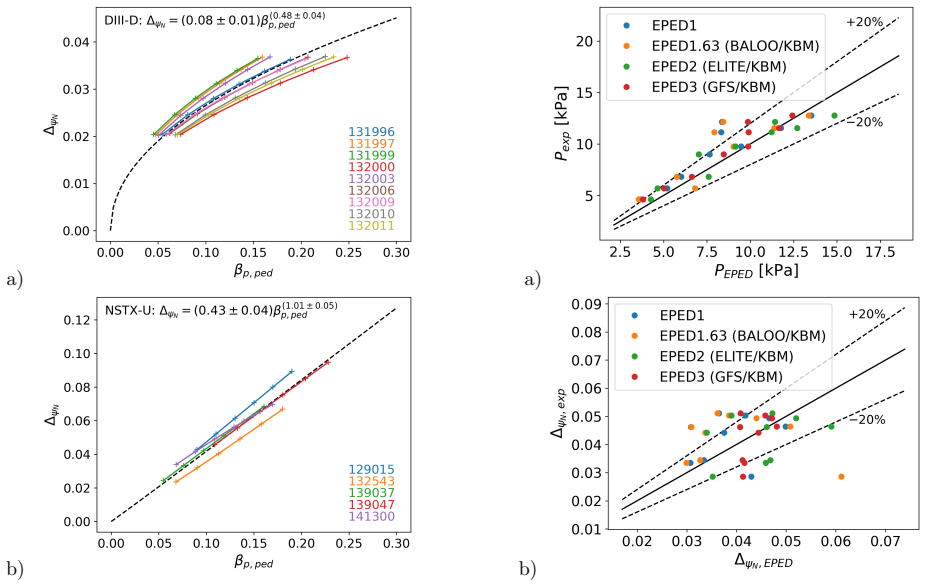
The EPED model [P.B. Snyder et al 2011 Nucl. Fusion 51 103016] had success describing the pedestals of the Type-I ELM and QH-mode operations in conventional tokamaks, by combining kinetic ballooning mode (KBM) and peeling-ballooning (PB) constraints. Within EPED, the KBM constraint is usually approximated by the ideal ballooning mode (IBM) stability threshold. It has been noted that quantitative differences between local ideal MHD and gyro-kinetic (GK) ballooning stability can be larger at low aspect ratio. KBM critical pedestals are consistent with observations in initial studies on conventional and spherical tokamaks. In this work, the application of a reduced model for the calculation of the kinetic ballooning stability boundary is presented based on a novel and newly developed Gyro-Fluid System (GFS) code [G.M. Staebler et al 2023 Phys. Plasmas 30 102501]. GFS is observed to capture KBMs in DIII-D as well as the NSTX(-U) pedestals, opening a route integrating this model into EPED. Finally, high-n global ballooning modes are observed to limit the access to the local 2nd stability and thus provide a transport mechanism that constrains the width evolution with beta_p,ped. The high-n global ballooning stability is approximated by its ideal MHD analogue using ELITE. It is shown that nearly local high-n with k_y*rho_s~1/2 modes can provide a proxy for the critical beta_p,ped when a 2nd stable access exists on DIII-D plasmas. The use of GFS and ELITE scaling in EPED provided an improved agreement in comparison to EPED1 with DIII-D pedestal data.
Editorial analysis
A structured set of objections, weighed in public.
Referee Report
Summary. The manuscript extends the EPED pedestal model by replacing the ideal ballooning mode (IBM) approximation for the kinetic ballooning mode (KBM) constraint with thresholds computed from the Gyro-Fluid System (GFS) reduced model, while approximating high-n global ballooning limits via ELITE scaling. It reports that GFS captures KBMs in both DIII-D and NSTX(-U) pedestals and that the combined GFS+ELITE approach yields improved agreement with DIII-D pedestal data relative to the original EPED1 implementation.
Significance. If the central results hold, the work would strengthen predictive modeling of pedestal structure in both conventional and low-aspect-ratio tokamaks by incorporating kinetic effects and global-mode constraints that are known to differ from ideal MHD at low A. The explicit use of a reduced gyro-fluid model and the identification of a high-n proxy for second-stable access represent concrete steps toward a more physics-based EPED variant.
major comments (3)
- [Abstract] Abstract and results discussion: the claim that 'the use of GFS and ELITE scaling in EPED provided an improved agreement in comparison to EPED1 with DIII-D pedestal data' is presented without quantitative metrics (e.g., RMS deviation in pedestal height or width, number of discharges, or error bars), so the magnitude and statistical significance of the improvement cannot be evaluated.
- [GFS application and validation] Section describing GFS application to DIII-D equilibria: no direct comparison is shown between GFS-computed KBM critical gradients or beta_p,ped and thresholds obtained from established full gyrokinetic codes (GYRO, GENE, etc.) for the same equilibria; without this benchmark the reported improvement versus EPED1 could reflect a different (not necessarily more accurate) stability boundary.
- [NSTX(-U) results] Discussion of low-aspect-ratio cases: the manuscript notes quantitative differences between local ideal MHD and gyro-kinetic ballooning at low aspect ratio yet supplies no explicit quantification of how GFS thresholds deviate from IBM for the NSTX(-U) parameters examined, leaving the extension of the model to spherical tokamaks unsupported by concrete numbers.
minor comments (2)
- [High-n global ballooning] Define the precise meaning of the proxy 'nearly local high-n with k_y*rho_s ~ 1/2 modes' and state the range of toroidal mode numbers over which the ELITE scaling is applied.
- [DIII-D comparison] Add a table or figure caption that explicitly lists the DIII-D discharges used for the comparison, including their aspect ratio, beta_p,ped, and collisionality ranges.
Simulated Author's Rebuttal
We thank the referee for their thoughtful comments on our manuscript. We have carefully considered each point and provide the following responses. Where appropriate, we will revise the manuscript to address the concerns raised.
read point-by-point responses
-
Referee: [Abstract] Abstract and results discussion: the claim that 'the use of GFS and ELITE scaling in EPED provided an improved agreement in comparison to EPED1 with DIII-D pedestal data' is presented without quantitative metrics (e.g., RMS deviation in pedestal height or width, number of discharges, or error bars), so the magnitude and statistical significance of the improvement cannot be evaluated.
Authors: We agree that the claim of improved agreement would benefit from quantitative support. In the revised manuscript, we will include specific metrics such as the RMS deviation in pedestal height and width, the number of DIII-D discharges considered, and associated error bars or statistical measures. This will enable a clearer evaluation of the improvement over EPED1. revision: yes
-
Referee: [GFS application and validation] Section describing GFS application to DIII-D equilibria: no direct comparison is shown between GFS-computed KBM critical gradients or beta_p,ped and thresholds obtained from established full gyrokinetic codes (GYRO, GENE, etc.) for the same equilibria; without this benchmark the reported improvement versus EPED1 could reflect a different (not necessarily more accurate) stability boundary.
Authors: The GFS model was developed and benchmarked against full gyrokinetic codes such as GYRO in its original publication (Staebler et al., Phys. Plasmas 2023). While we do not present new direct comparisons for the exact equilibria in this study, we will add a discussion referencing these prior validations and clarify that GFS provides a computationally efficient approximation suitable for integration into EPED. We believe this addresses the concern without requiring extensive new simulations for each case. revision: partial
-
Referee: [NSTX(-U) results] Discussion of low-aspect-ratio cases: the manuscript notes quantitative differences between local ideal MHD and gyro-kinetic ballooning at low aspect ratio yet supplies no explicit quantification of how GFS thresholds deviate from IBM for the NSTX(-U) parameters examined, leaving the extension of the model to spherical tokamaks unsupported by concrete numbers.
Authors: We acknowledge the need for explicit quantification. We will revise the manuscript to include specific values or additional figures quantifying the differences between GFS and IBM thresholds for the NSTX(-U) parameters, thereby strengthening the support for the model's extension to low-aspect-ratio tokamaks. revision: yes
Circularity Check
Self-citation of GFS reduced model supports EPED improvement claim without independent full-GK benchmark
specific steps
-
self citation load bearing
[Abstract]
"the application of a reduced model for the calculation of the kinetic ballooning stability boundary is presented based on a novel and newly developed Gyro-Fluid System (GFS) code [G.M. Staebler et al 2023 Phys. Plasmas 30 102501]. GFS is observed to capture KBMs in DIII-D as well as the NSTX(-U) pedestals, opening a route integrating this model into EPED. ... The use of GFS and ELITE scaling in EPED provided an improved agreement in comparison to EPED1 with DIII-D pedestal data."
The reported improvement is attributed to better physics from GFS replacing the IBM approximation. Because GFS originates in a prior publication by an overlapping author and the present manuscript supplies no side-by-side validation against full gyrokinetic codes (GYRO, GENE, etc.) for the DIII-D equilibria, the central claim reduces to accepting the self-cited model's accuracy as given rather than demonstrating it.
full rationale
The paper's central result is an empirical improvement in matching DIII-D pedestal data when EPED's KBM constraint is replaced by GFS outputs plus ELITE scaling. This relies on the prior GFS development paper (Staebler et al 2023) whose lead author is a co-author here. While self-citation is normal, the load-bearing step is the assumption that GFS thresholds are sufficiently accurate for DIII-D parameters; the manuscript notes quantitative differences from ideal MHD at low aspect ratio but provides no direct comparison to established gyrokinetic codes on the same equilibria. The improvement versus EPED1 is therefore consistent with using a different (not necessarily more correct) threshold. No self-definitional, fitted-input, or ansatz-smuggling reductions appear in the quoted material; the derivation remains partially independent but the key physics input is not externally verified within the present work.
Axiom & Free-Parameter Ledger
axioms (2)
- domain assumption KBM constraint can be approximated by ideal ballooning mode stability threshold in EPED
- domain assumption High-n global ballooning modes limit access to local 2nd stability region
Reference graph
Works this paper leans on
- [1]
- [2]
- [3]
- [4]
- [5]
- [6]
- [7]
- [8]
- [9]
- [10]
- [11]
- [12]
- [13]
- [14]
- [15]
- [16]
- [17]
- [18]
- [19]
- [20]
- [21]
- [22]
- [23]
- [24]
- [25]
discussion (0)
Sign in with ORCID, Apple, or X to comment. Anyone can read and Pith papers without signing in.