Dispersion of collective modes in spinful fractional quantum Hall states on the sphere
Pith reviewed 2026-05-21 23:02 UTC · model grok-4.3
The pith
Composite fermion excitons accurately describe collective modes in spinful fractional quantum Hall states on the sphere at all wavelengths.
A machine-rendered reading of the paper's core claim, the machinery that carries it, and where it could break.
Core claim
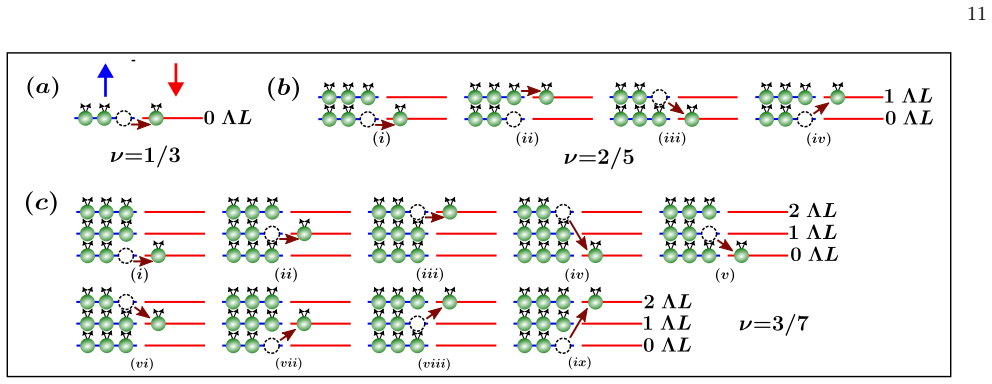
The CF excitons provide an accurate description of the collective modes at all wavelengths, while the density-wave states fail to do so. Specifically, the spin-flip density wave reliably captures the spin-flip collective mode only for the Laughlin and Halperin states, and that too only in the long-wavelength limit. For spin-singlet primary Jain states, the spin-conserving density mode is inaccurate even in the long-wavelength regime because of an additional high-energy spin-conserving parton mode, for which an ansatz is proposed and its Coulomb dispersion is computed at nu = 2/5.
What carries the argument
Composite fermion exciton trial wave functions for the collective modes, together with the commutation algebra of spinful LLL-projected density operators on the sphere that allows extraction of excitation energies from the ground-state static structure factor.
If this is right
- CF exciton states reproduce both spin-conserving and spin-flip mode dispersions at all wavelengths for the studied Jain-sequence fillings.
- LLL-projected density-wave states succeed only for the spin-flip mode of Laughlin and Halperin states in the long-wavelength limit.
- Spin-singlet primary Jain states require an extra high-energy spin-conserving parton mode to account for the spin-conserving collective excitation even at long wavelength.
- An explicit ansatz for the additional parton mode permits computation of its Coulomb dispersion in the spin-singlet state at filling factor 2/5.
- The predicted parton mode is observable in circularly polarized inelastic light scattering experiments.
Where Pith is reading between the lines
- If the CF exciton description holds, analogous exciton constructions may be needed to describe collective modes in other families of spinful fractional quantum Hall states.
- Detection of the extra parton mode would indicate that multi-component parton constructions are required for a complete account of dynamical excitations beyond the primary composite-fermion picture.
- The spherical-geometry dispersions supply concrete predictions that can be checked by future exact diagonalization studies on larger systems.
Load-bearing premise
The LLL-projected density-wave and CF exciton states are assumed to be sufficiently accurate variational descriptions of the true collective-mode eigenstates at all wavelengths.
What would settle it
Exact diagonalization of the Coulomb Hamiltonian on the sphere yielding collective-mode energies that deviate from the CF-exciton dispersions at intermediate and short wavelengths would falsify the claim of accuracy at all wavelengths.
Figures



read the original abstract
Collective modes capture the dynamical aspects of fractional quantum Hall (FQH) fluids. Depending on the active degrees of freedom, different types of collective modes can arise in a FQH state. In this work, we consider spinful FQH states in the lowest Landau level (LLL) along the Jain sequence of fillings $\nu{=}n/(2n{\pm}1)$ and compute the Coulomb dispersion of their spin-flip and spin-conserving collective modes in the spherical geometry. We use the LLL-projected density-wave and composite fermion (CF) exciton states as trial wave functions for these modes. To evaluate the dispersion of density-wave states, we derive the commutation algebra of spinful LLL-projected density operators on the sphere, which enables us to extract the gap of the density-wave excitations from the numerically computed density-density correlation function, i.e., the static structure factor, of the FQH ground state. We find that the CF excitons provide an accurate description of the collective modes at all wavelengths, while the density-wave states fail to do so. Specifically, the spin-flip density wave reliably captures the spin-flip collective mode only for the Laughlin and Halperin states, and that too only in the long-wavelength limit. Interestingly, for spin-singlet primary Jain states, the spin-conserving density mode is inaccurate even in the long-wavelength regime. We show that this discrepancy stems from the presence of an additional high-energy spin-conserving parton mode, similar to that found in fully polarized secondary Jain states at $\nu{=}n/(4n{\pm}1)$. We propose an ansatz for this parton mode and compute its Coulomb dispersion in the singlet state at $\nu{=}2/5$. The predicted parton mode can be observed in circularly polarized inelastic light scattering experiments.
Editorial analysis
A structured set of objections, weighed in public.
Referee Report
Summary. The paper computes Coulomb dispersions of spin-flip and spin-conserving collective modes for spinful FQH states along the Jain sequence ν = n/(2n ± 1) in the LLL on the sphere. LLL-projected density-wave and CF exciton trial states are used; the spinful projected density-operator algebra is derived to extract density-wave gaps directly from the ground-state static structure factor. The central claims are that CF excitons accurately describe the modes at all wavelengths while density-wave states fail (especially the spin-conserving mode in spin-singlet primary Jain states), with the discrepancy at ν = 2/5 attributed to an additional high-energy spin-conserving parton mode whose ansatz and dispersion are presented.
Significance. If the variational trial states faithfully represent the low-lying eigenstates, the work supplies useful numerical dispersions on the sphere, a technically sound algebraic route from structure factor to density-wave gaps, and a concrete parton-mode proposal that could be tested in circularly polarized inelastic light scattering. The parameter-free algebraic extraction and the explicit ansatz for the extra mode are positive features. The significance is reduced by the absence of direct benchmarks against exact eigenstates.
major comments (2)
- [Abstract and §5] Abstract and §5 (numerical results): the claim that 'CF excitons provide an accurate description of the collective modes at all wavelengths' is load-bearing for the headline conclusion, yet no wave-function overlaps with exact-diagonalization eigenvectors or direct comparisons of variational energies to exact mode energies are reported for accessible system sizes (N ≲ 12) where ED is feasible; without these, the asserted superiority over density-wave states and the necessity of the extra parton mode rest on unverified variational quality.
- [§4.2] §4.2 (spin-singlet Jain states at ν = 2/5): the post-hoc attribution of the long-wavelength discrepancy between the spin-conserving density-wave dispersion and the CF-exciton result to a distinct high-energy parton mode would be strengthened by an independent check, such as the variational energy of the parton ansatz relative to the CF exciton or a small-system overlap with the exact second excited state; the current presentation risks interpreting variational error as evidence for a new mode.
minor comments (2)
- [Figure captions and §3] Figure captions and §3: the dispersion plots would be clearer if the expected long-wavelength analytic limits (e.g., from Girvin-MacDonald-Platzman or single-mode approximation) were overlaid as reference curves.
- [§2] Notation in §2: the explicit form of the LLL-projected parton-mode ansatz should be written in the main text (rather than only in the supplement) to allow readers to reproduce the variational calculation.
Simulated Author's Rebuttal
We thank the referee for the careful reading of our manuscript and the constructive comments. We address each major point below and have incorporated revisions to strengthen the validation of our claims.
read point-by-point responses
-
Referee: [Abstract and §5] Abstract and §5 (numerical results): the claim that 'CF excitons provide an accurate description of the collective modes at all wavelengths' is load-bearing for the headline conclusion, yet no wave-function overlaps with exact-diagonalization eigenvectors or direct comparisons of variational energies to exact mode energies are reported for accessible system sizes (N ≲ 12) where ED is feasible; without these, the asserted superiority over density-wave states and the necessity of the extra parton mode rest on unverified variational quality.
Authors: We agree that direct benchmarks against exact diagonalization for small systems would provide stronger evidence for the accuracy of the CF exciton trial states. In the revised manuscript we will add wave-function overlaps between the CF exciton states and the exact eigenstates, together with comparisons of variational energies to exact mode energies, for all accessible system sizes up to N ≈ 12. These additions will directly support the superiority of CF excitons over density-wave states and the identification of the additional parton mode. revision: yes
-
Referee: [§4.2] §4.2 (spin-singlet Jain states at ν = 2/5): the post-hoc attribution of the long-wavelength discrepancy between the spin-conserving density-wave dispersion and the CF-exciton result to a distinct high-energy parton mode would be strengthened by an independent check, such as the variational energy of the parton ansatz relative to the CF exciton or a small-system overlap with the exact second excited state; the current presentation risks interpreting variational error as evidence for a new mode.
Authors: We acknowledge the value of an independent verification to distinguish a genuine additional mode from possible variational error. In the revision we will report the variational energy of the proposed parton ansatz relative to the CF exciton state at ν = 2/5. For the smallest accessible system sizes we will also compute the overlap of the parton ansatz with the exact second excited state. These calculations will be included to substantiate the attribution of the discrepancy to a distinct high-energy spin-conserving parton mode. revision: yes
Circularity Check
No significant circularity; algebraic extraction and variational ansatzes remain independent
full rationale
The paper derives the commutation algebra of spinful LLL-projected density operators on the sphere to extract density-wave gaps directly from the ground-state static structure factor; this step is a self-contained algebraic identity independent of any mode trial function. CF exciton and density-wave states are introduced as separate variational ansatzes whose dispersions are computed explicitly, while the additional parton-mode ansatz is proposed to interpret a quantitative mismatch rather than being fitted or defined to reproduce the input data by construction. No equation reduces to its own inputs, no uniqueness theorem is imported from self-citation, and no ansatz is smuggled via prior work. The derivation chain therefore stands on explicit computation and the new algebra rather than tautology.
Axiom & Free-Parameter Ledger
axioms (2)
- domain assumption Lowest Landau level projection remains valid for the collective-mode wave functions at the fillings considered.
- domain assumption The spherical geometry with its curvature corrections accurately captures the long-wavelength physics of the planar FQH system for these states.
invented entities (1)
-
high-energy spin-conserving parton mode
no independent evidence
Lean theorems connected to this paper
-
IndisputableMonolith/Cost/FunctionalEquation.leanwashburn_uniqueness_aczel unclear?
unclearRelation between the paper passage and the cited Recognition theorem.
We use the LLL-projected density-wave and composite fermion (CF) exciton states as trial wave functions... derive the commutation algebra of spinful LLL-projected density operators on the sphere... extract the gap... from the static structure factor
-
IndisputableMonolith/Foundation/AbsoluteFloorClosure.leanreality_from_one_distinction unclear?
unclearRelation between the paper passage and the cited Recognition theorem.
the CF excitons provide an accurate description of the collective modes at all wavelengths, while the density-wave states fail
What do these tags mean?
- matches
- The paper's claim is directly supported by a theorem in the formal canon.
- supports
- The theorem supports part of the paper's argument, but the paper may add assumptions or extra steps.
- extends
- The paper goes beyond the formal theorem; the theorem is a base layer rather than the whole result.
- uses
- The paper appears to rely on the theorem as machinery.
- contradicts
- The paper's claim conflicts with a theorem or certificate in the canon.
- unclear
- Pith found a possible connection, but the passage is too broad, indirect, or ambiguous to say the theorem truly supports the claim.
Reference graph
Works this paper leans on
-
[1]
Singlet states The SW dispersion of Coulomb-interacting particles in various singlet states, computed using the density wave ansatz (ADW mode), CF theory (A-CFE mode), and ED, is shown in Fig. 7. Unlike in the fully polarized states, the SW is gapped in spin-singlet states. Remark- ably, in the Halperin-(2,2,1), Halperin-(3,3,2) states [Figs. 7(a) and 7(b...
-
[2]
Partially polarized states The exact SW mode in the Jain 3/7 and 3/5 PP states is presented in Figs. 8(a) and 8(b), respectively. We find that the spin-flip CF excitons, corresponding to the tran- sition 1↑→1↓, do not model the exact dispersion very ac- curately. As was the case for the 2/3 spin-singlet Jain state, here too, JK projection does not produce...
-
[3]
The SDW dis- persion, also referred to as the GMP mode, is obtained from Eq
Singlet states: Prediction of a parton mode in the Halperin-(m, m, m−1)states This section presents results on the dispersion of spin- conserving neutral excitations in singlet states for the LLL Coulomb interaction, computed following the meth- ods discussed in the previous sections. The SDW dis- persion, also referred to as the GMP mode, is obtained fro...
-
[4]
Partially polarized states Strikingly, unlike in the fully polarized and singlet states, the spin-conserved CFE mode starts fromL=1 in PP states [see Fig, 10(a)], consistent with a low-lying exact state at that angular momentum. Note that since the JK-projection is less accurate for the reverse vor- tex attached PP states, we have not computed the spin- c...
work page 2023
-
[5]
Let us begin by considering the state ΨN/2,N/2 ν E with S=Sz=N/2
States in the maximal spinS=N/2multiplet Here, we demonstrate that the spin-flip density waves obtained from the IQH states in the maximal spinS=N/2 multiplet have a definite spin at allL, whereas for FQH states in theS=N/2 multiplet, the spin-density waves possess a definite spin only atL=1. Let us begin by considering the state ΨN/2,N/2 ν E with S=Sz=N/...
-
[6]
Spin-singlet states For a spin-singlet state ΨS=0 0 , it follows straightfor- wardly from Eqs. (B1)-(B3) that its spin-flip density- wave states have definite spinS=1, i.e., ⃗S2 ¯ρα L,M ΨS=0 0 = 2¯ρα L,M ΨS=0 0 ,(B13) where we have used the factS α ΨS=0 0 =0
-
[7]
Partially polarized states Similar to the fully polarized and singlet states, to infer the spin of the density waves in a PP state ΨPP 0 with S=S0<N/2 andS z=S0, we act the ⃗S2 operator on the resulting density-wave states. Consequently, one obtains ⃗S2 ¯ρz L,M ΨPP 0 =S 0(S0 + 1)¯ρz L,M ΨPP 0 −S − ¯ρ+ L,M ΨPP 0 ,(B14) ⃗S2 ¯ρ− L,M ΨPP 0 = (S0 −1)S 0 ¯ρ− L,...
-
[8]
Effective field theory of Jain states For the fully polarized Jain states atν=n/(2pn+η), whereη=±1 (withη=+1 for parallel-vortex attachment andη=−1 for reverse-vortex attachment), theK-matrix, charge vector ⃗tand spin-vector ⃗sare given as K= 2pC n +ηI n,(E1) ⃗t[i] = 1, i= 1,2,· · ·, n,(E2) ⃗s[i] = (2p−η)/2 +ηi, i= 1,2,· · ·, n,(E3) whereC n is then×nmatr...
-
[9]
Anomalously low magnetoroton modes at4/11 and4/13 Refs. [111, 112] considered the unconventional FQH states atν=4/11 andν=4/13, and found that the GMP mode for them has an anomalously low roton. The re- sults of Refs. [111, 112] were obtained by assuming that asq→0, the projected static structure factor ¯S(q) goes as (qℓ)4(1−ν)/(8ν). However, as we recent...
-
[10]
Relation between pair-correlation function and structure factor on the sphere This appendix provides a derivation connecting the to- tal pair-correlation functiong I and the structure factor SI on the sphere for a uniform state. On the sphere, the pair-correlation functiong I (Ω) in a uniform state is defined as gI (Ω) = ρI (Ω1)ρ I (Ω2) −δ (2) (Ω1 −Ω 2) ρ...
-
[11]
D. C. Tsui, H. L. Stormer, and A. C. Gossard, Two- dimensional magnetotransport in the extreme quantum limit, Phys. Rev. Lett.48, 1559 (1982)
work page 1982
-
[12]
E. E. Mendez, L. L. Chang, M. Heiblum, L. Esaki, M. Naughton, K. Martin, and J. Brooks, Fractionally quantized Hall effect in two-dimensional systems of ex- treme electron concentration, Phys. Rev. B30, 7310 (1984)
work page 1984
-
[13]
H. L. Stormer, D. C. Tsui, and A. C. Gossard, The frac- tional quantum Hall effect, Rev. Mod. Phys.71, S298 (1999)
work page 1999
-
[14]
W. Pan, H. L. Stormer, D. C. Tsui, L. N. Pfeiffer, K. W. Baldwin, and K. W. West, Transition from an electron solid to the sequence of fractional quantum Hall states at very low Landau level filling factor, Phys. Rev. Lett. 88, 176802 (2002)
work page 2002
-
[15]
R. R. Du, A. S. Yeh, H. L. Stormer, D. C. Tsui, L. N. Pfeiffer, and K. W. West, Fractional quantum Hall effect aroundν= 3/2: Composite fermions with a spin, Phys. Rev. Lett.75, 3926 (1995)
work page 1995
-
[16]
I. V. Kukushkin, K. v. Klitzing, and K. Eberl, Spin polarization of composite fermions: Measurements of the Fermi energy, Phys. Rev. Lett.82, 3665 (1999)
work page 1999
-
[17]
S. L. Sondhi, A. Karlhede, S. A. Kivelson, and E. H. Rezayi, Skyrmions and the crossover from the integer to fractional quantum Hall effect at small zeeman energies, Phys. Rev. B47, 16419 (1993)
work page 1993
-
[18]
C. Kallin and B. I. Halperin, Excitations from a filled Landau level in the two-dimensional electron gas, Phys. Rev. B30, 5655 (1984)
work page 1984
-
[19]
S. S. Mandal and J. K. Jain, Low-energy spin rotons in the fractional quantum Hall effect, Phys. Rev. B63, 201310 (2001)
work page 2001
-
[20]
U. Wurstbauer, D. Majumder, S. S. Mandal, I. Dujovne, T. D. Rhone, B. S. Dennis, A. F. Rigosi, J. K. Jain, A. Pinczuk, K. W. West, and L. N. Pfeiffer, Observa- tion of nonconventional spin waves in composite-fermion ferromagnets, Phys. Rev. Lett.107, 066804 (2011)
work page 2011
-
[21]
F. Amet, A. J. Bestwick, J. R. Williams, L. Bali- cas, K. Watanabe, T. Taniguchi, and D. Goldhaber- Gordon, Composite fermions and broken symmetries in graphene, Nat. Commun.6, 5838 (2015)
work page 2015
-
[22]
J. An, A. C. Balram, U. Khanna, and G. Murthy, Anomalous transport gaps of fractional quantum Hall phases in graphene Landau levels are induced by spin- valley entangled ground states, Phys. Rev. B112, 115418 (2025)
work page 2025
-
[23]
A. Pinczuk, B. S. Dennis, L. N. Pfeiffer, and K. West, Observation of collective excitations in the fractional quantum Hall effect, Phys. Rev. Lett.70, 3983 (1993)
work page 1993
-
[24]
G. S. Boebinger, A. M. Chang, H. L. Stormer, and D. C. Tsui, Magnetic field dependence of activation energies in the fractional quantum hall effect, Phys. Rev. Lett. 55, 1606 (1985)
work page 1985
-
[25]
T. Chakraborty, P. Pietil¨ ainen, and F. C. Zhang, El- ementary excitations in the fractional quantum Hall effect and the spin-reversed quasiparticles, Phys. Rev. Lett.57, 130 (1986)
work page 1986
-
[26]
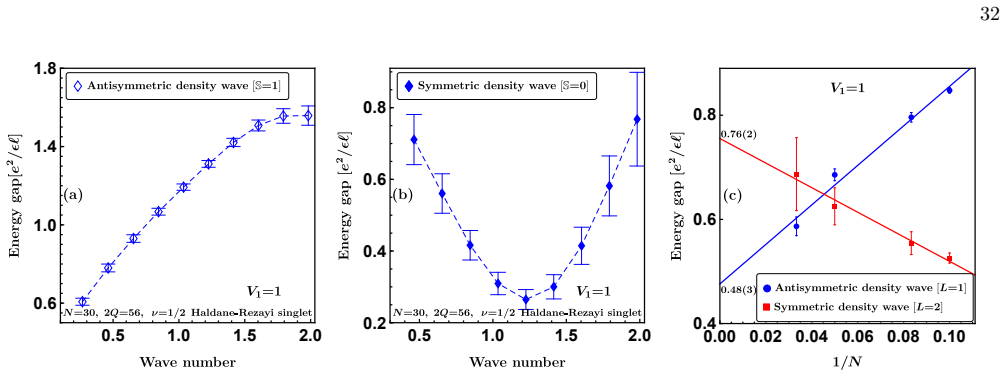
J. G. Groshaus, I. Dujovne, Y. Gallais, C. F. Hir- jibehedin, A. Pinczuk, Y.-W. Tan, H. Stormer, B. S. 32 0.5 1.0 1.5 2.0 0.6 1.0 1.4 1.8 0.5 1.0 1.5 2.00.2 0.4 0.6 0.8 0.00 0.02 0.04 0.06 0.08 0.10 0.4 0.6 0.8 FIG. 14. Spin-flip and spin-conserving density-wave gaps in theν=1/2 Haldane-Rezayi singlet state. The rightmost panel shows the thermodynamic ext...
work page 2008
-
[27]
A. C. Balram, U. Wurstbauer, A. Wojs, A. Pinczuk, and J. K. Jain, Fractionally charged skyrmions in fractional quantum Hall effect, Nat Commun6(2015), article
work page 2015
-
[28]
S. M. Girvin, A. H. MacDonald, and P. M. Platzman, Collective-excitation gap in the fractional quantum Hall effect, Phys. Rev. Lett.54, 581 (1985)
work page 1985
-
[29]
S. M. Girvin, A. H. MacDonald, and P. M. Platzman, Magneto-roton theory of collective excitations in the fractional quantum Hall effect, Phys. Rev. B33, 2481 (1986)
work page 1986
-
[30]
M. Rasolt and A. H. MacDonald, Collective excitations in the fractional quantum Hall effect of a multicompo- nent fermion system, Phys. Rev. B34, 5530 (1986)
work page 1986
-
[31]
R. B. Laughlin, Anomalous quantum Hall effect: An incompressible quantum fluid with fractionally charged excitations, Phys. Rev. Lett.50, 1395 (1983)
work page 1983
-
[32]
K. Moon, H. Mori, K. Yang, S. M. Girvin, A. H. Mac- Donald, L. Zheng, D. Yoshioka, and S.-C. Zhang, Spon- taneous interlayer coherence in double-layer quantum Hall systems: Charged vortices and kosterlitz-thouless phase transitions, Phys. Rev. B95, 5138 (1995)
work page 1995
-
[33]
J. K. Jain, Composite-fermion approach for the frac- tional quantum Hall effect, Phys. Rev. Lett.63, 199 (1989)
work page 1989
- [34]
-
[35]
J. K. Jain,Composite Fermions(Cambridge University Press, New York, US, 2007)
work page 2007
-
[36]
A. C. Balram and N. Regnault, Fractional quantum Hall effect of partons and the nature of the 8/17 state in the zeroth Landau level of bilayer graphene, Phys. Rev. B 110, L081114 (2024)
work page 2024
-
[37]
V. W. Scarola, K. Park, and J. K. Jain, Rotons of com- posite fermions: Comparison between theory and exper- iment, Phys. Rev. B61, 13064 (2000)
work page 2000
-
[38]
R. K. Dora and A. C. Balram, Static structure factor and the dispersion of the Girvin-MacDonald-Platzman density mode for fractional quantum Hall fluids on the Haldane sphere, Phys. Rev. B111, 115132 (2025)
work page 2025
-
[39]
F. D. M. Haldane, Fractional quantization of the Hall effect: A hierarchy of incompressible quantum fluid states, Phys. Rev. Lett.51, 605 (1983)
work page 1983
-
[40]
F. D. M. Haldane and E. H. Rezayi, Periodic Laughlin- Jastrow wave functions for the fractional quantized Hall effect, Phys. Rev. B31, 2529 (1985)
work page 1985
-
[41]
F. D. M. Haldane, Many-particle translational symme- tries of two-dimensional electrons at rational Landau- level filling, Phys. Rev. Lett.55, 2095 (1985)
work page 2095
-
[42]
A. C. Balram, Z. Liu, A. Gromov, and Z. Papi´ c, Very- high-energy collective states of partons in fractional quantum Hall liquids, Phys. Rev. X12, 021008 (2022)
work page 2022
-
[43]
D. X. Nguyen, F. D. M. Haldane, E. H. Rezayi, D. T. Son, and K. Yang, Multiple magnetorotons and spec- tral sum rules in fractional quantum Hall systems, Phys. Rev. Lett.128, 246402 (2022)
work page 2022
-
[44]
W. Yuzhu and Y. Bo, Geometric fluctuation of confor- mal Hilbert spaces and multiple graviton modes in frac- tional quantum Hall effect, Nature Communications14, 2317 (2023)
work page 2023
-
[45]
A. C. Balram, G. J. Sreejith, and J. K. Jain, Splitting of the Girvin-MacDonald-Platzman density wave and the nature of chiral gravitons in the fractional quantum Hall effect, Phys. Rev. Lett.133, 246605 (2024)
work page 2024
-
[46]
B. I. Halperin, Theory of the quantized Hall conduc- tance, Helvetica Physica Acta56, 75 (1983)
work page 1983
-
[47]
Gupta, Neereja Sundaresan, Thomas Alexander, Christopher J
J. Liang, Z. Liu, Z. Yang, Y. Huang, U. Wurstbauer, C. R. Dean, K. W. West, L. N. Pfeiffer, L. Du, and A. Pinczuk, Evidence for chiral graviton modes in frac- tional quantum Hall liquids, Nature 10.1038/s41586- 024-07201-w (2024)
-
[48]
T. T. Wu and C. N. Yang, Some properties of monopole harmonics, Phys. Rev. D16, 1018 (1977)
work page 1977
-
[49]
S. He, S. H. Simon, and B. I. Halperin, Response func- tion of the fractional quantized Hall state on a sphere. ii. exact diagonalization, Phys. Rev. B50, 1823 (1994)
work page 1994
-
[50]
Configuration interaction matrix elements for the quantum Hall effect
R. Wooten and J. Macek, Configuration interaction matrix elements for the quantum Hall effect (2014), arXiv:1408.5379 [cond-mat.str-el]
work page internal anchor Pith review Pith/arXiv arXiv 2014
-
[51]
S. A. Trugman and S. Kivelson, Exact results for the fractional quantum Hall effect with general interactions, Phys. Rev. B31, 5280 (1985)
work page 1985
-
[52]
R. K. Kamilla, J. K. Jain, and S. M. Girvin, Fermi-sea- like correlations in a partially filled Landau level, Phys. 33 Rev. B56, 12411 (1997)
work page 1997
-
[53]
A. C. Balram and J. K. Jain, Fermi wave vector for the partially spin-polarized composite-fermion Fermi sea, Phys. Rev. B96, 235102 (2017)
work page 2017
- [54]
-
[55]
X. G. Wu, G. Dev, and J. K. Jain, Mixed-spin incom- pressible states in the fractional quantum Hall effect, Phys. Rev. Lett.71, 153 (1993)
work page 1993
-
[56]
A. C. Balram, A. W´ ojs, and J. K. Jain, State counting for excited bands of the fractional quantum Hall effect: Exclusion rules for bound excitons, Phys. Rev. B88, 205312 (2013)
work page 2013
-
[57]
A. C. Balram, C. T¨ oke, A. W´ ojs, and J. K. Jain, Frac- tional quantum Hall effect in graphene: Quantitative comparison between theory and experiment, Phys. Rev. B92, 075410 (2015)
work page 2015
-
[58]
B. Yang and A. C. Balram, Elementary excitations in fractional quantum Hall effect from classical constraints, New Journal of Physics23, 013001 (2021)
work page 2021
-
[59]
A. C. Balram and A. W´ ojs, Fractional quantum Hall effect atν= 2 + 4/9, Phys. Rev. Research2, 032035 (2020)
work page 2020
-
[60]
A. C. Balram, Transitions from Abelian composite fermion to non-Abelian parton fractional quantum Hall states in the zeroth Landau level of bilayer graphene, Phys. Rev. B105, L121406 (2022)
work page 2022
-
[61]
X. G. Wen and A. Zee, Shift and spin vector: New topo- logical quantum numbers for the Hall fluids, Phys. Rev. Lett.69, 953 (1992)
work page 1992
-
[62]
J. K. Jain and R. K. Kamilla, Composite fermions in the Hilbert space of the lowest electronic Landau level, Int. J. Mod. Phys. B11, 2621 (1997)
work page 1997
-
[63]
J. K. Jain and R. K. Kamilla, Quantitative study of large composite-fermion systems, Phys. Rev. B55, R4895 (1997)
work page 1997
-
[64]
G. M¨ oller and S. H. Simon, Composite fermions in a negative effective magnetic field: A Monte Carlo study, Phys. Rev. B72, 045344 (2005)
work page 2005
-
[65]
S. C. Davenport and S. H. Simon, Spinful composite fermions in a negative effective field, Phys. Rev. B85, 245303 (2012)
work page 2012
-
[66]
M. Gattu and J. K. Jain, Unlocking new regimes in fractional quantum Hall effect with quaternions, Phys. Rev. Lett.134, 156501 (2025)
work page 2025
- [67]
-
[68]
Z. Liu, A. C. Balram, Z. Papi´ c, and A. Gromov, Quench dynamics of collective modes in fractional quantum Hall bilayers, Phys. Rev. Lett.126, 076604 (2021)
work page 2021
-
[69]
K. Binder and D. Heermann,Monte Carlo Simulation in Statistical Physics(Springer-Verlag Berlin Heidelberg, 2010)
work page 2010
-
[70]
R. B. Laughlin, Quantized Hall conductivity in two di- mensions, Phys. Rev. B23, 5632 (1981)
work page 1981
-
[71]
D. Yoshioka, A. H. MacDonald, and S. M. Girvin, Con- nection between spin-singlet and hierarchical wave func- tions in the fractional quantum Hall effect, Phys. Rev. B38, 3636 (1988)
work page 1988
-
[72]
D. Yoshioka, A. H. MacDonald, and S. M. Girvin, Frac- tional quantum Hall effect in two-layered systems, Phys. Rev. B39, 1932 (1989)
work page 1932
-
[73]
F. D. M. Haldane and E. H. Rezayi, Spin-singlet wave function for the half-integral quantum Hall effect, Phys. Rev. Lett.60, 956 (1988)
work page 1988
-
[74]
F. D. M. Haldane and E. H. Rezayi, Erratum: Spin- singlet wave function for the half-integral quantum Hall effect [phys. rev. lett. 60, 956 (1988)], Phys. Rev. Lett. 60, 1886 (1988)
work page 1988
-
[75]
V. Gurarie and C. Nayak, A plasma analogy and berry matrices for non-abelian quantum Hall states, Nucl. Phys. B506, 685 (1997)
work page 1997
-
[76]
N. Read and D. Green, Paired states of fermions in two dimensions with breaking of parity and time-reversal symmetries and the fractional quantum Hall effect, Phys. Rev. B61, 10267 (2000)
work page 2000
-
[77]
A. Seidel and K. Yang, Gapless excitations in the Haldane-Rezayi state: The thin-torus limit, Phys. Rev. B84, 085122 (2011)
work page 2011
-
[78]
V. Cr´ epel, N. Regnault, and B. Estienne, Matrix prod- uct state description and gaplessness of the Haldane- Rezayi state, Phys. Rev. B100, 125128 (2019)
work page 2019
-
[79]
D. X. Nguyen, K. Prabhu, A. C. Balram, and A. Gro- mov, Supergravity model of the Haldane-Rezayi frac- tional quantum Hall state, Phys. Rev. B107, 125119 (2023)
work page 2023
-
[80]
T. Nakajima and H. Aoki, Composite-fermion picture for the spin-wave excitation in the fractional quantum Hall system, Phys. Rev. Lett.73, 3568 (1994)
work page 1994
discussion (0)
Sign in with ORCID, Apple, or X to comment. Anyone can read and Pith papers without signing in.