Geometry, Energy and Sensitivity in Stochastic Proton Dynamics
Pith reviewed 2026-05-18 15:56 UTC · model grok-4.3
The pith
A logarithmic Milstein scheme paired with a Lie-group integrator preserves positivity and geometric structure in stochastic proton transport while producing consistent pathwise dose sensitivities.
A machine-rendered reading of the paper's core claim, the machinery that carries it, and where it could break.
Core claim
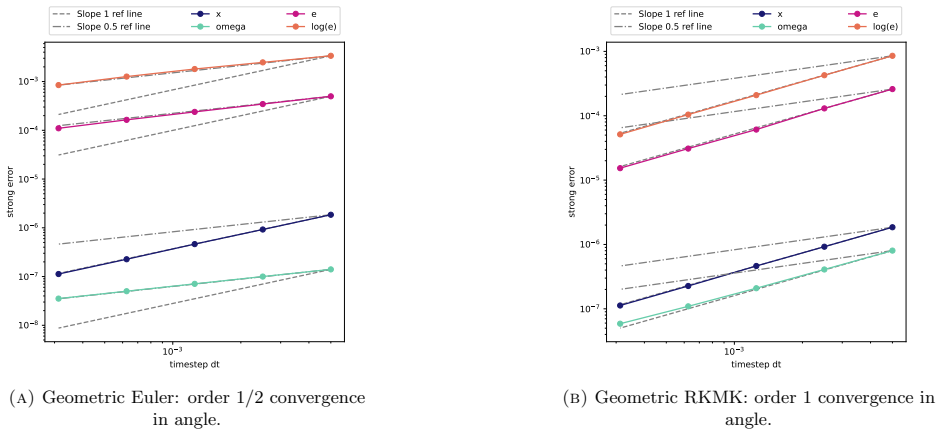
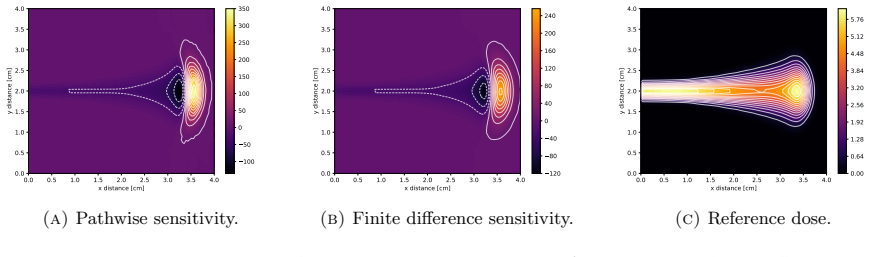
The logarithmic Milstein scheme for the energy equation guarantees positivity and achieves strong order one convergence; the combined method with Lie-group angular integrator maintains natural geometric invariants; the pathwise sensitivity estimator for regularised dose deposition is consistent and implementable.
What carries the argument
The logarithmic Milstein discretization of the energy SDE together with the Lie-group integrator for angular dynamics, which together enforce positivity and geometric conservation while supporting direct differentiation of the dose functional.
If this is right
- The schemes produce particle trajectories that remain physically admissible over long integration intervals.
- Strong order-one convergence holds for the energy process under the stated discretization.
- The sensitivity estimator yields stable gradients of dose with respect to model parameters directly from path realizations.
- Geometric invariants such as angular momentum constraints are preserved exactly by the combined integrator.
Where Pith is reading between the lines
- The structure-preserving property could allow larger time steps in Monte Carlo proton therapy simulations without introducing artificial energy gain.
- Pathwise sensitivities open the possibility of gradient-based optimization loops that adjust beam parameters while respecting the stochastic physics.
- The same Lie-group plus logarithmic-Milstein pattern may extend to other transport problems that combine multiplicative noise with manifold-valued directions.
Load-bearing premise
The underlying stochastic differential equations accurately represent the coupled physical processes of energy loss, range straggling, and angular diffusion in proton transport.
What would settle it
Running the schemes on a simplified test case with known exact solution and observing either negative energy values or measured convergence rates below order one would refute the claimed properties of the integrator.
Figures






read the original abstract
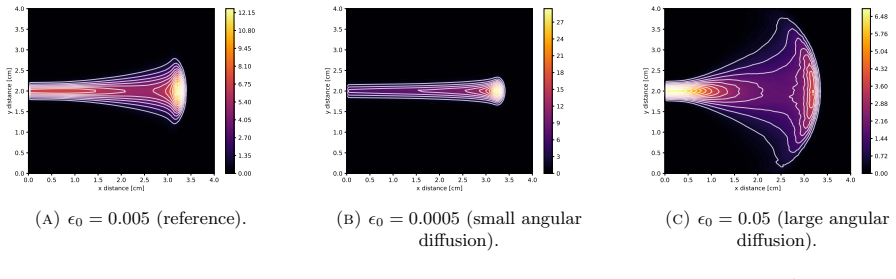
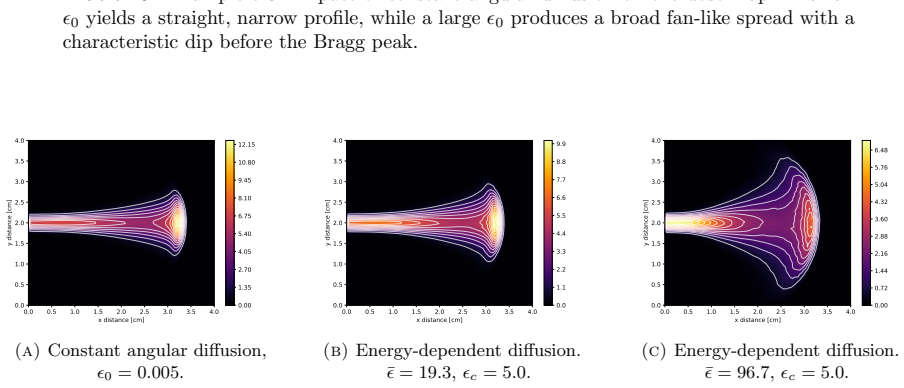
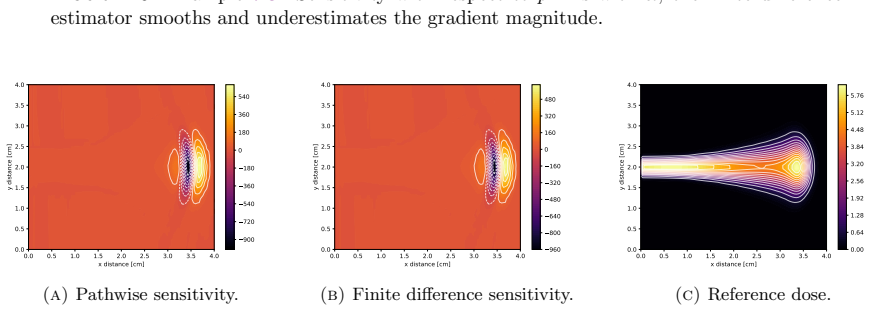
We develop numerical schemes and sensitivity methods for stochastic models of proton transport that couple energy loss, range straggling and angular diffusion. For the energy equation we introduce a logarithmic Milstein scheme that guarantees positivity and achieves strong order one convergence. For the angular dynamics we construct a Lie-group integrator. The combined method maintains the natural geometric invariants of the system. We formulate dose deposition as a regularised path-dependent functional, obtaining a pathwise sensitivity estimator that is consistent and implementable. Numerical experiments confirm that the proposed schemes achieve the expected convergence rates and provide stable estimates of dose sensitivities.
Editorial analysis
A structured set of objections, weighed in public.
Referee Report
Summary. The manuscript develops numerical schemes for stochastic models of proton transport coupling energy loss, range straggling, and angular diffusion. It introduces a logarithmic Milstein scheme for the energy equation that preserves positivity and achieves strong order one convergence, a Lie-group integrator for the angular dynamics that maintains geometric invariants, and a pathwise sensitivity estimator for a regularised path-dependent dose deposition functional. Numerical experiments are reported to confirm the expected convergence rates and to demonstrate stable dose sensitivity estimates.
Significance. If the central claims hold, the work provides structure-preserving integrators and an implementable sensitivity method for SDE models in proton transport. These features could improve the fidelity of dose calculations in radiotherapy simulations by respecting physical invariants such as positivity and angular geometry while supplying consistent pathwise gradients. The emphasis on geometric integration and regularised functionals represents a targeted advance within numerical analysis for stochastic particle dynamics.
major comments (1)
- [Section on the pathwise sensitivity estimator] Section on the pathwise sensitivity estimator (formulation of the regularised dose deposition functional): the consistency result is established for the smoothed functional at fixed positive regularization parameter. No error bounds or convergence analysis are supplied for the bias as the regularization parameter tends to zero, which is required to recover sensitivities of the original (non-regularised) dose functional. This gap is load-bearing for the abstract claim that the estimator is consistent and practically useful for dose sensitivities.
minor comments (2)
- [Abstract] The abstract states strong order one convergence without specifying the norm (e.g., L^p or almost-sure) or the precise statement of the theorem; a short clarification would aid readers.
- [Section on the combined method] The description of the combined scheme could include an explicit statement of which geometric invariants (energy positivity, angular norm, etc.) are preserved at the discrete level, with a brief reference to the relevant theorem or proposition.
Simulated Author's Rebuttal
We thank the referee for their careful reading of the manuscript and for the constructive comment on the pathwise sensitivity estimator. We address the point in detail below.
read point-by-point responses
-
Referee: Section on the pathwise sensitivity estimator (formulation of the regularised dose deposition functional): the consistency result is established for the smoothed functional at fixed positive regularization parameter. No error bounds or convergence analysis are supplied for the bias as the regularization parameter tends to zero, which is required to recover sensitivities of the original (non-regularised) dose functional. This gap is load-bearing for the abstract claim that the estimator is consistent and practically useful for dose sensitivities.
Authors: We thank the referee for this observation. The manuscript formulates dose deposition explicitly as a regularised path-dependent functional and establishes consistency of the pathwise sensitivity estimator for this regularised version at any fixed positive regularization parameter; this scope is stated in both the abstract and the relevant section. We do not assert consistency for the non-regularised functional in the absence of a limiting argument. We agree that error bounds on the bias incurred as the regularization parameter tends to zero would be needed to recover sensitivities of the original dose functional and that such bounds are not supplied. Providing a full convergence analysis for the vanishing-regularization limit would require additional approximation-theory estimates that lie outside the primary focus of the present work on structure-preserving integrators and implementable sensitivity estimators for the regularised case. In practice a small but fixed regularization parameter is selected to ensure differentiability while approximating the physical quantity, and the numerical experiments demonstrate stability of the resulting sensitivity estimates. In the revised version we will insert a short clarifying remark on the scope of the consistency result together with a note on the regularization limit as a natural direction for future analysis. revision: partial
Circularity Check
No significant circularity; methods derived from standard SDE and geometric integration techniques
full rationale
The paper introduces a logarithmic Milstein scheme for the energy SDE and a Lie-group integrator for angular dynamics, then formulates dose deposition as a regularised path-dependent functional to obtain a pathwise sensitivity estimator. These constructions follow from established stochastic calculus (Milstein expansion) and Lie-group methods for preserving invariants, without any quoted reduction of the claimed convergence or consistency results to fitted parameters, self-definitions, or load-bearing self-citations. The abstract and described content present the schemes and estimator as derived outputs rather than tautological renamings or inputs relabeled as predictions. A score of 2 reflects the normal allowance for minor self-citation that does not carry the central claims.
Axiom & Free-Parameter Ledger
axioms (1)
- domain assumption Stochastic differential equations coupling energy loss, range straggling and angular diffusion correctly describe proton transport.
Lean theorems connected to this paper
-
IndisputableMonolith/Cost/FunctionalEquation.leanwashburn_uniqueness_aczel unclear?
unclearRelation between the paper passage and the cited Recognition theorem.
logarithmic Milstein scheme that guarantees positivity and achieves strong order one convergence... Lie-group integrator... regularised path-dependent functional, obtaining a pathwise sensitivity estimator
What do these tags mean?
- matches
- The paper's claim is directly supported by a theorem in the formal canon.
- supports
- The theorem supports part of the paper's argument, but the paper may add assumptions or extra steps.
- extends
- The paper goes beyond the formal theorem; the theorem is a base layer rather than the whole result.
- uses
- The paper appears to rely on the theorem as machinery.
- contradicts
- The paper's claim conflicts with a theorem or certificate in the canon.
- unclear
- Pith found a possible connection, but the passage is too broad, indirect, or ambiguous to say the theorem truly supports the claim.
Reference graph
Works this paper leans on
-
[1]
A Positivity-Preserving Finite Element Framework for Accurate Dose Computation in Proton Therapy
[AHP25] B. S. Ashby, A. Hamdan, and T. Pryer. “A Positivity-Preserving Finite Element Framework for Accurate Dose Computation in Proton Therapy”. In:arXiv preprint arXiv:2506.01105(2025). [Ash+25] B. S. Ashby et al. “Efficient proton transport modelling for proton beam therapy and biological quantification”. In:Journal of Mathematical Biology90.5 (2025), ...
-
[2]
The Royal Society. 2024, p. 20230836. [Cro+24] A. Crossley et al. “Jump stochastic differential equations for the characterisation of the Bragg peak in proton beam radiotherapy”. In:arXiv preprint arXiv:2409.06965(2024). [Del04] P. Del Moral.Feynman-kac formulae. Springer,
-
[3]
[Den+24] S. Deng et al. “Positivity-preserving truncated Euler and Milstein methods for financial SDEs with super-linear coefficients”. In:arXiv preprint arXiv:2410.05614(2024). [Fad+20] B. Faddegon et al. “The TOPAS tool for particle simulation, a Monte Carlo simulation tool for physics, biology and clinical research”. In:Physica Medica72 (2020), pp. 114...
-
[4]
Optimization of stochastic systems via simulation
[Gly89] P. W. Glynn. “Optimization of stochastic systems via simulation”. In:Proceedings of the 21st conference on Winter simulation. 1989, pp. 90–105. [Got+93] B. Gottschalk et al. “Multiple Coulomb scattering of 160 MeV protons”. In:Nuclear Instru- ments and Methods in Physics Research Section B: Beam Interactions with Materials and Atoms74.4 (1993), pp...
-
[5]
Applications of Mathematics. Springer, 1992.doi:10.1007/978-3-662-12616-5. [KPP25] A. E. Kyprianou, A. Pim, and T. Pryer. “A Unified Framework from Boltzmann Transport to Proton Treatment Planning”. In:arXiv preprint arXiv:2508.10596(2025). [Kus+23] J. Kusch et al. “Kit-rt: An extendable framework for radiative transfer and therapy”. In:ACM Transactions o...
-
[6]
Higher strong order methods for linear Itˆ o SDEs on matrix Lie groups
[Mun+22a] M. Muniz et al. “Higher strong order methods for linear Itˆ o SDEs on matrix Lie groups”. In: BIT Numerical Mathematics62.4 (2022), pp. 1095–1119. [Mun+22b] M. Muniz et al. “Stochastic Runge-Kutta–Munthe-Kaas methods in the modelling of perturbed rigid bodies”. In:Advances in Applied Mathematics and Mechanics14.2 (2022), pp. 528–538. [NB12] H. N...
discussion (0)
Sign in with ORCID, Apple, or X to comment. Anyone can read and Pith papers without signing in.