A Pearl in the Shell: an ultra-compact dwarf within the tidal debris surrounding spiral galaxy NGC 7531
Pith reviewed 2026-05-18 16:12 UTC · model grok-4.3
The pith
A compact stellar system near NGC 7531 is an ultra-compact dwarf galaxy that was tidally stripped from a nuclear star cluster.
A machine-rendered reading of the paper's core claim, the machinery that carries it, and where it could break.
Core claim
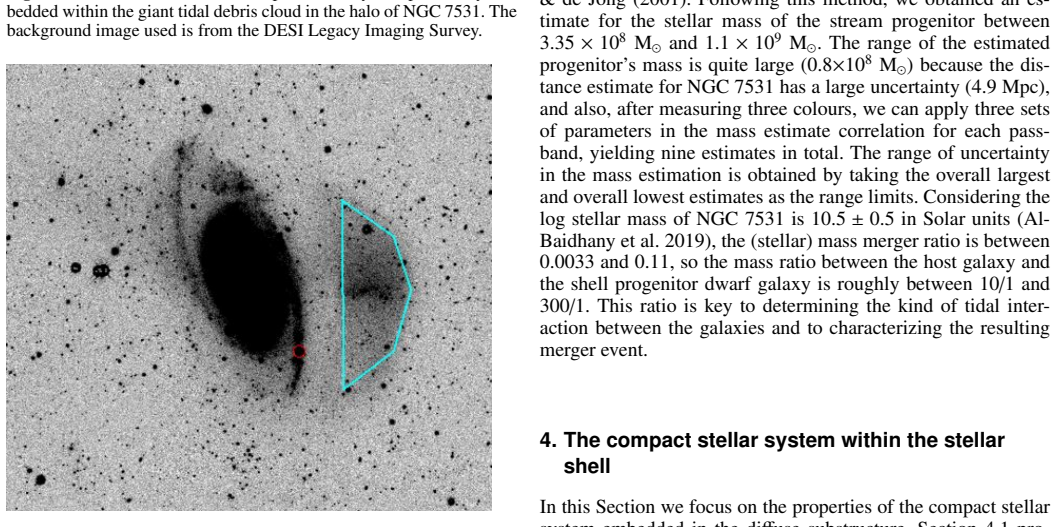
We confirm the compact stellar system is bound to NGC 7531 and rename it NGC 7531-UCD1. Its stellar mass of 3.7 million solar masses, half-light radius of 0.13 arcsec, and star-formation history place it among ultra-compact dwarfs. The presence of tidal tails and the timing of star formation together indicate the object began as a nuclear star cluster that was stripped during a minor merger. N-body models reproduce the large shell-like debris when the progenitor follows a near-radial orbit with two pericentric passages, the first coinciding with the measured star-formation enhancement one billion years ago.
What carries the argument
Classification of the compact stellar system as NGC 7531-UCD1 on the basis of its measured stellar mass, half-light radius, star-formation history, and spatial association with tidal tails, reinforced by N-body simulations that recover the shell morphology for a radial merger orbit.
If this is right
- The shell-like tidal debris contains between 300 million and 1.1 billion solar masses of stars, corresponding to a merger mass ratio between roughly 300:1 and 10:1.
- The progenitor galaxy approached on a nearly radial orbit and experienced two pericentric passages around NGC 7531.
- The first pericentric passage matches the epoch of enhanced star formation in the compact system about one billion years ago.
- Deep amateur images reveal additional tidal features not visible in the DESI Legacy Survey data.
Where Pith is reading between the lines
- Compact objects found in tidal debris around other nearby spirals could be checked with similar photometry and spectroscopy to test how often nuclear star clusters survive stripping and become ultra-compact dwarfs.
- If radial minor mergers commonly leave such remnants, then ultra-compact dwarfs may serve as tracers of recent accretion events in spiral galaxies.
- Mapping the orbits and ages of these objects could tighten constraints on the assembly history of disk galaxies beyond the Local Group.
Load-bearing premise
The measured size, mass, star-formation timing, and location inside tidal debris can be produced only by tidal stripping of a nuclear star cluster and not by other formation routes or by a chance line-of-sight alignment.
What would settle it
High-resolution imaging or spectroscopy that shows no tidal tails physically connecting the compact system to the shell debris, or radial-velocity data showing the system is not at the same distance as NGC 7531.
Figures




read the original abstract
Stellar substructures within tidal debris preserve information about their progenitor galaxies' properties, offering insights into hierarchical mass assembly. We examine a compact stellar system (CSS) around the nearby spiral galaxy NGC 7531, including the shell-like tidal debris. Our goals are to determine the nature of the CSS, reconstruct the accretion history, and understand how the large, diffuse shell-like structure formed. We present photometric measurements of the shell-like debris and CSS using DESI Legacy Imaging Survey (LS) data. We obtained Keck/LRIS spectroscopic data for the CSS to confirm its association with NGC 7531 and to derive its star formation history (SFH). Deep ($\sim$27.9 mag/arcsec$^{2}$) amateur telescope images enabled complete characterization of the tidal debris structure. We confirm the CSS is associated with NGC 7531. We rename it NGC 7531-UCD1, since its stellar mass ($3.7_{-0.7}^{+1.0}\times 10^6$ $\mathrm{M}_\odot$), half-light radius ($R_{h} = 0.13 \pm 0.05$ arcsec) and SFH place it as an ultra-compact dwarf galaxy (UCD). NGC 7531-UCD1 was likely a nuclear star cluster (NSC) that was tidally stripped into a UCD- this is further supported by the presence of tidal tails. We quantify the shell-like debris' mass as $M_\star\sim 3$--$11\times 10^8 M_\odot$, implying a merger mass ratio of ~300:1 to 10:1. Our amateur telescope images confirm new pieces of debris, previously unclear in the DESI LS images. N-body simulations reproduce the tidal features, requiring a near radial orbit of the progenitor with two pericentric passages. The first passage coincides with the measured star formation enhancement ~1 Gyr ago. Our findings agree with predictions about the NSC to UCD formation pathway via tidal stripping, and further confirm the presence of these objects outside of our Milky Way.
Editorial analysis
A structured set of objections, weighed in public.
Referee Report
Summary. The paper reports the discovery and analysis of a compact stellar system (CSS) embedded in the tidal debris around the nearby spiral galaxy NGC 7531. Using DESI Legacy Survey photometry, Keck/LRIS spectroscopy for velocity confirmation and star-formation history (SFH), deep amateur imaging to map shell-like structures, and N-body simulations, the authors classify the CSS as an ultra-compact dwarf (UCD) with stellar mass 3.7_{-0.7}^{+1.0}×10^6 M_⊙ and half-light radius R_h = 0.13 ± 0.05 arcsec. They rename it NGC 7531-UCD1 and interpret it as a former nuclear star cluster tidally stripped during a minor merger on a near-radial orbit with two pericentric passages, the first coinciding with an SFH enhancement ~1 Gyr ago. The shell debris mass is estimated at ~3–11×10^8 M_⊙, implying a merger mass ratio of ~10:1 to 300:1.
Significance. If the classification and origin interpretation hold, the work supplies a well-documented extragalactic example of the NSC-to-UCD tidal-stripping channel, together with direct constraints on a minor-merger accretion event. The coherent use of independent datasets (photometry, spectroscopy, deep imaging) and simulations that reproduce the observed tidal morphology strengthens evidence for hierarchical assembly and the preservation of substructures, extending such studies beyond the Local Group.
major comments (1)
- [interpretation section linking observations to N-body simulation results] In the interpretation linking the UCD properties, SFH timing, tidal tails, and N-body simulation results, the claim that NGC 7531-UCD1 was likely an NSC tidally stripped from the shell progenitor assumes this combination uniquely diagnoses the stripping pathway. Alternative UCD formation channels (e.g., merged star clusters or in-situ formation) are not quantitatively compared, and the probability of line-of-sight projection with unrelated debris is not assessed via statistical tests against null models or alternative simulation suites. This interpretive step is load-bearing for the proposed accretion history.
minor comments (2)
- [Abstract] The shell-like debris mass range (M_⋆ ∼ 3–11×10^8 M_⊙) is stated without an explicit description of the photometric bands, aperture corrections, or stellar-mass-to-light assumptions used in the estimate; adding this detail would improve reproducibility.
- The half-light radius is given only in arcsec; providing the corresponding physical size in parsecs at the adopted distance of NGC 7531 would facilitate direct comparison with other UCD samples in the literature.
Simulated Author's Rebuttal
We thank the referee for their positive evaluation of the work's significance and for the constructive comment on the interpretation section. We have revised the manuscript to include a more explicit discussion of alternative UCD formation channels and to clarify the low likelihood of projection effects based on the spectroscopic data. Our point-by-point response follows.
read point-by-point responses
-
Referee: [interpretation section linking observations to N-body simulation results] In the interpretation linking the UCD properties, SFH timing, tidal tails, and N-body simulation results, the claim that NGC 7531-UCD1 was likely an NSC tidally stripped from the shell progenitor assumes this combination uniquely diagnoses the stripping pathway. Alternative UCD formation channels (e.g., merged star clusters or in-situ formation) are not quantitatively compared, and the probability of line-of-sight projection with unrelated debris is not assessed via statistical tests against null models or alternative simulation suites. This interpretive step is load-bearing for the proposed accretion history.
Authors: We agree that a more direct comparison to alternative channels strengthens the manuscript. In the revised interpretation section we have added a paragraph noting that while merged star clusters or in-situ formation can produce UCDs in general, the specific combination of NGC 7531-UCD1's ultra-compact structural parameters, its precise spatial coincidence with the shell debris, and the alignment of its SFH burst with the first pericentric passage in the N-body models makes tidal stripping of an NSC the most economical explanation. A full quantitative likelihood analysis across channels would require population synthesis modeling that lies beyond the scope of this discovery paper. For line-of-sight projection, the Keck/LRIS velocity measurement matches NGC 7531 within the uncertainties, rendering a random alignment with unrelated material statistically improbable; we have inserted a brief statement to this effect. The existing N-body suite already reproduces the observed morphology under the proposed radial-orbit scenario, so new alternative suites were not generated. revision: yes
Circularity Check
No circularity: claims rest on independent observations and external simulations
full rationale
The paper derives its conclusions from direct photometric measurements of the shell and CSS using DESI Legacy Imaging Survey data, Keck/LRIS spectroscopy confirming association and yielding SFH, deep amateur imaging for tidal structure, and separate N-body simulations tuned to reproduce the observed debris morphology. The UCD classification follows from measured stellar mass, half-light radius, and SFH compared against literature definitions of UCDs; the NSC-stripping interpretation is presented as consistent with the presence of tidal tails and simulation timing rather than being defined into the inputs. No equations, fitted parameters, or self-citations reduce the central claims to tautology or construction from the target result itself. The derivation chain remains self-contained against external benchmarks.
Axiom & Free-Parameter Ledger
free parameters (1)
- UCD stellar mass
axioms (1)
- domain assumption Spectroscopic data confirm physical association of the CSS with NGC 7531 via matching distance or redshift.
Lean theorems connected to this paper
-
IndisputableMonolith/Foundation/RealityFromDistinction.leanreality_from_one_distinction unclear?
unclearRelation between the paper passage and the cited Recognition theorem.
N-body simulations reproduce the tidal features, requiring a near radial orbit of the progenitor with two pericentric passages. The first passage coincides with the measured star formation enhancement ~1 Gyr ago.
-
IndisputableMonolith/Foundation/AlexanderDuality.leanalexander_duality_circle_linking unclear?
unclearRelation between the paper passage and the cited Recognition theorem.
We rename it NGC 7531-UCD1, since its stellar mass (3.7_{-0.7}^{+1.0}×10^6 M_⊙), half-light radius (R_h = 0.13 ± 0.05 arcsec) and SFH place it as an ultra-compact dwarf galaxy (UCD).
What do these tags mean?
- matches
- The paper's claim is directly supported by a theorem in the formal canon.
- supports
- The theorem supports part of the paper's argument, but the paper may add assumptions or extra steps.
- extends
- The paper goes beyond the formal theorem; the theorem is a base layer rather than the whole result.
- uses
- The paper appears to rely on the theorem as machinery.
- contradicts
- The paper's claim conflicts with a theorem or certificate in the canon.
- unclear
- Pith found a possible connection, but the passage is too broad, indirect, or ambiguous to say the theorem truly supports the claim.
Reference graph
Works this paper leans on
-
[1]
2019, arXiv e-prints, arXiv:1909.11230
Akhlaghi, M. 2019, arXiv e-prints, arXiv:1909.11230
- [2]
-
[3]
A., Salman Chiad, S., Jabbar, W
Al-Baidhany, I. A., Salman Chiad, S., Jabbar, W. A., et al. 2019, in Journal of Physics Conference Series, V ol. 1234, Journal of Physics Conference Series, 012015
work page 2019
- [4]
-
[5]
Bekki, K., Couch, W. J., Drinkwater, M. J., & Shioya, Y . 2003, MNRAS, 344, 399
work page 2003
-
[6]
Bell, E. F. & de Jong, R. S. 2001, ApJ, 550, 212
work page 2001
-
[7]
Bonaca, A. & Price-Whelan, A. M. 2024, arXiv e-prints, arXiv:2405.19410
-
[8]
Brodie, J. P., Romanowsky, A. J., Strader, J., & Forbes, D. A. 2011, AJ, 142, 199
work page 2011
- [9]
- [10]
- [11]
- [12]
-
[13]
Y ., Belokurov, V ., Monty, S., & Evans, N
Davies, E. Y ., Belokurov, V ., Monty, S., & Evans, N. W. 2024, MNRAS, 529, L73
work page 2024
- [14]
-
[15]
Dey, A., Schlegel, D. J., Lang, D., & et al. 2019, AJ, 157, 168
work page 2019
-
[16]
Dutton, A. A. & Macciò, A. V . 2014, MNRAS, 441, 3359 Euclid Collaboration, Mellier, Y ., Abdurro’uf, et al. 2025a, A&A, 697, A1 Euclid Collaboration, V oggel, K., Lançon, A., et al. 2025b, A&A, 693, A251 Falcón-Barroso, J., Sánchez-Blázquez, P., Vazdekis, A., et al. 2011, A&A, 532, A95
work page 2014
-
[17]
A., Ferré-Mateu, A., Gannon, J
Forbes, D. A., Ferré-Mateu, A., Gannon, J. S., et al. 2022, MNRAS, 512, 802
work page 2022
- [18]
-
[19]
Hanuschik, R. W. 2003, A&A, 407, 1157
work page 2003
-
[20]
L., Pietrinferni, A., Cassisi, S., et al
Hidalgo, S. L., Pietrinferni, A., Cassisi, S., et al. 2018, ApJ, 856, 125
work page 2018
- [21]
-
[22]
K., Annibali, F., Cuillandre, J
Hunt, L. K., Annibali, F., Cuillandre, J. C., et al. 2025, A&A, 697, A9 Ivezi´c, Ž., Kahn, S. M., Tyson, J. A., et al. 2019, ApJ, 873, 111
work page 2025
-
[23]
Jennings, Z. G., Romanowsky, A. J., Brodie, J. P., et al. 2015, ApJ, 812, L10
work page 2015
-
[24]
D., Leja, J., Conroy, C., & Speagle, J
Johnson, B. D., Leja, J., Conroy, C., & Speagle, J. S. 2021, ApJS, 254, 22
work page 2021
-
[25]
Kravtsov, A. V . 2013, ApJ, 764, L31
work page 2013
-
[26]
Larsen, S. S., Ferguson, A. M. N., Howell, J. M., et al. 2025, arXiv e-prints, arXiv:2503.16637
-
[27]
Marleau, F. R., Cuillandre, J. C., Cantiello, M., et al. 2025, A&A, 697, A12
work page 2025
-
[28]
C., Fanson, J., Schiminovich, D., et al
Martin, D. C., Fanson, J., Schiminovich, D., et al. 2005, ApJ, 619, L1
work page 2005
-
[29]
Martinez-Delgado, D., Cooper, A. P., Roman, J., et al. 2021, arXiv e-prints, arXiv:2104.06071 Martínez-Delgado, D., Gabany, R. J., Crawford, K., et al. 2010, AJ, 140, 962 Martínez-Delgado, D., Peñarrubia, J., Gabany, R. J., et al. 2008, ApJ, 689, 184
- [30]
- [31]
- [32]
-
[33]
Moffat, A. F. J. 1969, A&A, 3, 455
work page 1969
- [34]
- [35]
- [36]
- [37]
- [38]
-
[39]
2021, MNRAS, 500, 2514 Article number, page 9 of 10 A&A proofs:manuscript no
Pfeffer, J., Lardo, C., Bastian, N., Saracino, S., & Kamann, S. 2021, MNRAS, 500, 2514 Article number, page 9 of 10 A&A proofs:manuscript no. aanda_NGC7531
work page 2021
-
[40]
Pizzella, A., Corsini, E. M., Dalla Bontà, E., et al. 2005, ApJ, 631, 785
work page 2005
-
[41]
Plummer, H. C. 1911, MNRAS, 71, 460
work page 1911
-
[42]
2020, The Journal of Open Source Software, 5, 2308
Prochaska, J., Hennawi, J., Westfall, K., et al. 2020, The Journal of Open Source Software, 5, 2308
work page 2020
- [43]
-
[44]
Romanowsky, A. J., Strader, J., Brodie, J. P., et al. 2012, ApJ, 748, 29
work page 2012
-
[45]
Romanowsky, A. J., Tang, Y ., & Bundy, K. A. 2025, Research Notes of the American Astronomical Society, 9, 181
work page 2025
-
[46]
Saifollahi, T., V oggel, K., Lançon, A., et al. 2025, A&A, 697, A10
work page 2025
- [47]
- [48]
-
[49]
Speagle, J. S. 2020, MNRAS, 493, 3132
work page 2020
-
[50]
Wide-Field InfraRed Survey Telescope-Astrophysics Focused Telescope Assets WFIRST-AFTA Final Report
Spergel, D., Gehrels, N., Breckinridge, J., et al. 2013, arXiv e-prints, arXiv:1305.5422
work page internal anchor Pith review Pith/arXiv arXiv 2013
- [51]
-
[52]
Urbano, M., Duc, P. A., Saifollahi, T., et al. 2024, arXiv e-prints, arXiv:2412.17672
-
[53]
2016, MNRAS, 463, 3409 V oggel, K
Vazdekis, A., Koleva, M., Ricciardelli, E., Röck, B., & Falcón-Barroso, J. 2016, MNRAS, 463, 3409 V oggel, K. T., Seth, A. C., Sand, D. J., et al. 2020, ApJ, 899, 140
work page 2016
- [54]
-
[55]
Willmer, C. N. A. 2018, ApJS, 236, 47
work page 2018
-
[56]
Zaritsky, D., Donnerstein, R., & Khim, D. J. 2025, The Open Journal of Astro- physics, 8, 90 Article number, page 10 of 10
work page 2025
discussion (0)
Sign in with ORCID, Apple, or X to comment. Anyone can read and Pith papers without signing in.