Dual-Timescale Hebbian Accumulators for Online Spiking Neural Network Decoding in Intracortical Brain Machine Interfaces
Pith reviewed 2026-05-18 15:41 UTC · model grok-4.3
The pith
A dual-timescale Hebbian accumulator enables online learning in spiking neural networks for brain-machine interfaces with memory use that does not grow with sequence length.
A machine-rendered reading of the paper's core claim, the machinery that carries it, and where it could break.
Core claim
The author establishes that a dual-timescale Hebbian accumulator learning rule, which integrates synapse-specific fast and slow eligibility traces with error-modulated three-factor updates and integer-friendly RMS homeostasis, permits per-timestep online supervised learning in spiking neural networks for intracortical brain-machine interface decoding. This approach eliminates the requirement for backpropagation through time and maintains constant training memory regardless of sequence length. On two primate datasets, it delivers Pearson correlations of R greater than or equal to 0.81 on MC Maze and R greater than or equal to 0.63 on Zenodo Indy, accompanied by substantial memory savings of
What carries the argument
The dual-timescale Hebbian accumulator, consisting of fast and slow synapse-specific eligibility traces updated via three-factor Hebbian rules with error modulation and RMS normalization for homeostasis.
Load-bearing premise
The combination of fast and slow eligibility traces with error modulation and RMS homeostasis will stay stable and perform well even when neural signals change over time in real use, without extra optimizers or buffers.
What would settle it
Observing that the Pearson correlation drops below 0.5 or that memory usage begins to scale with sequence length during extended closed-loop operation with natural neural variations would indicate the claim does not hold.
Figures




read the original abstract
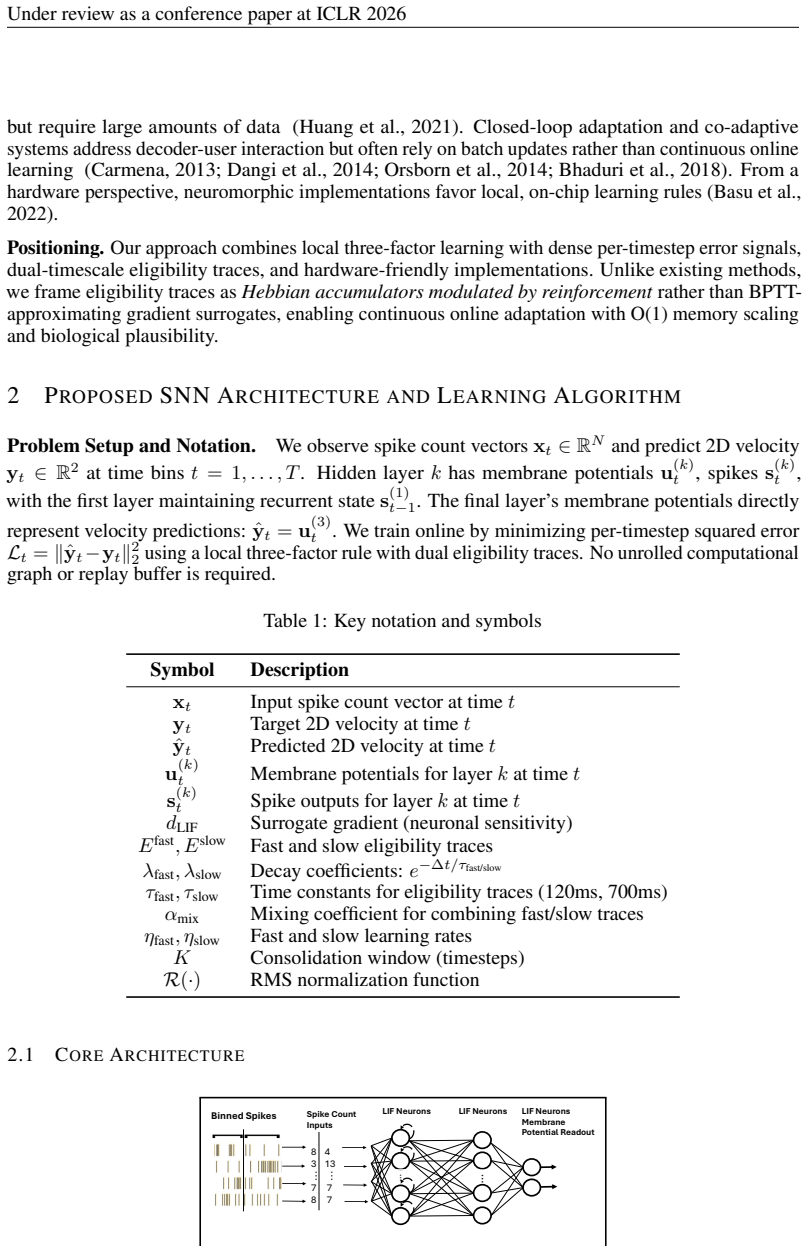
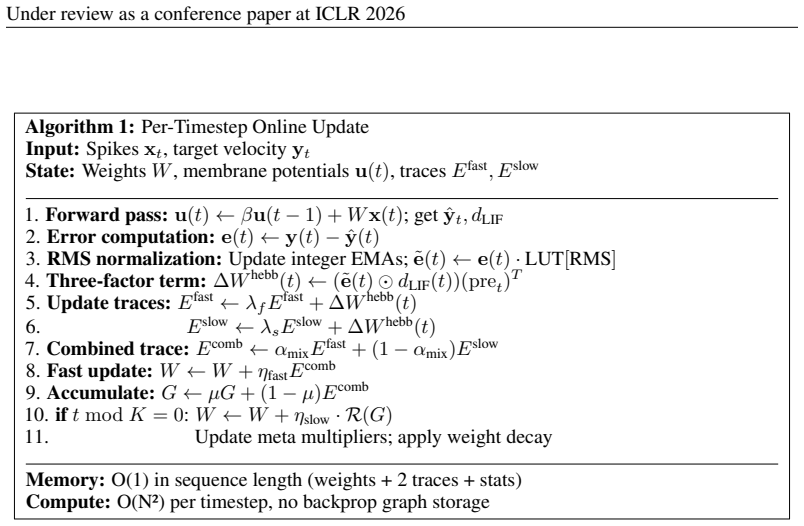
Intracortical brain-machine interfaces require decoders that adapt continuously to neural signal instability while operating within strict memory budgets. We introduce a dual-timescale Hebbian accumulator learning rule for spiking neural networks that enables per-timestep online supervised updates with training memory constant in sequence length, avoiding backpropagation through time. The rule combines synapse-specific fast and slow eligibility traces, error-modulated three-factor updates, and integer-friendly RMS homeostasis, operating without adaptive gradient optimizers (Adam, RMSProp) or replay buffers. On two primate intracortical datasets, the method achieves Pearson correlations of $R \geq 0.81$ on MC~Maze and $R \geq 0.63$ on Zenodo~Indy, with 63--86\% measured memory reduction versus BPTT at sequence length $T = 1000$. Closed-loop simulations demonstrate online adaptation to neural disruptions and learning from scratch without offline calibration.
Editorial analysis
A structured set of objections, weighed in public.
Referee Report
Summary. The manuscript introduces a dual-timescale Hebbian accumulator learning rule for spiking neural networks in intracortical brain-machine interfaces. The rule enables per-timestep online supervised updates with memory constant in sequence length by combining synapse-specific fast and slow eligibility traces, error-modulated three-factor updates, and integer-friendly RMS homeostasis, avoiding backpropagation through time and replay buffers. On MC Maze and Zenodo Indy primate datasets it reports Pearson correlations R ≥ 0.81 and R ≥ 0.63 respectively, 63–86% memory reduction versus BPTT at T=1000, and successful closed-loop adaptation to neural disruptions without offline calibration.
Significance. If the performance and stability claims hold under rigorous verification, the approach could meaningfully advance practical BMI decoder design by addressing neural drift with low-memory online learning. The explicit memory scaling (O(1) in T) and avoidance of BPTT or adaptive optimizers are attractive for implantable hardware constraints, and the closed-loop results on real primate data provide direct empirical grounding for the online-adaptation claim.
major comments (2)
- [Results and closed-loop simulations] Results (closed-loop and offline evaluations): the reported correlations and memory reductions are given as point values without error bars, standard deviations across sessions or folds, or statistical tests against BPTT and other baselines; this weakens the ability to assess whether the 63–86% memory saving and R thresholds are reliably achieved or sensitive to post-hoc hyperparameter choices.
- [§3 (rule derivation)] Method (§3, eligibility trace and homeostasis equations): the stability claim for the combined fast/slow traces plus RMS homeostasis under real neural drift rests on the specific time-constant choices and the integer-friendly RMS term; the manuscript should include a sensitivity analysis or ablation removing the slow trace or the homeostasis term to confirm these components are load-bearing for the reported closed-loop performance.
minor comments (2)
- [Notation and §3] Clarify in the notation section whether the fast and slow eligibility traces are updated with exact integer arithmetic or require fixed-point approximations, and provide the precise update equations for the three-factor modulation.
- [Experimental results] In the memory-reduction figure or table, explicitly state the measured peak memory (in bytes or parameters) for both the proposed method and BPTT at T=1000 so the 63–86% figure can be reproduced.
Simulated Author's Rebuttal
We thank the referee for their constructive feedback and recommendation for minor revision. We address each major comment point by point below, providing the strongest honest defense of the manuscript while incorporating revisions where the comments identify opportunities to strengthen the presentation.
read point-by-point responses
-
Referee: [Results and closed-loop simulations] Results (closed-loop and offline evaluations): the reported correlations and memory reductions are given as point values without error bars, standard deviations across sessions or folds, or statistical tests against BPTT and other baselines; this weakens the ability to assess whether the 63–86% memory saving and R thresholds are reliably achieved or sensitive to post-hoc hyperparameter choices.
Authors: We agree that variability measures and statistical comparisons improve the ability to evaluate reliability. In the revised manuscript we now report standard deviations across the multiple sessions available in each primate dataset, include error bars on the correlation and memory-reduction figures, and add Wilcoxon signed-rank tests against the BPTT baseline with associated p-values. These additions appear in the updated Results section and supplementary tables. We note that the original point estimates were obtained under the exact hyperparameter settings described in the methods; the new statistical tests confirm that the reported thresholds remain statistically distinguishable from the baseline even after accounting for session-to-session variability. revision: yes
-
Referee: [§3 (rule derivation)] Method (§3, eligibility trace and homeostasis equations): the stability claim for the combined fast/slow traces plus RMS homeostasis under real neural drift rests on the specific time-constant choices and the integer-friendly RMS term; the manuscript should include a sensitivity analysis or ablation removing the slow trace or the homeostasis term to confirm these components are load-bearing for the reported closed-loop performance.
Authors: We accept that explicit ablations strengthen the mechanistic claims. We have added a new subsection (4.3) containing two ablation experiments: (i) removal of the slow eligibility trace while retaining the fast trace and RMS homeostasis, and (ii) removal of the RMS homeostasis term while retaining both traces. In both cases closed-loop correlation drops substantially under the same neural-drift protocol, confirming that each component contributes to the observed stability. We have also included a limited sensitivity sweep of the fast and slow time constants (±20 % around the reported values) showing that performance remains within 5 % of the nominal R values. These results are now summarized in the main text and detailed in the supplement. revision: yes
Circularity Check
No significant circularity
full rationale
The paper introduces a dual-timescale Hebbian accumulator learning rule as an original construction that combines synapse-specific fast and slow eligibility traces, error-modulated three-factor updates, and integer-friendly RMS homeostasis. This rule is defined directly in the manuscript and yields per-timestep online updates with memory independent of sequence length T by design, without reducing to fitted parameters from the evaluation data or relying on load-bearing self-citations for uniqueness theorems. Reported Pearson correlations and memory reductions are empirical measurements on external primate datasets (MC Maze, Zenodo Indy) rather than quantities forced by construction from the same inputs.
Axiom & Free-Parameter Ledger
axioms (1)
- domain assumption Spiking neural networks with the described eligibility traces and homeostasis can decode motor intent from intracortical recordings under non-stationary conditions.
Lean theorems connected to this paper
-
IndisputableMonolith/Cost/FunctionalEquation.leanwashburn_uniqueness_aczel unclear?
unclearRelation between the paper passage and the cited Recognition theorem.
The algorithm begins with local three-factor Hebbian updates... E(ℓ)_fast(t) = λ_fast E(ℓ)_fast(t−1) + ΔW(ℓ)_hebb(t), E(ℓ)_slow(t) = λ_slow E(ℓ)_slow(t−1) + ΔW(ℓ)_hebb(t)
-
IndisputableMonolith/Foundation/RealityFromDistinction.leanreality_from_one_distinction unclear?
unclearRelation between the paper passage and the cited Recognition theorem.
Closed-loop simulations demonstrate online adaptation to neural disruptions... with 63--86% measured memory reduction versus BPTT at sequence length T = 1000
What do these tags mean?
- matches
- The paper's claim is directly supported by a theorem in the formal canon.
- supports
- The theorem supports part of the paper's argument, but the paper may add assumptions or extra steps.
- extends
- The paper goes beyond the formal theorem; the theorem is a base layer rather than the whole result.
- uses
- The paper appears to rely on the theorem as machinery.
- contradicts
- The paper's claim conflicts with a theorem or certificate in the canon.
- unclear
- Pith found a possible connection, but the passage is too broad, indirect, or ambiguous to say the theorem truly supports the claim.
Reference graph
Works this paper leans on
-
[1]
" write newline "" before.all 'output.state := FUNCTION n.dashify 't := "" t empty not t #1 #1 substring "-" = t #1 #2 substring "--" = not "--" * t #2 global.max substring 't := t #1 #1 substring "-" = "-" * t #2 global.max substring 't := while if t #1 #1 substring * t #2 global.max substring 't := if while FUNCTION format.date year duplicate empty "emp...
-
[2]
L. F. Abbott and S. B. Nelson. Synaptic plasticity: Taming the beast. Nature Neuroscience, 3 0 (11S): 0 1178--1183, 2000. doi:10.1038/81453
-
[3]
Learning to learn by gradient descent by gradient descent
Marcin Andrychowicz, Misha Denil, Sergio Gomez, Matthew Hoffman, David Pfau, Tom Schaul, Brendan Shillingford, and Nando de Freitas. Learning to learn by gradient descent by gradient descent. In Advances in Neural Information Processing Systems 29 (NeurIPS 2016), pp.\ 3981--3989, 2016
work page 2016
-
[4]
Spiking neural network integrated circuits: A review of trends and future directions
Arindam Basu, Charlotte Frenkel, Lei Deng, and Xueyong Zhang. Spiking neural network integrated circuits: A review of trends and future directions. arXiv preprint, 2022. Authors listed alphabetically
work page 2022
-
[5]
A solution to the learning dilemma for recurrent networks of spiking neurons
Guillaume Bellec, Franz Scherr, Darjan Salaj, et al. A solution to the learning dilemma for recurrent networks of spiking neurons. Nature Communications, 11: 0 3625, 2020. doi:10.1038/s41467-020-17236-y
-
[6]
Marcus K. Benna and Stefano Fusi. Computational principles of synaptic memory consolidation. Nature Neuroscience, 19 0 (12): 0 1697--1706, 2016
work page 2016
-
[7]
Abhishek Bhaduri, Amitava Banerjee, Subhrajit Roy, Shantanu Kar, and Arindam Basu. Spiking neural classifier with lumped dendritic nonlinearity and binary synapses: A current mode vlsi implementation and analysis. Neural Computation, 30 0 (3): 0 723--760, 2018. doi:10.1162/neco_a_01045
-
[8]
Guo-qiang Bi and Mu-ming Poo. Synaptic modifications in cultured hippocampal neurons: Dependence on spike timing, synaptic strength, and postsynaptic cell type. Journal of Neuroscience, 18 0 (24): 0 10464--10472, 1998
work page 1998
-
[9]
Spike timing-dependent plasticity: A hebbian learning rule
Natalia Caporale and Yang Dan. Spike timing-dependent plasticity: A hebbian learning rule. Annual Review of Neuroscience, 31: 0 25--46, 2008
work page 2008
-
[10]
Jose M. Carmena. Advances in neuroprosthetic learning and control. PLoS Biology, 11 0 (5): 0 e1001561, 2013
work page 2013
-
[11]
Mark Churchland and Matthew Kaufman. Mc\_maze: macaque primary motor and dorsal premotor cortex spiking activity during delayed reaching (version 0.220113.0400) [data set], 2022. URL https://doi.org/10.48324/dandi.000128/0.220113.0400
-
[12]
Cunningham, Paul Nuyujukian, Vikash Gilja, Cindy A
John P. Cunningham, Paul Nuyujukian, Vikash Gilja, Cindy A. Chestek, Stephen I. Ryu, and Krishna V. Shenoy. A closed-loop human simulator for investigating the role of feedback control in brain--machine interfaces. Journal of Neurophysiology, 105 0 (4): 0 1932--1949, 2011. doi:10.1152/jn.00503.2010
-
[13]
Siddharth Dangi, Suma Gowda, Hamilton G. Moorman, Amy L. Orsborn, Kelvin So, Maryam Shanechi, and Jose M. Carmena. Continuous closed-loop decoder adaptation with a recursive maximum likelihood algorithm allows for rapid performance acquisition in brain--machine interfaces. Neural Computation, 26 0 (9): 0 1811--1839, 2014
work page 2014
-
[14]
Loihi: A neuromorphic manycore processor with on-chip learning
Mike Davies, Narayan Srinivasa, Tien-Hsin Lin, et al. Loihi: A neuromorphic manycore processor with on-chip learning. IEEE Micro, 38 0 (1): 0 82--99, 2018
work page 2018
-
[15]
Model-agnostic meta-learning for fast adaptation of deep networks
Chelsea Finn, Pieter Abbeel, and Sergey Levine. Model-agnostic meta-learning for fast adaptation of deep networks. In Proceedings of the 34th International Conference on Machine Learning (ICML 2017), volume 70 of Proceedings of Machine Learning Research, pp.\ 1126--1135, 2017
work page 2017
-
[16]
R zvan V. Florian. Reinforcement learning through modulation of spike-timing-dependent synaptic plasticity. Neural Computation, 19 0 (6): 0 1468--1502, 2007. doi:10.1162/neco.2007.19.6.1468
-
[17]
Neuromodulated spike-timing-dependent plasticity, and theory of three-factor learning rules
Nicolas Fr \'e maux and Wulfram Gerstner. Neuromodulated spike-timing-dependent plasticity, and theory of three-factor learning rules. Frontiers in Neural Circuits, 9: 0 85, 2016. doi:10.3389/fncir.2015.00085
-
[18]
Furber, Francesco Galluppi, Steve Temple, and Luis A
Steve B. Furber, Francesco Galluppi, Steve Temple, and Luis A. Plana. The spinnaker project. Proceedings of the IEEE, 102 0 (5): 0 652--665, 2014
work page 2014
-
[19]
Stefano Fusi, Patrick J. Drew, and L. F. Abbott. Cascade models of synaptic plasticity: Toward the goal of understanding cerebral cortex. Neuron, 45 0 (4): 0 599--611, 2005
work page 2005
-
[20]
Karunesh Ganguly and Jose M. Carmena. Emergence of a stable cortical map for neuroprosthetic control. PLoS Biology, 7 0 (7): 0 e1000153, 2009
work page 2009
-
[21]
Triplet spike time-dependent plasticity in a floating-gate synapse
Roshan Gopalakrishnan and Arindam Basu. Triplet spike time-dependent plasticity in a floating-gate synapse. IEEE Transactions on Neural Networks and Learning Systems, 28 0 (4): 0 778--790, 2017. doi:10.1109/TNNLS.2015.2506740
-
[22]
Meta-learning biologically plausible semi-supervised update rules
Keren Gu, Sam Greydanus, Luke Metz, Niru Maheswaranathan, and Jascha Sohl-Dickstein. Meta-learning biologically plausible semi-supervised update rules. bioRxiv, pp.\ 2019.12.30.891184, 2019. doi:10.1101/2019.12.30.891184
-
[23]
Jennifer Hasler and Arindam Basu. Historical perspective and opportunity for computing in memory using floating-gate and resistive non-volatile computing including neuromorphic computing. Neuromorphic Computing and Engineering, 5: 0 12001, 2025. doi:10.1088/2634-4386/ad9b4a
-
[24]
Ahmed Hasssan, Jian Meng, Anupreetham Anupreetham, and Jae-sun Seo. SpQuant-SNN : Ultra-low precision membrane potential with sparse activations unlock the potential of on-device spiking neural networks applications. Frontiers in Neuroscience, 18: 0 1440000, 2024. doi:10.3389/fnins.2024.1440000
-
[25]
Donald O. Hebb. The Organization of Behavior. Wiley, New York, 1949
work page 1949
-
[26]
Sepp Hochreiter, A. Steven Younger, and Peter R. Conwell. Learning to learn using gradient descent. In Proceedings of the International Conference on Artificial Neural Networks (ICANN 2001), pp.\ 87--94, 2001
work page 2001
-
[27]
X. Huang, Y. Xu, J. Hua, W. Yi, H. Yin, R. Hu, and S. Wang. A review on signal processing approaches to reduce calibration time in eeg-based brain--computer interface. Frontiers in Neuroscience, 15: 0 733546, 2021. doi:10.3389/fnins.2021.733546
-
[28]
Shaista Hussain, Shih-Chii Liu, and Arindam Basu. Hardware-amenable structural learning for spike-based pattern classification using a simple model of active dendrites. Neural Computation, 27 0 (4): 0 845--897, 2015. doi:10.1162/NECO_a_00713
-
[29]
Memory and information processing in neuromorphic systems
Giacomo Indiveri and Shih-Chii Liu. Memory and information processing in neuromorphic systems. Proceedings of the IEEE, 103 0 (8): 0 1379--1397, 2015
work page 2015
-
[30]
Eugene M. Izhikevich. Solving the distal reward problem through linkage of STDP and dopamine signaling. Cerebral Cortex, 17 0 (10): 0 2443--2452, 2007
work page 2007
-
[31]
Diederik P. Kingma and Jimmy Ba. Adam: A method for stochastic optimization. arXiv preprint, 2015
work page 2015
-
[32]
James Kirkpatrick, Razvan Pascanu, Neil Rabinowitz, et al. Overcoming catastrophic forgetting in neural networks. Proceedings of the National Academy of Sciences USA, 114 0 (13): 0 3521--3526, 2017. doi:10.1073/pnas.1611835114
-
[33]
Learning with three factors: modulating hebbian plasticity with errors
Lukasz Kusmierz, Takuya Isomura, and Taro Toyoizumi. Learning with three factors: modulating hebbian plasticity with errors. Current Opinion in Neurobiology, 46: 0 170--177, 2017. doi:10.1016/j.conb.2017.08.020
-
[34]
Zhe Li, Joseph E. O'Doherty, Mikhail A. Lebedev, and Miguel A. L. Nicolelis. Adaptive decoding for brain--machine interfaces through bayesian parameter updates. Neural Computation, 23 0 (12): 0 3162--3204, 2011. doi:10.1162/NECO_a_00207
-
[35]
Lillicrap, Adam Santoro, Luke Marris, Colin J
Timothy P. Lillicrap, Adam Santoro, Luke Marris, Colin J. Akerman, and Geoffrey Hinton. Backpropagation and the brain. Nature Reviews Neuroscience, 21 0 (6): 0 335--346, 2020. doi:10.1038/s41583-020-0275-8
-
[36]
Regulation of synaptic efficacy by coincidence of postsynaptic APs and EPSPs
Henry Markram, Joachim L "u bke, Michael Frotscher, and Bert Sakmann. Regulation of synaptic efficacy by coincidence of postsynaptic APs and EPSPs . Science, 275 0 (5297): 0 213--215, 1997
work page 1997
-
[37]
Szymon Mazurek, E. Paxon Frady, and Friedrich T. Sommer. Three-factor learning in spiking neural networks: An overview of methods and trends from a machine learning perspective. arXiv preprint, 2025
work page 2025
-
[38]
Paul A. Merolla, John V. Arthur, Rodrigo Alvarez-Icaza, et al. A million spiking-neuron integrated circuit with a scalable communication network and interface. Science, 345 0 (6197): 0 668--673, 2014
work page 2014
-
[39]
Thomas Miconi, Jeff Clune, and Kenneth O. Stanley. Differentiable plasticity: Training plastic neural networks with backpropagation. In Proceedings of the 35th International Conference on Machine Learning (ICML 2018), volume 80 of Proceedings of Machine Learning Research, pp.\ 3559--3568, 2018
work page 2018
-
[40]
First-spike based visual categorization using reward-modulated STDP
Milad Mozafari et al. First-spike based visual categorization using reward-modulated STDP . arXiv preprint, 2018
work page 2018
-
[41]
Neftci, Hesham Mostafa, and Friedemann Zenke
Emre O. Neftci, Hesham Mostafa, and Friedemann Zenke. Surrogate gradient learning in spiking neural networks: Bringing the power of gradient-based optimization to spiking neural networks. IEEE Signal Processing Magazine, 36 0 (6): 0 51--63, 2019. doi:10.1109/MSP.2019.2931595
-
[42]
Joseph E. O'Doherty, Mariana M. B. Cardoso, Joseph G. Makin, and Philip N. Sabes. Nonhuman primate reaching with multichannel sensorimotor cortex electrophysiology. Dataset, 2017. URL https://doi.org/10.5281/zenodo.583331
-
[43]
Amy L. Orsborn, Hamilton G. Moorman, Simon A. Overduin, et al. Closed-loop decoder adaptation shapes neural plasticity for skillful neuroprosthetic control. Neuron, 82 0 (6): 0 1380--1393, 2014
work page 2014
-
[44]
Chethan Pandarinath et al. High performance communication by people with paralysis using an intracortical brain--computer interface. eLife, 6: 0 e18554, 2017. doi:10.7554/eLife.18554
-
[45]
Triplets of spikes in a model of spike timing-dependent plasticity
Jean-Pascal Pfister and Wulfram Gerstner. Triplets of spikes in a model of spike timing-dependent plasticity. Journal of Neuroscience, 26 0 (38): 0 9673--9682, 2006
work page 2006
-
[46]
Brian Premchand, Kyaw Kyar Toe, Chuanchu Wang, Shoeb Shaikh, Camilo Libedinsky, Kai Keng Ang, and Rosa Q. So. Decoding movement direction from cortical microelectrode recordings using an lstm-based neural network. In Proceedings of the 42nd Annual International Conference of the IEEE Engineering in Medicine & Biology Society (EMBC), pp.\ 3007--3010, Montr...
-
[47]
Kaushik Roy, Akhilesh Jaiswal, and Priyadarshini Panda. Towards spike-based machine intelligence with neuromorphic computing. Nature, 575 0 (7784): 0 607--617, 2019. doi:10.1038/s41586-019-1677-2
-
[48]
Patrick T. Sadtler, Kevin M. Quick, Matthew D. Golub, et al. Neural constraints on learning. Nature, 512 0 (7515): 0 423--426, 2014
work page 2014
-
[49]
Meta-spikepropamine: learning to learn with synaptic plasticity in spiking neural networks
Samuel Schmidgall, Joe Hays, and Alexander Ororbia. Meta-spikepropamine: learning to learn with synaptic plasticity in spiking neural networks. Frontiers in Neuroscience, 17: 0 1183321, 2023. doi:10.3389/fnins.2023.1183321
-
[50]
H. Sebastian Seung. Learning in spiking neural networks by reinforcement of stochastic synaptic transmission. Neural Computation, 15 0 (8): 0 1821--1849, 2003
work page 2003
-
[51]
Sunil Krishna, Jyotibdha Acharya, Arindam Basu, Kian Hsiang Chua, Nitish V
Shoeb Shaikh, Na Duong Tran, G. Sunil Krishna, Jyotibdha Acharya, Arindam Basu, Kian Hsiang Chua, Nitish V. Thakor, and Haizhou Li. Neuromorphic decoders that outperform kalman filter and neural networks. IEEE Transactions on Biomedical Circuits and Systems, 13 0 (6): 0 1615--1624, 2019. doi:10.1109/TBCAS.2019.2944486
-
[52]
Meta-learning biologically plausible plasticity rules with random feedback pathways
Navid Shervani-Tabar and Robert Rosenbaum. Meta-learning biologically plausible plasticity rules with random feedback pathways. Nature Communications, 14: 0 1555, 2023. doi:10.1038/s41467-023-37562-1
-
[53]
Jerry J. Shih, Dean J. Krusienski, and Jonathan R. Wolpaw. Brain--computer interfaces in medicine. Mayo Clinic Proceedings, 87 0 (Suppl 1): 0 S107--S110, 2012
work page 2012
-
[54]
S. Song, K. D. Miller, and L. F. Abbott. Competitive hebbian learning through spike-timing-dependent synaptic plasticity. Nature Neuroscience, 3 0 (9): 0 919--926, 2000
work page 2000
-
[55]
David Sussillo, Sergey D. Stavisky, Jonathan C. Kao, Stephen I. Ryu, and Krishna V. Shenoy. Making brain--machine interfaces robust to future neural variability. Nature Communications, 7: 0 13749, 2016. doi:10.1038/ncomms13749
-
[56]
Elijah A. Taeckens and Sahil Shah. A spiking neural network with continuous local learning for robust online brain--machine interface. Journal of Neural Engineering, 20 0 (6): 0 066042, 2024. doi:10.1088/1741-2552/ad1787
-
[57]
Gina G. Turrigiano and Sacha B. Nelson. Homeostatic plasticity in the developing nervous system. Nature Reviews Neuroscience, 5 0 (2): 0 97--107, 2004. doi:10.1038/nrn1328
-
[58]
Wolpaw, Niels Birbaumer, Dennis J
Jonathan R. Wolpaw, Niels Birbaumer, Dennis J. McFarland, Gert Pfurtscheller, and Theresa M. Vaughan. Brain--computer interfaces for communication and control. Clinical Neurophysiology, 113 0 (6): 0 767--791, 2002
work page 2002
-
[59]
Black, David Mumford, Yun Gao, Elie Bienenstock, and John P
Wei Wu, Michael J. Black, David Mumford, Yun Gao, Elie Bienenstock, and John P. Donoghue. Modeling and decoding motor cortical activity using a switching kalman filter. IEEE Transactions on Biomedical Engineering, 51 0 (6): 0 933--942, 2004. doi:10.1109/TBME.2004.826666
-
[60]
SuperSpike: Supervised Learning in Multilayer Spiking Neural Networks
Friedemann Zenke and Surya Ganguli. Superspike: Supervised learning in multilayer spiking neural networks. Neural Computation, 30 0 (6): 0 1514--1541, 2018. doi:10.1162/neco_a_01086
-
[61]
Friedemann Zenke and Tim P. Vogels. The remarkable robustness of surrogate gradient learning for instilling complex function in spiking neural networks. Neural Computation, 33 0 (4): 0 899--925, 2021. doi:10.1162/neco_a_01367
-
[62]
Continual learning through synaptic intelligence
Friedemann Zenke, Ben Poole, and Surya Ganguli. Continual learning through synaptic intelligence. In Proceedings of the 34th International Conference on Machine Learning (ICML 2017), volume 70 of Proceedings of Machine Learning Research, pp.\ 3987--3995, 2017
work page 2017
-
[63]
\@ifxundefined[1] #1\@undefined \@firstoftwo \@secondoftwo \@ifnum[1] #1 \@firstoftwo \@secondoftwo \@ifx[1] #1 \@firstoftwo \@secondoftwo [2] @ #1 \@temptokena #2 #1 @ \@temptokena \@ifclassloaded agu2001 natbib The agu2001 class already includes natbib coding, so you should not add it explicitly Type <Return> for now, but then later remove the command n...
-
[64]
\@lbibitem[] @bibitem@first@sw\@secondoftwo \@lbibitem[#1]#2 \@extra@b@citeb \@ifundefined br@#2\@extra@b@citeb \@namedef br@#2 \@nameuse br@#2\@extra@b@citeb \@ifundefined b@#2\@extra@b@citeb @num @parse #2 @tmp #1 NAT@b@open@#2 NAT@b@shut@#2 \@ifnum @merge>\@ne @bibitem@first@sw \@firstoftwo \@ifundefined NAT@b*@#2 \@firstoftwo @num @NAT@ctr \@secondoft...
-
[65]
@open @close @open @close and [1] URL: #1 \@ifundefined chapter * \@mkboth \@ifxundefined @sectionbib * \@mkboth * \@mkboth\@gobbletwo \@ifclassloaded amsart * \@ifclassloaded amsbook * \@ifxundefined @heading @heading NAT@ctr thebibliography [1] @ \@biblabel @NAT@ctr \@bibsetup #1 @NAT@ctr @ @openbib .11em \@plus.33em \@minus.07em 4000 4000 `\.\@m @bibit...
discussion (0)
Sign in with ORCID, Apple, or X to comment. Anyone can read and Pith papers without signing in.