Gaia DR3 Variable White Dwarfs vetted by ZTF
Pith reviewed 2026-05-18 15:41 UTC · model grok-4.3
The pith
Gaia DR3 astrometric and photometric criteria combined with ZTF time series yield 1423 variable white dwarf candidates, 141 of them periodic.
A machine-rendered reading of the paper's core claim, the machinery that carries it, and where it could break.
Core claim
The authors define a Gaia DR3 sample of 1423 candidate variable white dwarfs using astrometric and photometric quantities, cross-match 864 of them with ZTF DR23 time series, and apply multiband Lomb-Scargle periodograms to detect significant periodicity in 141 objects. OPTICS clustering then classifies the periodic stars, recovering three ZZ Ceti, 15 GW Vir, one V777 Her, and 24 white-dwarf–main-sequence binaries while adding 519 newly identified candidates overall, of which 83 are new periodic detections.
What carries the argument
Gaia DR3 astrometric-plus-photometric selection criteria for variability, followed by multiband Lomb-Scargle periodogram analysis on ZTF light curves and OPTICS clustering to group and label the periodic detections.
Load-bearing premise
The Gaia DR3 astrometric and photometric cuts pick out mostly genuine variable white dwarfs rather than contaminants, and the periods found by Lomb-Scargle on ZTF data reflect real stellar changes instead of sampling artifacts.
What would settle it
High-cadence follow-up photometry or spectroscopy on a random subset of the 723 non-periodic candidates that shows no intrinsic variability at the amplitudes expected for white-dwarf pulsators or binaries would indicate that the initial Gaia selection contains substantial contamination.
Figures



read the original abstract
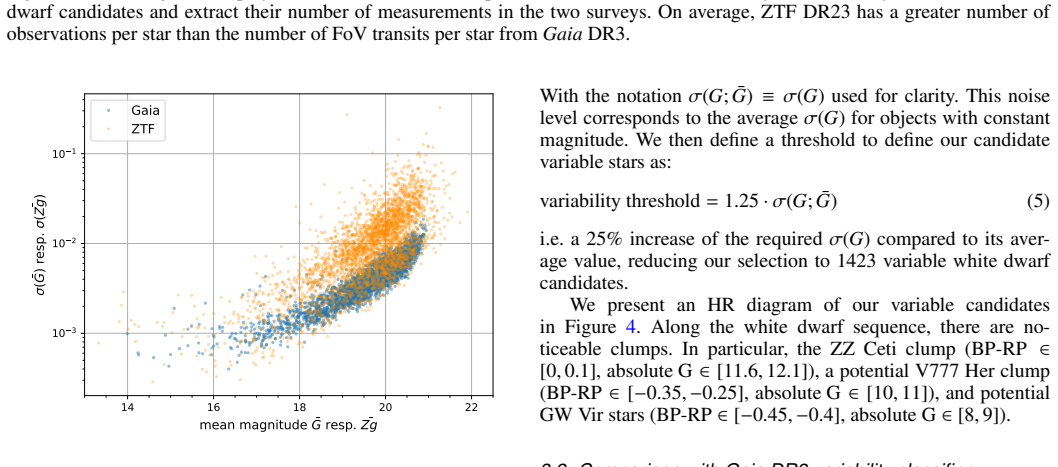
The publications of Gaia DR2 and DR3 have brought major improvements in stellar astrometry and photometry, particularly regarding the description of the white dwarf sequence. Notably, Gaia DR2 enabled the detection of variability in white dwarfs based solely on averaged astrometric and photometric quantities, i.e. the astrometric 5 parameters (positions, proper motion, and parallax) and general photometry properties in the G, BP and RP bands (mean, standard deviation and number of measurements). We identify and classify variable white dwarfs using Gaia DR3 data and Zwicky Transient Facility DR23 observations. The objective is to construct a catalogue of pulsating white dwarf candidates with robust selection criteria. We define a new sample of candidate variable white dwarfs using Gaia DR3 astrometric and photometric data. We cross-match this sample with the ZTF DR23 catalogue and apply a multiband Lomb-Scargle periodogram analysis to detect periodic variability. We then use the OPTICS unsupervised clustering algorithm to to group and classify the confirmed periodic stars. We identify 1423 variable white dwarfs candidates from Gaia DR3, with 864 having ZTF time series. 141 present significant periodicity. We classify these objects into known categories, including ZZ Ceti stars, GW Vir, V777 Her, and white dwarf-main sequence binaries. Our analysis yields several periodic stars, including three ZZ Ceti, 15 GW Vir, one V777 Her, and 24 WD-MS binaries. Furthermore, it reveals a significant population of potentialy variable stars, though without confirmed periodicity. Finally we publish our catalogue of candidate variable white dwarfs including variability status, periodicity, and classification information for the 864 sources with ZTF time series, 519 of them newly identified (including 83 new periodic stars).
Editorial analysis
A structured set of objections, weighed in public.
Referee Report
Summary. The paper claims to construct a catalog of variable white dwarf candidates by applying Gaia DR3 astrometric and photometric selection criteria to identify 1423 candidates, cross-matching 864 with ZTF DR23 time series, performing multiband Lomb-Scargle periodogram analysis to detect significant periodicity in 141 sources, applying OPTICS clustering for classification into types including 3 ZZ Ceti, 15 GW Vir, 1 V777 Her, and 24 WD-MS binaries, and releasing a catalog for the 864 sources that includes 519 newly identified candidates of which 83 are newly periodic.
Significance. If the periodicity detections hold after validation, the work would provide a useful public catalog expanding the sample of known variable white dwarfs and periodic pulsators from combined Gaia and ZTF data. Strengths include the direct use of public survey data, standard algorithms (Lomb-Scargle and OPTICS), and the release of the catalog with variability status and classifications, which supports reproducibility and follow-up studies.
major comments (1)
- [Abstract / Periodogram analysis] Abstract and methods description of the multiband Lomb-Scargle analysis: no quantitative false-alarm probability threshold, no explicit alias-rejection procedure (e.g., comparison to the spectral window function or requirement that the same frequency dominates independently in g and r), and no injection-recovery tests on the actual ZTF observing cadence are described. Given ZTF's strong nightly sampling aliases near 1 d^{-1} and harmonics, this leaves open the possibility that a non-negligible fraction of the 141 'significant periodicity' detections (and thus the 83 new periodic stars) are artifacts rather than intrinsic variability. This directly affects the reliability of the central counts and classifications.
minor comments (2)
- [Abstract] Abstract contains two clear typos: 'to to group' and 'potentialy variable'.
- [Methods] The exact numerical thresholds applied for the Gaia DR3 variability selection (astrometric and photometric) and the Lomb-Scargle significance cut are not stated, making it difficult to reproduce the initial 1423-candidate sample.
Simulated Author's Rebuttal
We thank the referee for their constructive and detailed review of our manuscript. Their comments on the periodogram analysis are well taken, and we address them point by point below. We will revise the manuscript accordingly to improve the description of our methods and strengthen the reliability assessment of the reported periodicities.
read point-by-point responses
-
Referee: [Abstract / Periodogram analysis] Abstract and methods description of the multiband Lomb-Scargle analysis: no quantitative false-alarm probability threshold, no explicit alias-rejection procedure (e.g., comparison to the spectral window function or requirement that the same frequency dominates independently in g and r), and no injection-recovery tests on the actual ZTF observing cadence are described. Given ZTF's strong nightly sampling aliases near 1 d^{-1} and harmonics, this leaves open the possibility that a non-negligible fraction of the 141 'significant periodicity' detections (and thus the 83 new periodic stars) are artifacts rather than intrinsic variability. This directly affects the reliability of the central counts and classifications.
Authors: We agree that the methods section requires a more quantitative and explicit description of the periodicity detection criteria. In the revised manuscript we will add the specific false-alarm probability threshold adopted for the multiband Lomb-Scargle periodograms (currently described only qualitatively as 'significant'). We will also make explicit our alias-rejection approach, which includes requiring that the dominant frequency be consistent between the independent g- and r-band periodograms; this step was performed but not detailed in the original text. Regarding injection-recovery tests on the actual ZTF cadence, such tests were not carried out in the submitted version. We acknowledge that they would provide a more complete validation of the detection efficiency and false-positive rate. We will either perform a representative set of injection tests or, if resource constraints prevent a full suite, add a quantitative discussion of the expected impact of nightly aliases on the 141 detections. These additions will directly address the referee's concern about the reliability of the 83 newly identified periodic stars. revision: yes
Circularity Check
No circularity; derivation applies standard algorithms to public survey data
full rationale
The paper selects 1423 variable white dwarf candidates from Gaia DR3 astrometric and photometric quantities, cross-matches 864 with ZTF DR23, runs multiband Lomb-Scargle periodograms to identify 141 periodic sources, and applies the standard OPTICS algorithm for classification into ZZ Ceti, GW Vir, etc. No equations, fitted parameters, or self-citations reduce the reported counts, periodicity detections, or classifications to quantities defined by the authors' own prior results or by construction. All steps are direct applications of external catalogs and established, non-author-specific methods.
Axiom & Free-Parameter Ledger
free parameters (3)
- Gaia variability selection thresholds
- Lomb-Scargle significance threshold
- OPTICS clustering parameters
axioms (2)
- standard math Lomb-Scargle periodogram reliably extracts periodic signals from unevenly sampled, multi-band photometric time series under standard noise assumptions.
- domain assumption White dwarfs exhibiting periodic variability belong to established observational classes (ZZ Ceti, GW Vir, V777 Her, WD-MS binaries) whose period ranges are known.
Lean theorems connected to this paper
-
IndisputableMonolith/Cost/FunctionalEquation.leanwashburn_uniqueness_aczel unclear?
unclearRelation between the paper passage and the cited Recognition theorem.
We then analyze our cleaned time series with Generalised Lomb-Scargle periodograms ... FAP_Zg resp. Zr (f) < 10^{-3} ... LS(f) > 0.1 ... OPTICS unsupervised clustering algorithm ... parameters: absolute G magnitude, BP-RP colour, log10 frequency, and log10 amplitude ratio
-
IndisputableMonolith/Foundation/DimensionForcing.leanalexander_duality_circle_linking unclear?
unclearRelation between the paper passage and the cited Recognition theorem.
We identify 1423 variable white dwarfs candidates from Gaia DR3, with 864 having ZTF time series. 141 present significant periodicity.
What do these tags mean?
- matches
- The paper's claim is directly supported by a theorem in the formal canon.
- supports
- The theorem supports part of the paper's argument, but the paper may add assumptions or extra steps.
- extends
- The paper goes beyond the formal theorem; the theorem is a base layer rather than the whole result.
- uses
- The paper appears to rely on the theorem as machinery.
- contradicts
- The paper's claim conflicts with a theorem or certificate in the canon.
- unclear
- Pith found a possible connection, but the passage is too broad, indirect, or ambiguous to say the theorem truly supports the claim.
Reference graph
Works this paper leans on
-
[1]
Althaus, L. G., Córsico, A. H., Isern, J., & García-Berro, E. 2010, A&A Rev., 18, 471
work page 2010
-
[2]
M., Kriegel, H.-P., & Sander, J
Ankerst, M., Breunig, M. M., Kriegel, H.-P., & Sander, J. 1999, SIGMOD Rec., 28, 49 Astropy Collaboration, Price-Whelan, A. M., Lim, P. L., et al. 2022, ApJ, 935, 167 Astropy Collaboration, Price-Whelan, A. M., Sip˝ocz, B. M., et al. 2018, AJ, 156, 123
work page 1999
-
[3]
Baluev, R. V . 2008, Monthly Notices of the Royal Astronomical Society, 385, 1279
work page 2008
-
[4]
Bellm, E. C., Kulkarni, S. R., Graham, M. J., et al. 2019, PASP, 131, 018002
work page 2019
- [5]
-
[6]
Dufour, P., Blouin, S., Coutu, S., et al. 2017, The Montreal White Dwarf Database: A Tool for the Community, conference Name: 20th European White Dwarf Workshop V olume: 509 ADS Bibcode: 2017ASPC..509....3D
work page 2017
-
[7]
W., Riello, M., De Angeli, F., et al
Evans, D. W., Riello, M., De Angeli, F., et al. 2018, A&A, 616, A4
work page 2018
-
[8]
1998, PhD thesis, University of Geneva
Eyer, L. 1998, PhD thesis, University of Geneva
work page 1998
- [9]
-
[10]
Eyer, L., Mowlavi, N., Evans, D. W., et al. 2017, arXiv e-prints, arXiv:1702.03295
work page internal anchor Pith review Pith/arXiv arXiv 2017
-
[11]
Eyer, L., Rimoldini, L., Rohrbasser, L., et al. 2020, in Stars and their Variability Observed from Space, ed. C. Neiner, W. W. Weiss, D. Baade, R. E. Griffin, C. C. Lovekin, & A. F. J. Moffat, 11–17 Gaia Collaboration, Brown, A. G. A., Vallenari, A., et al. 2018, A&A, 616, A1 Gaia Collaboration, Brown, A. G. A., Vallenari, A., et al. 2021, A&A, 649, A1 Ga...
-
[12]
Guidry, J. A., Vanderbosch, Z. P., Hermes, J. J., et al. 2021, ApJ, 912, 125
work page 2021
-
[13]
Lindegren, L., Hernández, J., Bombrun, A., et al. 2018, A&A, 616, A2
work page 2018
-
[14]
Lindegren, L., Klioner, S. A., Hernández, J., et al. 2021, A&A, 649, A2
work page 2021
-
[15]
Lomb, N. R. 1976, Ap&SS, 39, 447 Maíz Apellániz, J., Holgado, G., Pantaleoni González, M., & Caballero, J. A. 2023, A&A, 677, A137
work page 1976
-
[16]
Masci, F. J., Laher, R. R., Rusholme, B., et al. 2018, Publications of the As- tronomical Society of the Pacific, 131, 018003, publisher: The Astronomical Society of the Pacific
work page 2018
-
[17]
Mignard, F., Bailer-Jones, C., Bastian, U., et al. 2008, in IAU Symposium, V ol. 248, A Giant Step: from Milli- to Micro-arcsecond Astrometry, ed. W. J. Jin, I. Platais, & M. A. C. Perryman, 224–230
work page 2008
- [18]
-
[19]
2000, Astronomy and Astrophysics Sup- plement Series, 143, 23
Ochsenbein, F., Bauer, P., & Marcout, J. 2000, Astronomy and Astrophysics Sup- plement Series, 143, 23
work page 2000
- [20]
-
[21]
Rimoldini, L., Holl, B., Gavras, P., et al. 2023, A&A, 674, A14 Article number, page 8 Timour Jestin et al.: Gaia DR3 Variable White Dwarfs vetted by ZTF
work page 2023
-
[22]
Scargle, J. D. 1982, ApJ, 263, 835
work page 1982
-
[23]
Lernen, Wissen, Daten, Analysen
Schubert, E. & Gertz, M. 2018, in CEUR Workshop Proceedings, V ol. 2191, Proceedings of the Conference "Lernen, Wissen, Daten, Analysen", ed. R. Gemulla, S. P. Ponzetto, C. Bizer, M. Keuper, & H. Stuckenschmidt (Mannheim, Germany: CEUR), 318–329, iSSN: 1613-0073
work page 2018
-
[24]
VanderPlas, J. T. & Ivezi ´c, Ž. 2015, The Astrophysical Journal, 812, 18, pub- lisher: IOP ADS Bibcode: 2015ApJ...812...18V
work page 2015
-
[25]
Virtanen, P., Gommers, R., Oliphant, T. E., et al. 2020, Nature Methods, 17, 261, publisher: Nature Publishing Group Article number, page 9 A&A proofs:manuscript no. draft Appendix A: Additional materials Article number, page 10 Timour Jestin et al.: Gaia DR3 Variable White Dwarfs vetted by ZTF (a) Gaia DR3 103999471976858496 (b) Gaia DR3 9300937222081844...
work page 2020
discussion (0)
Sign in with ORCID, Apple, or X to comment. Anyone can read and Pith papers without signing in.