Novel Quantum Spin Liquid States in the S = {frac{1}{2}} Three-Dimensional Compound Y₃Cu₂Sb₃O₁₄
Pith reviewed 2026-05-18 16:10 UTC · model grok-4.3
The pith
Measurements on Y3Cu2Sb3O14 show no long-range magnetic order and persistent spin dynamics to 0.077 K, pointing to a quantum spin liquid after a partial valence bond solid forms.
A machine-rendered reading of the paper's core claim, the machinery that carries it, and where it could break.
Core claim
In the three-dimensional S = 1/2 system Y3Cu2Sb3O14 consisting of two inequivalent Cu2+ sites each forming an edge shared triangular lattice, magnetic susceptibility, specific heat, 89Y NMR, muon spin relaxation, and ESR measurements confirm the absence of any long-range magnetic ordering and the persistence of spin dynamics down to 0.077 K. In 89Y NMR an anomaly at about 120 K is suggested to arise from a fraction of the spins condensing into a singlet valence bond solid state. A plateau in the muon relaxation rate between 60 K and 10 K is taken to signify the valence bond solid state from a fraction of the spins, followed by an increase and another plateau below about 1 K presumably from a
What carries the argument
Temperature-dependent muon spin relaxation rate exhibiting two distinct plateaus that separate a partial valence bond solid regime from a low-temperature quantum spin liquid regime.
If this is right
- The material maintains dynamic spins without freezing or ordering to millikelvin temperatures.
- A fraction of the copper spins form singlets near 120 K as indicated by the NMR anomaly.
- The entire spin system enters a quantum spin liquid regime below roughly 1 K.
- Competing antiferromagnetic interactions identified by DFT generate the frustration that stabilizes the liquid state.
Where Pith is reading between the lines
- Applying an external magnetic field could split the low-temperature excitations and test the nature of the proposed spin liquid.
- The three-dimensional geometry offers a contrast to two-dimensional triangular-lattice spin-liquid candidates for future comparative studies.
- Neutron scattering experiments could directly map the spin correlations in the intermediate and lowest-temperature regimes.
Load-bearing premise
The specific assignment of the 120 K NMR anomaly and the two muon-relaxation plateaus to a partial valence-bond-solid state and a full quantum-spin-liquid state rather than to other possible low-energy excitations or experimental artifacts.
What would settle it
Observation of magnetic Bragg peaks indicating long-range order below 1 K or the disappearance of the low-temperature muon relaxation plateau would contradict the proposed quantum spin liquid state.
Figures


read the original abstract
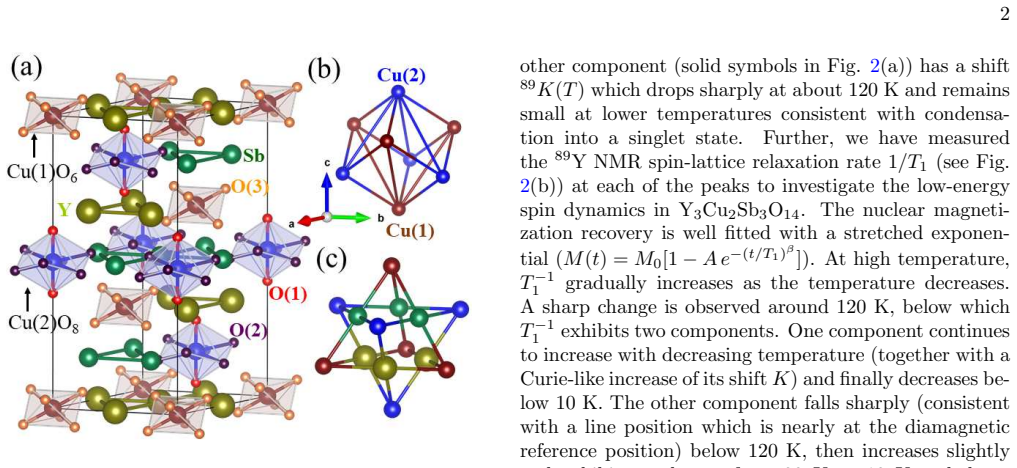
The three-dimensional $S = {\frac{1}{2}}$ system Y$_{3}$Cu$_{2}$Sb$_{3}$O$_{14}$ consists of two inequivalent Cu$^{2+}$ sites, each forming an edge shared triangular lattice. Our magnetic susceptibility $\chi(T)$, specific heat $C_p(T)$, $^{89}$Y nuclear magnetic resonance (NMR), muon spin relaxation ($\upmu\mathrm{SR}$), and electron spin resonance (ESR) measurements on this system confirm the absence of any long-range magnetic ordering and the persistence of spin dynamics down to 0.077 K. In $^{89}$Y NMR we find an anomaly at about 120 K which we suggest arises from a fraction of the spins condensing into a singlet (a valence bond solid VBS) state. A plateau in the muon relaxation rate is observed between 60 K and 10 K (signifying the VBS state from a fraction of the spins) followed by an increase and another plateau below about 1 K (presumably signifying the quantum spin liquid state from all the spins). Our density functional theory calculations find a dominant antiferromagnetic interaction along the body diagonal with inequivalent Cu(1) and Cu(2) ions alternately occupying the corners of the cube. All other near-neighbour interactions between the Cu ions are also found to be antiferromagnetic and are thought to drive the frustration.
Editorial analysis
A structured set of objections, weighed in public.
Referee Report
Summary. The manuscript reports magnetic susceptibility χ(T), specific heat Cp(T), 89Y NMR, μSR, ESR, and DFT calculations on the 3D S=1/2 compound Y3Cu2Sb3O14 with two inequivalent Cu sites forming edge-shared triangular lattices. It claims absence of long-range magnetic order and persistence of spin dynamics to 0.077 K, with a ~120 K 89Y NMR anomaly interpreted as partial spin condensation into a valence-bond-solid (VBS) state from a fraction of spins, and μSR relaxation-rate plateaus (60–10 K then below ~1 K) assigned to partial VBS followed by a full quantum spin liquid (QSL) involving all spins. DFT finds dominant antiferromagnetic body-diagonal coupling plus other AF near-neighbor interactions producing frustration.
Significance. The multi-technique confirmation of no long-range order down to 0.077 K is a solid experimental result that adds a new 3D frustrated S=1/2 candidate to the short list of materials without conventional ordering. If the VBS/QSL partitioning can be placed on a quantitative footing using the DFT exchange network, the work would strengthen evidence for exotic states in three-dimensional lattices; the current qualitative assignments limit the immediate impact.
major comments (2)
- [NMR results and discussion] NMR section (discussion of the 120 K anomaly): the claim that this feature arises from a fraction of Cu spins condensing into singlets (partial VBS) is not supported by any calculated Knight-shift drop, 1/T1 behavior, or site-selective response using the DFT-derived dominant body-diagonal AF interaction and the two inequivalent Cu sites; without such modeling the anomaly could equally reflect impurity effects or a structural crossover.
- [μSR results] μSR section (plateaus in relaxation rate): the assignment of the 60–10 K plateau to VBS from a fraction of spins and the low-T plateau below ~1 K to a full QSL from all spins rests on qualitative interpretation; a microscopic calculation of the expected depolarization rate for partial singlet formation on the reported exchange network is required to rule out conventional paramagnetic slowing or experimental artifacts.
minor comments (2)
- [Abstract] Abstract and conclusions: the tentative phrasing 'we suggest' and 'presumably signifying' for the VBS and QSL assignments should be carried through consistently when stating the central claims.
- [DFT section] DFT calculations: a table listing the computed exchange constants (J values and signs) for all near-neighbor pairs would allow direct assessment of the frustration strength and comparison with the experimental energy scales.
Simulated Author's Rebuttal
We thank the referee for the careful and constructive review of our manuscript. We respond to the major comments point by point below, providing the strongest possible defense of our interpretations based on the available data while being honest about the qualitative nature of some assignments.
read point-by-point responses
-
Referee: NMR section (discussion of the 120 K anomaly): the claim that this feature arises from a fraction of Cu spins condensing into singlets (partial VBS) is not supported by any calculated Knight-shift drop, 1/T1 behavior, or site-selective response using the DFT-derived dominant body-diagonal AF interaction and the two inequivalent Cu sites; without such modeling the anomaly could equally reflect impurity effects or a structural crossover.
Authors: We agree that quantitative modeling of the Knight shift and relaxation rate using the DFT exchange parameters would provide stronger evidence for the partial VBS interpretation. In the manuscript, the anomaly is identified through the temperature dependence of the 89Y Knight shift, which shows a deviation around 120 K, and a corresponding feature in 1/T1. This is interpreted as partial singlet formation because it occurs at a temperature scale much higher than the low-temperature QSL regime and is consistent with the frustrated AF interactions found in DFT. To address alternative explanations, we note that impurity effects would typically manifest as a low-temperature Curie tail in susceptibility, which is not observed, and the feature is seen in multiple measurements. A structural crossover is not indicated by our structural characterization. We will revise the manuscript to include a more explicit discussion of these points and the limitations of the current interpretation. revision: yes
-
Referee: μSR section (plateaus in relaxation rate): the assignment of the 60–10 K plateau to VBS from a fraction of spins and the low-T plateau below ~1 K to a full QSL from all spins rests on qualitative interpretation; a microscopic calculation of the expected depolarization rate for partial singlet formation on the reported exchange network is required to rule out conventional paramagnetic slowing or experimental artifacts.
Authors: The assignment of the μSR plateaus is indeed qualitative, correlating the 60-10 K plateau with the NMR anomaly at 120 K (adjusted for the different sensitivity) as partial VBS, and the low-T plateau as the onset of QSL dynamics. This is supported by the overall experimental picture of no long-range order and persistent spin fluctuations to 0.077 K from μSR, NMR, and other probes. Conventional paramagnetic slowing is inconsistent with the lack of freezing in specific heat and the frustration from DFT. We have checked for artifacts through careful data analysis. However, we do not have a microscopic calculation of the depolarization rate at this stage. We will update the manuscript to better justify the temperature scales and discuss why other interpretations are less favored. revision: partial
- Quantitative calculation of the Knight shift drop and 1/T1 using the DFT-derived interactions for the partial VBS state
- Microscopic modeling of the muon depolarization rate for the partial singlet formation on the exchange network
Circularity Check
No circularity: experimental inferences from direct measurements
full rationale
The paper is an experimental study reporting raw data from χ(T), Cp(T), 89Y NMR, μSR, and ESR, plus supporting DFT calculations for the exchange network. The key claims (no long-range order, persistence of dynamics to 0.077 K, 120 K NMR anomaly suggested as partial VBS, muon-rate plateaus assigned to VBS then QSL) are qualitative interpretations of observed features rather than outputs of any derivation, fit, or equation that reduces to the inputs by construction. No self-citations are invoked as load-bearing uniqueness theorems, no parameters are fitted to target conclusions and relabeled as predictions, and the DFT results are presented as independent first-principles input. The work is therefore self-contained against external benchmarks and receives the default non-circularity finding.
Axiom & Free-Parameter Ledger
axioms (1)
- domain assumption Absence of long-range magnetic order together with persistent dynamics at the lowest temperatures indicates a quantum spin liquid in a frustrated S=1/2 system.
Lean theorems connected to this paper
-
IndisputableMonolith/Foundation/AlexanderDuality.leanalexander_duality_circle_linking unclear?
unclearRelation between the paper passage and the cited Recognition theorem.
Our density functional theory calculations find a dominant antiferromagnetic interaction along the body diagonal with inequivalent Cu(1) and Cu(2) ions alternately occupying the corners of the cube. All other near-neighbour interactions between the Cu ions are also found to be antiferromagnetic and are thought to drive the frustration.
-
IndisputableMonolith/Cost/FunctionalEquation.leanwashburn_uniqueness_aczel unclear?
unclearRelation between the paper passage and the cited Recognition theorem.
A plateau in the muon relaxation rate is observed between 60 K and 10 K (signifying the VBS state from a fraction of the spins) followed by an increase and another plateau below about 1 K (presumably signifying the quantum spin liquid state from all the spins).
What do these tags mean?
- matches
- The paper's claim is directly supported by a theorem in the formal canon.
- supports
- The theorem supports part of the paper's argument, but the paper may add assumptions or extra steps.
- extends
- The paper goes beyond the formal theorem; the theorem is a base layer rather than the whole result.
- uses
- The paper appears to rely on the theorem as machinery.
- contradicts
- The paper's claim conflicts with a theorem or certificate in the canon.
- unclear
- Pith found a possible connection, but the passage is too broad, indirect, or ambiguous to say the theorem truly supports the claim.
Reference graph
Works this paper leans on
-
[1]
was ob- tained by subtracting the lattice contribution obtained from the data of the nonmagnetic structural analog Lu3Zn2Sb3O14 ([ 21] for details). Cmag(T ) exhibits a broad hump at 10 K followed by a plateau around 1 K. The low- T plateau is suppressed in fields greater than 30 kOe. The entropy change calculated by integrating the Cmag(T )/T vs. T data i...
work page 2021
-
[2]
T.-H. Han, J. S. Helton, S. Chu, D. G. Nocera, J. A. Rodriguez-Rivera, C. Broholm, and Y. S. Lee, Fraction- alized excitations in the spin-liquid state of a kagome- lattice antiferromagnet, Nature 492, 406 (2012)
work page 2012
-
[3]
Y. Okamoto, H. Yoshida, and Z. Hiroi, Vesignieite BaCu3V2O8(OH)2 as a candidate spin-1/2 kagome an- tiferromagnet, J. Phys. Soc. Jpn. 78, 033701 (2009)
work page 2009
-
[4]
Y. Zhou, K. Kanoda, and T.-K. Ng, Quantum spin liquid states, Rev. Mod. Phys. 89, 025003 (2017)
work page 2017
-
[5]
J. P. Sheckelton, J. R. Neilson, D. G. Soltan, and T. M. McQueen, Possible valence-bond condensation in the frustrated cluster magnet LiZn 2Mo3O8, Nature Mater. 11, 493 (2012)
work page 2012
-
[6]
R. Flint and P. A. Lee, Emergent honeycomb lattice in LiZn2Mo3O8, Phys. Rev. Lett. 111, 217201 (2013)
work page 2013
-
[7]
S. Chillal, Y. Iqbal, H. O. Jeschke, J. A. Rodriguez- Rivera, R. Bewley, P. Manuel, D. Khalyavin, P. Steffens, R. Thomale, A. N. Islam, and B. Lake, Evidence for a three-dimensional quantum spin liquid in PbCuTe 2O6, Nat. Commun. 11, 2348 (2020)
work page 2020
-
[8]
Z. L. Dun, J. Trinh, K. Li, M. Lee, K. W. Chen, R. Baum- bach, Y. F. Hu, Y. X. Wang, E. S. Choi, B. S. Shastry, A. P. Ramirez, and H. D. Zhou, Magnetic ground states of the rare-earth tripod kagome lattice Mg 2RE3Sb3O14 (RE= Gd, Dy, Er), Phys. Rev. Lett. 116, 157201 (2016)
work page 2016
-
[9]
Z. L. Dun, J. Trinh, M. Lee, E. S. Choi, K. Li, Y. F. Hu, Y. X. Wang, N. Blanc, A. P. Ramirez, and H. D. Zhou, Structural and magnetic properties of two branches of the tripod-kagome-lattice family A 2R3Sb3O14 (A= Mg, Zn; R= Pr, Nd, Gd, Tb, Dy, Ho, Er, Yb), Phys. Rev. B 95, 104439 (2017)
work page 2017
-
[10]
J. A. Paddison, H. S. Ong, J. O. Hamp, P. Mukher- jee, X. Bai, M. G. Tucker, N. P. Butch, C. Castel- novo, M. Mourigal, and S. Dutton, Emergent order in the kagome ising magnet Dy 3Mg2Sb3O14, Nat. Commun. 7, 13842 (2016)
work page 2016
- [12]
- [14]
-
[15]
Y. Yang, X. Li, C. Tan, Z. Zhu, J. Zhang, Z. Ding, 6 Q. Wu, C. Chen, T. Shiroka, Y. Xia, et al. , Intrinsic new properties of a quantum spin liquid, arXiv preprint 10.48550/arXiv.2102.09271 (2021)
-
[16]
O. Bradley, Y. Zhang, J. Oitmaa, and R. R. Singh, High- temperature magnetization and entropy of the triangular lattice hubbard model in a zeeman field, arXiv preprint 10.48550/arXiv.2303.03550 (2023)
-
[17]
K. Li, Y. Hu, Y. Wang, T. Kamiyama, B. Wang, Z. Li, and J. Lin, Syntheses and properties of a family of new compounds RE 3Sb3Co2O14 (RE= La, Pr, Nd, Sm– Ho) with an ordered pyrochlore structure, J. Solid State Chem. 217, 80 (2014)
work page 2014
-
[18]
S. Mayouf, C. Vincent, M. Fadia, Z. Kheira, T. Bouazza, and B. Naceur, Synthesis and characterization of a new ordered rhombohedral pyrochlore family Ln 3Sb3Cu2O14 (Ln= Pr, Nd, Sm, Eu, Tb, Dy) with more detailed study of the Sm compound, J. Solid State Chem. 326, 124205 (2023)
work page 2023
-
[19]
M. B. Sanders, K. M. Baroudi, J. W. Krizan, O. A. Mukadam, and R. J. Cava, Synthesis, crystal structure, and magnetic properties of novel 2D kagome materials RE3Sb3Mg2O14 (RE = La, Pr, Sm, Eu, Tb, Ho) : com- parison to RE 3Sb3Zn2O14 family, Phys. Status Solidi B 253, 2056 (2016)
work page 2056
-
[20]
M. B. Sanders, J. W. Krizan, and R. J. Cava, RE3Sb3Zn2O14 (RE= La, Pr, Nd, Sm, Eu, Gd): a new family of pyrochlore derivatives with rare earth ions on a 2D kagome lattice, J. Mater. Chem. C 4, 541 (2016)
work page 2016
- [21]
-
[22]
See supplemental material at [url will be inserted by the production group] for the supporting results and discus- sion which includes [ 10, 12, 23, 33–43],
- [23]
-
[25]
J. P. Perdew, K. Burke, and M. Ernzerhof, Generalized gradient approximation made simple, Phys. Rev. Lett. 77, 3865 (1996)
work page 1996
-
[26]
V. I. Anisimov, J. Zaanen, and O. K. Andersen, Band theory and Mott insulators: Hubbard U instead of Stoner I, Phys. Rev. B 44, 943 (1991)
work page 1991
-
[27]
G. Kresse and J. Hafner, Ab initio molecular dynamics for liquid metals, Phys. Rev. B 47, 558 (1993)
work page 1993
-
[28]
G. Kresse and J. Furthm¨ uller, Efficient iterative schemes for ab initio total-energy calculations using a plane-wave basis set, Phys. Rev. B 54, 11169 (1996)
work page 1996
-
[29]
P. E. Bl¨ ochl, Projector augmented-wave method, Phys. Rev. B 50, 17953 (1994)
work page 1994
-
[30]
G. Kresse and D. Joubert, From ultrasoft pseudopoten- tials to the projector augmented-wave method, Phys. Rev. B 59, 1758 (1999)
work page 1999
-
[31]
H. J. Xiang, E. J. Kan, S.-H. Wei, M.-H. Whangbo, and X. G. Gong, Predicting the spin-lattice order of frus- trated systems from first principles, Phys. Rev. B 84, 224429 (2011)
work page 2011
-
[32]
R. Kumar, T. Dey, P. M. Ette, K. Ramesha, A. Chakraborty, I. Dasgupta, R. Eremina, S. T´ oth, A. Shahee, S. Kundu, M. Prinz-Zwick, A. A. Gippius, H. A. K. von Nidda, N. B¨ uttgen, P. Gegenwart, and A. V. Mahajan, Structural, thermodynamic, and local probe investigations of the honeycomb material Ag 3LiMn2O6, Phys. Rev. B 99, 144429 (2019)
work page 2019
-
[33]
X. Li, H. Yu, F. Lou, J. Feng, M.-H. Whangbo, and H. Xi- ang, Spin hamiltonians in magnets: Theories and com- putations, Molecules 26, 803 (2021)
work page 2021
-
[34]
J. Rodr ´ ıguez-Carvajal, Recent advances in magnetic structure determination by neutron powder diffraction, Physica B: Condensed Matter 192, 55 (1993)
work page 1993
-
[38]
E. M. Kenney, C. U. Segre, W. Lafargue-Dit-Hauret, O. I. Lebedev, M. Abramchuk, A. Berlie, S. P. Cottrell, G. Simutis, F. Bahrami, N. E. Mordvinova, G. Fabbris, J. L. McChesney, D. Haskel, X. Rocquefelte, M. J. Graf, and F. Tafti, Coexistence of static and dynamic mag- netism in the kitaev spin liquid material Cu 2IrO3, Phys. Rev. B 100, 094418 (2019)
work page 2019
-
[44]
F. Pratt, WIMDA: a muon data analysis program for the Windows PC, Physica B: Condensed Matter 289, 710 (2000) . Supplemental Material: Novel Quantum Spin Liquid States in the S = 1 2 three-dimensional compound Y 3Cu2Sb3O14 Saikat Nandi, 1, ∗ Rounak Das, 2 Sagar Mahapatra, 3 J¨ org Sichelschmidt,4 M. Hemmida, 5 H.-A. Krug von Nidda, 5 Marlis Schuller, 5 N....
work page 2000
-
[45]
corners becomes the trigonal c-axes. Examination of the X-ray diffraction patterns of Y 3Cu2Sb3O14 reveals that the strongest peak (222) for pyrochlore at 2 θ ∼ 30◦ has split into two peaks, qualitatively suggesting complete Cu–Y and Cu–Sb site-ordering [ 4]. Magnetization Temperature-dependent magnetic susceptibility ( χ ≡ M/H ) measurements of Y 3Cu2Sb3O...
-
[46]
The temperature- dependent dc susceptibility χ measured at H = 20 kOe, along with the inverse susceptibility (1 /χ ), is also shown in Fig. 4(b). No clear indication of any long-range mag- netic ordering is observed down to 0.4 K and the data also do not show any anomaly in the dc and ac magnetic susceptibility data. Fig. 4(c) displays the magnetiza- tion...
-
[47]
In the presence of static magnetism, an LF of 10 Bloc could completely suppress the static field and decouple the muon spins from the influence of that in- ternal static fields. Decoupling is not possible even in 8 /s48 /s53 /s49/s48 /s48/s46/s48 /s48/s46/s49 /s48/s46/s50 /s48/s46/s51 /s48/s32/s79/s101 /s52/s50/s32/s79/s101 /s55/s53/s55/s32/s79/s101 /s51/s50...
-
[48]
J. Rodr ´ ıguez-Carvajal, Recent advances in magnetic structure determination by neutron powder diffraction, FIG. 12. Non-spin polarized total (grey), Cu- d partial (red) and O- p partial (green) DOS for Y 3Cu2Sb3O14. Physica B: Condensed Matter 192, 55 (1993)
work page 1993
-
[49]
F. Pratt, WIMDA: a muon data analysis program for the Windows PC, Physica B: Condensed Matter 289, 710 (2000)
work page 2000
-
[50]
C. Lee, S. Lee, H.-S. Kim, S. Kittaka, Y. Kohama, T. Sakakibara, K. H. Lee, J. van Tol, D. I. Gorbunov, S.-H. Do, S. Yoon, A. Berlie, and K.-Y. Choi, Random singlets in the S = 5 / 2 coupled frustrated cubic lattice Lu3Sb3Mn2O14, Phys. Rev. B 107, 214404 (2023)
work page 2023
- [51]
-
[52]
G. A. Bain and J. F. Berry, Diamagnetic corrections and Pascal’s constants, J. Chem. Educ. 85, 532 (2008)
work page 2008
-
[53]
Y. S. Choi, C. H. Lee, S. Lee, S. Yoon, W.-J. Lee, J. Park, A. Ali, Y. Singh, J.-C. Orain, G. Kim, J.-S. Rhyee, W.-T. Chen, F. Chou, and K.-Y. Choi, Exotic low-energy exci- tations emergent in the random kitaev magnet Cu 2IrO3, Phys. Rev. Lett. 122, 167202 (2019)
work page 2019
-
[54]
K. Kitagawa, T. Takayama, Y. Matsumoto, A. Kato, R. Takano, Y. Kishimoto, S. Bette, R. Dinnebier, G. Jackeli, and H. Takagi, A spin–orbital-entangled quan- tum liquid on a honeycomb lattice, Nature 554, 341 (2018)
work page 2018
-
[55]
F. Bahrami, W. Lafargue-Dit-Hauret, O. I. Lebedev, R. Movshovich, H.-Y. Yang, D. Broido, X. Rocquefelte, and F. Tafti, Thermodynamic evidence of proximity to a kitaev spin liquid in Ag 3LiIr2O6, Phys. Rev. Lett. 123, 237203 (2019)
work page 2019
-
[56]
E. M. Kenney, C. U. Segre, W. Lafargue-Dit-Hauret, O. I. Lebedev, M. Abramchuk, A. Berlie, S. P. Cottrell, G. Simutis, F. Bahrami, N. E. Mordvinova, G. Fabbris, J. L. McChesney, D. Haskel, X. Rocquefelte, M. J. Graf, and F. Tafti, Coexistence of static and dynamic mag- netism in the kitaev spin liquid material Cu 2IrO3, Phys. Rev. B 100, 094418 (2019) . 9
work page 2019
- [57]
-
[58]
M. Bouvier, P. Lethuillier, and D. Schmitt, Specific heat in some gadolinium compounds. I. experimental, Phys. Rev. B 43, 13137 (1991)
work page 1991
- [59]
-
[60]
M. Pula, S. Sharma, J. Gautreau, S. K. P., A. Kanigel, M. D. Frontzek, T. N. Dolling, L. Clark, S. Dunsiger, A. Ghara, and G. M. Luke, Candidate for a quantum spin liquid ground state in the shastry-sutherland lattice material Yb2Be2GeO7, Phys. Rev. B 110, 014412 (2024)
work page 2024
-
[61]
K. Bhattacharya, S. Mohanty, A. D. Hillier, M. T. F. Telling, R. Nath, and M. Majumder, Evidence of quan- tum spin liquid state in a Cu 2+-based S = 1 / 2 triangu- lar lattice antiferromagnet, Phys. Rev. B 110, L060403 (2024)
work page 2024
discussion (0)
Sign in with ORCID, Apple, or X to comment. Anyone can read and Pith papers without signing in.