Observation of Galactic center in the sub-MeV gamma-ray band with electron-tracking Compton camera
Pith reviewed 2026-05-18 16:02 UTC · model grok-4.3
The pith
A balloon-borne electron-tracking Compton camera detected gamma rays from the Galactic center in the 150-600 keV band at 7.9 sigma significance.
A machine-rendered reading of the paper's core claim, the machinery that carries it, and where it could break.
Core claim
The authors present the direct detection of gamma-ray emission from the Galactic center in the 150-600 keV band using the electron-tracking Compton camera, which has a 3.1 sr field of view. A one-day flight yielded a 7.9 sigma excess over background in the image map from the Galactic center region. The positronium-related flux extracted from a multi-component model is (3.2 plus or minus 1.4) times 10 to the minus 2 photons per square centimeter per second, consistent with INTEGRAL within 1 sigma. All three tested spatial models (point source, multi-component, and symmetric Gaussian) are statistically acceptable.
What carries the argument
The electron-tracking Compton camera (ETCC), which reconstructs the direction and energy of each gamma ray through electron tracking to produce an image and spectrum simultaneously.
If this is right
- The ETCC provides a simple and unambiguous analysis path for MeV gamma-ray imaging.
- The instrument is ready for future high-precision surveys from balloons or satellites.
- The measured flux supports models of positron annihilation in the Galactic center.
- Spatial models ranging from a point source to a Gaussian distribution remain compatible with the current data.
Where Pith is reading between the lines
- Longer flights would allow tighter constraints on whether the emission is extended or point-like.
- The wide field of view could enable simultaneous monitoring of other bright MeV sources during future flights.
- Repeating the measurement at higher altitude or with shielding refinements would reduce atmospheric background and improve sensitivity.
Load-bearing premise
The background model and instrument response function accurately isolate the Galactic center signal without significant contamination from atmospheric or instrumental effects during the short balloon flight.
What would settle it
A second independent observation with comparable exposure that shows no excess at the Galactic center position in the same energy band would falsify the detection claim.
Figures


read the original abstract
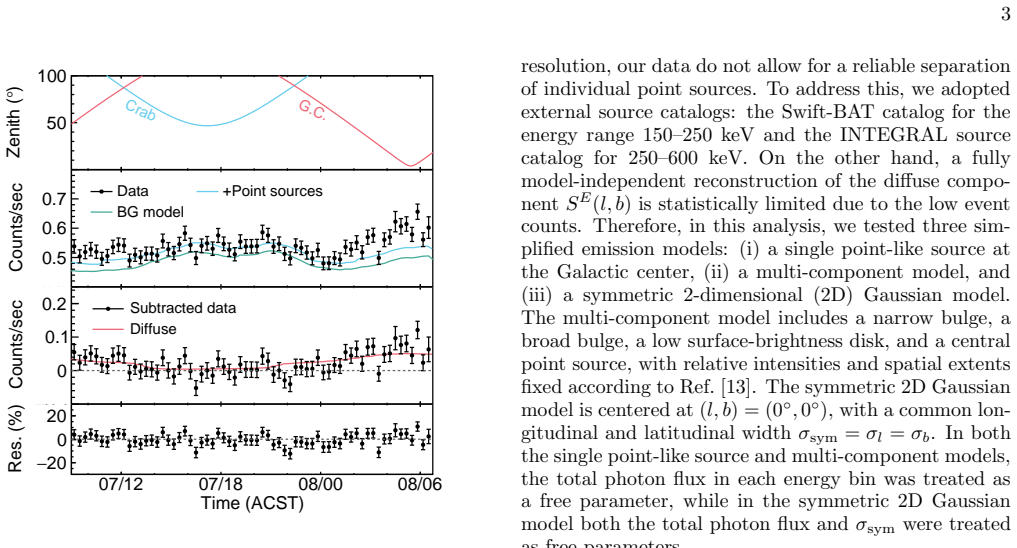
We report the direct detection of gamma-ray emission from the Galactic center in the 150-600 keV band using the electron-tracking Compton camera (ETCC), which has a wide field of view of 3.1 sr. This represents the first application of this linear, imaging-spectroscopy method to observations of the Galactic center. Measurements in a one-day flight over Australia yielded significant gamma-ray detection in the light curve and revealed a $7.9\sigma$ excess over the background in the image map from the Galactic center region. These results, obtained through a simple and unambiguous analysis, demonstrate the high reliability and sensitivity of the ETCC and establish its potential for future high-precision MeV gamma-ray observations. The measured intensity and spatial distribution were tested against three emission models: a single point-like source, a multi-component structure, and a symmetric two-dimensional Gaussian. All three were found to be statistically consistent with the data. The positronium-related flux provided by the multi-component model is $(3.2~\pm~1.4) \times 10^{-2}$ photons cm$^{-2}$s$^{-1}$, consistent with the value reported by INTEGRAL within $1\sigma$. These results establish the potential of the ETCC for future high-precision MeV gamma-ray surveys.
Editorial analysis
A structured set of objections, weighed in public.
Referee Report
Summary. The manuscript reports the first application of an electron-tracking Compton camera (ETCC) to observe the Galactic center in the 150-600 keV band during a one-day balloon flight over Australia. It claims a 7.9σ excess over background in the reconstructed image map from the Galactic center region, with the measured intensity and spatial distribution tested against point-like, multi-component, and symmetric Gaussian emission models. The multi-component model yields a positronium-related flux of (3.2 ± 1.4) × 10^{-2} photons cm^{-2} s^{-1}, stated to be consistent with INTEGRAL within 1σ. The analysis is described as simple and unambiguous, demonstrating the ETCC's reliability for future MeV observations.
Significance. If the background subtraction and systematics are shown to be robust, this work provides an independent detection that validates the ETCC's imaging-spectroscopy capability in the sub-MeV band from a balloon platform. The wide 3.1 sr field of view and direct comparison to external INTEGRAL data represent a useful proof-of-concept for high-precision MeV gamma-ray surveys, particularly if the result can be reproduced with quantified error budgets.
major comments (3)
- [Data Analysis] In the Data Analysis section describing background subtraction: the manuscript does not detail how the background model accounts for time-varying atmospheric gamma-ray production, cosmic-ray induced events, or instrumental activation over the one-day flight. This is load-bearing for the 7.9σ excess claim, as the wide 3.1 sr FOV increases the risk of including non-Galactic-center events; a flight-specific Monte Carlo validation or time-binned subtraction method should be presented.
- [Results] In the Results section on the image map: the 7.9σ significance is reported without explicit description of the statistical method, background distribution assumptions, or any simulation-based validation of the instrument response function. Residual contamination could affect this central quantitative result and must be quantified.
- [Model Fitting] In the section on emission model fitting: while the multi-component model flux is reported as consistent with INTEGRAL within 1σ, the propagation of uncertainties from background subtraction and the instrument response into the fitted parameters and consistency tests is not addressed. This weakens the claim that all three models are statistically consistent with the data.
minor comments (2)
- [Abstract] The abstract states the analysis is 'simple and unambiguous,' but this phrasing should be supported by explicit cross-references to the detailed methods in the main text.
- [Figures] Figure captions for the image map and light curve should explicitly indicate the Galactic center extraction region and any off-source background regions used.
Simulated Author's Rebuttal
We thank the referee for the constructive and detailed report. We address each major comment below and indicate where revisions will be made to strengthen the manuscript.
read point-by-point responses
-
Referee: [Data Analysis] In the Data Analysis section describing background subtraction: the manuscript does not detail how the background model accounts for time-varying atmospheric gamma-ray production, cosmic-ray induced events, or instrumental activation over the one-day flight. This is load-bearing for the 7.9σ excess claim, as the wide 3.1 sr FOV increases the risk of including non-Galactic-center events; a flight-specific Monte Carlo validation or time-binned subtraction method should be presented.
Authors: We agree that additional detail on background modeling is warranted given the one-day flight and wide field of view. In the revised manuscript we will expand the Data Analysis section to describe the time-binned subtraction approach that uses off-source intervals when the Galactic center was outside the field of view, together with the Monte Carlo simulations already performed to assess atmospheric and cosmic-ray contributions. We note that a fully time-resolved atmospheric model for every component is limited by the short flight duration, but the off-source method provides a robust first-order subtraction for this proof-of-concept observation. revision: yes
-
Referee: [Results] In the Results section on the image map: the 7.9σ significance is reported without explicit description of the statistical method, background distribution assumptions, or any simulation-based validation of the instrument response function. Residual contamination could affect this central quantitative result and must be quantified.
Authors: We accept that the statistical procedure underlying the 7.9σ claim requires explicit documentation. The revised Results section will state that the significance is obtained from a likelihood-ratio test under Poisson statistics, with the background distribution estimated from off-region data. We will also report the outcome of instrument-response Monte Carlo simulations used to confirm that residual contamination does not alter the quoted significance at the reported level. revision: yes
-
Referee: [Model Fitting] In the section on emission model fitting: while the multi-component model flux is reported as consistent with INTEGRAL within 1σ, the propagation of uncertainties from background subtraction and the instrument response into the fitted parameters and consistency tests is not addressed. This weakens the claim that all three models are statistically consistent with the data.
Authors: The referee correctly identifies the missing uncertainty propagation. In the revised Model Fitting section we will explicitly describe how uncertainties arising from background subtraction and the instrument response function are propagated into the fitted fluxes and model-comparison statistics via covariance matrices and standard error propagation. This addition will support the statement that all three models remain statistically consistent with the data. revision: yes
Circularity Check
No circularity in direct observational detection
full rationale
The paper reports an empirical detection of Galactic center gamma-ray emission in the 150-600 keV band from a one-day balloon flight, with the central quantitative result being a 7.9σ excess in the reconstructed image map. This excess is obtained via straightforward imaging-spectroscopy analysis of ETCC data and is cross-checked for consistency against independent external measurements from INTEGRAL. No derivation chain, equations, or model fitting reduces by construction to the paper's own inputs; the background subtraction and instrument response are treated as standard observational corrections rather than self-referential fits. The result is therefore self-contained against external benchmarks with no load-bearing self-citations or ansatz smuggling.
Axiom & Free-Parameter Ledger
axioms (2)
- domain assumption Background model accurately represents non-source contributions in the balloon flight data.
- domain assumption Instrument response and efficiency are correctly modeled for the ETCC in flight conditions.
Lean theorems connected to this paper
-
IndisputableMonolith/Foundation/AbsoluteFloorClosure.leanreality_from_one_distinction unclear?
unclearRelation between the paper passage and the cited Recognition theorem.
The expected count D_E',p' ... + A_E' B_E',p'(t) Δt (Eq. 1); background model generated with PARMA/Geant4 scaled by normalization A_E' fitted to off-source window; chi-square values 43 (p=0.50) and 40 (p=0.63) for single-point and multi-component models.
What do these tags mean?
- matches
- The paper's claim is directly supported by a theorem in the formal canon.
- supports
- The theorem supports part of the paper's argument, but the paper may add assumptions or extra steps.
- extends
- The paper goes beyond the formal theorem; the theorem is a base layer rather than the whole result.
- uses
- The paper appears to rely on the theorem as machinery.
- contradicts
- The paper's claim conflicts with a theorem or certificate in the canon.
- unclear
- Pith found a possible connection, but the passage is too broad, indirect, or ambiguous to say the theorem truly supports the claim.
Reference graph
Works this paper leans on
-
[1]
W. A. Mahoney, J. C. Ling, and W. A. Wheaton, HEAO 3 Observations of the Galactic Center 511 keV Line, The Astrophysical Journal92, 387 (1994)
work page 1994
-
[2]
V. Schoenfelder, H. Aarts, K. Bennett, H. de Boer, J. Clear, W. Collmar, A. Connors, A. Deerenberg, R. Diehl, A. von Dordrecht, J. W. den Herder, W. Hermsen, M. Kippen, L. Kuiper, G. Lichti, J. Lock- wood, J. Macri, M. McConnell, D. Morris, R. Much, J. Ryan, G. Simpson, M. Snelling, G. Stacy, H. Steinle, A. Strong, B. N. Swanenburg, B. Taylor, C. de Vries...
work page 1993
-
[3]
N. Gehrels, S. D. Barthelmy, B. J. Teegarden, J. Tueller, M. Leventhal, and C. J. MacCallum, GRIS Observations of Positron Annihilation Radiation from the Galactic Center, The Astrophysical Journal375, L13 (1991)
work page 1991
-
[4]
W. R. Purcell, L.-X. Cheng, D. D. Dixon, R. L. Kinzer, J. D. Kurfess, M. Leventhal, M. A. Saunders, J. G. Skibo, D. M. Smith, and J. Tueller, Osse mapping of galactic 511 kev positron annihilation line emission, The Astrophysi- cal Journal491, 725 (1997)
work page 1997
-
[5]
C. Winkler, T. J. L. Courvoisier, G. Di Cocco, N. Gehrels, A. Gim´ enez, S. Grebenev, W. Hermsen, J. M. Mas-Hesse, F. Lebrun, N. Lund, G. G. C. Palumbo, J. Paul, J. P. Roques, H. Schnopper, V. Sch¨ onfelder, R. Sunyaev, B. Teegarden, P. Ubertini, G. Vedrenne, and A. J. Dean, The INTEGRAL mission, Astronomy and Astrophysics411, L1 (2003)
work page 2003
-
[6]
R. Diehl, H. Halloin, K. Kretschmer, G. G. Lichti, V. Sch¨ onfelder, A. W. Strong, A. von Kienlin, W. Wang, P. Jean, J. Kn¨ odlseder, J.-P. Roques, G. Weidenspoint- ner, S. Schanne, D. H. Hartmann, C. Winkler, and C. Wunderer, Radioactive 26Al from massive stars in the Galaxy, Nature439, 45 (2006)
work page 2006
-
[7]
S. S. Tsygankov, R. A. Krivonos, A. A. Lutovinov, M. G. Revnivtsev, E. M. Churazov, R. A. Sunyaev, and S. A. Grebenev, Galactic survey of 44ti sources with the ibis telescope onboard integral, Monthly Notices of the Royal Astronomical Society458, 3411 (2016)
work page 2016
-
[8]
Diehl, Roland, Siegert, Thomas, Hillebrandt, Wolfgang, Krause, Martin, Greiner, Jochen, Maeda, Keiichi, R¨ opke, Friedrich K., Sim, Stuart A., Wang, Wei, and Zhang, Xiaoling, Sn2014j gamma rays from the 56ni decay chain, Astronomy and Astrophysics574, A72 (2015)
work page 2015
-
[9]
T. Siegert, R. Diehl, J. Greiner, M. G. H. Krause, A. M. Beloborodov, M. C. Bel, F. Guglielmetti, J. Rodriguez, A. W. Strong, and X. Zhang, Positron annihilation sig- natures associated with the outburst of the microquasar V404 Cygni, Nature531, 341 (2016)
work page 2016
-
[10]
C. Keith and D. Hooper, 511 kev excess and primordial black holes, Phys. Rev. D104, 063033 (2021)
work page 2021
-
[11]
T. Siegert, C. Boehm, F. Calore, R. Diehl, M. G. H. Krause, P. D. Serpico, and A. C. Vincent, An integral/spi view of reticulum ii: particle dark matter and primordial black holes limits in the mev range, Monthly Notices of the Royal Astronomical Society511, 914 (2022)
work page 2022
-
[12]
G. Skinner, R. Diehl, X. Zhang, L. Bouchet, and P. Jean, The galactic distribution of the 511 keve+/e−annihila- tion radiation, in10th INTEGRAL Workshop: A Syner- gistic View of the High-Energy Sky (INTEGRAL 2014) (2014) pp. 15–19
work page 2014
-
[13]
Siegert, Thomas, Diehl, Roland, Khachatryan, Gerasim, Krause, Martin G. H., Guglielmetti, Fabrizia, Greiner, Jochen, Strong, Andrew W., and Zhang, Xiaoling, Gamma-ray spectroscopy of positron annihilation in the milky way, Astronomy and Astrophysics586, A84 (2016)
work page 2016
-
[14]
J. A. Tomsick, A. Zoglauer, C. Sleator, H. Lazar, J. Beechert, S. Boggs, J. Roberts, T. Siegert, A. Low- ell, E. Wulf, E. Grove, B. Phlips, T. Brandt, A. Smale, C. Kierans, E. Burns, D. Hartmann, M. Leising, M. Ajello, C. Fryer, M. Amman, H.-K. Chang, P. Jean, and P. von Ballmoos, The compton spectrometer and im- ager (2019)
work page 2019
-
[15]
C. A. Kierans, S. E. Boggs, A. Zoglauer, A. W. Lowell, C. Sleator, J. Beechert, T. J. Brandt, P. Jean, H. Lazar, J. Roberts, T. Siegert, J. A. Tomsick, and P. v. Ballmoos, Detection of the 511 kev galactic positron annihilation line with cosi, The Astrophysical Journal895, 44 (2020)
work page 2020
-
[16]
T. Siegert, S. E. Boggs, J. A. Tomsick, A. C. Zoglauer, C. A. Kierans, C. C. Sleator, J. Beechert, T. J. Brandt, P. Jean, H. Lazar, A. W. Lowell, J. M. Roberts, and P. v. Ballmoos, Imaging the 511 kev positron annihilation sky with cosi, The Astrophysical Journal897, 45 (2020)
work page 2020
-
[17]
M. J. Harris, B. J. Teegarden, T. L. Cline, N. Gehrels, D. M. Palmer, R. Ramaty, and H. Seifert, Transient 7 gamma-ray spectrometer measurements of the positron annihilation spectrum from the galactic center, The As- trophysical Journal501, L55 (1998)
work page 1998
-
[18]
T. Tanimori, H. Kubo, A. Takada, S. Iwaki, S. Komura, S. Kurosawa, Y. Matsuoka, K. Miuchi, S. Miyamoto, T. Mizumoto, Y. Mizumura, K. Nakamura, S. Nakamura, M. Oda, J. D. Parker, T. Sawano, S. Sonoda, T. Take- mura, D. Tomono, and K. Ueno, An electron-tracking compton telescope for a survey of the deep universe by mev gamma-rays, The Astrophysical Journal8...
work page 2015
-
[19]
T. Tanimori, H. Kubo, K. Miuchi, T. Nagayoshi, R. Orito, A. Takada, A. Takeda, and M. Ueno, Mevγ-ray imaging detector with micro-tpc, New Astronomy Re- views48, 263 (2004), astronomy with Radioactivities IV and Filling the Sensitivity Gap in MeV Astronomy
work page 2004
-
[20]
A. W. Strong, Maximum Entropy imaging of comptel data, Experimental Astronomy6, 97 (1995)
work page 1995
-
[21]
J. Kn¨ odlseder, D. Dixon, K. Bennett, H. Bloe- men, R. Diehl, W. Hermsen, U. Oberlack, J. Ryan, V. Sch¨ onfelder, and P. von Ballmoos, Image reconstruc- tion of COMPTEL 1.8 MeV (26) AL line data, Astron- omy and Astrophysics345, 813 (1999)
work page 1999
-
[22]
C. Kierans, T. Takahashi, and G. Kanbach, Compton telescopes for gamma-ray astrophysics, inHandbook of X-ray and Gamma-ray Astrophysics, edited by C. Bambi and A. Santangelo (Springer Nature Singapore, Singa- pore, 2022) pp. 1–72
work page 2022
- [23]
-
[24]
S. Wilderman, N. Clinthorne, J. Fessler, and W. Rogers, List-mode maximum likelihood reconstruction of comp- ton scatter camera images in nuclear medicine, in1998 IEEE Nuclear Science Symposium Conference Record. 1998 IEEE Nuclear Science Symposium and Medical Imaging Conference (Cat. No.98CH36255), Vol. 3 (1998) pp. 1716–1720 vol.3
work page 1998
-
[25]
A. Takada, T. Takemura, K. Yoshikawa, Y. Mizumura, T. Ikeda, Y. Nakamura, K. Onozaka, M. Abe, K. Ham- aguchi, H. Kubo, S. Kurosawa, K. Miuchi, K. Saito, T. Sawano, and T. Tanimori, First observation of the mev gamma-ray universe with bijective imaging spectroscopy using the electron-tracking compton telescope on board smile-2+, The Astrophysical Journal93...
work page 2022
- [26]
- [27]
-
[28]
T. Sato, Analytical model for estimating the zenith angle dependence of terrestrial cosmic ray fluxes, PLOS ONE 11, 1 (2016)
work page 2016
-
[29]
S. Agostinelli, J. Allison, K. Amako, J. Apostolakis, H. Araujo, P. Arce, M. Asai, D. Axen, S. Banerjee, G. Barrand, F. Behner, L. Bellagamba, J. Boudreau, L. Broglia, A. Brunengo, H. Burkhardt, S. Chauvie, J. Chuma, R. Chytracek, G. Cooperman, G. Cosmo, P. Degtyarenko, A. Dell’Acqua, G. Depaola, D. Diet- rich, R. Enami, A. Feliciello, C. Ferguson, H. Fes...
work page 2003
-
[30]
N. Gehrels, G. Chincarini, P. Giommi, K. O. Mason, J. A. Nousek, A. A. Wells, N. E. White, S. D. Barthelmy, D. N. Burrows, L. R. Cominsky, K. C. Hurley, F. E. Mar- shall, P. M´ esz´ aros, P. W. A. Roming, L. Angelini, L. M. Barbier, T. Belloni, S. Campana, P. A. Caraveo, M. M. Chester, O. Citterio, T. L. Cline, M. S. Cropper, J. R. Cummings, A. J. Dean, E...
work page 2004
-
[31]
L. Bouchet, E. Jourdain, J.-P. Roques, A. Strong, R. Diehl, F. Lebrun, and R. Terrier, Integral spi all- sky view in soft gamma rays: A study of point-source and galactic diffuse emission*, The Astrophysical Jour- nal679, 1315 (2008)
work page 2008
-
[32]
K. Oh, M. Koss, C. B. Markwardt, K. Schawinski, W. H. Baumgartner, S. D. Barthelmy, S. B. Cenko, N. Gehrels, R. Mushotzky, A. Petulante, C. Ricci, A. Lien, and B. Trakhtenbrot, The 105-month swift-bat all-sky hard x-ray survey, The Astrophysical Journal Supplement Se- ries235, 4 (2018)
work page 2018
-
[33]
C. M. Karwin, T. Siegert, J. Beechert, J. A. Tom- 8 sick, T. A. Porter, M. Negro, C. Kierans, M. Ajello, I. Martinez-Castellanos, A. Shih, A. Zoglauer, S. E. Boggs, and (for the COSI Collaboration), Probing the galactic diffuse continuum emission with cosi, The As- trophysical Journal959, 90 (2023)
work page 2023
-
[34]
J. Berteaud, F. Calore, J. Iguaz, P. D. Serpico, and T. Siegert, Strong constraints on primordial black hole dark matter from 16 years of integral/spi observations, Phys. Rev. D106, 023030 (2022)
work page 2022
-
[35]
E. Orlando, Imprints of cosmic rays in multifrequency observations of the interstellar emission, Monthly Notices of the Royal Astronomical Society475, 2724 (2017)
work page 2017
- [36]
-
[37]
Siegert, Thomas, Berteaud, Joanna, Calore, Francesca, Serpico, Pasquale D., and Weinberger, Christoph, Dif- fuse galactic emission spectrum between 0.5 and 8.0 mev, Astronomy and Astrophysics660, A130 (2022)
work page 2022
-
[38]
N. Prantzos, C. Boehm, A. M. Bykov, R. Diehl, K. Ferri` ere, N. Guessoum, P. Jean, J. Knoedlseder, A. Marcowith, I. V. Moskalenko, A. Strong, and G. Wei- denspointner, The 511 kev emission from positron anni- hilation in the galaxy, Rev. Mod. Phys.83, 1001 (2011)
work page 2011
- [39]
- [40]
- [41]
-
[42]
A. Ray, R. Laha, J. B. Mu˜ noz, and R. Caputo, Near future mev telescopes can discover asteroid-mass primor- dial black hole dark matter, Phys. Rev. D104, 023516 (2021)
work page 2021
-
[43]
R. Laha, Primordial black holes as a dark matter candi- date are severely constrained by the galactic center 511 kevγ-ray line, Phys. Rev. Lett.123, 251101 (2019)
work page 2019
-
[44]
P., Sch¨ onfelder, V., Teegarden, B
Jean, P., Vedrenne, G., Roques, J. P., Sch¨ onfelder, V., Teegarden, B. J., von Kienlin, A., Kn¨ odlseder, J., Wun- derer, C., Skinner, G. K., Weidenspointner, G., Atti´ e, D., Boggs, S., Caraveo, P., Cordier, B., Diehl, R., Gros, M., Leleux, P., Lichti, G. G., Kalemci, E., Kiener, J., Lonjou, V., Mandrou, P., Paul, Ph., Schanne, S., and von Ball- moos, P...
work page 2003
-
[45]
C. Stahle, D. Palmer, L. Bartlett, A. Parsons, Z. Shi, C. Lisse, C. Sappington, N. Cao, P. Shu, N. Gehrels, B. Teegarden, F. Birsa, S. Singh, J. Odom, C. Hanchak, J. Tueller, S. Barthelmy, J. Krizmanic, and L. Barbier, Cdznte detectors for gamma-ray burst arcsecond imaging and spectroscopy (basis), Nuclear Instruments and Meth- ods in Physics Research Sec...
work page 1996
-
[46]
L. Bouchet, A. W. Strong, T. A. Porter, I. V. Moskalenko, E. Jourdain, and J.-P. Roques, Diffuse emis- sion measurement with the spectrometer on integral as an indirect probe of cosmic-ray electrons and positrons, The Astrophysical Journal739, 29 (2011)
work page 2011
discussion (0)
Sign in with ORCID, Apple, or X to comment. Anyone can read and Pith papers without signing in.