In ratio section method and algorithms for minimizing unimodal functions
Pith reviewed 2026-05-18 15:40 UTC · model grok-4.3
The pith
A ratio-based interval sectioning method minimizes unimodal functions with fewer evaluations than bisection or golden section searches.
A machine-rendered reading of the paper's core claim, the machinery that carries it, and where it could break.
Core claim
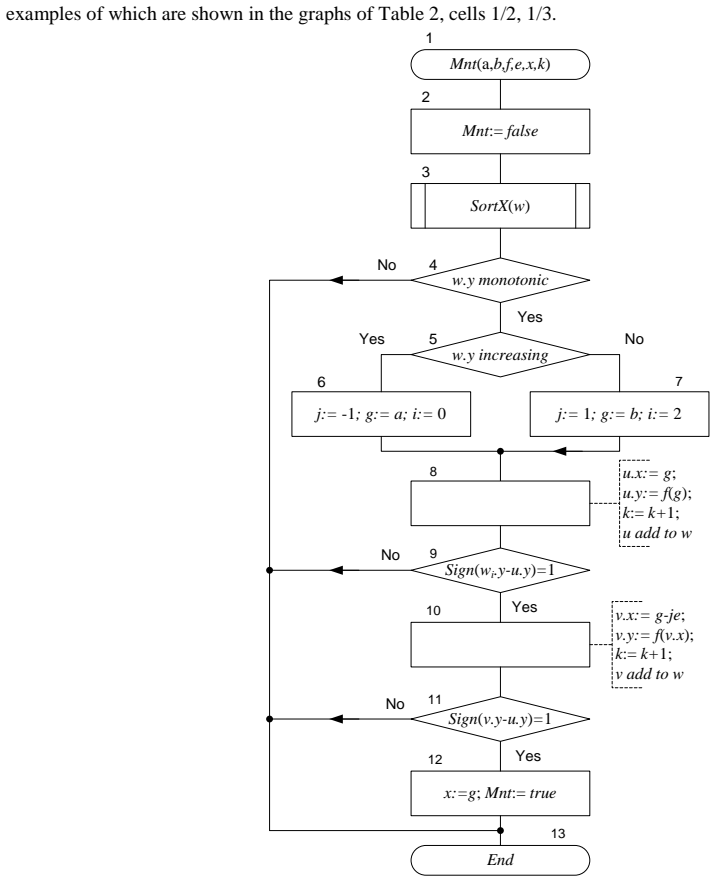
The ratio section method sections an interval in a given ratio for minimizing unimodal functions. It is capable of quickly recognizing monotone functions and functions with a flat bottom, which increases its performance as measured by the number of function evaluations. The passive and active algorithms were compared to bisection and golden section on twenty unimodal functions, showing the proposed method to be the fastest known for this purpose. The active algorithm outperforms the Brent method as well, and modernizing Brent with the ratio section procedure makes it faster by a factor of 1.69.
What carries the argument
The ratio section search, a procedure that divides the interval according to a fixed ratio while detecting monotonicity or flat regions to reduce evaluations.
Load-bearing premise
The performance claims depend on the specific ratio chosen for sectioning and on the twenty test functions being representative of unimodal functions in general, including monotone and flat-bottom cases.
What would settle it
A counterexample would be a unimodal function, or a new test set, on which the ratio section algorithms require more function evaluations on average than the golden section method.
Figures


read the original abstract
This paper proposes a new method for section an interval in a given ratio intended for minimizing unimodal functions. The ratio section search is capable of quickly recognizing monotone functions and functions with a flat bottom, which contributes to increasing its performance, as measured by the number of minimized function evaluations. The method is implemented as passive and active algorithms. A comparison of the performance of the developed method with that of the classical methods of bisection search and the golden section search was performed on the basis of the data used to minimize twenty unimodal functions of various types. For all types of functions, the passive algorithm is 2.26 times faster than the bisection search and 1.72 times faster than the golden section method. Thus, the proposed method turned out to be the fastest of the known methods of cutting off segments intended for minimizing unimodal functions. The active algorithm is faster: for all types of functions, these indicators are 3.31 and 2.52, respectively. The fastest combined Brent method was also modernized. After the golden section procedure is replaced with a procedure for dividing a segment in a given ratio, a numerical experiment is conducted. The modernized method is 1.69 times faster than its prototype. Moreover, the performance of the active algorithm for dividing a segment at a given ratio exceeds that of the Brent method by 1.48 times for all types of functions. The modernized Brent method is approximately 4 times faster than the bisection search and 3 times faster than the golden section method.
Editorial analysis
A structured set of objections, weighed in public.
Referee Report
Summary. The paper proposes a ratio-section method for minimizing unimodal functions, implemented as passive and active algorithms capable of recognizing monotone functions and those with flat bottoms. Numerical comparisons on twenty unimodal test functions claim that the passive algorithm requires 2.26 times fewer evaluations than bisection search and 1.72 times fewer than golden section search; the active algorithm improves these factors to 3.31 and 2.52. The paper also replaces the golden-section step in Brent's method with the ratio procedure, reporting a 1.69-fold improvement and overall superiority of the active ratio method over Brent by a factor of 1.48.
Significance. If the empirical claims prove reproducible, the method could offer a practical efficiency gain for one-dimensional unimodal minimization, particularly when flat regions or monotonicity are present. Explicit handling of these cases is a constructive contribution. However, the complete absence of a specified ratio, algorithmic details, test-function characterization, or any convergence analysis limits the work's significance for a numerical analysis audience.
major comments (4)
- [Abstract] Abstract: the specific numerical or symbolic value of the section ratio is never stated, rendering the central performance claims (2.26×, 1.72×, etc.) impossible to reproduce or compare with the golden ratio (≈0.618) used by the baseline method.
- [Abstract] Abstract: no description, pseudocode, or decision rule is supplied for the monotone-function or flat-bottom detection that is asserted to drive the reported speedups; without this mechanism the performance advantage cannot be verified or generalized.
- [Abstract] Abstract: the twenty unimodal test functions are neither listed nor characterized (domains, locations or lengths of flat intervals, sources), so it is impossible to assess whether they adequately represent the diversity of unimodal behavior invoked in the headline claims.
- [Abstract] Abstract: the paper supplies no derivation, error bound, or convergence-rate analysis for the ratio-section procedure; all superiority statements rest on unspecified numerical counts whose raw data and statistical treatment are also absent.
minor comments (2)
- [Abstract] Abstract contains minor grammatical and phrasing issues (e.g., 'section an interval' should read 'sectioning an interval'; 'the data used to minimize twenty unimodal functions' is unclear).
- The manuscript would benefit from a short table or appendix listing the twenty test functions together with their key properties (interval length, flat-region size, etc.).
Simulated Author's Rebuttal
We thank the referee for the careful reading and constructive suggestions. We agree that several details must be made explicit to support reproducibility and to meet the standards of a numerical analysis audience. We address each major comment below and will incorporate the necessary additions in the revised manuscript.
read point-by-point responses
-
Referee: [Abstract] Abstract: the specific numerical or symbolic value of the section ratio is never stated, rendering the central performance claims (2.26×, 1.72×, etc.) impossible to reproduce or compare with the golden ratio (≈0.618) used by the baseline method.
Authors: We agree that the abstract must state the section ratio explicitly. The ratio is a fixed parameter of the method (defined in Section 2 of the manuscript) that was selected to minimize the worst-case number of evaluations for unimodal functions. We will revise the abstract to include the exact numerical value of this ratio so that the reported speed-ups can be directly compared with the golden-section baseline. revision: yes
-
Referee: [Abstract] Abstract: no description, pseudocode, or decision rule is supplied for the monotone-function or flat-bottom detection that is asserted to drive the reported speedups; without this mechanism the performance advantage cannot be verified or generalized.
Authors: We accept that the detection rules for monotonicity and flat bottoms must be described. These rules are implemented in both the passive and active algorithms and are responsible for the observed savings on the test set. We will add a concise description together with pseudocode and the precise decision criteria to the revised manuscript. revision: yes
-
Referee: [Abstract] Abstract: the twenty unimodal test functions are neither listed nor characterized (domains, locations or lengths of flat intervals, sources), so it is impossible to assess whether they adequately represent the diversity of unimodal behavior invoked in the headline claims.
Authors: We agree that the test suite must be fully documented. The twenty functions were chosen to include strictly unimodal, flat-bottom, and near-monotone cases. We will insert a table (or appendix) that lists each function, its domain, the location and length of any flat interval, and the source or construction method. revision: yes
-
Referee: [Abstract] Abstract: the paper supplies no derivation, error bound, or convergence-rate analysis for the ratio-section procedure; all superiority statements rest on unspecified numerical counts whose raw data and statistical treatment are also absent.
Authors: We acknowledge that a theoretical analysis strengthens the contribution for a numerical-analysis readership. While the manuscript emphasizes empirical performance, we will add a short section deriving the interval-reduction factor of the ratio-section step and stating the resulting linear convergence rate. Raw evaluation counts and a brief statistical summary will also be supplied in a supplementary table. revision: partial
Circularity Check
No circularity: empirical performance claims rest on direct test results
full rationale
The paper proposes a ratio-section method (passive and active variants) for unimodal minimization and reports performance via numerical experiments on twenty test functions, directly counting function evaluations against bisection and golden-section baselines. No mathematical derivation chain, fitted parameters renamed as predictions, or self-citation load-bearing steps exist; the speedup factors (2.26×, 1.72×, etc.) are literal outputs of the described test runs rather than quantities forced by redefinition or internal consistency. The analysis is therefore self-contained against external benchmarks.
Axiom & Free-Parameter Ledger
free parameters (1)
- section ratio
axioms (1)
- domain assumption The objective function is unimodal
Lean theorems connected to this paper
-
IndisputableMonolith/Cost/FunctionalEquation.leanwashburn_uniqueness_aczel unclear?
unclearRelation between the paper passage and the cited Recognition theorem.
The ratio section search ... dividing a segment in a given ratio c ... c = 0.5 ... c = 0.2 ... minimum average number of evaluations K ... c = 0.2
-
IndisputableMonolith/Foundation/ArithmeticFromLogic.leanLogicNat induction and embed_strictMono unclear?
unclearRelation between the paper passage and the cited Recognition theorem.
recognizing monotone functions and functions with a flat bottom
What do these tags mean?
- matches
- The paper's claim is directly supported by a theorem in the formal canon.
- supports
- The theorem supports part of the paper's argument, but the paper may add assumptions or extra steps.
- extends
- The paper goes beyond the formal theorem; the theorem is a base layer rather than the whole result.
- uses
- The paper appears to rely on the theorem as machinery.
- contradicts
- The paper's claim conflicts with a theorem or certificate in the canon.
- unclear
- Pith found a possible connection, but the passage is too broad, indirect, or ambiguous to say the theorem truly supports the claim.
Reference graph
Works this paper leans on
-
[1]
Vieira, D.A.G., Lisboa, A. C. ”Line search methods with guaranteed asymptotical convergence to an improving local optimum of multimodal functions”, European Journal of Operational Research, Vol.235, Issue 1, 38 – 46, (2014). https://doi.org/10.1016/j.ejor.2013.12.041
-
[2]
Waeber, R., Frazier, P. I., Henderson, S. G.”Bisection search with noisy responses”. SIAM Journal on Control and Optimization, 51.3 2261 – 2279, (2013). https://doi.org/10.1137/120861898
-
[3]
Line Search for Convex Minimization”
Orseau, L., Hutter, M. Line Search for Convex Minimization”. arXiv preprint arXiv:2307.16560. (2023). https://doi.org/10.48550/arXiv.2307.16560
-
[4]
”Bisection method or binary-search method role and purposes”
Sharma,P. ”Bisection method or binary-search method role and purposes”. Pranjana: The Journal of Management Awareness, 26 (1 and 2), 107 – 112, (2023). https://doi.org/10.5958/0974-0945.2023.00010.4
-
[5]
Kiefer, J.”Sequential minimax search for a maxim`um”, Proceedings of the American Mathematical Society, 4 (3) 502 –
-
[6]
https://doi.org/10.2307/2032161
(1953). https://doi.org/10.2307/2032161
-
[7]
”Minimization and Maximization of Functions: Golden-Section Search in One Dimension”
Pejic,D., Arsic, M. ”Minimization and Maximization of Functions: Golden-Section Search in One Dimension”. In: Milutinovic, V., Kotlar, M. (eds) Exploring the DataFlow Supercomputing Paradigm. Computer Communications and Networks. Springer, Cham (2019). https://doi.org/10.1007/978-3-030-13803-5_3
-
[8]
Chemistry Africa 7, 4017 – 4029, (2024)
Abdelouahhab, M., Manar, S., Benhida, R.”Optimization of the Reaction Temperature During Phosphoric Acid Production Using Fibonacci Numbers and Golden Section Methods”. Chemistry Africa 7, 4017 – 4029, (2024). 14 https://doi.org/10.1007/s42250-024-00971-w
-
[9]
Agushaka, J. O., Ezugwu, A. E., Abualigah, L.”Gazelle optimization algorithm: a novel nature-inspired metaheuristic optimizer”. Neural Comput & Applic 35, 4099 – 4131 (2023). https://doi.org/10.1007/s00521-022-07854-6
-
[10]
P.”Algorithms For Minimization Without Derivatives”
Brent, R. P.”Algorithms For Minimization Without Derivatives”. Mathematics of Computation, 19(5), (2002). https://doi.org/10.2307/2005713
-
[11]
Dekker, T. J.”Finding a zero by means of successive linear interpolation”, in Dejon, B.; Henrici, P., Constructive Aspects of the Fundamental Theorem of Algebra, London: Wiley-Interscience, (2009). ISBN 978-0-471-20300-1
work page 2009
-
[12]
Gegenfurtner,K. R. ”PRAXIS: Brent's algorithm for function minimization”. Behavior Research Methods, Instruments, & Computers 24, 560 – 564 (1992). https://doi.org/10.3758/BF03203605
-
[13]
Kodnyanko, V. A., Grigorieva, O. A., Strok, L.V.”Сombined Newton's third-order convergence method for minimize one variable functions”. Radio Electronics, Computer Science, Control, (2), 48 – 55 (2021). https://doi.org/10.15588/1607-3274- 2021-2-5
-
[14]
Steffen, V., Della Pasqua, C. C., De Oliveira, M. S., Da Silva, E. A. ”Halving interval guaranteed for Dekker and Brent root finding methods”. Examples and Counterexamples, 100173. (2024) https://doi.org/10.2139/ssrn.4702916
-
[15]
Schommer, A., Xavier, M. A., Morrey, D., Collier, G.”Real-Time Deployment Strategies for State of Power Estimation Algorithms” No. 2024-01-2198). SAE Technical Paper (2024). https://doi.org/10.4271/2024-01-2198
-
[16]
S.”Engineering optimization: theory and practice”
Rao, S. S.”Engineering optimization: theory and practice”. John Wiley & Sons, Hoboken, New Jersey. (2009)
work page 2009
-
[17]
Wilde, D. J. Optimum seeking methods. Englewood Cliffs, NJ: Prentice Hall, Inc. 423 p. (1964),
work page 1964
-
[18]
V. Beiranvand, W. Hare,Y. Lucet. ”Best practices for comparing optimization algorithms”. Optim. Eng. 18, 815 – 848 (2017). https://doi.org/10.1007/s11081-017-9366-1
-
[19]
A.”Economical dichotomous search for minimizing one-variable functions”
Kodnyanko, V. A.”Economical dichotomous search for minimizing one-variable functions”. Radio Electronics, Computer Science, Control, (3), 34 – 39, (2019). https://doi.org/10.15588/1607-3274-2019-3-4
-
[20]
Teti, D. Delphi Cookbook. Second Edition. Packt Publishing Ltd., 2016. ISBN 978-1-78528-742-8
work page 2016
-
[21]
R.”Toutenburg Statistics (3rd ed.) ”
Rao, C. R.”Toutenburg Statistics (3rd ed.) ”. Berlin: Springer. (2008). ISBN 978-3-540-74226-5. 1998
work page 2008
discussion (0)
Sign in with ORCID, Apple, or X to comment. Anyone can read and Pith papers without signing in.