Broadband interferometry-based searches for photon-axion conversion in vacuum
Pith reviewed 2026-05-18 15:37 UTC · model grok-4.3
The pith
A vacuum Mach-Zehnder interferometer with a high-finesse cavity projects sensitivity to photon-axion couplings of 3.7×10^{-14} GeV^{-1} up to 380 μeV.
A machine-rendered reading of the paper's core claim, the machinery that carries it, and where it could break.
Core claim
The central claim is that the WINTER interferometer, incorporating an external magnetic field and vacuum in one arm along with a Fabry-Pérot cavity of finesse 10^5, will achieve photon-axion coupling sensitivities down to g_{aγγ} ≃ 3.7×10^{-14} GeV^{-1} for axion masses up to 380 μeV, reaching the DFSZ theoretical line through broadband detection of amplitude and polarization changes.
What carries the argument
The WISP Interferometer (WINTER), a Mach-Zehnder-type setup with photon-axion mixing in a vacuum arm via the Primakoff effect, enhanced by a Fabry-Pérot cavity of finesse 10^5 operated in vacuum to amplify the interaction.
If this is right
- The search proceeds without any assumption that axions constitute dark matter.
- The method covers a continuous mass range up to 380 μeV rather than discrete tuned frequencies.
- Polarization modulation isolates the axion-induced amplitude shift from other effects.
- The vacuum environment and cavity combination extends laboratory reach toward theoretically motivated coupling values.
Where Pith is reading between the lines
- If vacuum operation succeeds, the same interferometric layout could be scaled or adapted to probe other weakly interacting slim particles.
- The broadband character offers a complementary laboratory test that does not rely on astrophysical or cosmological production mechanisms.
- A working prototype would allow direct comparison of sensitivity limits between interferometric and resonant cavity haloscope approaches in the same mass window.
Load-bearing premise
The Fabry-Pérot cavity with finesse of 10^5 can be operated stably in vacuum while preserving the low noise and high stability required for the projected sensitivity.
What would settle it
Measurement showing that the cavity finesse drops or noise rises above the design threshold when the Fabry-Pérot cavity is placed in vacuum, preventing the target coupling sensitivity from being reached.
Figures



read the original abstract
A novel experiment is introduced to detect photon-axion conversion independent of the dark-matter hypothesis in a broad mass-range called WISP Interferometer (WINTER). The setup consists of a free-space Mach-Zehnder-type interferometer incorporating an external magnetic field and vacuum in one of the arms, where photon-axion mixing occurs via the Primakoff effect and is detected through changes in amplitude. The expected axion-induced signal is then modulated by polarization changes. The experiment is designed to integrate a Fabry-P\'erot cavity with a finesse of $10^{5}$ that will be operated in a vacuum environment, significantly enhancing the sensitivity. It is projected to reach the DFSZ theoretical line with photon-axion coupling sensitivities down to $g_{a\gamma\gamma}\simeq 3.7\times10^{-14}$ $\text{GeV}^{-1}$ for axion masses up to 380 $\mu$eV.
Editorial analysis
A structured set of objections, weighed in public.
Referee Report
Summary. The manuscript proposes the WINTER experiment: a Mach-Zehnder interferometer with a magnetic field and vacuum in one arm to detect photon-axion conversion via the Primakoff effect. A Fabry-Pérot cavity of finesse 10^5 is included to enhance sensitivity, with the axion-induced signal modulated by polarization changes. The central claim is a projected reach of g_{aγγ} ≃ 3.7×10^{-14} GeV^{-1} for axion masses up to 380 μeV, sufficient to test the DFSZ line.
Significance. If the projected sensitivity can be realized, the result would be significant for axion searches by providing broadband coverage independent of the dark-matter hypothesis and by using interferometric readout rather than resonant conversion. The approach could complement existing helioscope and haloscope limits in the μeV mass range.
major comments (2)
- [Abstract] Abstract: the sensitivity projection g_{aγγ} ≃ 3.7×10^{-14} GeV^{-1} is stated without derivation, error budget, or explicit formula showing how the value follows from the cavity finesse of 10^5, magnetic-field strength, integration time, or shot-noise floor. No equation or calculation is supplied that would allow independent verification of the scaling with F/π.
- [Experimental Setup] Cavity and vacuum section: the projection assumes the Fabry-Pérot cavity maintains an effective finesse of 10^5 and remains shot-noise limited when operated at 10^{-6}–10^{-8} mbar. No measured vacuum-cavity data, outgassing model, thermal-drift analysis, or alignment-stability budget is provided to support that the vacuum environment introduces neither excess mirror losses nor additional amplitude/phase noise.
minor comments (2)
- Define the acronym WISP at first use and clarify the distinction between WISP and WINTER.
- Figure captions should explicitly state the assumed integration time, magnetic-field strength, and noise model used to generate the projected sensitivity curve.
Simulated Author's Rebuttal
We thank the referee for the careful reading and constructive comments on our manuscript. We address each major point below and have revised the manuscript to improve transparency and support for the projections.
read point-by-point responses
-
Referee: [Abstract] Abstract: the sensitivity projection g_{aγγ} ≃ 3.7×10^{-14} GeV^{-1} is stated without derivation, error budget, or explicit formula showing how the value follows from the cavity finesse of 10^5, magnetic-field strength, integration time, or shot-noise floor. No equation or calculation is supplied that would allow independent verification of the scaling with F/π.
Authors: We agree that the abstract would benefit from an explicit indication of the scaling. The projected sensitivity follows from the cavity-enhanced effective interaction length scaling as F/π, combined with the applied magnetic field, integration time, and shot-noise floor. In the revised manuscript we have added a concise statement of this scaling to the abstract together with a reference to the full derivation and error budget now summarized in the main text. revision: yes
-
Referee: [Experimental Setup] Cavity and vacuum section: the projection assumes the Fabry-Pérot cavity maintains an effective finesse of 10^5 and remains shot-noise limited when operated at 10^{-6}–10^{-8} mbar. No measured vacuum-cavity data, outgassing model, thermal-drift analysis, or alignment-stability budget is provided to support that the vacuum environment introduces neither excess mirror losses nor additional amplitude/phase noise.
Authors: The referee correctly notes that the sensitivity projection rests on the assumption that a finesse of 10^5 can be maintained in the stated vacuum range without excess losses or noise. As this is a proposed experiment, no measured data for the final WINTER apparatus exist at present. We have revised the manuscript to include a dedicated discussion of the expected vacuum performance, drawing on standard outgassing models and alignment budgets reported for comparable high-finesse cavities in the literature, and we explicitly flag that these assumptions will be validated experimentally during commissioning. revision: partial
Circularity Check
No circularity: sensitivity projection uses standard scaling with stated design assumptions
full rationale
The manuscript calculates projected reach by applying the known Primakoff conversion probability scaled by the cavity enhancement factor F/π (with F=10^5 given as a design target). This is a forward projection from first-principles formulas and an assumed performance level, not a fit to data that is then relabeled as a prediction. No equation reduces to its own output by construction, no self-citation supplies a load-bearing uniqueness theorem, and the vacuum-cavity operation is presented as an engineering requirement rather than a result derived from the sensitivity claim itself. The derivation chain is therefore self-contained against external benchmarks.
Axiom & Free-Parameter Ledger
free parameters (1)
- Fabry-Pérot cavity finesse
axioms (1)
- domain assumption Photon-axion mixing occurs via the Primakoff effect in an external magnetic field
Lean theorems connected to this paper
-
IndisputableMonolith/Foundation/RealityFromDistinction.leanreality_from_one_distinction unclear?
unclearRelation between the paper passage and the cited Recognition theorem.
The experiment is designed to integrate a Fabry-Pérot cavity with a finesse of 10^5 that will be operated in a vacuum environment, significantly enhancing the sensitivity. It is projected to reach the DFSZ theoretical line with photon-axion coupling sensitivities down to g_aγγ ≃ 3.7×10^{-14} GeV^{-1}
What do these tags mean?
- matches
- The paper's claim is directly supported by a theorem in the formal canon.
- supports
- The theorem supports part of the paper's argument, but the paper may add assumptions or extra steps.
- extends
- The paper goes beyond the formal theorem; the theorem is a base layer rather than the whole result.
- uses
- The paper appears to rely on the theorem as machinery.
- contradicts
- The paper's claim conflicts with a theorem or certificate in the canon.
- unclear
- Pith found a possible connection, but the passage is too broad, indirect, or ambiguous to say the theorem truly supports the claim.
Reference graph
Works this paper leans on
-
[1]
limit is also shown in gray. The specific parameters used for the calculation of both setups are shown in Tab. I. Note that the differences in the cutoff axion masses between the prototype and the full WINTER setup are due to the differ- ent wavelengths and magnet length along which the FPC is integrated. Parameter WINTER-prototype WINTER B ext 1.2 T 9 T ...
-
[2]
Input fields The input field at Port 1 of WINTER’s MZI is represented as a superposition of two linear polarization components differentiated byχ=π/2, and modulated at a frequencyω m. Mathematically, this modulated electric field can be expressed as a Jones vector: Ein1(t) =E 0 1 +β m sin(ωmt+χ) 1 +β m sin(ωmt) eiωγ t,(19) while Port 2 has no input field:...
-
[3]
Carrier Amplitude Contribution Considering the optical fields at the sensing and reference arms after the first 50/50 BS from Eq. 25, the opti- cal carrier field contributions are estimated, accounting for the photon-axion mixing effect (P γ→a) and the length contributions from each arm, which are given by: Ecar,S = E0√ 2(1−P γ→a)e i[ωγ t−kγ(L+ ∆L 2 )],(2...
-
[4]
Analogous to the carrier interference condition from Eq
Sideband Amplitude Contribution The upper(+) and lower(-) sideband contribution for the sensitive and reference arms is given by: Esid,(±),S =± βmE0 2i √ 2 (1−P γ→a)e i[(ωγ+ωm)t−ϕ± S ], (35) Esid,(±),R =± βmE0 2 √ 2 ei[(ωγ+ωm)t−ϕ± R], (36) where the phase contributions for each arm are: ϕ± S = (kγ ±k m) L+ ∆L 2 ϕ± R = (kγ ±k m) L− ∆L 2 (37) The total side...
-
[5]
Power Output Estimation To estimate the power we expand the complex expressions using Eqs. 33-34 and Eqs. 39-40 with the phase values from Eqs. 44-45: Pout1 =E ∗ car,out1 ·E car,out1 +E ∗ car,out1 ·E sid,out1 +E car,out1 ·E ∗ sid,out1 +E ∗ sid,out1 ·E sid,out1 = = 1 4 E2 0 2 + (−2 +Pγ→a)Pγ→a −2(−1 +P γ→a) cosαγ +β 2 m h 2 + (−2 +Pγ→a)Pγ→a + 2(−1 +P γ→a) c...
-
[6]
Analytical approximation Assuming Gaussian beam propagation, the beam expands from its waist at the plane mirror (w plane) to a larger radius at the concave mirror (w conc(LFPC)), calculated from the Rayleigh range as follows: zR = πw2 plane λ (58) wconc(LFPC) =w plane s 1 + LFPC zR 2 (59) Clipping losses arise from the mode mismatch between the beam wais...
-
[7]
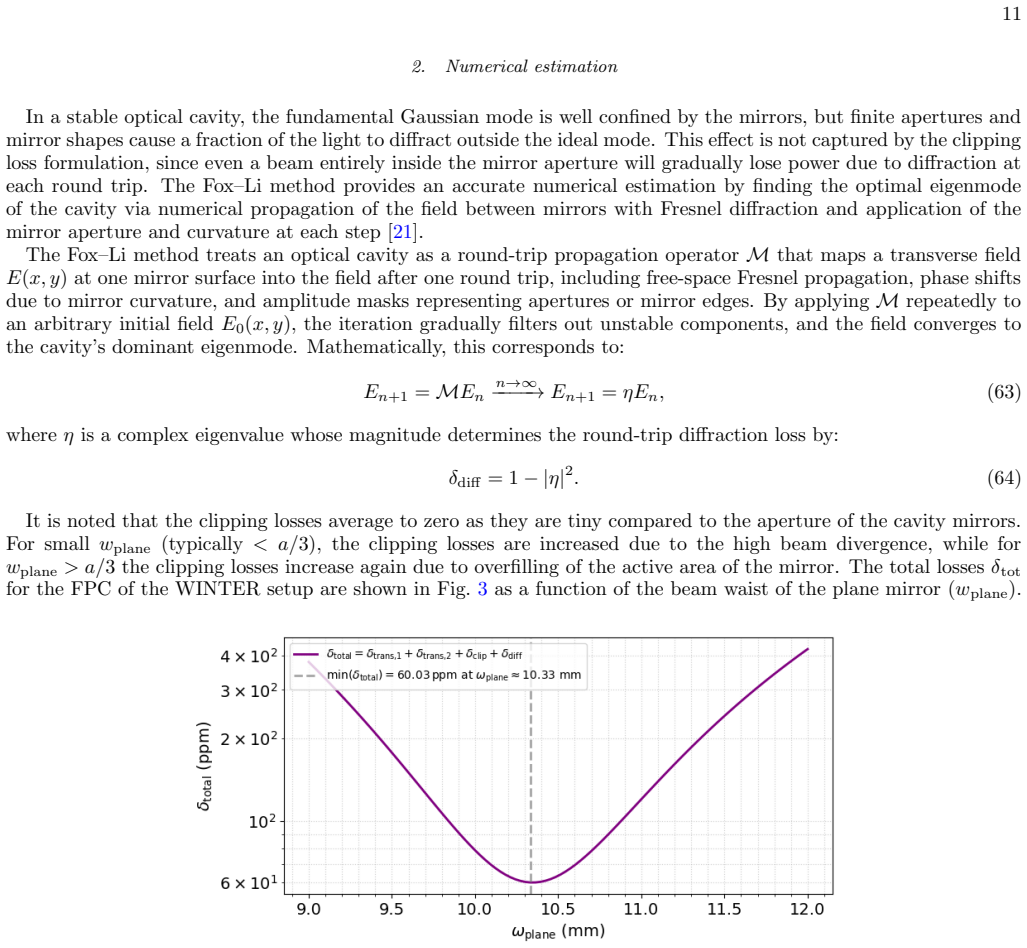
Numerical estimation In a stable optical cavity, the fundamental Gaussian mode is well confined by the mirrors, but finite apertures and mirror shapes cause a fraction of the light to diffract outside the ideal mode. This effect is not captured by the clipping loss formulation, since even a beam entirely inside the mirror aperture will gradually lose powe...
-
[8]
Thermal Considerations WINTER’s experimental setup employs a high-finesse optical cavity with mirror coatings and substrates engi- neered to minimize absorption and scattering, enabling stable long-term operation at high intra-cavity power. Under the conditions characterized by the parameters listed in Tab II, the system achieves intra-cavity power densit...
-
[9]
R. D. Peccei and H. R. Quinn, Physical Review Letters 38, 1440 (1977)
work page 1977
-
[10]
J. E. Kim, Physical Review Letters43, 103 (1979)
work page 1979
-
[11]
M. Dine, W. Fischler, and M. Srednicki, Physics Letters B104, 199 (1981)
work page 1981
- [12]
-
[13]
B. Eggemeier, C. A. J. O’Hare, G. Pierobon, J. Redondo, and Y. Y. Y. Wong, Axion minivoids and implications for direct detection (2022), arXiv:2212.00560 [hep-ph]
-
[14]
M. Vogelsberger and S. D. M. White, Monthly Notices of the Royal Astronomical Society413, 1419 (2011), https://academic.oup.com/mnras/article- pdf/413/2/1419/18595473/mnras0413-1419.pdf
work page 2011
-
[15]
G. Mueller, P. Sikivie, D. B. Tanner, and K. van Bibber, Phys. Rev. D80, 072004 (2009)
work page 2009
- [16]
-
[17]
J. M. Batllori, Y. Gu, D. Horns, M. Maroudas, and J. Ul- richs, Phys. Rev. D109, 123001 (2024)
work page 2024
-
[18]
J. C. Kimball and N. Cue, Phys. Rev. Lett.57, 1935 (1986). 13
work page 1935
-
[19]
S. Borsanyi, Z. Fodor, J. Guenther, K. H. Kampert, S. D. Katz, T. Kawanai, T. G. Kovacs, S. W. Mages, A. Pasz- tor, F. Pittler, J. Redondo, A. Ringwald, and K. K. Sz- abo, Nature539, 69 (2016)
work page 2016
- [20]
-
[21]
Anastassopoulos, et al., (CAST Collaboration), Na- ture Phys.13, 584 (2017)
V. Anastassopoulos, et al., (CAST Collaboration), Na- ture Phys.13, 584 (2017)
work page 2017
-
[22]
R. W. P. Drever, J. L. Hall, F. V. Kowalski, J. Hough, G. M. Ford, A. J. Munley, and H. Ward, Applied Physics B31, 97 (1983)
work page 1983
-
[23]
Toptica Photonics AG, Private communication (2024)
work page 2024
-
[24]
K. Altenm¨ uller, V. Anastassopoulos, S. Arguedas- Cuendis, S. Aune, J. Baier, K. Barth, H. Br¨ auninger, G. Cantatore, F. Caspers, J. F. Castel, S. A. C ¸ etin, F. Christensen, C. Cogollos, T. Dafni, M. Davenport, T. A. Decker, K. Desch, D. D´ ıez-Ib´ a˜ nez, B. D¨ obrich, E. Ferrer-Ribas, H. Fischer, W. Funk, J. Gal´ an, J. A. Garc´ ıa, A. Gardikiotis, ...
work page 2024
- [25]
-
[26]
J. H. P˜ old and A. D. Spector, EPJ Tech. Instrum.7, 1 (2020), arXiv:1710.06634 [physics.ins-det]
work page internal anchor Pith review Pith/arXiv arXiv 2020
- [27]
- [28]
-
[29]
A. G. Fox and T. Li, The Bell System Technical Journal 40, 453 (1961)
work page 1961
-
[30]
G. Billingsley, H. Yamamoto, and L. Zhang, inProceed- ings of the American Society for Precision Engineering (ASPE) 2017 Spring Topical Meeting(2017) pp. 78–83, lIGO Document P1700029-v5
work page 2017
discussion (0)
Sign in with ORCID, Apple, or X to comment. Anyone can read and Pith papers without signing in.