Relativistically-strong electromagnetic waves in magnetized plasmas
Pith reviewed 2026-05-18 14:28 UTC · model grok-4.3
The pith
Subluminal relativistically strong electromagnetic waves in magnetized plasmas terminate when their electric field reaches the strength of the background magnetic field.
A machine-rendered reading of the paper's core claim, the machinery that carries it, and where it could break.
Core claim
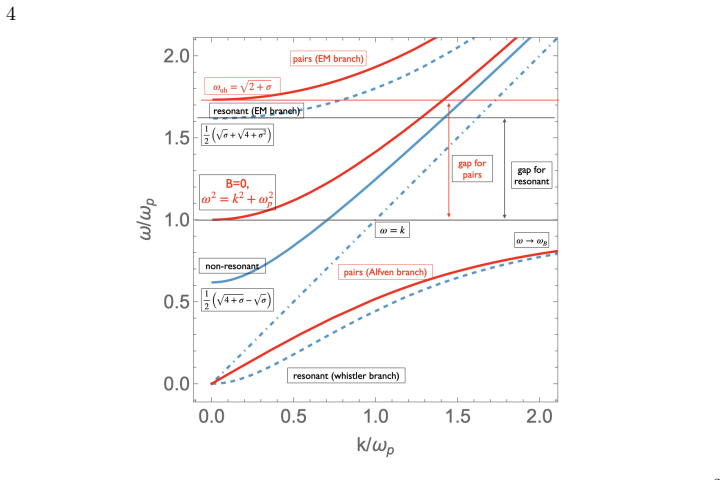
In the two-fluid description, dispersion relations for superluminal branches remain qualitatively similar to the linear case but with reduced cutoff frequencies, whereas subluminal branches terminate at finite ω* − k* with vanishing group velocity. This termination implies that subluminal modes satisfying E_w(ω) ≥ B_0 cannot propagate. In extended systems such as neutron star magnetospheres, a strong wave therefore opens the magnetosphere.
What carries the argument
The termination of subluminal dispersion curves at the amplitude where the wave electric field equals or exceeds the background magnetic field B_0.
If this is right
- Nonlinear corrections reduce the cutoff frequency for superluminal waves while keeping the general form of ω(k) intact.
- Subluminal whistler and Alfvén waves reach a termination point with zero group velocity.
- Strong waves cannot propagate through extended magnetized plasmas once E_w exceeds B_0.
- This leads to opening of the magnetosphere by the wave in systems like those of neutron stars.
Where Pith is reading between the lines
- If the termination holds, it may constrain wave amplitudes in other compact object environments beyond neutron stars.
- Laboratory plasma experiments could search for the predicted cutoff in dispersion for high-amplitude subluminal waves.
- The effect might alter models of energy transport in magnetized relativistic outflows.
Load-bearing premise
The two-fluid approximation stays valid for arbitrarily large wave amplitudes and the assumed scaling of a0 with frequency does not qualitatively change the termination of subluminal branches.
What would settle it
Detection of a propagating subluminal wave with electric field amplitude larger than the guide field, or a dispersion relation that continues past the predicted termination point, would disprove the claim.
Figures


read the original abstract
Using a two-fluid approach, we consider the properties of relativistically nonlinear (arbitrary $a_0$), circularly polarized \EM\ waves propagating along magnetic field in electron-ion and pair plasmas. Dispersion relations depend on how wave intensity scales with frequency, $a_0 (\omega)$. For superluminal branches, the nonlinear effects reduce the cut-off frequency, while the general form of the dispersion relations $\omega(k)$ remains similar to the linear case. For subluminal waves, whistlers and Alfven, a new effect appears: dispersion curves effectively terminate at finite $\omega^\ast - k^\ast$, where the group velocity becomes zero. Qualitatively, subluminal modes with fluctuating electric field larger than the guide field, $E_w (\omega) \geq B_0$, cannot propagate. In extended systems, e.g., within magnetospheres of neutron stars, this leads to opening of the magnetosphere by a strong wave.
Editorial analysis
A structured set of objections, weighed in public.
Referee Report
Summary. The manuscript uses a two-fluid approach to derive dispersion relations for relativistically nonlinear, circularly polarized electromagnetic waves propagating parallel to a background magnetic field in electron-ion and pair plasmas. The relations are shown to depend explicitly on the assumed scaling a0(ω). Superluminal branches exhibit a reduced cutoff frequency while retaining a form similar to the linear case. Subluminal branches (whistlers and Alfvén waves) terminate at finite (ω*, k*) where the group velocity vanishes. The authors argue qualitatively that modes with fluctuating electric field Ew(ω) ≥ B0 cannot propagate, implying that strong waves can open the magnetosphere in extended systems such as neutron-star magnetospheres.
Significance. If the termination result for subluminal modes proves independent of the particular a0(ω) scaling and remains within the validity domain of the two-fluid model, the work identifies a new propagation limit for strong waves in magnetized plasmas with direct relevance to astrophysical magnetospheres. The explicit incorporation of intensity scaling into the dispersion relations is a constructive feature that permits regime-specific exploration.
major comments (2)
- [Derivation of subluminal dispersion relations] The central claim that subluminal branches terminate when Ew(ω) ≥ B0 (preventing propagation and opening the magnetosphere) is presented as a qualitative, general result. Because the dispersion relations are stated to depend on the choice of a0(ω) scaling, the manuscript must demonstrate explicitly that the zero-group-velocity point coincides with the Ew = B0 condition for at least two distinct scalings (constant a0 and, e.g., a0 ∝ 1/ω). This verification is required to establish that the termination is not an artifact of one parametrization family.
- [Two-fluid model setup] The two-fluid approximation is applied for arbitrarily large relativistic amplitudes a0. The manuscript should provide a quantitative discussion or estimate of the amplitude range over which the fluid closure remains valid, particularly when relativistic particle motion or wave-induced density perturbations may require kinetic corrections.
minor comments (2)
- Clarify in the text whether the reported termination applies equally to electron-ion and pair plasmas or whether differences appear in the subluminal branches.
- Ensure that all figures showing dispersion curves label the chosen a0(ω) scaling explicitly in the caption or legend.
Simulated Author's Rebuttal
We thank the referee for the careful reading and constructive comments, which help clarify the generality of our results on subluminal mode termination and the domain of the two-fluid model. We address each major comment below and will incorporate revisions to strengthen the manuscript.
read point-by-point responses
-
Referee: [Derivation of subluminal dispersion relations] The central claim that subluminal branches terminate when Ew(ω) ≥ B0 (preventing propagation and opening the magnetosphere) is presented as a qualitative, general result. Because the dispersion relations are stated to depend on the choice of a0(ω) scaling, the manuscript must demonstrate explicitly that the zero-group-velocity point coincides with the Ew = B0 condition for at least two distinct scalings (constant a0 and, e.g., a0 ∝ 1/ω). This verification is required to establish that the termination is not an artifact of one parametrization family.
Authors: We agree that explicit verification across scalings strengthens the claim of generality. In the revised manuscript we will add explicit calculations for both constant a0 and a0 ∝ 1/ω. For each scaling we solve the nonlinear dispersion relation to locate the point where group velocity vanishes and confirm that this termination occurs at Ew = B0. The results will be shown in a new figure and accompanying text, demonstrating that the zero-group-velocity termination is independent of the specific a0(ω) parametrization within the families considered. revision: yes
-
Referee: [Two-fluid model setup] The two-fluid approximation is applied for arbitrarily large relativistic amplitudes a0. The manuscript should provide a quantitative discussion or estimate of the amplitude range over which the fluid closure remains valid, particularly when relativistic particle motion or wave-induced density perturbations may require kinetic corrections.
Authors: We acknowledge the importance of delineating the validity range of the two-fluid closure. In the revision we will insert a quantitative discussion estimating that the model remains applicable for a0 up to several tens (depending on plasma beta and magnetization), based on the point at which wave-induced density perturbations δn/n become order-unity or when particle trajectories require kinetic treatment to capture trapping or cyclotron resonances. We will compare these estimates to existing particle-in-cell results for strong waves and note the regime where the fluid description is expected to hold. revision: yes
Circularity Check
Derivation self-contained within two-fluid dispersion relations
full rationale
The paper derives dispersion relations for relativistically nonlinear circularly polarized EM waves using the two-fluid approximation in electron-ion and pair plasmas. It explicitly notes that relations depend on the wave intensity scaling a0(ω), then shows that superluminal branches retain a form similar to the linear case while subluminal branches (whistlers and Alfvén) terminate at finite ω*−k* where group velocity vanishes. The qualitative statement that modes with Ew(ω)≥B0 cannot propagate follows directly from this termination condition under the model assumptions. No equation reduces the termination result to a fitted parameter by construction, no self-citation chain is load-bearing for the central claim, and the derivation remains independent of external benchmarks or prior author-specific uniqueness theorems. The result is therefore self-contained against the stated two-fluid model and intensity scaling.
Axiom & Free-Parameter Ledger
axioms (1)
- domain assumption Two-fluid description remains valid for arbitrarily relativistic wave amplitudes
Lean theorems connected to this paper
-
IndisputableMonolith/Cost/FunctionalEquation.leanwashburn_uniqueness_aczel unclear?
unclearRelation between the paper passage and the cited Recognition theorem.
Dispersion relations depend on how wave intensity scales with frequency, a0(ω). ... subluminal modes ... terminate at finite ω∗−k∗ ... Ew(ω)≥B0 cannot propagate.
-
IndisputableMonolith/Foundation/RealityFromDistinction.leanreality_from_one_distinction unclear?
unclearRelation between the paper passage and the cited Recognition theorem.
Using a two-fluid approach ... fully nonlinear treatment.
What do these tags mean?
- matches
- The paper's claim is directly supported by a theorem in the formal canon.
- supports
- The theorem supports part of the paper's argument, but the paper may add assumptions or extra steps.
- extends
- The paper goes beyond the formal theorem; the theorem is a base layer rather than the whole result.
- uses
- The paper appears to rely on the theorem as machinery.
- contradicts
- The paper's claim conflicts with a theorem or certificate in the canon.
- unclear
- Pith found a possible connection, but the passage is too broad, indirect, or ambiguous to say the theorem truly supports the claim.
Forward citations
Cited by 1 Pith paper
-
Powerful parametric instability of Alfven waves in astrophysical pair plasma
Nonlinear Alfven waves with k near k0 in highly magnetized pair plasmas experience strong modulational instability that drives density fluctuations and generates high-frequency modes.
Reference graph
Works this paper leans on
-
[1]
, " * write output.state after.block = add.period write newline
ENTRY address author booktitle chapter edition editor howpublished institution journal key month note number organization pages publisher school series title type volume year eprint label extra.label sort.label short.list INTEGERS output.state before.all mid.sentence after.sentence after.block FUNCTION init.state.consts #0 'before.all := #1 'mid.sentence ...
-
[2]
" write newline "" before.all 'output.state := FUNCTION n.dashify 't := "" t empty not t #1 #1 substring "-" = t #1 #2 substring "--" = not "--" * t #2 global.max substring 't := t #1 #1 substring "-" = "-" * t #2 global.max substring 't := while if t #1 #1 substring * t #2 global.max substring 't := if while FUNCTION word.in bbl.in capitalize " " * FUNCT...
-
[3]
Akhiezer , A. I. , Akhiezer , I. A. , Polovin , R. V. , Sitenko , A. G. & Stepanov , K. N. 1975 Plasma electrodynamics. Volume 1 - Linear theory. Volume 2 - Non-linear theory and fluctuations . Oxford Pergamon Press International Series on Natural Philosophy 1
work page 1975
-
[4]
Akhiezer , A. I. & Polovin , R. V. 1956 Theory of Wave Motion of an Electron Plasma . Soviet Physics-JETP 3 , 696--705
work page 1956
-
[5]
Beloborodov , Andrei M. 2021 Can a Strong Radio Burst Escape the Magnetosphere of a Magnetar? 922 (1), L7 , arXiv:arXiv: 2108.07881
- [6]
-
[7]
Bolotovskii , B. M. & Stolyarov , S. N. 1975 Current status of the electrodynamics of moving media (infinite media) . Soviet Physics Uspekhi 17 , 875
work page 1975
-
[8]
CHIME/FRB Collaboration , Andersen , B. C. , Bandura , K. M. , Bhardwaj , M. , Bij , A. , Boyce , M. M. , Boyle , P. J. , Brar , C. , Cassanelli , T. , Chawla , P. , Chen , T. , Cliche , J. F. , Cook , A. , Cubranic , D. , Curtin , A. P. , Denman , N. T. , Dobbs , M. , Dong , F. Q. , Fandino , M. , Fonseca , E. , Gaensler , B. M. , Giri , U. , Good , D. C...
-
[9]
Clemmow , P. C. 1974 Nonlinear waves in a cold plasma by Lorentz transformation . Journal of Plasma Physics 12 (2), 297--317
work page 1974
- [10]
-
[11]
957 (2), 102 , arXiv:arXiv: 2309.09218
Golbraikh , Ephim & Lyubarsky , Yuri 2023 On the Escape of Low-frequency Waves from Magnetospheres of Neutron Stars . 957 (2), 102 , arXiv:arXiv: 2309.09218
-
[12]
Heyvaerts , J. , Lehner , T. & Mottez , F. 2012 Non-linear simple relativistic Alfv \'e n waves in astrophysical plasmas . 542 , A128
work page 2012
-
[13]
Landau , L. D. , Pitaevskii , L. P. & Lifshitz , E. M. 1984 Electrodynamics of continuous media \/ . Elsevier Science & Technology Books
work page 1984
-
[14]
Lorimer , D. R. , Bailes , M. , McLaughlin , M. A. , Narkevic , D. J. & Crawford , F. 2007 A Bright Millisecond Radio Burst of Extragalactic Origin . Science 318 , 777 , arXiv:arXiv: 0709.4301
work page internal anchor Pith review Pith/arXiv arXiv 2007
-
[15]
Physical Constraints On Fast Radio Burst
Luan , J. & Goldreich , P. 2014 Physical Constraints on Fast Radio Bursts . 785 , L26 , arXiv:arXiv: 1401.1795
work page internal anchor Pith review Pith/arXiv arXiv 2014
-
[16]
A model for fast extragalactic radio bursts
Lyubarsky , Y. 2014 A model for fast extragalactic radio bursts . 442 , L9--L13 , arXiv:arXiv: 1401.6674
work page internal anchor Pith review Pith/arXiv arXiv 2014
-
[17]
922 (2), 166 , arXiv:arXiv: 2102.07010
Lyutikov , Maxim 2021 Coherent Emission in Pulsars, Magnetars, and Fast Radio Bursts: Reconnection-driven Free Electron Laser . 922 (2), 166 , arXiv:arXiv: 2102.07010
-
[18]
Fast radio bursts as giant pulses from young rapidly rotating pulsars
Lyutikov , M. , Burzawa , L. & Popov , S. B. 2016 Fast radio bursts as giant pulses from young rapidly rotating pulsars . 462 , 941--950 , arXiv:arXiv: 1603.02891
work page internal anchor Pith review Pith/arXiv arXiv 2016
-
[19]
Petroff , E. , Hessels , J. W. T. & Lorimer , D. R. 2022 Fast radio bursts at the dawn of the 2020s . 30 (1), 2 , arXiv:arXiv: 2107.10113
-
[20]
& Lyutikov , Maxim 2023 Relativistic coronal mass ejections from magnetars
Sharma , Praveen , Barkov , Maxim V. & Lyutikov , Maxim 2023 Relativistic coronal mass ejections from magnetars . 524 (4), 6024--6051 , arXiv:arXiv: 2302.08848
-
[21]
Soviet Physics Uspekhi 10 (4), 509
Veselago, Viktor G 1968 The electrodynamics of substances with simultaneously negative values of and . Soviet Physics Uspekhi 10 (4), 509
work page 1968
discussion (0)
Sign in with ORCID, Apple, or X to comment. Anyone can read and Pith papers without signing in.