Key role of the Madden-Julian Oscillation on tropical and subtropical humid heat and heatwaves
Pith reviewed 2026-05-18 15:10 UTC · model grok-4.3
The pith
The Madden-Julian Oscillation can double or halve humid heatwave likelihood across large tropical and subtropical areas year-round.
A machine-rendered reading of the paper's core claim, the machinery that carries it, and where it could break.
Core claim
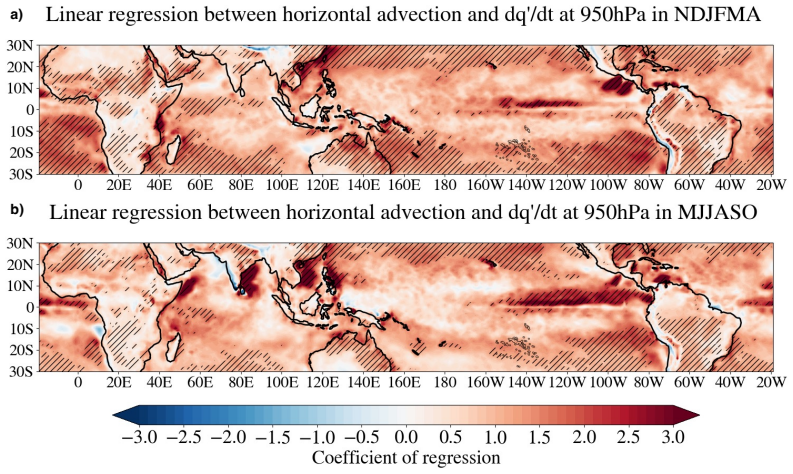
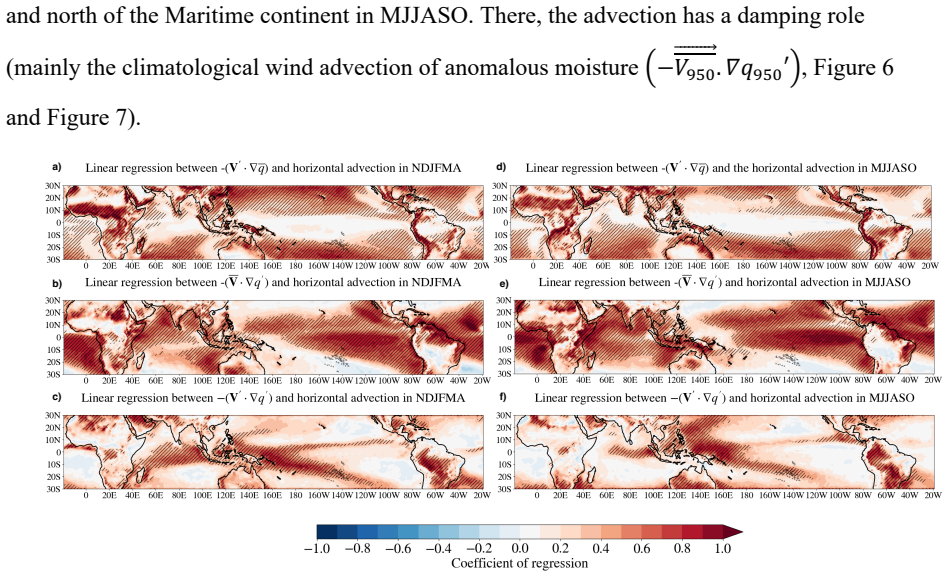
The MJO and the associated BSISO have a significant influence on humid heat and heatwaves over much of the tropics and subtropics across all seasons, both over terrestrial and marine regions. Humid heatwave likelihood can double or halve, depending on the MJO phase, in large areas of the Earth. The MJO/BSISO's influence on wet-bulb temperature is primarily via specific humidity rather than dry-bulb temperature anomalies. In the subtropics and other regions where we typically do not find a strong signal of the convection, we find that intraseasonal anomalies of specific humidity and dry-bulb temperature are influenced by horizontal advection in the planetary boundary layer.
What carries the argument
MJO phase composites that isolate intraseasonal anomalies in specific humidity and planetary-boundary-layer advection to modulate wet-bulb temperature.
If this is right
- Subseasonal forecasts of humid heat risk can incorporate MJO phase information for lead times of several weeks.
- Risk-management planning in tropical and subtropical regions can adjust for expected doubling or halving of heatwave likelihood by MJO phase.
- Humid heat variability is tied to intraseasonal oscillations rather than solely to longer-term climate trends.
- Marine and terrestrial humid heat responses are both organized by the same MJO-driven moisture and wind anomalies.
Where Pith is reading between the lines
- Similar composite analyses could test whether other intraseasonal modes produce comparable humid-heat modulations.
- Future changes in MJO frequency or strength under warming would be expected to alter baseline humid heatwave statistics.
- The advection pathway identified in the subtropics suggests testable links to regional wind-climatology interactions in climate models.
Load-bearing premise
MJO phase-based composites cleanly isolate causal effects on wet-bulb temperature without substantial confounding from other modes, trends, or data selection choices.
What would settle it
Finding no consistent change in humid heatwave frequency or wet-bulb temperature across MJO phases in an independent global reanalysis or observational record would falsify the central claim.
Figures


read the original abstract
Humid heat stress and heatwaves pose significant risks for living organisms, from humans and wildlife to insects. These threats have wide-ranging health, ecological, and socio-economic impacts that are expected to worsen with climate change. How large-scale climate modes drive the week-to-month variability of humid heat remains poorly understood at the global scale. This limitation hinders the development of accurate forecasts necessary for risk-management measures, notably in the heavily populated and ecologically fragile regions of the tropics and subtropics. With forecast lead times up to several weeks, the Madden-Julian Oscillation (MJO), a global-scale intraseasonal tropical atmospheric disturbance circumnavigating earth in around 30-60 days, provides considerable predictability for weather conditions, and meteorological and oceanic extremes. Here we show that the MJO, and the associated boreal summer intraseasonal oscillation (BSISO), have a significant influence on humid heat and heatwaves over much of the tropics and subtropics across all seasons, both over terrestrial and marine regions. Humid heatwave likelihood can double or halve, depending on the MJO phase, in large areas of the Earth. The MJO/BSISO's influence on wet-bulb temperature is primarily via specific humidity rather than dry-bulb temperature anomalies. In the subtropics and other regions where we typically do not find a strong signal of the convection, we find that intraseasonal anomalies of specific humidity and dry-bulb temperature are influenced by horizontal advection in the planetary boundary layer. Particularly in the subtropics where advection of the climatological moisture and temperature gradient by MJO-related anomalous winds is an important term.
Editorial analysis
A structured set of objections, weighed in public.
Referee Report
Summary. The paper claims that the Madden-Julian Oscillation (MJO) and associated Boreal Summer Intraseasonal Oscillation (BSISO) exert a significant influence on humid heat and heatwaves over much of the tropics and subtropics in all seasons, both over land and ocean. Using MJO phase composites, it reports that humid heatwave likelihood can double or halve depending on phase, with the effect on wet-bulb temperature driven primarily by specific humidity anomalies and, in subtropics, by horizontal advection of climatological gradients in the planetary boundary layer.
Significance. If the results hold after addressing potential confounders, the work would establish intraseasonal tropical modes as important drivers of subseasonal humid heat variability at global scale. This could improve extended-range forecasts of heat stress and support risk management in vulnerable regions, while the land-ocean and all-season coverage broadens its relevance for both human health and ecological impacts.
major comments (2)
- [Data and Methods] Data and Methods (composite construction): The MJO/BSISO phase composites for wet-bulb temperature and heatwave probability do not describe any removal or regression of ENSO, IOD, or long-term trends. Because MJO amplitude and phase are known to be modulated by ENSO, and ENSO directly alters tropical specific humidity and temperature, unremoved interannual signals could be aliased into the reported phase-dependent likelihood changes, undermining the isolation of the intraseasonal effect.
- [Results] Results (quantitative claims): The assertion that humid heatwave likelihood doubles or halves in large areas lacks accompanying details on the precise heatwave definition, baseline frequencies, number of events per phase, or statistical significance testing. Without these, the magnitude of the reported effect cannot be evaluated for robustness.
minor comments (2)
- [Abstract] Abstract: The final sentence on advection in the subtropics is grammatically incomplete ('is an important term.') and should be revised for clarity.
- [Abstract] Abstract: Clarify how the BSISO is defined and applied outside boreal summer, given that the MJO is active year-round.
Simulated Author's Rebuttal
We thank the referee for their constructive and insightful comments, which have helped us improve the clarity and robustness of our analysis. We agree that potential confounding by interannual modes and additional quantitative details on the heatwave results warrant attention. Our responses to the major comments are provided below, along with the revisions we will implement.
read point-by-point responses
-
Referee: [Data and Methods] Data and Methods (composite construction): The MJO/BSISO phase composites for wet-bulb temperature and heatwave probability do not describe any removal or regression of ENSO, IOD, or long-term trends. Because MJO amplitude and phase are known to be modulated by ENSO, and ENSO directly alters tropical specific humidity and temperature, unremoved interannual signals could be aliased into the reported phase-dependent likelihood changes, undermining the isolation of the intraseasonal effect.
Authors: We agree this is a valid concern that could affect the isolation of the intraseasonal signal. To address it, we will add a new subsection in the Methods describing the regression of ENSO (Niño 3.4 index) and IOD indices, as well as removal of linear trends, from the specific humidity and temperature fields prior to phase compositing. We will then recompute the key composites and likelihood changes; if the primary findings remain robust, we will report both the original and revised results for transparency. revision: yes
-
Referee: [Results] Results (quantitative claims): The assertion that humid heatwave likelihood doubles or halves in large areas lacks accompanying details on the precise heatwave definition, baseline frequencies, number of events per phase, or statistical significance testing. Without these, the magnitude of the reported effect cannot be evaluated for robustness.
Authors: We acknowledge that these supporting details are needed for a full assessment of robustness. In the revised manuscript we will expand the Methods to state the exact heatwave definition (wet-bulb temperature exceeding the local 95th percentile for at least three consecutive days), provide baseline climatological frequencies, report the number of events per MJO/BSISO phase, and include statistical significance testing via a 1000-member bootstrap resampling of the phase composites. These elements will be added to the text and indicated on the relevant figures. revision: yes
Circularity Check
No circularity: observational composites on external MJO index
full rationale
The paper's central claim rests on standard phase-based composites of an externally defined MJO/BSISO index applied to observed wet-bulb temperature and heatwave metrics. No equations, fitted parameters, or self-citations are described that reduce the reported influence (doubling/halving of likelihood) to the input data by construction. The analysis is self-contained against external benchmarks such as the Wheeler-Hendon MJO index and reanalysis datasets, with no self-definitional steps or load-bearing self-citations.
Axiom & Free-Parameter Ledger
axioms (2)
- standard math MJO phases are defined using established indices such as RMM or similar
- domain assumption Humid heat is quantified via wet-bulb temperature
Lean theorems connected to this paper
-
IndisputableMonolith/Foundation/RealityFromDistinction.leanreality_from_one_distinction (8-tick period / Tick orbit) echoes?
echoesECHOES: this paper passage has the same mathematical shape or conceptual pattern as the Recognition theorem, but is not a direct formal dependency.
We can classify the various phases of the MJO ... into 8 different areas/phases ... using the OMI index ... composites ... for each MJO phase pair
-
IndisputableMonolith/Cost/FunctionalEquation.leanJ(x) = ½(x + x⁻¹) − 1 uniqueness / washburn_uniqueness_aczel unclear?
unclearRelation between the paper passage and the cited Recognition theorem.
The MJO/BSISO’s influence on wet-bulb temperature is primarily via specific humidity rather than dry-bulb temperature anomalies ... horizontal advection ... −V·∇q
What do these tags mean?
- matches
- The paper's claim is directly supported by a theorem in the formal canon.
- supports
- The theorem supports part of the paper's argument, but the paper may add assumptions or extra steps.
- extends
- The paper goes beyond the formal theorem; the theorem is a base layer rather than the whole result.
- uses
- The paper appears to rely on the theorem as machinery.
- contradicts
- The paper's claim conflicts with a theorem or certificate in the canon.
- unclear
- Pith found a possible connection, but the passage is too broad, indirect, or ambiguous to say the theorem truly supports the claim.
Reference graph
Works this paper leans on
-
[1]
Introduction Global air temperature has risen since the pre-industrial period (IPCC, 2023) with the past ten years (2015-2024) all being in the top ten of the warmest years in global temperature data records going back to 1850 (NOAA, 2025). Global warming trends and associated increased extreme events such as heatwaves have, for a long time, focused on me...
work page 2023
-
[2]
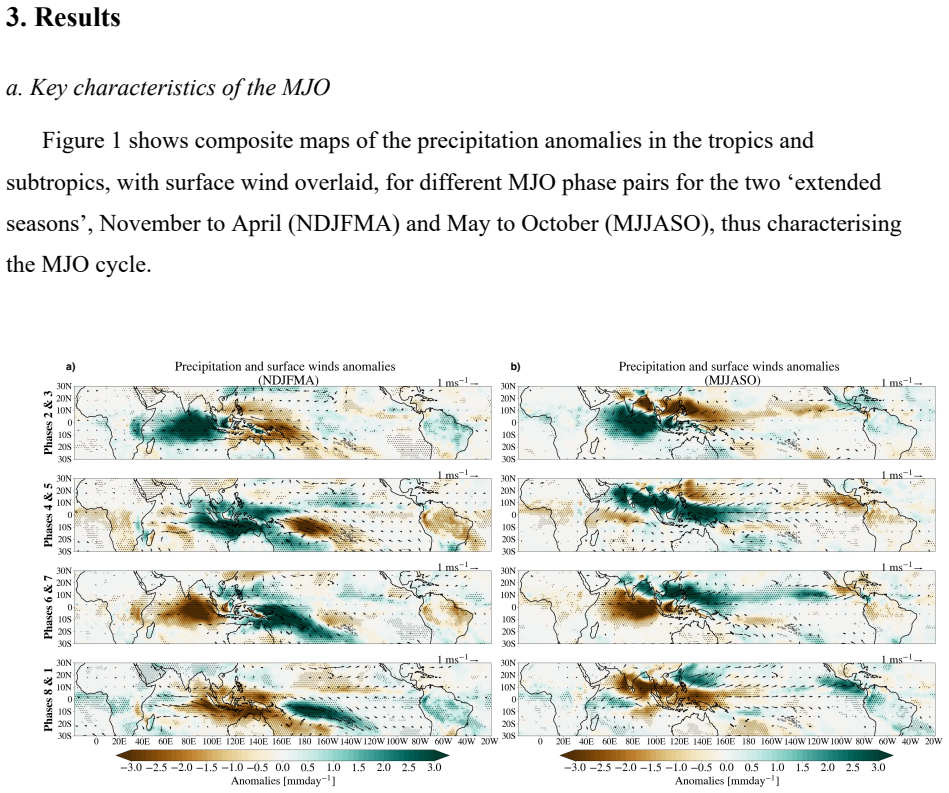
Results a. Key characteristics of the MJO Figure 1 shows composite maps of the precipitation anomalies in the tropics and subtropics, with surface wind overlaid, for different MJO phase pairs for the two ‘extended seasons’, November to April (NDJFMA) and May to October (MJJASO), thus characterising the MJO cycle. Fig. 1. Composite maps of intraseasonal an...
work page 1966
-
[3]
El Niño–Madden-Julian Oscillation
Summary and discussion We have quantified the influence of the Madden-Julian Oscillation on intraseasonal variations of humid heat and heatwaves (based on the wet-bulb temperature, Tw) across the tropics and subtropics. Our analysis has revealed statistically significant (at the 95% confidence level) and robust anomalies of Tw (and other heat stress metri...
-
[4]
https://doi.org/10.1175/JCLI-D-19-0337.1 Huffman, G
Journal of Climate, 33(8), 3333–3349. https://doi.org/10.1175/JCLI-D-19-0337.1 Huffman, G. J., Adler, R. F., Morrissey, M. M., Bolvin, D. T., Curtis, S., Joyce, R., McGavock, B., & Susskind, J. (2001). Global Precipitation at One-Degree Daily Resolution from Multisatellite Observations. Journal of Hydrometeorology, 2(1), 36–50. https://doi.org/10.1175/152...
discussion (0)
Sign in with ORCID, Apple, or X to comment. Anyone can read and Pith papers without signing in.