A Novel Site-Specific Inference Model for Urban Canyon Channels: From Measurements to Modeling
Pith reviewed 2026-05-18 13:55 UTC · model grok-4.3
The pith
A site-specific model infers urban canyon channel statistics directly from street width by clustering multipath components according to canyon geometry.
A machine-rendered reading of the paper's core claim, the machinery that carries it, and where it could break.
Core claim
By extracting multipath components from measurements and clustering them according to geometric propagation paths derived explicitly from canyon width, the model establishes a direct mapping from physical environment parameters to the statistical characteristics of those components, yielding a site-specific inference framework that reproduces measured channel behavior with high accuracy and robustness across different urban canyon scenarios.
What carries the argument
Site-specific channel inference model that clusters MPCs by geometric propagation paths derived from canyon width alone to map environment geometry to MPC statistics.
If this is right
- Channel statistics such as delay spread and angular spread can be predicted for new canyon sites using only width and basic geometry inputs.
- The model supports more accurate wireless system design for intelligent transportation without requiring full three-dimensional building databases.
- A step-by-step implementation procedure allows direct parameterization from sub-6 GHz field data.
- Second-order statistics derived from the model match those obtained from measurements in varied canyon layouts.
Where Pith is reading between the lines
- The geometry-based clustering could be tested for stability when canyon width varies along the street rather than remaining constant.
- Extending the mapping to include vehicle motion or time-varying scatterers would address dynamic scenarios left implicit in the static model.
- Comparison against ray-tracing tools in the same canyons would quantify how much accuracy is retained by using width alone.
Load-bearing premise
Multipath components extracted from measurements can be reliably clustered using geometric paths based only on canyon width, without detailed building heights or material properties.
What would settle it
New measurements in a canyon of measured width that show large mismatches in delay spread or power delay profile compared to the model's predicted statistics would falsify the mapping.
Figures




read the original abstract
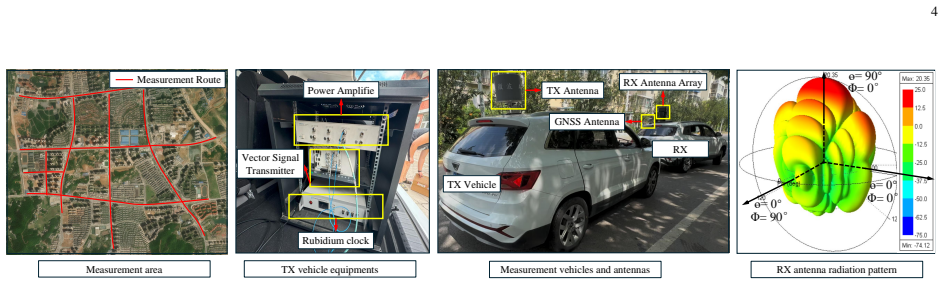
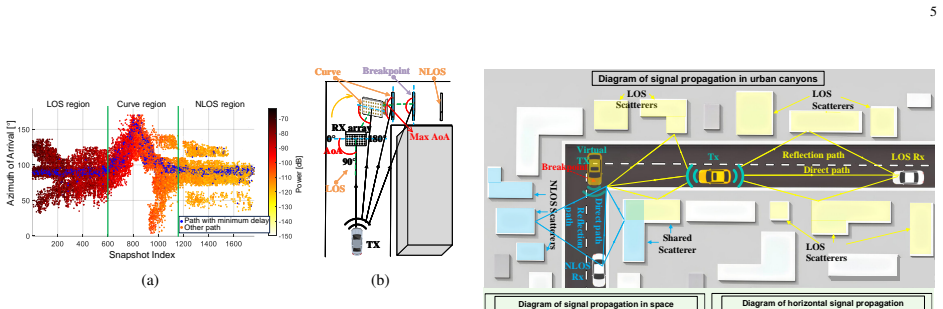
With the rapid development of intelligent transportation and smart city applications, urban canyon has become a critical scenario for the design and evaluation of wireless communication systems. Due to its unique environmental layout, the channel characteristics in urban canyon are strongly a street geometry and building distribution, thereby exhibiting significant site-specific channel condition. However, this feature has not been well captured in existing channel models. In this paper, we propose a site-specific channel inference model based on environmental geometry, the model is parameterized using sub-6GHz channel measurements. Multipath components (MPCs) are extracted and clustered according to geometric propagation, which are explicitly derived from the influence of canyon width, thereby establishing an interpretable mapping between the physical environment and statistical characteristics of MPCs. A step-by-step implementation scheme is presented. Subsequently, the proposed site-specific channel inference model is validated by comparing second-order statistics of channels, derived from the model and measurements. The results show that the proposed model achieves high accuracy and robustness in different urban canyon scenarios.
Editorial analysis
A structured set of objections, weighed in public.
Referee Report
Summary. The manuscript proposes a site-specific channel inference model for urban canyon wireless channels. MPCs are extracted from sub-6 GHz measurements and clustered according to geometric propagation paths derived explicitly from canyon width. This produces an interpretable mapping from physical environment geometry to MPC statistical characteristics. The model is parameterized from the measurements, a step-by-step implementation scheme is given, and validation consists of comparing second-order channel statistics between the model outputs and the measurements, with the claim that the model achieves high accuracy and robustness across different urban canyon scenarios.
Significance. If the width-derived geometric clustering produces a robust, interpretable mapping that generalizes, the work could supply a practical, measurement-calibrated alternative to generic stochastic models for site-specific urban channel prediction, which is relevant for intelligent transportation and smart-city applications. The emphasis on second-order statistics and geometry-to-MPC interpretability is a constructive direction, though the absence of independent test data or quantitative error metrics limits the strength of the current evidence.
major comments (2)
- [Abstract] Abstract: the validation is stated to consist of comparing second-order statistics between model and measurements, yet the text provides no quantitative error metrics (RMSE, normalized mean square error, or correlation values), no error-bar information, and no description of data-exclusion or train/test split rules. Without these, the central claim of 'high accuracy and robustness' cannot be evaluated quantitatively.
- [Abstract (MPC extraction and clustering paragraph)] Abstract (paragraph on MPC extraction and clustering): the clustering is performed 'according to geometric propagation, which are explicitly derived from the influence of canyon width' without additional building height or material data. This assumption is load-bearing for the claimed interpretable mapping; real urban canyons exhibit strong sensitivity of reflection coefficients, diffraction, and excess loss to facade materials and height irregularities that a width-only ray geometry does not encode.
minor comments (2)
- Clarify whether the model parameters for MPC statistics are fitted on the full measurement set or on a held-out subset, and state this explicitly in the validation section.
- Ensure that all figures showing clustered MPCs include the underlying canyon-width geometry used to generate the propagation paths for direct visual comparison.
Simulated Author's Rebuttal
We appreciate the referee's constructive feedback and positive view of the work's potential significance for site-specific urban channel modeling. We address each major comment below with point-by-point responses, indicating planned revisions where appropriate.
read point-by-point responses
-
Referee: [Abstract] Abstract: the validation is stated to consist of comparing second-order statistics between model and measurements, yet the text provides no quantitative error metrics (RMSE, normalized mean square error, or correlation values), no error-bar information, and no description of data-exclusion or train/test split rules. Without these, the central claim of 'high accuracy and robustness' cannot be evaluated quantitatively.
Authors: We agree that explicit quantitative metrics strengthen the claims. Although the manuscript body presents side-by-side comparisons of second-order statistics (power delay profiles, RMS delay spread, and angular spreads) that visually demonstrate close agreement across multiple canyon scenarios, we will revise the abstract and results section to report specific RMSE and correlation coefficient values for these statistics. We will also add error bars to the relevant figures and clarify the validation procedure: the model is parameterized directly from the full measurement set via width-derived geometric clustering, without a conventional train/test split, because the objective is interpretable, measurement-calibrated inference rather than blind prediction on held-out data. revision: yes
-
Referee: [Abstract (MPC extraction and clustering paragraph)] Abstract (paragraph on MPC extraction and clustering): the clustering is performed 'according to geometric propagation, which are explicitly derived from the influence of canyon width' without additional building height or material data. This assumption is load-bearing for the claimed interpretable mapping; real urban canyons exhibit strong sensitivity of reflection coefficients, diffraction, and excess loss to facade materials and height irregularities that a width-only ray geometry does not encode.
Authors: The referee correctly notes that the model derives geometric paths primarily from canyon width. This choice follows directly from our sub-6 GHz measurement campaign, in which width variations produced the dominant, repeatable changes in MPC angles and delays, enabling an explicit and interpretable geometry-to-MPC mapping. Effects of building height and facade materials are statistically embedded in the extracted MPC power and delay parameters from the measured environments. We will add a new discussion subsection that explicitly states this modeling assumption, acknowledges the sensitivity to unmodeled parameters in more heterogeneous canyons, and outlines possible extensions (e.g., incorporating average reflection coefficients when such data are available). This preserves the core contribution while improving transparency. revision: partial
- Absence of results from an independent test dataset collected separately from the measurements used for model parameterization.
Circularity Check
Model parameters fitted to sub-6 GHz measurements then validated by comparing statistics to the same measurements
specific steps
-
fitted input called prediction
[Abstract]
"the model is parameterized using sub-6GHz channel measurements. ... the proposed site-specific channel inference model is validated by comparing second-order statistics of channels, derived from the model and measurements. The results show that the proposed model achieves high accuracy and robustness in different urban canyon scenarios."
Parameters are obtained by fitting to the identical sub-6 GHz measurements whose second-order statistics are subsequently used for validation. Consequently the reported agreement between model-derived and measurement-derived statistics is statistically forced by the fitting step rather than constituting an independent prediction or test.
full rationale
The paper parameterizes its site-specific model directly from the sub-6 GHz channel measurements and then validates it by comparing second-order statistics derived from the model against those same measurements. This reduces the claimed validation to a check of how well the fitted parameters reproduce their own inputs rather than an independent test on held-out data or a parameter-free derivation. The geometry-to-MPC clustering step is presented as establishing an interpretable mapping, but because the clustering and parameterization both originate from the identical measurement set, the mapping is constructed from the data it is later shown to match. No external benchmarks, machine-checked theorems, or separate test scenarios are invoked to break the loop. The central claim therefore exhibits partial circularity of the fitted-input-called-prediction type, warranting a score of 6 rather than a higher value that would require the entire result to collapse by definition.
Axiom & Free-Parameter Ledger
free parameters (1)
- model parameters for MPC statistics
axioms (1)
- domain assumption MPCs can be extracted and clustered according to geometric propagation derived from canyon width to establish an interpretable mapping to statistical characteristics
Reference graph
Works this paper leans on
-
[1]
C. Huang, R. He, B. Ai, A. F. Molisch, B. K. Lau, K. Haneda, B. Liu, C. Wang, M. Yang, C. Oestgeset al., “Artificial intel- ligence enabled radio propagation for communications—part ii: Scenario identification and channel modeling,”IEEE Transac- tions on Antennas and Propagation, vol. 70, no. 6, pp. 3955– 3969, 2022
work page 2022
-
[2]
R. He, C. Schneider, B. Ai, G. Wang, Z. Zhong, D. A. Dupleich, R. S. Thomae, M. Boban, J. Luo, and Y . Zhang, “Propagation channels of 5G millimeter-wave vehicle-to-vehicle communica- tions: Recent advances and future challenges,”IEEE vehicular technology magazine, vol. 15, no. 1, pp. 16–26, 2019
work page 2019
-
[3]
V . Vardhan Gudla, V . Babu Kumaravelu, B. Anjana, P. Sel- vaprabhu, N. Baskar, H. Sheeba John Kennedy, S. Nath Sur, W. Montlouis, A. Lucky Imoize, and A. Murugadass, “Aber per- formance evaluation of ris-aided millimeter wave massive MIMO system under 3GPP 5G channels,”Massive MIMO for Future Wireless Communication Systems: Technology and Applications, p...
work page 2025
-
[4]
Analytical channel modeling: From MIMO to extra large-scale MIMO,
J. Tian, Y . Han, S. Jin, J. Zhang, and J. Wang, “Analytical channel modeling: From MIMO to extra large-scale MIMO,”Chinese Journal of Electronics, vol. 34, no. 1, pp. 1–15, 2025
work page 2025
-
[5]
Characterization of quasi-stationarity regions for vehicle-to-vehicle radio channels,
R. He, O. Renaudin, V . Kolmonen, K. Haneda, Z. Zhong, B. Ai, and C. Oestges, “Characterization of quasi-stationarity regions for vehicle-to-vehicle radio channels,”IEEE Transactions on Antennas and Propagation, vol. 63, no. 5, pp. 2237–2251, 2015
work page 2015
-
[6]
Non-stationarity characteristics in dynamic vehicular isac channels at 28 GHz,
Z. Zhang, R. He, M. Yang, X. Zhang, Z. Qi, H. Mi, G. Sun, J. Yang, and B. Ai, “Non-stationarity characteristics in dynamic vehicular isac channels at 28 GHz,”Chinese Journal of Electron- ics, vol. 34, no. 1, pp. 73–81, 2025
work page 2025
-
[7]
Characterizing urban vehicle-to-vehicle communications for re- liable safety applications,
F. Lyu, H. Zhu, N. Cheng, H. Zhou, W. Xu, M. Li, and X. Shen, “Characterizing urban vehicle-to-vehicle communications for re- liable safety applications,”IEEE Transactions on Intelligent Transportation Systems, vol. 21, no. 6, pp. 2586–2602, 2019
work page 2019
-
[8]
Q. Zhu, C. X. Wang, B. Hua, K. Mao, S. Jiang, and M. Yao, “3GPP TR 38.901 channel model,” inthe wiley 5G Ref: the essential 5G reference online. Wiley Press, 2021, pp. 1–35
work page 2021
-
[9]
P. Kyosti, “WINNER II channel models,”IST, Tech. Rep. IST-4- 027756 WINNER II D1. 1.2 V1. 2, 2007
work page 2007
-
[10]
The COST 2100 MIMO channel model,
L. Liu, C. Oestges, J. Poutanen, K. Haneda, P. Vainikainen, F. Quitin, F. Tufvesson, and P. De Doncker, “The COST 2100 MIMO channel model,”IEEE Wireless Communications, vol. 19, no. 6, pp. 92–99, 2012
work page 2012
-
[11]
COST CA20120 interact framework of artificial intelligence- based channel modeling,
R. He, N. D. Cicco, B. Ai, M. Yang, Y . Miao, and M. Boban, “COST CA20120 interact framework of artificial intelligence- based channel modeling,”IEEE Wireless Communications, 2025
work page 2025
-
[12]
L. Raschkowski, P. Ky ¨osti, K. Kusume, T. J ¨ams¨a, V . Nurmela, A. Karttunen, A. Roivainen, T. Imai, J. J ¨arvel¨ainen, J. Medbo, J. Vihri ¨al¨a, J. Meinil ¨a, K. Haneda, V . Hovinen, J. Ylitalo, N. Omaki, A. Hekkala, R. Weiler, and M. Peter, “METIS Channel Models (D1.4),” 07 2015
work page 2015
-
[13]
Towards 6G: Paradigm of realistic terahertz channel modeling,
K. Guan, H. Yi, D. He, B. Ai, and Z. Zhong, “Towards 6G: Paradigm of realistic terahertz channel modeling,”China Com- munications, vol. 18, no. 5, pp. 1–18, 2021
work page 2021
-
[14]
Channel measurement and modeling for 5G urban microcellular scenarios,
M. Peter, R. J. Weiler, B. G ¨oktepe, W. Keusgen, and K. Sak- aguchi, “Channel measurement and modeling for 5G urban microcellular scenarios,”Sensors, vol. 16, no. 8, p. 1330, 2016
work page 2016
-
[15]
Site-specific radio channel representation for 5G and 6G,
T. Zemen, J. Gomez-Ponce, A. Chandra, M. Walter, E. Ak- soy, R. He, D. Matolak, M. Kim, J.-I. Takada, S. Salous, R. Valenzuela, and A. F. Molisch, “Site-specific radio channel representation for 5G and 6G,”IEEE Communications Magazine, vol. 63, no. 6, pp. 106–113, 2025
work page 2025
-
[16]
Channel measurements and modeling for dynamic vehicular isac scenarios at 28 ghz,
Z. Zhang, R. He, B. Ai, M. Yang, X. Zhang, Z. Qi, and Y . Yuan, “Channel measurements and modeling for dynamic vehicular isac scenarios at 28 ghz,”IEEE Transactions on Communications, vol. 73, no. 8, pp. 6884–6897, 2025
work page 2025
- [17]
-
[18]
O. Kanhere, H. Poddar, and T. S. Rappaport, “Calibration of NYURay for ray tracing using 28, 73, and 142 GHz channel measurements conducted in indoor, outdoor, and factory scenar- ios,”IEEE Transactions on Antennas and Propagation, 2024
work page 2024
-
[19]
B. Rainer, M. Hofer, S. Zelenbaba, D. L ¨oschenbrand, T. Zemen, X. Ye, and P. Priller, “Scalable, resource and locality-aware se- lection of active scatterers in geometry-based stochastic channel models,” in2021 IEEE 32nd Annual International Symposium on Personal, Indoor and Mobile Radio Communications (PIMRC). IEEE, 2021, pp. 885–891
work page 2021
-
[20]
Accurate urban path loss models including diffuse scatter,
D. Chizhik, J. Du, M. Kohli, A. Adhikari, R. Feick, R. A. Valenzuela, and G. Zussman, “Accurate urban path loss models including diffuse scatter,” in2023 17th European Conference on Antennas and Propagation (EuCAP). IEEE, 2023, pp. 1–3
work page 2023
-
[21]
Around- corner and over-top 28 GHz measurement in manhattan: Path loss and AoA for MU-MIMO,
A. Adhikari, S. Mukherjee, A. Mehta, M. Kohli, R. Feick, R. Valenzuela, D. Chizhik, J. Du, and G. Zussman, “Around- corner and over-top 28 GHz measurement in manhattan: Path loss and AoA for MU-MIMO,” inIEEE INFOCOM 2025-IEEE Conference on Computer Communications. IEEE, 2025, pp. 1–10
work page 2025
-
[22]
Non-geometrical stochastic model for non-stationary wideband vehicular communication channels,
Z. Huang, X. Zhang, and X. Cheng, “Non-geometrical stochastic model for non-stationary wideband vehicular communication channels,”IET Communications, vol. 14, no. 1, pp. 54–62, 2020
work page 2020
-
[23]
C. Li, W. Chen, Z. Pei, F. Chang, J. Yu, and F. Luo, “Non- stationary time-varying vehicular channel characteristics for different roadside scattering environments,”Scientific Reports, vol. 12, no. 1, p. 14344, 2022
work page 2022
-
[24]
Characterization of quasi-stationarity re- gions for V2V channels in various driving states,
M. Guo, F. Yu, Y . Tong, Y . Yu, C. A. Guti ´errez, J. Rodr ´ıguez- Pi˜neiro, and X. Yin, “Characterization of quasi-stationarity re- gions for V2V channels in various driving states,” in2024 IEEE 99th Vehicular Technology Conference (VTC2024-Spring). IEEE, 2024, pp. 1–5
work page 2024
-
[25]
Dynamic V2V channel measurement and modeling at street intersection scenarios,
M. Yang, B. Ai, R. He, Z. Ma, H. Mi, D. Fei, Z. Zhong, Y . Li, and J. Li, “Dynamic V2V channel measurement and modeling at street intersection scenarios,”IEEE Transactions on Antennas and Propagation, vol. 71, no. 5, pp. 4417–4432, 2023
work page 2023
-
[26]
Double-directional V2V channel measurement using ReRoMA at 60 GHz,
H. Hammoud, Y . Zhang, Z. Cheng, S. Sangodoyin, M. Hofer, F. Pasic, T. M. Pohl, R. Z ´avorka, A. Prokes, T. Zemenet al., “Double-directional V2V channel measurement using ReRoMA at 60 GHz,”arXiv preprint arXiv:2412.01165, 2024
-
[27]
Measurement based tapped delay line model for train-to-train communications,
E. M. Big ˜notte, P. Unterhuber, A. A. G ´omez, S. Sand, and M. M. Errasti, “Measurement based tapped delay line model for train-to-train communications,”IEEE Transactions on Vehicular Technology, vol. 72, no. 4, pp. 4168–4181, 2022
work page 2022
-
[28]
Autoregressive modeling approach for non-stationary vehicular channel simulation,
M. Yusuf, E. Tanghe, F. Challita, P. Laly, L. Martens, D. P. Gaillot, M. Lienard, and W. Joseph, “Autoregressive modeling approach for non-stationary vehicular channel simulation,”IEEE Transactions on Vehicular Technology, vol. 71, no. 2, pp. 1124– 1131, 2021
work page 2021
-
[29]
Physics-informed generative modeling of wireless channels,
B. B ¨ock, A. Oeldemann, T. Mayer, F. Rossetto, and W. Utschick, “Physics-informed generative modeling of wireless channels,” arXiv preprint arXiv:2502.10137, 2025
-
[30]
A general 3D non-stationary wireless channel model for 5G and beyond,
J. Bian, C. Wang, X. Gao, X. You, and M. Zhang, “A general 3D non-stationary wireless channel model for 5G and beyond,” IEEE Transactions on Wireless Communications, vol. 20, no. 5, pp. 3211–3224, 2021
work page 2021
-
[31]
H. Radpour, L. Minz, S.-O. Park, D. Kim, and Y .-C. Moon, “Dynamic geometry-based stochastic channel modeling for po- 14 larized MIMO systems with moving scatterers,”arXiv preprint arXiv:2306.04549, 2023
-
[32]
E. Assiimwe and Y . W. Marye, “A mobility model for a 3D non- stationary geometry cluster-based channel model for high speed trains in MIMO wireless channels,”Sensors, vol. 22, no. 24, p. 10019, 2022
work page 2022
-
[33]
C. Huang, R. Wang, P. Tang, R. He, B. Ai, Z. Zhong, C. Oestges, and A. F. Molisch, “Geometry-cluster-based stochastic MIMO model for vehicle-to-vehicle communications in street canyon scenarios,”IEEE Transactions on Wireless Communications, vol. 20, no. 2, pp. 755–770, 2020
work page 2020
-
[34]
A geometry-based stochastic model for truck communication channels in freeway scenarios,
C. Huang, R. Wang, C. Wang, P. Tang, and A. F. Molisch, “A geometry-based stochastic model for truck communication channels in freeway scenarios,”IEEE Transactions on Commu- nications, vol. 70, no. 8, pp. 5572–5586, 2022
work page 2022
-
[35]
Z. Huang, L. Bai, M. Sun, X. Cheng, P. E. Mogensen, and X. Cai, “A mixed-bouncing based non-stationarity and consistency 6G V2V channel model with continuously arbitrary trajectory,”IEEE Transactions on Wireless Communications, vol. 23, no. 2, pp. 1634–1650, 2023
work page 2023
-
[36]
Novel 3D geometry-based stochastic models for non-isotropic MIMO vehicle-to-vehicle channels,
Y . Yuan, C. Wang, X. Cheng, B. Ai, and D. I. Laurenson, “Novel 3D geometry-based stochastic models for non-isotropic MIMO vehicle-to-vehicle channels,”IEEE transactions on wireless com- munications, vol. 13, no. 1, pp. 298–309, 2013
work page 2013
-
[37]
Machine learning-based urban canyon path loss prediction using 28 GHz manhattan measurements,
A. Gupta, J. Du, D. Chizhik, R. A. Valenzuela, and M. Sellathu- rai, “Machine learning-based urban canyon path loss prediction using 28 GHz manhattan measurements,”IEEE Transactions on Antennas and Propagation, vol. 70, no. 6, pp. 4096–4111, 2022
work page 2022
-
[38]
A geometry-based stochastic wireless channel model using channel images,
S. Kang, “A geometry-based stochastic wireless channel model using channel images,” in2024 IEEE Virtual Conference on Communications (VCC). IEEE, 2024, pp. 1–6
work page 2024
-
[39]
A tutorial on environment- aware communications via channel knowledge map for 6G,
Y . Zeng, J. Chen, J. Xu, D. Wu, X. Xu, S. Jin, X. Gao, D. Gesbert, S. Cui, and R. Zhang, “A tutorial on environment- aware communications via channel knowledge map for 6G,” IEEE communications surveys & tutorials, vol. 26, no. 3, pp. 1478–1519, 2024
work page 2024
-
[40]
How much data is needed for channel knowledge map construction?
X. Xu and Y . Zeng, “How much data is needed for channel knowledge map construction?”IEEE Transactions on Wireless Communications, vol. 23, no. 10, pp. 13 011–13 021, 2024
work page 2024
-
[41]
Environment-aware hybrid beamforming by leveraging channel knowledge map,
D. Wu, Y . Zeng, S. Jin, and R. Zhang, “Environment-aware hybrid beamforming by leveraging channel knowledge map,” IEEE Transactions on Wireless Communications, vol. 23, no. 5, pp. 4990–5005, 2023
work page 2023
-
[42]
Space-alternating generalized expectation-maximization algorithm,
J. A. Fessler and A. O. Hero, “Space-alternating generalized expectation-maximization algorithm,”IEEE Transactions on sig- nal processing, vol. 42, no. 10, pp. 2664–2677, 2002
work page 2002
-
[43]
Characterization of an indoor MIMO channel in frequency do- main using the 3D-SAGE algorithm,
M. Matthaiou, D. I. Laurenson, N. Razavi-Ghods, and S. Salous, “Characterization of an indoor MIMO channel in frequency do- main using the 3D-SAGE algorithm,” in2007 IEEE International Conference on Communications. IEEE, 2007, pp. 5868–5872
work page 2007
-
[44]
A. F. Molisch,Wireless communications. John Wiley & Sons, 2012, vol. 34
work page 2012
-
[45]
B. H. Fleury, “First-and second-order characterization of direc- tion dispersion and space selectivity in the radio channel,”IEEE Transactions on Information Theory, vol. 46, no. 6, pp. 2027– 2044, 2002
work page 2027
discussion (0)
Sign in with ORCID, Apple, or X to comment. Anyone can read and Pith papers without signing in.