A weak Lehmer code for type F₄
Pith reviewed 2026-05-18 14:10 UTC · model grok-4.3
The pith
Two functions define a weak Lehmer code that builds multicomplexes matching the rank-generating functions of all lower Bruhat intervals in F4.
A machine-rendered reading of the paper's core claim, the machinery that carries it, and where it could break.
Core claim
For the finite Coxeter group of type F4, two functions can be defined that together act as a weak Lehmer code. These functions yield an algorithm that, for any lower Bruhat interval, produces a multicomplex whose rank-generating function equals the Poincaré polynomial of the interval. The same work shows that the set of all palindromic Poincaré polynomials of F4 arises as an induced subposet of the Bruhat order and carries the structure of a lattice.
What carries the argument
A weak Lehmer code consisting of exactly two functions that label group elements to generate the required multicomplex on each lower Bruhat interval.
If this is right
- The rank-generating function of each constructed multicomplex equals the Poincaré polynomial of its lower Bruhat interval.
- The construction applies uniformly to every lower Bruhat interval in F4.
- The palindromic Poincaré polynomials of F4 form a lattice as an induced subposet of the Bruhat order.
- The two-function code supplies a concrete realization of the general existence result for multicomplexes on Weyl groups.
Where Pith is reading between the lines
- The explicit algorithm makes the general existence of multicomplexes constructive for this particular Weyl group.
- The lattice on palindromic polynomials supplies a combinatorial ordering that may aid enumeration or comparison of these invariants.
- Similar two-function weakenings of Lehmer codes could be tested for other Coxeter types where a strong version is known to fail.
Load-bearing premise
A strong Lehmer code does not exist for type F4, forcing any explicit construction to rely on a version built from precisely two functions.
What would settle it
Run the algorithm on any chosen lower Bruhat interval in F4, compute the rank-generating function of the output multicomplex, and check whether it differs from the Poincaré polynomial of that interval.
Figures


read the original abstract
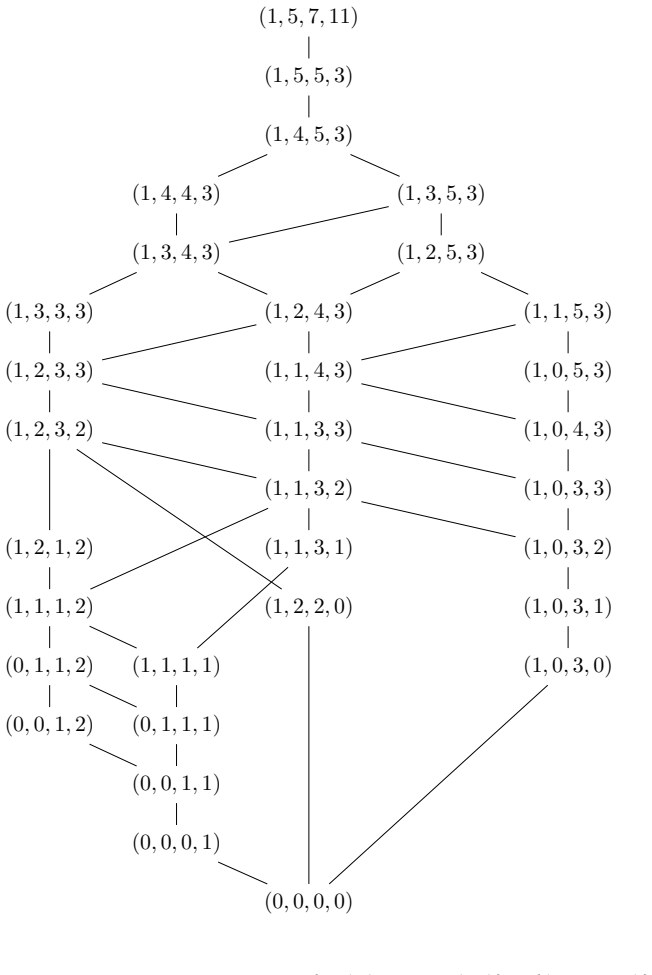
We provide an algorithm to construct a multicomplex for any lower Bruhat interval of $F_4$, such that its rank--generating function equals that of the Bruhat interval. For Weyl groups, it is always possible to find such a multicomplex thanks to the work of Bj\"{o}rner and Ekedahl. The algorithm is based on only two functions, which weaken the notion of Lehmer code for finite Coxeter groups, motivated by the fact that a strong Lehmer code for type $F_4$ does not exist. We also realize the set of palindromic Poincar\'e polynomials of $F_4$ as an induced subposet of the Bruhat order that forms a lattice.
Editorial analysis
A structured set of objections, weighed in public.
Referee Report
Summary. The manuscript provides an algorithm based on two functions that together constitute a weak Lehmer code for the Weyl group of type F4. For any lower Bruhat interval, the algorithm produces a multicomplex whose rank-generating function equals the Poincaré polynomial of the interval. The construction is motivated by the non-existence of a strong Lehmer code in this type and relies on the existence theorem of Björner and Ekedahl. The paper further shows that the palindromic Poincaré polynomials of F4 form an induced lattice subposet of the Bruhat order.
Significance. If the algorithm is correct and fully specified, the work supplies an explicit, computable realization of the multicomplexes whose existence is guaranteed for all finite Coxeter groups. Because F4 is the smallest exceptional type in which a strong Lehmer code fails, the two-function weakening is a natural and potentially reusable device. The lattice realization of the palindromic polynomials is a clean structural observation that may be of independent interest to combinatorialists studying Bruhat orders.
major comments (2)
- §3, Algorithm 1: the two functions are defined piecewise on the length and on the simple reflections, but the manuscript does not explicitly verify that every reduced word is assigned a unique pair of values; a short table or inductive argument confirming bijectivity onto the target multicomplex would strengthen the claim that the rank-generating function equality holds for all intervals.
- §4, Theorem 4.3: the proof that the constructed multicomplex has the correct rank-generating function proceeds by induction on length, yet the base case for the identity element and the inductive step for covering relations are only sketched; an explicit check for the longest element of a rank-3 parabolic subgroup would make the induction transparent.
minor comments (3)
- Notation: the symbol for the second function of the weak Lehmer code is introduced without a dedicated definition line; adding a displayed equation would improve readability.
- Figure 2: the Hasse diagram of the induced lattice on palindromic polynomials is drawn at a scale that obscures the labels on the middle rank; a larger version or an explicit listing of the polynomials would help.
- References: the citation to Björner–Ekedahl is given only in the introduction; repeating the full reference in the section where the existence theorem is invoked would be convenient.
Simulated Author's Rebuttal
We thank the referee for the careful reading of the manuscript and the constructive comments. We address each major comment below and indicate the changes we will make in the revised version.
read point-by-point responses
-
Referee: §3, Algorithm 1: the two functions are defined piecewise on the length and on the simple reflections, but the manuscript does not explicitly verify that every reduced word is assigned a unique pair of values; a short table or inductive argument confirming bijectivity onto the target multicomplex would strengthen the claim that the rank-generating function equality holds for all intervals.
Authors: We agree that an explicit verification of bijectivity would strengthen the claim. The piecewise definitions on length and simple reflections are intended to assign unique pairs by construction, but the manuscript does not include a direct confirmation. In the revision we will add a short table for reduced words of lengths up to 6 together with a brief inductive argument showing that the two functions produce distinct pairs for distinct reduced words and that the image is exactly the target multicomplex. This will make the equality of rank-generating functions fully transparent for every lower interval. revision: yes
-
Referee: §4, Theorem 4.3: the proof that the constructed multicomplex has the correct rank-generating function proceeds by induction on length, yet the base case for the identity element and the inductive step for covering relations are only sketched; an explicit check for the longest element of a rank-3 parabolic subgroup would make the induction transparent.
Authors: We accept that the inductive argument would benefit from greater detail. We will expand the proof of Theorem 4.3 to state the base case for the identity element explicitly and to spell out the inductive step for covering relations. We will also insert an explicit verification for the longest element of a rank-3 parabolic subgroup (for example, the parabolic subgroup generated by the first three simple reflections) to illustrate how the rank-generating function is preserved under the covering relation. revision: yes
Circularity Check
No significant circularity; derivation is self-contained by explicit construction
full rationale
The paper defines two explicit functions that constitute the weak Lehmer code and supplies a concrete algorithm that, for any lower Bruhat interval in F4, builds a multicomplex whose rank-generating function is shown to match that of the interval by direct verification of the construction steps. The non-existence of a strong Lehmer code is invoked only as motivation and is not used inside the algorithm or the equality proof. The Björner-Ekedahl existence theorem is cited as an independent external result that guarantees such multicomplexes exist for Weyl groups in general; it is not derived from or dependent on the present definitions. The lattice realization of the palindromic Poincaré polynomials is obtained by exhibiting an induced subposet of the Bruhat order, again by explicit construction rather than by reduction to fitted parameters or self-referential equations. No step equates a claimed prediction to an input by definition or by a self-citation chain.
Axiom & Free-Parameter Ledger
axioms (1)
- domain assumption For any Weyl group there exists a multicomplex whose rank-generating function equals that of any given lower Bruhat interval (Björner-Ekedahl).
Reference graph
Works this paper leans on
-
[1]
S. C. Billey, C. K. Fan, and J. Losonczy,The parabolic map, Journal of Algebra 214.1, 1-7 (1999)
work page 1999
-
[2]
S. C. Billey,Pattern avoidance and rational smoothness of Schubert varieties, Advances in Mathematics 139.1, 141-156 (1998)
work page 1998
-
[3]
A. Björner and F. Brenti,Combinatorics of Coxeter Groups, Graduate Texts in Mathematics, 231, Springer-Verlag, New York, 2005
work page 2005
-
[4]
A. Björner and T. Ekedahl,On the shape of Bruhat intervals, Annals of mathematics, 799-817 (2009)
work page 2009
-
[5]
D. Bolognini and P. Sentinelli,The Lehmer complex of a Bruhat interval, arXiv preprint arXiv:2501.03037 (2025)
-
[6]
J. B. Carrell,The Bruhat graph of a Coxeter group, a conjecture of Deodhar, and rational smoothness of Schubert varieties.Proceedings of Symposia in Pure Mathematics. American Mathematical Society, 1994
work page 1994
-
[7]
The Sage Developers.SageMath, the Sage Mathematics Software Sys- tem(Version 9.3)
-
[8]
R. P. Stanley,Combinatorics and Commutative Algebra, Vol. 41. Springer Science & Business Media (2007). 18 (1,5,7,11) (1,3,5,5) (1,3,4,5) (1,3,4,4) (1,3,3,5) (1,3,3,4) (1,2,3,5) (1,3,3,3) (1,2,3,4) (1,1,3,5) (1,2,3,3) (1,1,3,4) (0,1,3,5) (1,2,2,3) (1,1,3,3) (0,1,3,4) (1,1,2,3) (0,1,3,3) (1,1,2,2) (1,1,1,3) (0,1,2,3) (1,1,1,2) (0,1,2,2) (0,1,1,3) (1,1,1,1)...
work page 2007
discussion (0)
Sign in with ORCID, Apple, or X to comment. Anyone can read and Pith papers without signing in.