A Framework to Systematically Study the Nonlinear Fluid-Structure Interaction of Phononic Materials with Aerodynamic Flows
Pith reviewed 2026-05-18 13:04 UTC · model grok-4.3
The pith
Phononic materials in aerodynamic flows can be described by four behavioral parameters that determine their effects on vortex shedding.
A machine-rendered reading of the paper's core claim, the machinery that carries it, and where it could break.
Core claim
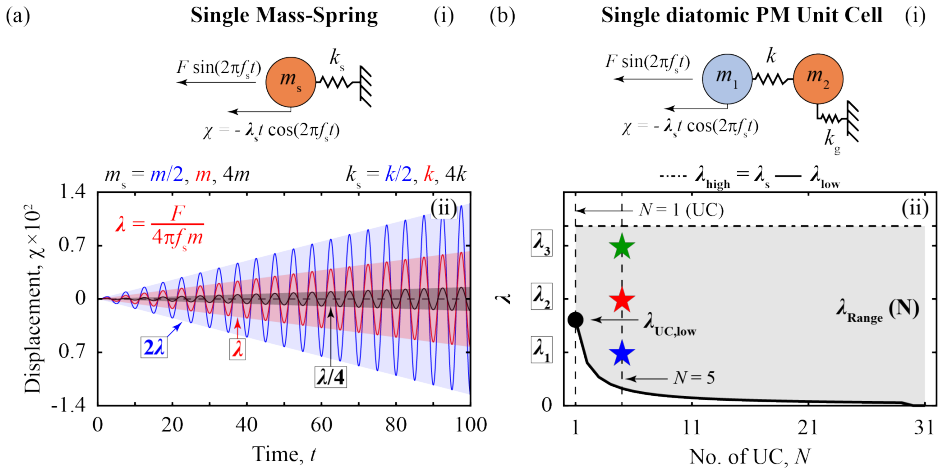
Our study proposes four critical PM behavioral parameters -- effective stiffness, truncation resonance frequency, a quantity representing the dynamic displacement amplitude, and unit cell mass -- that influence the spectral characteristics of the vortex-shedding process inherent to the flat plate system. Results show connections between each parameter and distinct behavior in the lift coefficient in FSI.
What carries the argument
Four behavioral parameters for phononic materials in FSI (effective stiffness, truncation resonance frequency, dynamic displacement amplitude, and unit cell mass) that map to structural parameters and shape flow spectra.
If this is right
- Each of the four behavioral parameters produces a distinct signature in the lift coefficient during fluid-structure interaction.
- The parameters allow systematic quantification of how phononic materials modulate flow unsteadiness and vortex shedding.
- Identifying behavioral parameters rather than only structural ones simplifies the study of nonlinear FSI in aerodynamic flows.
- The approach supports passive flow control design using phononic materials in flat-plate configurations.
Where Pith is reading between the lines
- The same behavioral-parameter approach could be tested in turbulent or compressible flow regimes to address transition delay or shock-boundary-layer control.
- Experimental measurements on fabricated phononic plates could validate the simulation-derived mappings to structural design variables.
- Designers might target specific behavioral parameters to achieve desired changes in lift or drag without exhaustive structural optimization.
Load-bearing premise
High-fidelity strongly coupled simulations can reliably quantify the influence of these behavioral parameters on FSI dynamics and that a clear mapping exists from behavioral parameters back to the underlying structural parameters of the phononic material.
What would settle it
A simulation or experiment in which independently varying one behavioral parameter produces no distinct predicted change in the vortex-shedding spectrum or lift coefficient would challenge the framework.
Figures




read the original abstract
Phononic materials (PMs) are periodic media that exhibit novel elastodynamic responses. While PMs have made progress in vibration-mitigation applications, recent studies have demonstrated the potential of PMs to passively and adaptively modulate flow behavior through fluid-structure interaction (FSI). For example, PMs have been shown to delay laminar-to-turbulent transition and mitigate unsteadiness in shock-boundary layer interactions. However, a systematic framework to relate the effect of specific PM behaviors to the FSI dynamics is lacking. Such a framework is essential to systematically investigate the complex and nonlinear coupled dynamics of the FSI. Further, parameters that are not typically considered in PM models become critical, such as the vibration amplitude. This article addresses this gap by proposing FSI-relevant ``behavioral'' parameters, distinct from the structural parameters of the PM, but with a clear mapping provided to them. We use high-fidelity, strongly coupled simulations to quantify the FSI between a novel configuration of laminar flow past a flat plate, equipped with a PM. Our study proposes four critical PM behavioral parameters -- effective stiffness, truncation resonance frequency, a quantity representing the dynamic displacement amplitude, and unit cell mass -- that influence the spectral characteristics of the vortex-shedding process inherent to the flat plate system. Results show connections between each parameter and distinct behavior in the lift coefficient in FSI. While the focus of this work is on the PM-FSI dynamics in an aerodynamic flow, we argue that identifying these behavioral parameters is key to unlocking scientific study and design with phononic materials in fluid flows more broadly.
Editorial analysis
A structured set of objections, weighed in public.
Referee Report
Summary. The manuscript proposes a systematic framework for investigating nonlinear fluid-structure interaction (FSI) between phononic materials (PMs) and aerodynamic flows. It introduces four behavioral parameters—effective stiffness, truncation resonance frequency, dynamic displacement amplitude, and unit cell mass—that are distinct from but mappable to the PM structural parameters. High-fidelity, strongly coupled simulations of laminar flow over a flat plate equipped with a PM are used to demonstrate connections between each behavioral parameter and distinct features in the spectral content of the lift coefficient arising from vortex shedding.
Significance. If the behavioral parameters can be shown to be independently controllable with an invertible mapping to structural design variables, the framework would provide a valuable tool for extending PM applications from vibration control to passive flow modulation in aerodynamics. The use of strongly coupled simulations to link parameter variations to lift-coefficient spectra is a positive step toward falsifiable design rules, though the overall impact depends on resolving questions of parameter orthogonality.
major comments (1)
- [Definition of behavioral parameters and simulation methodology] The central claim that the four behavioral parameters can be systematically varied to map distinct effects onto vortex-shedding spectra requires explicit demonstration that dynamic displacement amplitude can be adjusted independently while holding effective stiffness, truncation resonance frequency, and unit cell mass fixed. In a strongly coupled nonlinear FSI system, amplitude emerges from the instantaneous force balance; without shown constraints (e.g., external forcing or damping) that preserve invariance of the other three parameters, the set is not orthogonal and the framework reduces to post-hoc correlation rather than a controllable design space. This issue is load-bearing for the proposed framework and must be addressed with concrete simulation protocols or additional constraints.
minor comments (2)
- Clarify the precise definition and units of the 'quantity representing the dynamic displacement amplitude' to avoid ambiguity with emergent response quantities.
- Provide explicit mapping equations or tables showing how each behavioral parameter translates back to the underlying PM structural parameters (e.g., lattice geometry, material moduli).
Simulated Author's Rebuttal
We thank the referee for their constructive and detailed review. The emphasis on demonstrating orthogonality among the behavioral parameters is well taken, as it directly affects the framework's utility for systematic design. We address the major comment below and commit to revisions that strengthen this aspect of the work.
read point-by-point responses
-
Referee: [Definition of behavioral parameters and simulation methodology] The central claim that the four behavioral parameters can be systematically varied to map distinct effects onto vortex-shedding spectra requires explicit demonstration that dynamic displacement amplitude can be adjusted independently while holding effective stiffness, truncation resonance frequency, and unit cell mass fixed. In a strongly coupled nonlinear FSI system, amplitude emerges from the instantaneous force balance; without shown constraints (e.g., external forcing or damping) that preserve invariance of the other three parameters, the set is not orthogonal and the framework reduces to post-hoc correlation rather than a controllable design space. This issue is load-bearing for the proposed framework and must be addressed with concrete simulation protocols or additional constraints.
Authors: We agree that independent controllability is essential for the framework to move beyond observed correlations toward a true design space. The dynamic displacement amplitude is indeed an emergent quantity in the coupled FSI problem. In the current manuscript the four parameters are obtained by mapping from distinct structural features of the phononic unit cells (stiffness from spring constants, resonance from band-gap edges, mass from density/geometry, and amplitude from the resulting modal participation under load). To address the referee's point directly, the revised manuscript will add a new subsection with targeted simulation protocols: we will introduce controlled variations in local geometry and internal damping that primarily affect displacement amplitude while re-computing and confirming that effective stiffness, truncation resonance frequency, and unit cell mass remain invariant to within numerical tolerance. These additional cases will be presented alongside the existing results to demonstrate the required orthogonality. revision: yes
Circularity Check
No circularity: behavioral parameters proposed and validated via independent simulations
full rationale
The paper proposes four behavioral parameters (effective stiffness, truncation resonance frequency, dynamic displacement amplitude, unit cell mass) with an asserted mapping to underlying PM structural parameters, then quantifies their influence on vortex-shedding spectra using high-fidelity strongly coupled FSI simulations. No equations, derivations, or self-citations are shown that reduce any claimed prediction or parameter to a fitted quantity defined from the same data or to a prior result by the same authors. The framework is self-contained against external simulation benchmarks rather than self-referential definitions, so the central claim does not collapse by construction.
Axiom & Free-Parameter Ledger
axioms (1)
- domain assumption High-fidelity, strongly coupled simulations accurately capture the nonlinear FSI dynamics between the phononic material and the laminar flow.
invented entities (1)
-
Behavioral parameters (effective stiffness, truncation resonance frequency, dynamic displacement amplitude, unit cell mass)
no independent evidence
Lean theorems connected to this paper
-
IndisputableMonolith/Cost/FunctionalEquation.leanwashburn_uniqueness_aczel unclear?
unclearRelation between the paper passage and the cited Recognition theorem.
Our study proposes four critical PM behavioral parameters -- effective stiffness, truncation resonance frequency, a quantity representing the dynamic displacement amplitude, and unit cell mass -- that influence the spectral characteristics of the vortex-shedding process
-
IndisputableMonolith/Foundation/AlphaCoordinateFixation.leanJ_uniquely_calibrated_via_higher_derivative unclear?
unclearRelation between the paper passage and the cited Recognition theorem.
keff = F_R_CS,mean / χ_mean,ref ; f_TR = ... ; λ = ... ; m_UC = ... (Eqs. 6-10)
What do these tags mean?
- matches
- The paper's claim is directly supported by a theorem in the formal canon.
- supports
- The theorem supports part of the paper's argument, but the paper may add assumptions or extra steps.
- extends
- The paper goes beyond the formal theorem; the theorem is a base layer rather than the whole result.
- uses
- The paper appears to rely on the theorem as machinery.
- contradicts
- The paper's claim conflicts with a theorem or certificate in the canon.
- unclear
- Pith found a possible connection, but the passage is too broad, indirect, or ambiguous to say the theorem truly supports the claim.
Reference graph
Works this paper leans on
-
[1]
D. M. Kochmann, K. Bertoldi, Exploiting microstructural instabilities in solids and structures: from metamaterials to structural transitions, Appl. Mech. Rev. 69 (2017) 050801
work page 2017
-
[2]
G. U. Patil, K. H. Matlack, Review of exploiting nonlinearity in phononic materials to enable nonlinear wave responses, Acta Mech. 233 (2022) 1–46
work page 2022
-
[3]
P. Jiao, J. Mueller, J. R. Raney, X. Zheng, A. H. Alavi, Mechanical metamaterials and beyond, Nat. Commun. 14 (2023) 6004
work page 2023
-
[4]
B. Wu, W. Jiang, J. Jiang, Z. Zhao, Y. Tang, W. Zhou, W. Chen, Wave manipulation in intelligent metamaterials: recent progress and prospects, Adv. Funct. Mater. 34 (2024) 2316745
work page 2024
-
[5]
M. S. Kushwaha, P. Halevi, L. Dobrzynski, B. Djafari-Rouhani, Acoustic band structure of periodic elastic composites, Phys. Rev. Lett. 71 (1993) 2022
work page 1993
-
[6]
M. S. Kushwaha, Classical band structure of periodic elastic composites, Int. J. Mod. Phys. B 10 (1996) 977–1094. 27
work page 1996
-
[7]
J. Lee, Y. Y. Kim, Elastic metamaterials for guided waves: from fundamentals to applications, Smart Mater. Struct. 32 (2023) 123001
work page 2023
-
[8]
U. Vishwakarma, M. Irfan, G. Theocharis, R. Chaunsali, Edge states with hidden topology in spinner lattices, Commun. Phys. 8 (2025) 83
work page 2025
- [9]
- [10]
-
[11]
F. Akbari-Farahani, S. Ebrahimi-Nejad, From defect mode to topological metamaterials: A state-of-the-art review of phononic crystals & acoustic metamaterials for energy harvesting, Sens. Actuator A Phys. (2023) 114871
work page 2023
-
[12]
F. Martinez, M. Maldovan, Metamaterials: Optical, acoustic, elastic, heat, mass, electric, magnetic, and hydrodynamic cloaking, Mater. Today Phys. 27 (2022) 100819
work page 2022
- [13]
-
[14]
M. V. Bastawrous, M. I. Hussein, Closed-form existence conditions for bandgap resonances in a finite periodic chain under general boundary conditions, J. Acoust. Soc. Am. 151 (2022) 286–298
work page 2022
-
[15]
H. Al Ba’ba’a, M. Nouh, T. Singh, Dispersion and topological characteristics of permutative polyatomic phononic crystals, Proc. R. Soc. A 475 (2019) 20190022
work page 2019
-
[16]
H. B. Al Ba’ba’a, H. Yousef, M. Nouh, A blueprint for truncation resonance placement in elastic diatomic lattices with unit cell asymmetry, JASA Express Lett. 4 (2024) 077501
work page 2024
-
[17]
V. Ramakrishnan, K. H. Matlack, A quantitative study of energy localization characteristics in defect-embedded monoatomic phononic crystals, J. Sound Vib. 614 (2025) 119164
work page 2025
-
[18]
M. I. Hussein, S. Biringen, O. R. Bilal, A. Kucala, Flow stabilization by subsurface phonons, Proc. R. Soc. A 471 (2015) 20140928
work page 2015
-
[19]
C. L. Willey, C. J. Barnes, V. W. Chen, K. Rosenberg, A. Medina, A. T. Juhl, Multi-input multi-output phononic subsurfaces for passive boundary layer transition delay, J. Fluids Struct. 121 (2023) 103936
work page 2023
-
[20]
T. Michelis, A. Putranto, M. Kotsonis, Attenuation of tollmien–schlichting waves using resonating surface-embedded phononic crystals, Phys. Fluids 35 (2023)
work page 2023
-
[21]
C. J. Barnes, C. L. Willey, K. Rosenberg, A. Medina, A. T. Juhl, Initial computational investigation toward passive transition delay using a phononic subsurface, in: AIAA Scitech 2021 Forum, 2021, p. 1454
work page 2021
-
[22]
R. Schmidt, H. Yousef, I. Roy, C. Scalo, M. Nouh, Perturbation energy extraction from a fluid via a subsurface acoustic diode with sustained downstream attenuation, J. Appl. Phys. 137 (2025)
work page 2025
- [23]
-
[24]
J. D. Navarro, D. Balderas, E. J. LaLonde, J. C. Velasquez-Gonzalez, E. N. Hoffman, C. S. Combs, D. Restrepo, Stabilization of hypersonic shockwave/boundary-layer interactions with phononic metamaterials, Matter (2025)
work page 2025
-
[25]
Compliant coatings, Annu. Rev. Fluid Mech. 20 (1988) 393–420
work page 1988
-
[26]
Gad-el Hak, Compliant coatings: A decade of progress, Appl
M. Gad-el Hak, Compliant coatings: A decade of progress, Appl. Mech. Rev. 49 (1996) S147–S157
work page 1996
-
[27]
C. H. Williamson, R. Govardhan, Vortex-induced vibrations, Annu. Rev. Fluid Mech. 36 (2004) 413–455
work page 2004
-
[28]
Sarpkaya, A critical review of the intrinsic nature of vortex-induced vibrations, J
T. Sarpkaya, A critical review of the intrinsic nature of vortex-induced vibrations, J. Fluids Struct. 19 (2004) 389–447
work page 2004
-
[29]
M. J. Shelley, J. Zhang, Flapping and bending bodies interacting with fluid flows, Annu. Rev. Fluid Mech. 43 (2011) 449–465
work page 2011
-
[30]
T. B. Benjamin, Effects of a flexible boundary on hydrodynamic stability, J. Fluid Mech. 9 (1960) 513–532
work page 1960
-
[31]
M. T. Landahl, On the stability of a laminar incompressible boundary layer over a flexible surface, J. Fluid Mech. 13 (1962) 609–632
work page 1962
-
[32]
P. Carpenter, A. Garrad, The hydrodynamic stability of flow over kramer-type compliant surfaces. part 1. tollmien-schlichting instabilities, J. Fluid Mech. 155 (1985) 465–510
work page 1985
-
[33]
M. Shelley, N. Vandenberghe, J. Zhang, Heavy flags undergo spontaneous oscillations in flowing water, Phys. Rev. Lett. 94 (2005) 094302
work page 2005
-
[34]
O. Doar´ e, S. Michelin, Piezoelectric coupling in energy-harvesting fluttering flexible plates: linear stability analysis and conversion efficiency, J. Fluids Struct. 27 (2011) 1357–1375
work page 2011
- [35]
-
[36]
A. Goza, T. Colonius, J. E. Sader, Global modes and nonlinear analysis of inverted-flag flapping, J. Fluid Mech. 857 (2018) 312–344
work page 2018
-
[37]
J.-L. Pfister, N. Fabbiane, O. Marquet, Global stability and resolvent analyses of laminar boundary-layer flow interacting with viscoelastic patches, J. Fluid Mech. 937 (2022) A1
work page 2022
-
[38]
J. Fredsoe, B. M. Sumer, Hydrodynamics around cylindrical structures, volume 12, World Scientific, 1997
work page 1997
- [39]
-
[40]
B. S. Connell, D. K. Yue, Flapping dynamics of a flag in a uniform stream, J. Fluid Mech. 581 (2007) 33–67
work page 2007
-
[41]
T. Khan, W. Li, J. Zhang, T. I.-P. Shih, Local vibrations and lift performance of low reynolds number airfoil, Propuls. Power Res. 6 (2017) 79–90. Volume 6 Issue 2 (Special Issue) 2017
work page 2017
-
[42]
W. Kang, M. Xu, W. Yao, J. Zhang, Lock-in mechanism of flow over a low-reynolds-number airfoil with morphing surface, Aerosp. Sci. Technol. 97 (2020) 105647. 28
work page 2020
-
[43]
E. Thompson, A. Goza, Surface morphing for aerodynamic flows at low and stalled angles of attack, Phys. Rev. Fluids 7 (2022) 024703
work page 2022
- [44]
-
[45]
M. H. Bae, S. H. Kim, H. M. Seung, J. H. Oh, Opening bandgap in monoatomic-diatomic convertible metamaterial with nonlinearity, Int. J. Mech. Sci. 289 (2025) 110067
work page 2025
-
[46]
A. Machado Burgos, S. Park, N. O’Brien, K. H. Matlack, A. Goza, Fluid-structure interaction between an unsteady vortex-driven aerodynamic flow and a diatomic phononic subsurface, in: AIAA SCITECH 2024 Forum, 2024, p. 1353
work page 2024
-
[47]
F. Bloch, ¨Uber die quantenmechanik der elektronen in kristallgittern, Zeitschrift f¨ ur Physik 52 (1929) 555–600
work page 1929
-
[48]
P. A. Deymier, Acoustic metamaterials and phononic crystals, volume 173, Springer science & Business media, 2013
work page 2013
-
[49]
M. I. Hussein, M. J. Frazier, Metadamping: An emergent phenomenon in dissipative metamaterials, J. Sound Vib. 332 (2013) 4767–4774
work page 2013
-
[50]
R. K. Narisetti, M. J. Leamy, M. Ruzzene, A perturbation approach for predicting wave propagation in one-dimensional nonlinear periodic structures, J. Vib. Acoust. 132 (2010)
work page 2010
-
[51]
I. Arretche, K. H. Matlack, Centrifugal forces enable band gaps that self-adapt to synchronous vibrations in rotating elastic metamaterial, Mech. Syst. Signal Process. 202 (2023) 110689
work page 2023
-
[52]
V. Ramakrishnan, M. J. Frazier, Architected material with independently tunable mass, damping, and stiffness via multi-stability and kinematic amplification, J. Acoust. Soc. Am. 153 (2023) 1283–1292
work page 2023
-
[53]
S. Nemat-Nasser, A. Srivastava, Negative effective dynamics mass-density and stiffness: Micro-architecture and phononic transport in periodic composites, AIP Adv. 1 (2011) 041502
work page 2011
-
[54]
C. S. Wojnar, D. M. Kochmann, A negative-stiffness phase in elastic composites can produce stable extreme effective dynamic but not static stiffness, Philos. Mag. 94 (2014) 532–555
work page 2014
-
[55]
C.-T. Lin, A. Goza, H. J. Bae, Active control for turbulent drag reduction by periodic blowing and suction, in: AIAA AVIATION FORUM AND ASCEND 2024, 2024, p. 3636
work page 2024
-
[56]
A. Goza, T. Colonius, A strongly-coupled immersed-boundary formulation for thin elastic structures, J. Comp. Phys. 336 (2017) 401–411
work page 2017
-
[57]
A. Goza, S. Liska, B. Morley, T. Colonius, Accurate computation of surface stresses and forces with immersed boundary methods, J. Comp. Phys. 321 (2016) 860–873
work page 2016
-
[58]
T. Colonius, K. Taira, A fast immersed boundary method using a nullspace approach and multi-domain far-field boundary conditions, Comput. Methods Appl. Mech. Eng. 197 (2008) 2131–2146
work page 2008
- [59]
discussion (0)
Sign in with ORCID, Apple, or X to comment. Anyone can read and Pith papers without signing in.