Designing AI-Infused Interactive Systems for Online Communities: A Systematic Literature Review
Pith reviewed 2026-05-18 12:42 UTC · model grok-4.3
The pith
A review of 77 studies organizes AI-infused systems for online communities around four participation aspects to identify recurring design and evaluation patterns.
A machine-rendered reading of the paper's core claim, the machinery that carries it, and where it could break.
Core claim
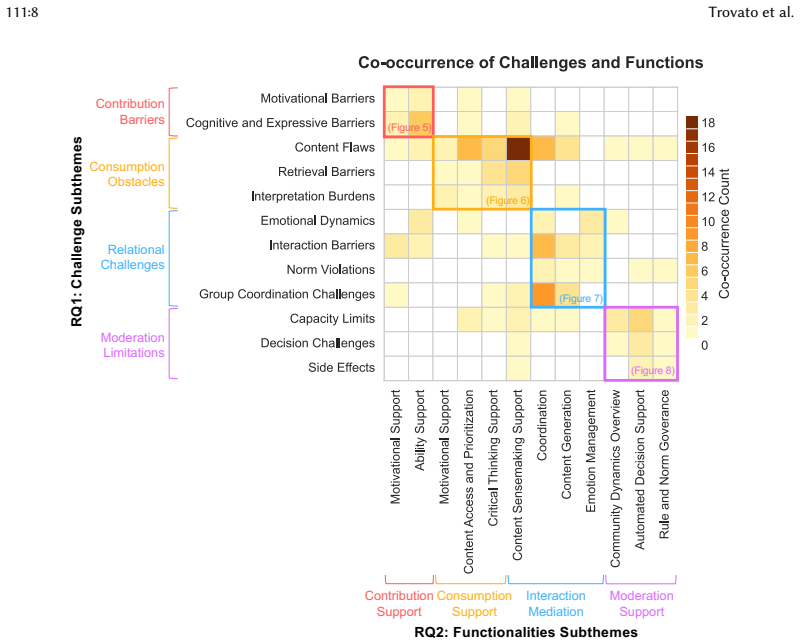
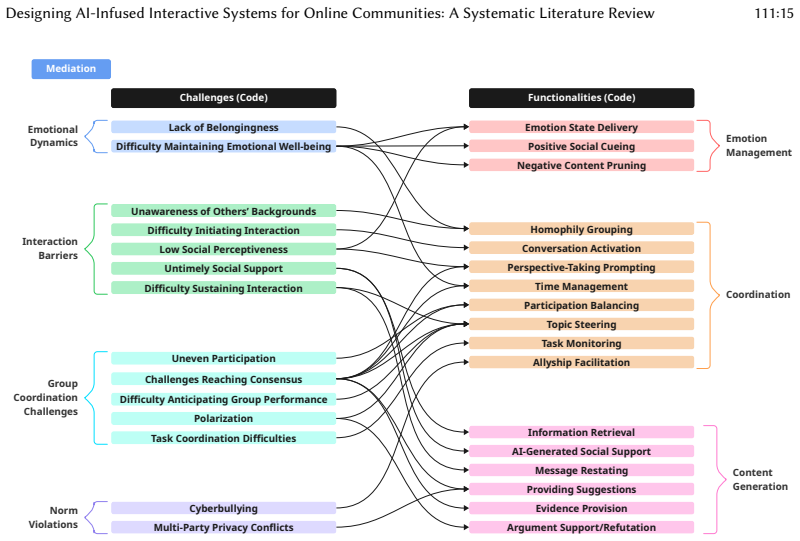
By systematically reviewing 77 studies, the authors organize their analysis of AI-infused systems according to the challenges addressed, the design functionalities provided, and the evaluation strategies used, all framed within the four core aspects of community participation—contribution, consumption, mediation, and moderation. This structure allows them to surface common design and evaluation patterns across the studies, distill key considerations that should inform future design decisions, and identify concrete opportunities for advancing research on these systems.
What carries the argument
Four aspects of community participation—contribution, consumption, mediation, and moderation—used as the primary organizing framework to categorize challenges, design functionalities, and evaluation strategies across the 77 studies.
If this is right
- Designers can apply the common patterns in functionalities to address similar challenges in contribution or moderation tasks.
- Researchers can adopt the reviewed evaluation strategies to produce more consistent assessments of system impact.
- Future systems can incorporate the distilled design considerations to better align AI features with community dynamics.
- Work on mediation and moderation aspects offers the clearest opportunities for expanding current capabilities.
Where Pith is reading between the lines
- The patterns identified could transfer to other digital social environments if the participation aspects remain similar.
- Testing the key design considerations through targeted deployments would provide direct evidence of their practical value.
- The review suggests that balanced coverage across all four participation aspects could produce more integrated AI support for communities.
Load-bearing premise
The 77 studies selected and their assignment to the four participation aspects accurately represent the full relevant literature without major omissions or misclassifications.
What would settle it
A search that surfaces many additional studies on AI-infused systems in online communities whose challenges, designs, or evaluations do not fit the identified patterns or the four participation aspects would undermine the completeness of the synthesis.
Figures





read the original abstract
AI-infused systems have demonstrated remarkable capabilities in addressing diverse human needs within online communities. Their widespread adoption has shaped user experiences and community dynamics at scale. However, designing such systems requires a clear understanding of user needs, careful design decisions, and robust evaluation. While research on AI-infused systems for online communities has flourished in recent years, a comprehensive synthesis of this space remains absent. In this work, we present a systematic review of 77 studies, analyzing the systems they propose through three lenses: the challenges they aim to address, their design functionalities, and the evaluation strategies employed. The first two dimensions are organized around four core aspects of community participation: contribution, consumption, mediation, and moderation. Our analysis identifies common design and evaluation patterns, distills key design considerations, and highlights opportunities for future research on AI-infused systems in online communities.
Editorial analysis
A structured set of objections, weighed in public.
Referee Report
Summary. The paper presents a systematic literature review of 77 studies on AI-infused interactive systems for online communities. It analyzes the systems via three lenses—challenges addressed, design functionalities, and evaluation strategies—organized around four core aspects of community participation: contribution, consumption, mediation, and moderation. The review extracts common design and evaluation patterns, distills key design considerations, and identifies opportunities for future research.
Significance. If the categorization and synthesis hold, the review could provide a useful organizing framework for an emerging HCI sub-area, helping researchers identify patterns across contribution/consumption/mediation/moderation and guiding practical design decisions. The structured analysis around participation aspects offers a reusable lens that future empirical work could test.
major comments (2)
- [Methods] Methods section: The review does not report inter-rater reliability (e.g., Cohen's kappa or percentage agreement) or provide a coding manual with explicit boundary definitions and overlap-resolution rules for assigning the 77 studies to the four participation aspects. This directly affects the stability of the extracted patterns and design considerations.
- [Results] Results / Analysis section: The claim that the 77 studies comprehensively represent the literature on AI-infused systems in online communities requires explicit justification of search strings, databases, date range, and inclusion/exclusion criteria; without these details the risk of omission or selection bias cannot be assessed.
minor comments (2)
- [Abstract] Abstract: The time period covered by the literature search and the exact number of papers screened versus included should be stated to give readers an immediate sense of scope.
- [Figures] Figures: Any summary tables or charts showing the distribution of studies across the four aspects would benefit from clearer axis labels and legends to improve readability.
Simulated Author's Rebuttal
We thank the referee for their thoughtful and constructive feedback on our systematic literature review. The comments highlight important aspects of transparency in methods and analysis that we will address to strengthen the manuscript. We respond to each major comment below.
read point-by-point responses
-
Referee: [Methods] Methods section: The review does not report inter-rater reliability (e.g., Cohen's kappa or percentage agreement) or provide a coding manual with explicit boundary definitions and overlap-resolution rules for assigning the 77 studies to the four participation aspects. This directly affects the stability of the extracted patterns and design considerations.
Authors: We agree that explicit reporting of the coding process would improve reproducibility and allow readers to better evaluate the stability of our categorizations. In the original work, two authors independently assigned studies to the four participation aspects (contribution, consumption, mediation, and moderation), with all disagreements resolved through iterative discussion and consensus among the full author team. We will revise the Methods section to describe this process in detail, report the percentage agreement achieved, provide explicit boundary definitions for each aspect, and include a supplementary coding manual with overlap-resolution rules. These changes will be incorporated in the revised manuscript. revision: yes
-
Referee: [Results] Results / Analysis section: The claim that the 77 studies comprehensively represent the literature on AI-infused systems in online communities requires explicit justification of search strings, databases, date range, and inclusion/exclusion criteria; without these details the risk of omission or selection bias cannot be assessed.
Authors: We appreciate this observation and acknowledge that greater detail on the search protocol is needed to substantiate the scope and assess potential biases. While the Methods section describes our systematic approach, we will expand it to explicitly list the search strings, the databases queried (including ACM Digital Library, IEEE Xplore, Springer, ScienceDirect, and Google Scholar), the date range (2010–2024), and the full set of inclusion/exclusion criteria. We will also add a brief discussion of limitations regarding literature coverage. These revisions will allow readers to evaluate the representativeness of the 77 studies. revision: yes
Circularity Check
No circularity in external literature synthesis
full rationale
This is a systematic literature review that selects and categorizes 77 external studies, then extracts patterns across challenges, design functionalities, and evaluation strategies. The four participation aspects (contribution, consumption, mediation, moderation) serve as an organizing framework applied to outside papers; no result is obtained by fitting parameters to the review's own data, redefining terms in terms of the output, or chaining self-citations whose content is unverified. The synthesis therefore remains independent of any internal construction and rests on the cited external works.
Axiom & Free-Parameter Ledger
axioms (1)
- domain assumption Standard systematic literature review methodology is sufficient to identify representative studies and extract design patterns
Lean theorems connected to this paper
-
IndisputableMonolith/Foundation/RealityFromDistinction.leanreality_from_one_distinction unclear?
unclearRelation between the paper passage and the cited Recognition theorem.
We present a systematic review of 77 studies, analyzing the systems they propose through three lenses: the challenges they aim to address, their design functionalities, and the evaluation strategies employed. The first two dimensions are organized around four core aspects of community participation: contribution, consumption, mediation, and moderation.
What do these tags mean?
- matches
- The paper's claim is directly supported by a theorem in the formal canon.
- supports
- The theorem supports part of the paper's argument, but the paper may add assumptions or extra steps.
- extends
- The paper goes beyond the formal theorem; the theorem is a base layer rather than the whole result.
- uses
- The paper appears to rely on the theorem as machinery.
- contradicts
- The paper's claim conflicts with a theorem or certificate in the canon.
- unclear
- Pith found a possible connection, but the passage is too broad, indirect, or ambiguous to say the theorem truly supports the claim.
Forward citations
Cited by 1 Pith paper
-
ConSearcher: Supporting Conversational Information Seeking in Online Communities with Member Personas
ConSearcher generates query-based member personas in an LLM conversational tool, yielding higher information-seeking outcomes and engagement than baselines in a 27-person study, with noted risks of over-personalization.
Reference graph
Works this paper leans on
-
[1]
Anand Ravi Aiyer, IV Ramakrishnan, and Vikas Ashok. 2023. Taming entangled accessibility forum threads for efficient screen reading. InProceedings of the 28th International Conference on Intelligent User Interfaces. 65–76
work page 2023
-
[2]
Ezgi Akar and Sona Mardikyan. 2018. User roles and contribution patterns in online communities: a managerial perspective.Sage Open8, 3 (2018), 2158244018794773
work page 2018
-
[3]
Saleema Amershi, Dan Weld, Mihaela Vorvoreanu, Adam Fourney, Besmira Nushi, Penny Collisson, Jina Suh, Shamsi Iqbal, Paul N Bennett, Kori Inkpen, et al. 2019. Guidelines for human-AI interaction. InProceedings of the 2019 chi conference on human factors in computing systems. 1–13. Proc. ACM Meas. Anal. Comput. Syst., Vol. 37, No. 4, Article 111. Publicati...
work page 2019
-
[4]
Arthur Armstrong and John Hagel. 2009. The real value of online communities. InKnowledge and communities. Routledge, 85–95
work page 2009
-
[5]
Johnson, Qian Pan, Casey Dugan, Michelle Brachman, and Carolina Spina
Zahra Ashktorab, Michael Desmond, James M. Johnson, Qian Pan, Casey Dugan, Michelle Brachman, and Carolina Spina. 2023. SME-in-the-loop: Interaction Preferences When Supervising Bots in Human-AI Communities. In Proceedings of the 2023 ACM Designing Interactive Systems Conference. ACM, Pittsburgh PA USA, 2281–2303
work page 2023
-
[6]
Shubham Atreja, Jane Im, Paul Resnick, and Libby Hemphill. 2024. AppealMod: Inducing Friction to Reduce Moderator Workload of Handling User Appeals.Proceedings of the ACM on Human-Computer Interaction8, CSCW1 (2024), 1–35
work page 2024
-
[7]
Sandeep Avula, Jaime Arguello, Robert Capra, Jordan Dodson, Yuhui Huang, and Filip Radlinski. 2019. Embedding search into a conversational platform to support collaborative search. InProceedings of the 2019 Conference on Human Information Interaction and Retrieval. 15–23
work page 2019
-
[8]
Sandeep Avula, Gordon Chadwick, Jaime Arguello, and Robert Capra. 2018. Searchbots: User engagement with chatbots during collaborative search. InProceedings of the 2018 conference on human information interaction & retrieval. 52–61
work page 2018
-
[9]
Sandeep Avula, Bogeum Choi, and Jaime Arguello. 2022. The effects of system initiative during conversational collaborative search.Proceedings of the ACM on Human-Computer Interaction6, CSCW1 (2022), 1–30
work page 2022
-
[10]
Aadesh Bagmar, Kevin Hogan, Dalia Shalaby, and James Purtilo. 2022. Analyzing the effectiveness of an extensible virtual moderator.Proceedings of the ACM on Human-Computer Interaction6, GROUP (2022), 1–16
work page 2022
-
[11]
Ivo Benke, Michael Thomas Knierim, and Alexander Maedche. 2020. Chatbot-based emotion management for distributed teams: A participatory design study.Proceedings of the ACM on Human-Computer Interaction4, CSCW2 (2020), 1–30
work page 2020
-
[12]
Reuben Binns. 2018. Fairness in machine learning: Lessons from political philosophy. InConference on fairness, accountability and transparency. PMLR, 149–159
work page 2018
-
[13]
Moira Burke, Robert Kraut, and Cameron Marlow. 2011. Social capital on Facebook: Differentiating uses and users. In Proceedings of the SIGCHI conference on human factors in computing systems. 571–580
work page 2011
-
[14]
Shuxian Cao, Dongliang Guo, Lina Cao, Shuo Li, Junlan Nie, Amit Kumar Singh, and Haibin Lv. 2023. VisDmk: visual analysis of massive emotional danmaku in online videos.The Visual Computer39, 12 (2023), 6553–6570
work page 2023
-
[15]
Eshwar Chandrasekharan, Chaitrali Gandhi, Matthew Wortley Mustelier, and Eric Gilbert. 2019. Crossmod: A cross-community learning-based system to assist reddit moderators.Proceedings of the ACM on human-computer interaction3, CSCW (2019), 1–30
work page 2019
-
[16]
Guanzheng Chen, Chenghan Xie, Qijie Lu, Yifei Huang, Linxuan Miao, and Zhenhui Peng. 2022. TopsBot: Facilitating Mental Health Peer Support with a Topic-based Writing Assistant in Instant Messaging Apps. InProceedings of the Tenth International Symposium of Chinese CHI. 256–261
work page 2022
-
[17]
Jianqing Chen, Hong Xu, and Andrew B Whinston. 2011. Moderated online communities and quality of user-generated content.Journal of management information systems28, 2 (2011), 237–268
work page 2011
-
[18]
Michelene TH Chi and Ruth Wylie. 2014. The ICAP framework: Linking cognitive engagement to active learning outcomes.Educational psychologist49, 4 (2014), 219–243
work page 2014
-
[19]
Chun-Wei Chiang, Zhuoran Lu, Zhuoyan Li, and Ming Yin. 2024. Enhancing AI-Assisted Group Decision Making through LLM-Powered Devil’s Advocate. InProceedings of the 29th International Conference on Intelligent User Interfaces. 103–119
work page 2024
-
[20]
Chao-Min Chiu, Hsin-Yi Huang, Hsiang-Lan Cheng, and Pei-Chen Sun. 2015. Understanding online community citizenship behaviors through social support and social identity.International journal of information management35, 4 (2015), 504–519
work page 2015
-
[21]
Frederick Choi, Tanvi Bajpai, Sowmya Pratipati, and Eshwar Chandrasekharan. 2023. ConvEx: A Visual Conversation Exploration System for Discord Moderators.Proceedings of the ACM on Human-Computer Interaction7, CSCW2 (2023), 1–30
work page 2023
-
[22]
Gabriele Cimolino and TC Nicholas Graham. 2022. Two heads are better than one: A dimension space for unifying human and artificial intelligence in shared control. InProceedings of the 2022 CHI Conference on Human Factors in Computing Systems. 1–21
work page 2022
-
[23]
Dan Cosley, Dan Frankowski, Loren Terveen, and John Riedl. 2007. SuggestBot: using intelligent task routing to help people find work in wikipedia. InProceedings of the 12th international conference on Intelligent user interfaces. 32–41
work page 2007
-
[24]
Rodrigo Fernandes Gomes da Silva, Chanchal K Roy, Mohammad Masudur Rahman, Kevin A Schneider, Klérisson Paixão, Carlos Eduardo de Carvalho Dantas, and Marcelo de Almeida Maia. 2020. CROKAGE: effective solution recommendation for programming tasks by leveraging crowd knowledge.Empirical Software Engineering25 (2020), 4707–4758
work page 2020
-
[25]
Sander de Jong, Joel Wester, Tim Schrills, Kristina S. Secher, Carla F. Griggio, and Niels van Berkel. 2024. Assessing Cognitive and Social Awareness among Group Members in AI-assisted Collaboration. InProceedings of the International Conference on Mobile and Ubiquitous Multimedia. 338–350. Proc. ACM Meas. Anal. Comput. Syst., Vol. 37, No. 4, Article 111....
work page 2024
-
[26]
Hyo Jin Do, Ha-Kyung Kong, Jaewook Lee, and Brian P Bailey. 2022. How should the agent communicate to the group? Communication strategies of a conversational agent in group chat discussions.Proceedings of the ACM on Human-Computer Interaction6, CSCW2 (2022), 1–23
work page 2022
-
[27]
Hyo Jin Do, Ha-Kyung Kong, Pooja Tetali, Karrie Karahalios, and Brian P Bailey. 2023. Inform, Explain, or Control: Techniques to Adjust End-User Performance Expectations for a Conversational Agent Facilitating Group Chat Discussions.Proceedings of the ACM on Human-Computer Interaction7, CSCW2 (2023), 1–26
work page 2023
-
[28]
Hyo Jin Do, Ha-Kyung Kong, Pooja Tetali, Jaewook Lee, and Brian P Bailey. 2023. To err is AI: imperfect interventions and repair in a conversational agent facilitating group chat discussions.Proceedings of the ACM on Human-Computer Interaction7, CSCW1 (2023), 1–23
work page 2023
-
[29]
Bryan Dosono and Bryan Semaan. 2019. Moderation practices as emotional labor in sustaining online communities: The case of AAPI identity work on Reddit. InProceedings of the 2019 CHI conference on human factors in computing systems. 1–13
work page 2019
-
[30]
Gregory Dyke, David Adamson, Iris Howley, and Carolyn Penstein Rosé. 2013. Enhancing scientific reasoning and discussion with conversational agents.IEEE Transactions on Learning Technologies6, 3 (2013), 240–247
work page 2013
-
[31]
Christo El Morr, Bushra Kundi, Fariah Mobeen, Sarah Taleghani, Yahya El-Lahib, and Rachel Gorman. 2024. AI and disability: A systematic scoping review.Health Informatics Journal30, 3 (2024), 14604582241285743
work page 2024
-
[32]
David Ellis, Rachel Oldridge, and Ana Vasconcelos. 2004. Community and virtual community.Annual review of information science and technology38, 1 (2004), 145–186
work page 2004
-
[33]
David Engel, Anita Williams Woolley, Ishani Aggarwal, Christopher F Chabris, Masamichi Takahashi, Keiichi Nemoto, Carolin Kaiser, Young Ji Kim, and Thomas W Malone. 2015. Collective intelligence in computer-mediated collaboration emerges in different contexts and cultures. InProceedings of the 33rd annual ACM conference on human factors in computing syste...
work page 2015
-
[34]
Siwei Fu, Jian Zhao, Hao Fei Cheng, Haiyi Zhu, and Jennifer Marlow. 2018. T-cal: Understanding team conversational data with calendar-based visualization. InProceedings of the 2018 CHI conference on human factors in computing systems. 1–13
work page 2018
-
[35]
Mingkun Gao, Hyo Jin Do, and Wai-Tat Fu. 2018. Burst your bubble! an intelligent system for improving awareness of diverse social opinions. InProceedings of the 23rd International Conference on Intelligent User Interfaces. 371–383
work page 2018
-
[36]
Zhipeng Gao, Xin Xia, David Lo, John Grundy, Xindong Zhang, and Zhenchang Xing. 2023. I know what you are searching for: Code snippet recommendation from stack overflow posts.ACM Transactions on Software Engineering and Methodology32, 3 (2023), 1–42
work page 2023
-
[37]
Anna S Geraedts, Annet M Kleiboer, Jos Twisk, Noortje M Wiezer, Willem van Mechelen, and Pim Cuijpers. 2014. Long-term results of a web-based guided self-help intervention for employees with depressive symptoms: randomized controlled trial.Journal of medical Internet research16, 7 (2014), e168
work page 2014
-
[38]
2019.Inclusive design for a digital world: Designing with accessibility in mind
Regine M Gilbert. 2019.Inclusive design for a digital world: Designing with accessibility in mind. Apress
work page 2019
-
[39]
Tarleton Gillespie. 2018.Custodians of the Internet: Platforms, content moderation, and the hidden decisions that shape social media. Yale University Press
work page 2018
-
[40]
Henner Gimpel, Stefanie Lahmer, Moritz Wöhl, and Valerie Graf-Drasch. 2024. Digital facilitation of group work to gain predictable performance.Group Decision and Negotiation33, 1 (2024), 113–145
work page 2024
-
[41]
Peiyuan Gong, Jiamian Li, and Jiaxin Mao. 2024. Cosearchagent: a lightweight collaborative search agent with large language models. InProceedings of the 47th International ACM SIGIR Conference on Research and Development in Information Retrieval. 2729–2733
work page 2024
-
[42]
Jarod Govers, Eduardo Velloso, Vassilis Kostakos, and Jorge Goncalves. 2024. AI-Driven Mediation Strategies for Audience Depolarisation in Online Debates. InProceedings of the CHI Conference on Human Factors in Computing Systems. 1–18
work page 2024
-
[43]
Shirley Gregor and Alan R Hevner. 2013. Positioning and presenting design science research for maximum impact. MIS quarterly(2013), 337–355
work page 2013
-
[44]
Rafik Hadfi, Jawad Haqbeen, Sofia Sahab, and Takayuki Ito. 2021. Argumentative conversational agents for online discussions.Journal of Systems Science and Systems Engineering30 (2021), 450–464
work page 2021
-
[45]
Qiushi Han, Haitong Chen, Haoxiang Fan, and Zhenhui Peng. 2023. ReDBot: Exploring Conversational Recommenda- tion for Decision-Making Support in Group Chats. InProceedings of the Eleventh International Symposium of Chinese CHI. 73–80
work page 2023
-
[46]
Sandra G Hart. 2006. NASA-task load index (NASA-TLX); 20 years later. InProceedings of the human factors and ergonomics society annual meeting, Vol. 50. Sage publications Sage CA: Los Angeles, CA, 904–908
work page 2006
-
[47]
Caroline Haythornthwaite. 2005. Social networks and Internet connectivity effects.Information, Community & Society 8, 2 (2005), 125–147
work page 2005
-
[48]
Wanrong He, Mitchell L Gordon, Lindsay Popowski, and Michael S Bernstein. 2023. Cura: Curation at Social Media Scale.Proceedings of the ACM on Human-Computer Interaction7, CSCW2 (2023), 1–33. Proc. ACM Meas. Anal. Comput. Syst., Vol. 37, No. 4, Article 111. Publication date: August 2018. 111:30 Trovato et al
work page 2023
-
[49]
Brent Hecht, Jaime Teevan, Meredith Morris, and Dan Liebling. 2012. Searchbuddies: Bringing search engines into the conversation. InProceedings of the International AAAI Conference on Web and Social Media, Vol. 6. 138–145
work page 2012
-
[50]
Ming Shan Hee, Karandeep Singh, Charlotte Ng Si Min, Kenny Tsu Wei Choo, and Roy Ka-Wei Lee. 2024. Brinjal: A Web-Plugin for Collaborative Hate Speech Detection. InCompanion Proceedings of the ACM Web Conference 2024. 1063–1066
work page 2024
-
[51]
Alan R Hevner, Salvatore T March, Jinsoo Park, and Sudha Ram. 2004. Design science in information systems research. MIS quarterly(2004), 75–105
work page 2004
-
[52]
Enamul Hoque and Giuseppe Carenini. 2015. Convisit: Interactive topic modeling for exploring asynchronous online conversations. InProceedings of the 20th International Conference on Intelligent User Interfaces. 169–180
work page 2015
-
[53]
Enamul Hoque, Shafiq Joty, Luis Marquez, and Giuseppe Carenini. 2017. CQAVis: Visual text analytics for community question answering. InProceedings of the 22nd International Conference on Intelligent User Interfaces. 161–172
work page 2017
-
[54]
Alicia Iriberri and Gondy Leroy. 2009. A life-cycle perspective on online community success.ACM Computing Surveys (CSUR)41, 2 (2009), 1–29
work page 2009
-
[55]
Takayuki Ito, Rafik Hadfi, and Shota Suzuki. 2022. An agent that facilitates crowd discussion: A crowd discussion support system based on an automated facilitation agent.Group Decision and Negotiation31, 3 (2022), 621–647
work page 2022
-
[56]
Farnaz Jahanbakhsh, Yannis Katsis, Dakuo Wang, Lucian Popa, and Michael Muller. 2023. Exploring the use of personalized AI for identifying misinformation on social media. InProceedings of the 2023 CHI Conference on Human Factors in Computing Systems. 1–27
work page 2023
-
[57]
Samireh Jalali and Claes Wohlin. 2012. Systematic literature studies: database searches vs. backward snowballing. In Proceedings of the ACM-IEEE international symposium on Empirical software engineering and measurement. 29–38
work page 2012
-
[58]
Shagun Jhaver, Iris Birman, Eric Gilbert, and Amy Bruckman. 2019. Human-machine collaboration for content regulation: The case of reddit automoderator.ACM Transactions on Computer-Human Interaction (TOCHI)26, 5 (2019), 1–35
work page 2019
-
[59]
Shagun Jhaver, Amy Bruckman, and Eric Gilbert. 2019. Does transparency in moderation really matter? User behavior after content removal explanations on reddit.Proceedings of the ACM on Human-Computer Interaction3, CSCW (2019), 1–27
work page 2019
-
[60]
Charles Kiene, Andrés Monroy-Hernández, and Benjamin Mako Hill. 2016. Surviving an" eternal september" how an online community managed a surge of newcomers. InProceedings of the 2016 CHI Conference on Human Factors in Computing Systems. 1152–1156
work page 2016
-
[61]
Hyunwoo Kim, Haesoo Kim, Kyung Je Jo, and Juho Kim. 2021. StarryThoughts: facilitating diverse opinion exploration on social issues.Proceedings of the ACM on Human-Computer Interaction5, CSCW1 (2021), 1–29
work page 2021
-
[62]
Soomin Kim, Jinsu Eun, Changhoon Oh, Bongwon Suh, and Joonhwan Lee. 2020. Bot in the bunch: Facilitating group chat discussion by improving efficiency and participation with a chatbot. InProceedings of the 2020 CHI Conference on Human Factors in Computing Systems. 1–13
work page 2020
-
[63]
Soomin Kim, Jinsu Eun, Joseph Seering, and Joonhwan Lee. 2021. Moderator chatbot for deliberative discussion: Effects of discussion structure and discussant facilitation.Proceedings of the ACM on Human-Computer Interaction5, CSCW1 (2021), 1–26
work page 2021
-
[64]
Barbara Kitchenham, Stuart Charters, et al. 2007. Guidelines for performing systematic literature reviews in software engineering
work page 2007
-
[65]
Aniket Kittur and Robert E Kraut. 2008. Harnessing the wisdom of crowds in wikipedia: quality through coordination. InProceedings of the 2008 ACM conference on Computer supported cooperative work. 37–46
work page 2008
-
[66]
Daria Korobenko, Anastasija Nikiforova, and Rajesh Sharma. 2024. Towards a privacy and security-aware framework for ethical AI: Guiding the development and assessment of AI systems. InProceedings of the 25th Annual International Conference on Digital Government Research. 740–753
work page 2024
-
[67]
2012.Building Successful Online Communities: Evidence-based Social Design
RE Kraut. 2012.Building Successful Online Communities: Evidence-based Social Design. MIT Press
work page 2012
-
[68]
Rohit Kumar and Carolyn P Rosé. 2014. Triggering effective social support for online groups.ACM Transactions on Interactive Intelligent Systems (TiiS)3, 4 (2014), 1–32
work page 2014
-
[69]
Bum Chul Kwon, Sung-Hee Kim, Sukwon Lee, Jaegul Choo, Jina Huh, and Ji Soo Yi. 2015. VisOHC: Designing visual analytics for online health communities.IEEE transactions on visualization and computer graphics22, 1 (2015), 71–80
work page 2015
-
[70]
Vivian Lai, Samuel Carton, Rajat Bhatnagar, Q Vera Liao, Yunfeng Zhang, and Chenhao Tan. 2022. Human-ai collaboration via conditional delegation: A case study of content moderation. InProceedings of the 2022 CHI Conference on Human Factors in Computing Systems. 1–18
work page 2022
-
[71]
Cliff Lampe and Paul Resnick. 2004. Slash (dot) and burn: distributed moderation in a large online conversation space. InProceedings of the SIGCHI conference on Human factors in computing systems. 543–550
work page 2004
-
[72]
Cliff Lampe, Rick Wash, Alcides Velasquez, and Elif Ozkaya. 2010. Motivations to participate in online communities. InProceedings of the SIGCHI conference on Human factors in computing systems. 1927–1936. Proc. ACM Meas. Anal. Comput. Syst., Vol. 37, No. 4, Article 111. Publication date: August 2018. Designing AI-Infused Interactive Systems for Online Com...
work page 2010
-
[73]
Rabindra Lamsal, Aaron Harwood, and Maria Rodriguez Read. 2022. Socially enhanced situation awareness from microblogs using artificial intelligence: A survey.Comput. Surveys55, 4 (2022), 1–38
work page 2022
-
[74]
Reeva Lederman, Greg Wadley, John Gleeson, Sarah Bendall, and Mario Álvarez-Jiménez. 2014. Moderated online social therapy: Designing and evaluating technology for mental health.ACM Transactions on Computer-Human Interaction (TOCHI)21, 1 (2014), 1–26
work page 2014
-
[75]
Fion SL Lee, Douglas Vogel, and Moez Limayem. 2003. Virtual community informatics: A review and research agenda. Journal of Information Technology Theory and Application (JITTA)5, 1 (2003), 5
work page 2003
-
[76]
Sung-Chul Lee, Jaeyoon Song, Eun-Young Ko, Seongho Park, Jihee Kim, and Juho Kim. 2020. Solutionchat: Real-time moderator support for chat-based structured discussion. InProceedings of the 2020 CHI conference on human factors in computing systems. 1–12
work page 2020
-
[77]
Uichin Lee, Jihyoung Kim, Eunhee Yi, Juyup Sung, and Mario Gerla. 2013. Analyzing crowd workers in mobile pay-for-answer q&a. InProceedings of the SIGCHI conference on human factors in computing systems. 533–542
work page 2013
-
[78]
James R Lewis. 2018. The system usability scale: past, present, and future.International Journal of Human–Computer Interaction34, 7 (2018), 577–590
work page 2018
-
[79]
Haotian Li, Yun Wang, and Huamin Qu. 2024. Where are we so far? understanding data storytelling tools from the perspective of human-ai collaboration. InProceedings of the CHI Conference on Human Factors in Computing Systems. 1–19
work page 2024
-
[80]
Chengzhong Liu, Zeyu Huang, Dingdong Liu, Shixu Zhou, Zhenhui Peng, and Xiaojuan Ma. 2022. PlanHelper: Supporting Activity Plan Construction with Answer Posts in Community-Based QA Platforms.Proceedings of the ACM on Human-Computer Interaction6, CSCW2 (2022), 1–26
work page 2022
discussion (0)
Sign in with ORCID, Apple, or X to comment. Anyone can read and Pith papers without signing in.