Lagrangian description and quantification of scalar mixing in fluid flows from particle tracks
Pith reviewed 2026-05-18 12:02 UTC · model grok-4.3
The pith
Combining diffusion maps on particle trajectories with deterministic particle methods yields a data-driven Lagrangian quantification of scalar mixing in fluid flows.
A machine-rendered reading of the paper's core claim, the machinery that carries it, and where it could break.
Core claim
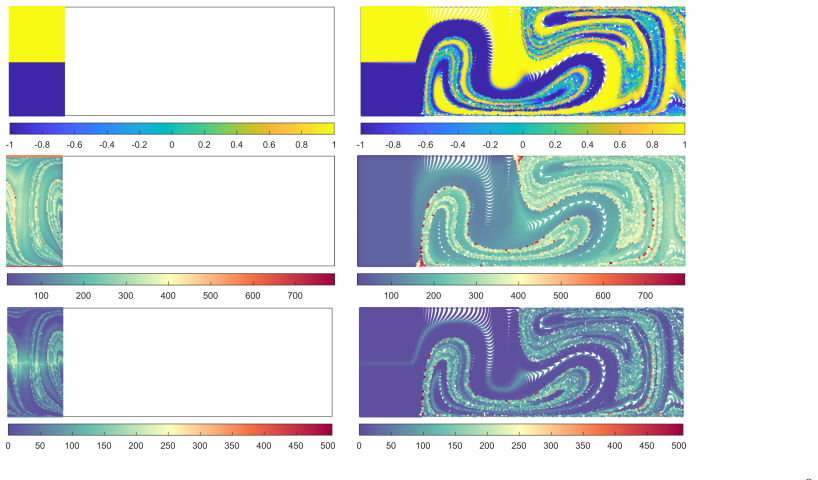
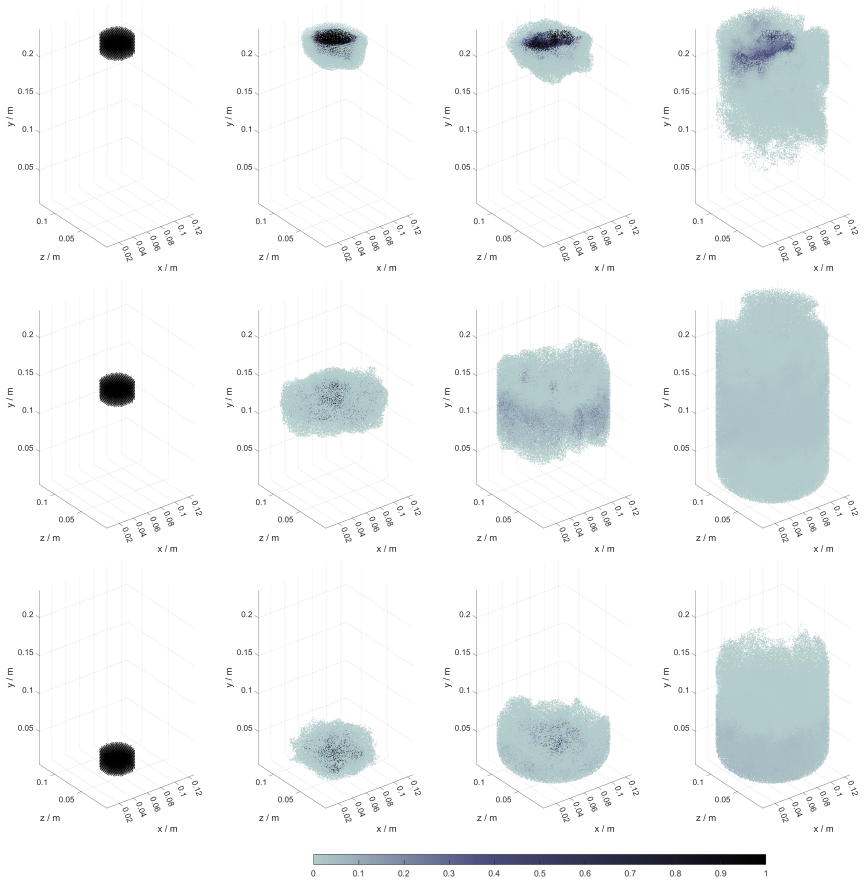
We develop a data-driven description and quantification of transport and mixing of scalar quantities by combining a diffusion map approach for the extraction of coherent flow structures with aspects of deterministic particle methods.
What carries the argument
Diffusion map extraction of coherent flow structures from tracer trajectories, integrated with deterministic particle methods to follow scalar transport and mixing.
If this is right
- Quantification of scalar mixing becomes possible from trajectory data alone.
- Organizing flow structures can be linked directly to measurable mixing outcomes.
- The framework supports control of transport processes by identifying which structures dominate mixing.
- Data-driven analysis extends to flows where full Eulerian fields are unavailable.
Where Pith is reading between the lines
- The approach could be tested on experimental particle image velocimetry data in laboratory turbulence to measure real-world mixing rates.
- Extensions might incorporate chemical reactions by evolving scalar fields along the same particle tracks.
- Similar trajectory-based methods could quantify mixing in environmental or biological flows where only sparse tracking data exists.
Load-bearing premise
The method assumes that coherent structures found by diffusion maps on particle tracks can be combined with deterministic particle methods to give accurate scalar mixing quantification, without specifying how the scalar field itself is initialized or checked against known rates.
What would settle it
Running the method on particle tracks from a simple flow with an exact analytic mixing solution, such as steady shear flow, and checking whether the computed mixing rate matches the known value would confirm or refute the claim.
Figures






read the original abstract
Understanding, quantifying and controlling transport and mixing processes are central in the study of fluid flows. Many different Lagrangian approaches have been proposed for detecting organizing flow structures that determine material transport, including recent data-based methods that aim to identify such coherent objects directly from tracer trajectories. These methods have helped to gain a better understanding of the underlying dynamics. However, the quantification of scalar mixing has not been the focus. Here, we develop a data-driven description and quantification of transport and mixing of scalar quantities by combining a diffusion map approach for the extraction of coherent flow structures with aspects of deterministic particle methods.
Editorial analysis
A structured set of objections, weighed in public.
Referee Report
Summary. The manuscript develops a data-driven Lagrangian framework for describing and quantifying scalar transport and mixing in fluid flows. It combines diffusion-map embeddings of particle trajectories to identify coherent structures with deterministic particle advection to compute mixing diagnostics directly from tracks.
Significance. If the quantitative mixing measure can be shown to recover established rates without additional closures, the method would supply a practical tool for analyzing mixing from sparse Lagrangian data in complex or experimental flows. The synthesis of diffusion maps with particle methods is a natural extension of existing coherent-structure techniques, but its value hinges on explicit validation against known scalar-variance decay laws.
major comments (3)
- [§3.2] §3.2 (Diffusion-map construction): No derivation is supplied showing that the diffusion-map embedding preserves the action of the advection-diffusion operator on an advected scalar field; without this step the claim that coherent structures directly yield a mixing diagnostic rests on an untested geometric equivalence.
- [§4.1] §4.1 (Scalar-field reconstruction): The procedure for assigning or reconstructing a scalar concentration field from the particle tracks is not specified; it is therefore impossible to verify that the subsequent deterministic-particle mixing diagnostic recovers the correct variance decay (e.g., exponential in the Batchelor regime or power-law in chaotic advection).
- [§5] §5 (Numerical examples): The reported mixing quantifications are not compared against analytical or high-fidelity Eulerian benchmarks for any canonical flow; this omission leaves the central claim of quantitative accuracy unsupported.
minor comments (2)
- Notation for the diffusion-map kernel and the deterministic-particle update rule should be unified across sections to avoid ambiguity.
- Figure captions should explicitly state the number of particles and the time interval used for each diffusion-map embedding.
Simulated Author's Rebuttal
We thank the referee for the thoughtful and detailed report. The comments identify important points for clarification and validation. Below we respond to each major comment and describe the revisions we will make to the manuscript.
read point-by-point responses
-
Referee: [§3.2] §3.2 (Diffusion-map construction): No derivation is supplied showing that the diffusion-map embedding preserves the action of the advection-diffusion operator on an advected scalar field; without this step the claim that coherent structures directly yield a mixing diagnostic rests on an untested geometric equivalence.
Authors: We appreciate the referee highlighting this theoretical aspect. The manuscript employs diffusion maps primarily to extract coherent structures from particle trajectories, which characterize the geometric organization of transport. The scalar mixing quantification is then obtained separately via deterministic particle advection applied to scalar values carried by the particles. We do not assert a direct preservation of the full advection-diffusion operator by the embedding alone; rather, the approach combines the structural information from diffusion maps with particle-based computation of mixing diagnostics. Nevertheless, we agree that a clearer exposition of the underlying rationale, including relevant properties of diffusion maps and their relation to transport operators, would improve the presentation. We will revise §3.2 to include a concise discussion of this connection and supporting references. revision: yes
-
Referee: [§4.1] §4.1 (Scalar-field reconstruction): The procedure for assigning or reconstructing a scalar concentration field from the particle tracks is not specified; it is therefore impossible to verify that the subsequent deterministic-particle mixing diagnostic recovers the correct variance decay (e.g., exponential in the Batchelor regime or power-law in chaotic advection).
Authors: This is a valid observation. The current text states that particles carry passive scalar values that are advected according to the deterministic particle method, but the precise steps for reconstructing a continuous scalar field from the discrete tracks (e.g., interpolation or kernel-based estimation) are not elaborated in §4.1. We will expand this section to specify the reconstruction procedure employed and to indicate how the resulting mixing diagnostic is formulated so that its behavior can be checked against known variance-decay regimes. revision: yes
-
Referee: [§5] §5 (Numerical examples): The reported mixing quantifications are not compared against analytical or high-fidelity Eulerian benchmarks for any canonical flow; this omission leaves the central claim of quantitative accuracy unsupported.
Authors: We concur that explicit benchmark comparisons are necessary to substantiate the quantitative claims. While §5 presents results for several flows, direct side-by-side validation against analytical solutions or high-resolution Eulerian computations of scalar variance decay is absent. In the revised manuscript we will incorporate such comparisons for at least one canonical case (for example, a steady or time-periodic flow with known mixing rates) to demonstrate that the Lagrangian diagnostics recover the expected decay laws. revision: yes
Circularity Check
No significant circularity: methodological fusion of established techniques
full rationale
The paper presents a data-driven approach to scalar mixing quantification by combining diffusion maps (for coherent structures from trajectories) with deterministic particle methods. The abstract and description frame this as an application of two pre-existing techniques to a new target without any equations that reduce a claimed prediction or quantification to a fitted parameter, self-definition, or self-citation chain. No load-bearing uniqueness theorem, ansatz smuggling, or renaming of known results is indicated. The derivation chain remains self-contained as a synthesis whose quantitative accuracy can be checked against external mixing benchmarks independent of the paper's own fitted values.
Axiom & Free-Parameter Ledger
axioms (1)
- domain assumption Diffusion maps applied to particle trajectories can extract coherent flow structures that determine material transport and mixing.
Lean theorems connected to this paper
-
IndisputableMonolith/Cost/FunctionalEquation.leanwashburn_uniqueness_aczel unclear?
unclearRelation between the paper passage and the cited Recognition theorem.
We extend the space-time diffusion map approach [22] for the identification of coherent sets in order to model the evolution of a scalar quantity under the action of advection and diffusion by means of given Lagrangian tracer trajectories. The resulting data-based model is similar in spirit to classical particle methods [32, 33, 34] ... wk+1_i = wk_i + τ 4D/ϵ² ∑ pij(tk)(wk_j − wk_i)
-
IndisputableMonolith/Foundation/RealityFromDistinction.leanreality_from_one_distinction unclear?
unclearRelation between the paper passage and the cited Recognition theorem.
The quantification of scalar mixing has not been the focus. Here, we develop a data-driven description and quantification of transport and mixing of scalar quantities by combining a diffusion map approach ...
What do these tags mean?
- matches
- The paper's claim is directly supported by a theorem in the formal canon.
- supports
- The theorem supports part of the paper's argument, but the paper may add assumptions or extra steps.
- extends
- The paper goes beyond the formal theorem; the theorem is a base layer rather than the whole result.
- uses
- The paper appears to rely on the theorem as machinery.
- contradicts
- The paper's claim conflicts with a theorem or certificate in the canon.
- unclear
- Pith found a possible connection, but the passage is too broad, indirect, or ambiguous to say the theorem truly supports the claim.
Forward citations
Cited by 1 Pith paper
-
Data-driven Reduction of Transfer Operators for Particle Clustering Dynamics
A data-driven framework reduces particle-based transfer operators via concentration projection, geometric manifold, and finite-state discretization to reproduce clustering transitions and metastable states from simula...
Reference graph
Works this paper leans on
-
[1]
Michael R. Allshouse and Thomas Peacock. Lagrangian based methods for coherent structure detection. Chaos, 25(9):097617, 2015
work page 2015
-
[2]
Lagrangian coherent structures
George Haller. Lagrangian coherent structures. Annual Review of Fluid Mechanics , 47:137–162, 2015
work page 2015
-
[3]
A critical comparison of Lagrangian methods for coherent structure detection
Alireza Hadjighasem, Mohammad Farazmand, Daniel Blazevski, Gary Froyland, and George Haller. A critical comparison of Lagrangian methods for coherent structure detection. Chaos, 27(5):053104, 2017
work page 2017
-
[4]
Mattner, and Sanjeeva Balasuriya
Aleksandar Badza, Trent W. Mattner, and Sanjeeva Balasuriya. How sensitive are Lagrangian coherent structures to uncertainties in data? Physica D: Nonlinear Phe- nomena, 444:133580, 2023
work page 2023
-
[5]
Sanjeeva Balasuriya, Nicholas T. Ouellette, and Irina I. Rypina. Generalized Lagrangian coherent structures. Physica D , 372:31–51, 2018
work page 2018
-
[6]
Florian Huhn, Alexandra von Kameke, Silvia Allen-Perkins, Pedro Montero, Anabela Venancio, and Vicente Pérez-Muñuzuri. Horizontal Lagrangian transport in a tidal- driven estuary Transport barriers attached to prominent coastal boundaries. Conti- nental Shelf Research , 39-40:1–13, 2012
work page 2012
-
[7]
Florian Huhn, Alexandra von Kameke, Vicente Pérez-Muñuzuri, Maria Josefina Olasco- aga, and Francisco Javier Beron-Vera. The impact of advective transport by the South Indian Ocean Countercurrent on the Madagascar plankton bloom. Geophysical Research Letters, 39(6), 2012
work page 2012
-
[8]
Douglas H. Kelley, Michael R. Allshouse, and Nicholas T. Ouellette. Lagrangian co- herent structures separate dynamically distinct regions in fluid flows. Phys. Rev. E , 88:013017, Jul 2013
work page 2013
-
[9]
How coherent structures dominate the residence time in a bubble wake: An experimental example
Alexandra von Kameke, Sven Kastens, Sophie Rüttinger, Sonja Herres-Pawlis, and Michael Schlüter. How coherent structures dominate the residence time in a bubble wake: An experimental example. Chemical Engineering Science , 207:317–326, 2019
work page 2019
-
[10]
Nikolas O. Aksamit, Alex P. Encinas-Bartos, George Haller, and David E. Rival. Rel- ative fluid stretching and rotation for sparse trajectory observations. Journal of Fluid Mechanics, 996:A40, 2024. 28
work page 2024
-
[11]
Gary Froyland and Kathrin Padberg-Gehle. A rough-and-ready cluster-based approach for extracting finite-time coherent sets from sparse and incomplete trajectory data. Chaos, 25(8):087406, 2015
work page 2015
-
[12]
Computational study of three- dimensional Lagrangian transport and mixing in a stirred tank reactor
Christian Weiland, Eike Steuwe, Jürgen Fitschen, Marko Hoffmann, Michael Schlüter, Kathrin Padberg-Gehle, and Alexandra von Kameke. Computational study of three- dimensional Lagrangian transport and mixing in a stirred tank reactor. Chemical En- gineering Journal Advances , 14:100448, 2023
work page 2023
-
[13]
Assessing Lagrangian coherence in atmospheric blocking
Henry Schoeller, Robin Chemnitz, Péter Koltai, Maximilian Engel, and Stephan Pfahl. Assessing Lagrangian coherence in atmospheric blocking. Nonlinear Processes in Geo- physics, 32(1):51–73, 2025
work page 2025
-
[14]
Jezabel Curbelo and Irina I. Rypina. A three dimensional Lagrangian analysis of the smoke plume from the 2019/2020 Australian wildfire event. Journal of Geophysical Research: Atmospheres, 128(21):e2023JD039773, 2023
work page 2019
-
[15]
Spectral- clustering approach to Lagrangian vortex detection
Alireza Hadjighasem, Daniel Karrasch, Hiroshi Teramoto, and George Haller. Spectral- clustering approach to Lagrangian vortex detection. Physical Review E , 93(6):063107, 2016
work page 2016
-
[16]
Network-based study of Lagrangian transport and mixing
Kathrin Padberg-Gehle and Christiane Schneide. Network-based study of Lagrangian transport and mixing. Nonlinear Processes in Geophysics , 24(4):661–671, 2017
work page 2017
-
[17]
Kristy L. Schlueter-Kuck and John O. Dabiri. Coherent structure colouring: identi- fication of coherent structures from sparse data using graph theory. J. Fluid Mech. , 811:468–486, 2017
work page 2017
-
[18]
Gary Froyland and Oliver Junge. Robust FEM-based extraction of finite-time coherent sets using scattered, sparse, and incomplete trajectories. SIAM Journal on Applied Dynamical Systems, 17(2):1891–1924, 2018
work page 1924
-
[19]
Rypina, Alireza Hadjighasem, and Thomas Peacock
Margaux Filippi, Irina I. Rypina, Alireza Hadjighasem, and Thomas Peacock. An optimized-parameter spectral clustering approach to coherent structure detection in geophysical flows. Fluids, 6(1), 2021
work page 2021
-
[20]
Vieweg, Jörg Schumacher, and Kathrin Padberg-Gehle
Christiane Schneide, Philipp P. Vieweg, Jörg Schumacher, and Kathrin Padberg-Gehle. Evolutionary clustering of Lagrangian trajectories in turbulent RayleighBénard convec- tion flows. Chaos, 32(1):013123, 2022
work page 2022
-
[21]
Vieweg, Anna Klünker, Jörg Schumacher, and Kathrin Padberg-Gehle
Philipp P. Vieweg, Anna Klünker, Jörg Schumacher, and Kathrin Padberg-Gehle. La- grangian studies of coherent sets and heat transport in constant heat flux-driven turbu- lent RayleighBénard convection. European Journal of Mechanics - B/Fluids , 103:69–85, 2024. 29
work page 2024
-
[22]
Ralf Banisch and Péter Koltai. Understanding the geometry of transport: diffusion maps for Lagrangian trajectory data unravel coherent sets. Chaos: An Interdisciplinary Journal of Nonlinear Science , 27(3):035804, 2017
work page 2017
-
[23]
Ronald R. Coifman and Stéphane Lafon. Diffusion maps. Applied and Computational Harmonic Analysis, 21(1):5–30, 2006
work page 2006
-
[24]
Boaz Nadler, Stéphane Lafon, Ronald R. Coifman, and Ioannis G. Kevrekidis. Diffusion maps, spectral clustering and reaction coordinates of dynamical systems. Applied and Computational Harmonic Analysis , 21(1):113–127, 2006
work page 2006
-
[25]
Stephane Lafon and Ann B. Lee. Diffusion maps and coarse-graining: A unified frame- work for dimensionality reduction, graph partitioning, and data set parameterization. IEEE Transactions on Pattern Analysis and Machine Intelligence , 28(9):1393–1403, 2006
work page 2006
-
[26]
Dynamic isoperimetry and the geometry of Lagrangian coherent struc- tures
Gary Froyland. Dynamic isoperimetry and the geometry of Lagrangian coherent struc- tures. Nonlinearity, 28(10):3587, 2015
work page 2015
-
[27]
Vieweg, Christiane Schneide, Kathrin Padberg-Gehle, and Jörg Schumacher
Philipp P. Vieweg, Christiane Schneide, Kathrin Padberg-Gehle, and Jörg Schumacher. Lagrangian heat transport in turbulent three-dimensional convection. Phys. Rev. Fluids, 6:L041501, Apr 2021
work page 2021
-
[28]
Shake-The-Box: La- grangian particle tracking at high particle image densities
Daniel Schanz, Sebastian Gesemann, and Andreas Schröder. Shake-The-Box: La- grangian particle tracking at high particle image densities. Exp Fluids , 57:70, 2016
work page 2016
-
[29]
3D Lagrangian particle tracking in fluid mechan- ics
Andreas Schröder and Daniel Schanz. 3D Lagrangian particle tracking in fluid mechan- ics. Annual Review of Fluid Mechanics , 55:511–540, 2023
work page 2023
-
[30]
Shiyong Tan, Ashwanth Salibindla, Ashik U. M. Masuk, and Rui Ni. Introducing OpenLPT: new method of removing ghost particles and high-concentration particle shadow tracking. Exp Fluids , 61:47, 2020
work page 2020
-
[31]
Open-flow mix- ing and transfer operators
Anna Klünker, Kathrin Padberg-Gehle, and Jean-Luc Thiffeault. Open-flow mix- ing and transfer operators. Philosophical Transactions of the Royal Society A , 380(2225):20210028, 2022
work page 2022
-
[32]
The weighted particle method for convection- diffusion equations
Pierre Degond and Sylvie Mas-Gallic. The weighted particle method for convection- diffusion equations. I. The case of an isotropic viscosity. Mathematics of Computation , 53(188):485–507, 1989
work page 1989
-
[33]
Eldredge, Anthony Leonard, and Tim Colonius
Jeff D. Eldredge, Anthony Leonard, and Tim Colonius. A general deterministic treat- ment of derivatives in particle methods. Journal of Computational Physics , 180(2):686– 709, 2002. 30
work page 2002
-
[34]
Chapter 7 - a practical guide to deterministic particle methods
Alina Chertock. Chapter 7 - a practical guide to deterministic particle methods. In Rémi Abgrall and Chi-Wang Shu, editors, Handbook of Numerical Methods for Hyperbolic Problems, volume 18 of Handbook of Numerical Analysis , pages 177–202. Elsevier, 2017
work page 2017
-
[35]
Ronald R. Coifman and Matthew J. Hirn. Diffusion maps for changing data. Applied and Computational Harmonic Analysis , 36(1):79–107, 2014
work page 2014
-
[36]
Laplacian eigenmaps for dimensionality reduction and data representation
Mikhail Belkin and Partha Niyogi. Laplacian eigenmaps for dimensionality reduction and data representation. Neural Computation, 15(6):1373–1396, 2003
work page 2003
-
[37]
A tutorial on spectral clustering
Ulrike von Luxburg. A tutorial on spectral clustering. Statistics and Computing , 17:396– 416, 2007
work page 2007
-
[38]
Rock, and Konstantinos Sakellariou
Gary Froyland, Christopher P. Rock, and Konstantinos Sakellariou. Sparse eigenbasis approximation: Multiple feature extraction across spatiotemporal scales with applica- tion to coherent set identification. Commun. Nonlinear Sci. Numer. Simul. , 77:81–107, 2019
work page 2019
-
[39]
A multiscale measure for mixing
George Mathew, Igor Mezić, and Linda Petzold. A multiscale measure for mixing. Physica D: Nonlinear Phenomena , 211(1-2):23–46, 2005
work page 2005
-
[40]
Using multiscale norms to quantify mixing and transport
Jean-Luc Thiffeault. Using multiscale norms to quantify mixing and transport. Non- linearity, 25(2):R1, 2012
work page 2012
-
[41]
Ralf Banisch, Péter Koltai, and Kathrin Padberg-Gehle. Network measures of mixing. Chaos, 29(6):063125, 2019
work page 2019
-
[42]
Geoffrey I Taylor. LXXV. On the decay of vortices in a viscous fluid. The London, Edinburgh, and Dublin Philosophical Magazine and Journal of Science , 46(274):671– 674, 1923
work page 1923
-
[43]
Jean-Luc Thiffeault. adcell: MATLAB code for solving the advection- diffusion equation for a two-dimensional incompressible autonomous cellular flow. https://github.com/jeanluct/adcell
-
[44]
Shadden, Francois Lekien, and Jerrold E
Shawn C. Shadden, Francois Lekien, and Jerrold E. Marsden. Definition and prop- erties of Lagrangian coherent structures from finite-time Lyapunov exponents in two- dimensional aperiodic flows. Physica D: Nonlinear Phenomena , 212(3-4):271–304, 2005
work page 2005
-
[45]
Sebastian Hofmann, Christian Weiland, Jürgen Fitschen, Alexandra von Kameke, Marko Hoffmann, and Michael Schlüter. Lagrangian sensors in a stirred tank reactor: Comparing trajectories from 4D-Particle Tracking Velocimetry and Lattice-Boltzmann simulations. Chemical Engineering Journal , 449:137549, 2022
work page 2022
-
[46]
Maike Kuschel, Jürgen Fitschen, Marko Hoffmann, Alexandra von Kameke, Michael Schlüter, and Thomas Thmas Wucherpfennig. Validation of novel Lattice Boltzmann large eddy simulations (LB LES) for equipment characterization in biopharma. Pro- cesses, 9(6):950, 2021. 31
work page 2021
-
[47]
Eike Steuwe. Investigation of transport barriers within a continuous stirred tank reactor using three-dimensional Lagrangian coherent structures. Master’s thesis, TU Hamburg, 2022
work page 2022
-
[48]
Novel evaluation method to determine the local mixing time distribution in stirred tank reactors
Jürgen Fitschen, Sebastian Hofmann, Johannes Wutz, Alexandra von Kameke, Marko Hoffmann, Thomas Wucherpfennig, and Michael Schlüter. Novel evaluation method to determine the local mixing time distribution in stirred tank reactors. Chemical Engineering Science: X , 10:100098, 2021. 32
work page 2021
discussion (0)
Sign in with ORCID, Apple, or X to comment. Anyone can read and Pith papers without signing in.