Modeling Spatial Heterogeneity in Exposure Buffers and Risk: A Hierarchical Bayesian Approach
Pith reviewed 2026-05-18 12:55 UTC · model grok-4.3
The pith
A hierarchical Bayesian model lets exposure buffer sizes and effects vary across space instead of fixing them arbitrarily.
A machine-rendered reading of the paper's core claim, the machinery that carries it, and where it could break.
Core claim
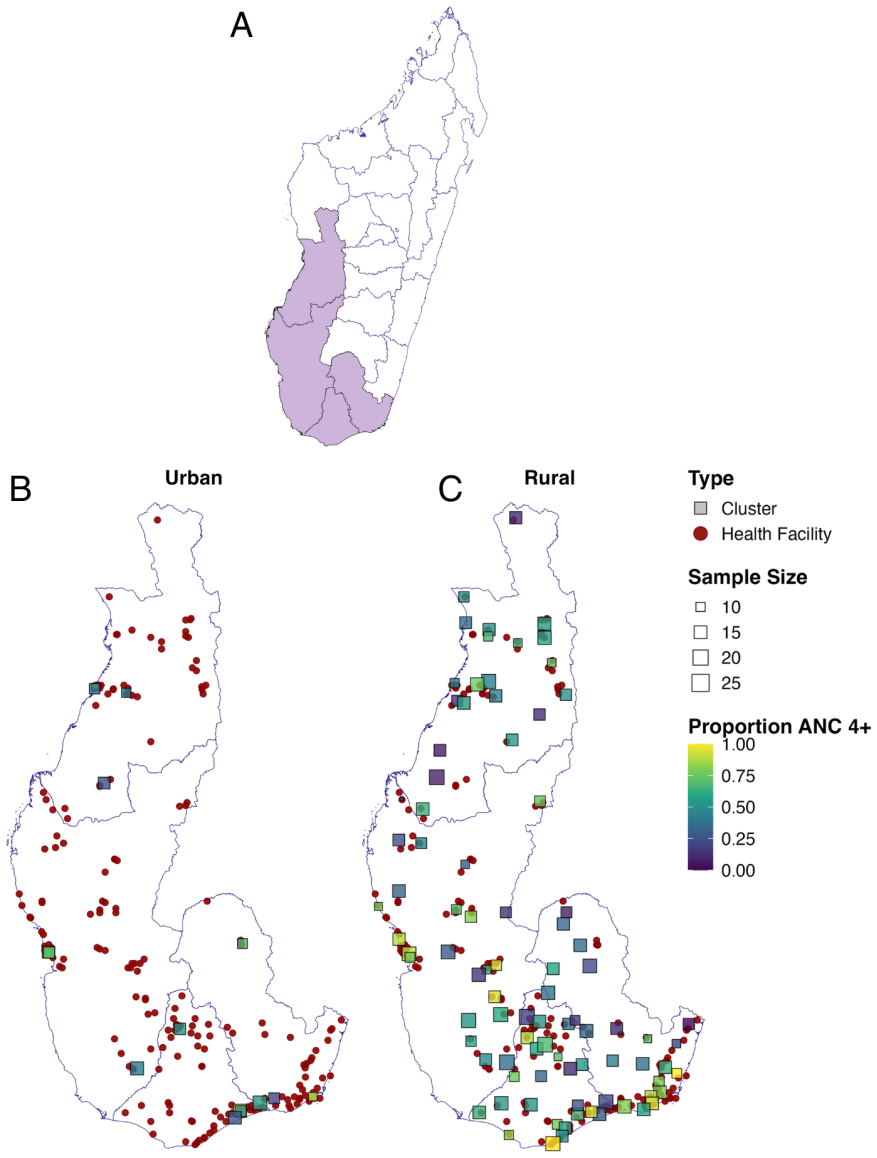
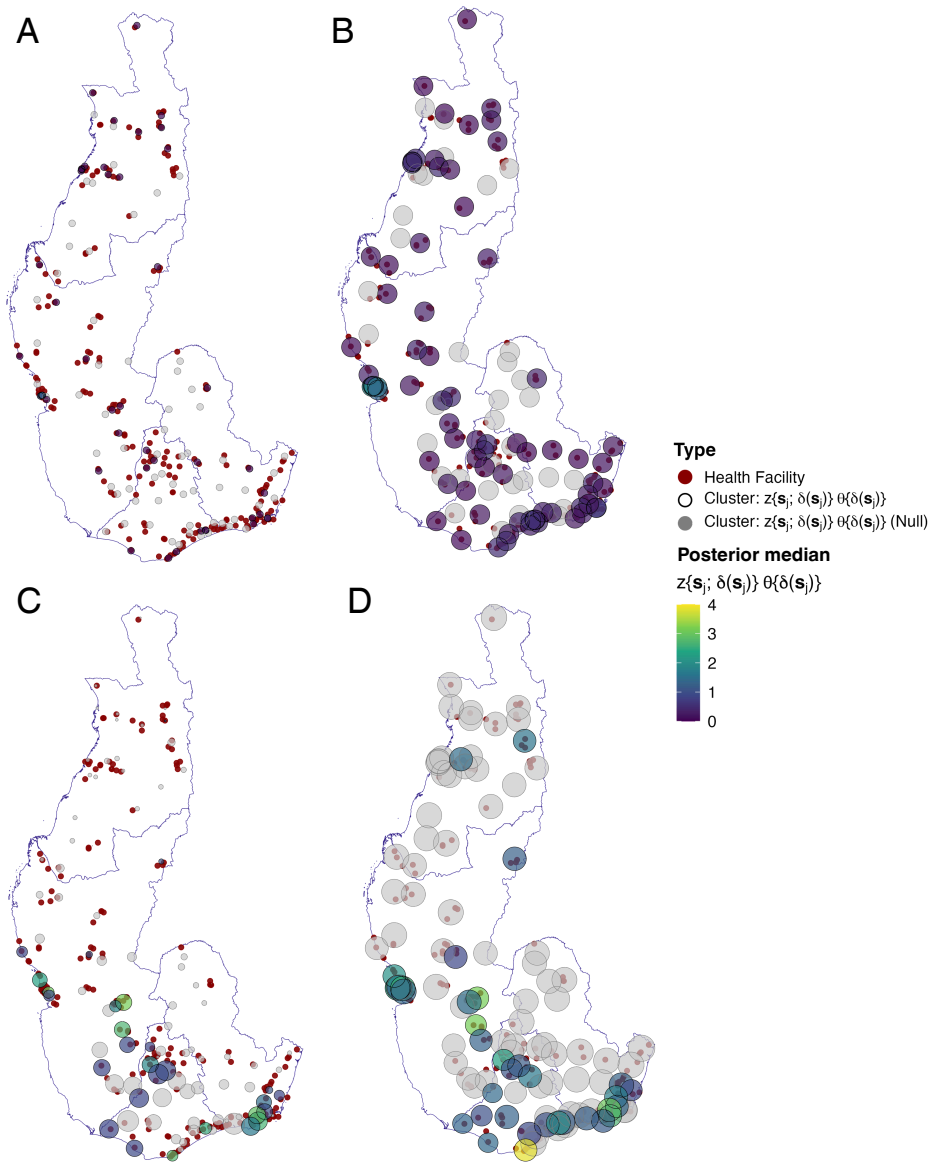
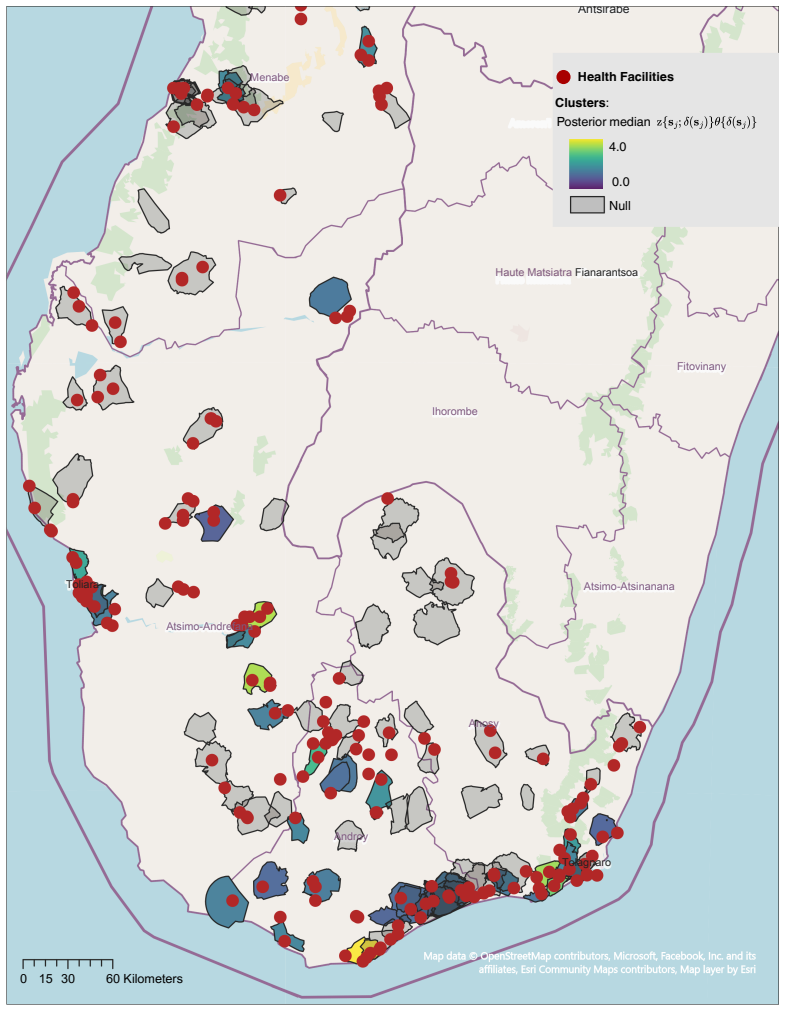
SVBR is a hierarchical Bayesian spatial change-point model that estimates buffer radii and exposure effects as spatially varying parameters rather than assuming they are constant. By treating the radius as an unknown quantity to be inferred, the model avoids arbitrary fixed-buffer choices and recovers more accurate parameter estimates and inferences than conventional methods in simulation studies. In the Madagascar healthcare application, the method shows a generally positive association between proximity to facilities and antenatal care uptake, together with clear spatial heterogeneity in both the effective buffer distance and the magnitude of the effect.
What carries the argument
SVBR (Spatially-Varying Buffer Radii): a hierarchical Bayesian spatial change-point model that treats buffer radii as unknown parameters allowed to vary spatially along with the exposure effects.
If this is right
- SVBR yields improved recovery of key parameters and narrower credible intervals compared with standard fixed-radius buffer models in controlled simulations.
- In the Madagascar data, proximity to healthcare facilities is associated with higher antenatal care use, but both the relevant distance and the strength of the association vary by region.
- The method supplies a data-driven alternative to arbitrary buffer-radius selection while remaining computationally feasible through the accompanying R package EpiBuffer.
- Relaxing the constant-radius assumption changes the quantitative conclusions about exposure in at least one real public-health setting.
Where Pith is reading between the lines
- The same modeling strategy could be used for other distance-based exposures such as air pollution or flood risk, where the distance that matters may also differ by location.
- If the spatial variation detected in Madagascar holds in other settings, health planners might need location-specific rather than uniform distance thresholds when siting new facilities.
- Extending the change-point structure to non-circular buffers or to multiple overlapping risk factors would be a direct next step that stays within the same Bayesian framework.
Load-bearing premise
The true spatial pattern of buffer radii and exposure effects can be recovered from the data by the hierarchical Bayesian change-point structure without large bias introduced by the choice of priors or the assumed form of spatial dependence.
What would settle it
Re-running the simulations with data generated from a single fixed buffer radius across the entire domain and checking whether SVBR still reports substantial spatial variation or loses its reported gains in estimation accuracy.
Figures
read the original abstract
Place-based epidemiology studies often rely on circular buffers to define ``exposure'' to spatially distributed risk factors, where the buffer radius represents a threshold beyond which exposure does not influence the outcome of interest. This approach is popular due to its simplicity and alignment with public health policies. However, buffer radii are often chosen relatively arbitrarily and assumed constant across the spatial domain. This may result in suboptimal statistical inference if these modeling choices are incorrect. To address this, we develop SVBR (Spatially-Varying Buffer Radii), a flexible hierarchical Bayesian spatial change points approach that treats buffer radii as unknown parameters and allows both radii and exposure effects to vary spatially. Through simulations, we find that SVBR improves estimation and inference for key model parameters compared to traditional methods. We also apply SVBR to study healthcare access in Madagascar, finding that proximity to healthcare facilities generally increases antenatal care usage, with clear spatial variation in this relationship. By relaxing rigid assumptions about buffer characteristics, our method offers a flexible, data-driven approach to accurately defining exposure and quantifying its impact. The newly developed methods are available in the R package EpiBuffer.
Editorial analysis
A structured set of objections, weighed in public.
Referee Report
Summary. The paper introduces SVBR, a hierarchical Bayesian spatial change-point model for place-based epidemiology that treats buffer radii as unknown spatially varying parameters alongside exposure effects. Simulations are reported to show improved estimation and inference relative to traditional fixed-radius approaches, and the method is applied to antenatal care data in Madagascar, where proximity to facilities is found to increase usage with notable spatial variation. The methods are implemented in the R package EpiBuffer.
Significance. If the hierarchical construction recovers true spatial heterogeneity in radii and effects without substantial bias induced by the spatial covariance or prior choices, the framework would offer a principled, data-driven alternative to arbitrary buffer definitions that are common in spatial epidemiology. The open R package supports reproducibility. The real-data application illustrates potential for detecting spatially varying relationships, but the overall impact hinges on demonstrating robustness beyond matched simulation settings.
major comments (2)
- [Simulation study] Simulation study (details referenced in abstract): The claim of improved estimation and inference is presented without reported bias, coverage, or RMSE values under misspecified spatial ranges or non-stationary true radii; if the data-generating process matches the fitted Gaussian process and hyperpriors, the reported gains may not generalize and could reflect in-sample performance rather than robustness.
- [Model specification] Model specification (hierarchical spatial change-point construction): Radii enter the likelihood as location-specific thresholds defining the exposure indicator; the spatial process and its hyperparameters therefore control borrowing of strength. No sensitivity analysis is described for alternative covariance functions (e.g., Matérn vs. exponential) or hyperprior scales on the change-point parameters, raising the possibility that posterior means for radii and effects are shrunk toward the mean even when true heterogeneity is shorter-range.
minor comments (2)
- [Abstract] The abstract states that 'proximity to healthcare facilities generally increases antenatal care usage' but does not report the posterior probability or credible interval for the average effect; adding this summary statistic would clarify the strength of the overall finding.
- [Methods] Notation for the spatial process on radii (e.g., whether a single GP or separate processes for radius and effect) should be defined explicitly in the methods section to avoid ambiguity when readers implement the model.
Simulated Author's Rebuttal
We thank the referee for their thoughtful and constructive comments, which have helped us improve the manuscript. We address the major comments point by point below and have made revisions to strengthen the simulation study and add sensitivity analyses as suggested.
read point-by-point responses
-
Referee: [Simulation study] Simulation study (details referenced in abstract): The claim of improved estimation and inference is presented without reported bias, coverage, or RMSE values under misspecified spatial ranges or non-stationary true radii; if the data-generating process matches the fitted Gaussian process and hyperpriors, the reported gains may not generalize and could reflect in-sample performance rather than robustness.
Authors: We appreciate the referee highlighting this limitation. Our primary simulations were designed to first establish that SVBR recovers parameters when the data-generating process aligns with the model assumptions, which is a standard initial step for validating new methods. To directly address concerns regarding generalization and robustness, we have expanded the simulation study in the revised manuscript. This now includes scenarios with misspecified spatial ranges and non-stationary true radii. We report bias, coverage probabilities, and RMSE values for these cases, which continue to show advantages for SVBR over fixed-radius approaches. revision: yes
-
Referee: [Model specification] Model specification (hierarchical spatial change-point construction): Radii enter the likelihood as location-specific thresholds defining the exposure indicator; the spatial process and its hyperparameters therefore control borrowing of strength. No sensitivity analysis is described for alternative covariance functions (e.g., Matérn vs. exponential) or hyperprior scales on the change-point parameters, raising the possibility that posterior means for radii and effects are shrunk toward the mean even when true heterogeneity is shorter-range.
Authors: We agree that sensitivity to covariance functions and hyperpriors is an important consideration given the role of the spatial process in borrowing strength. In the revised manuscript, we have added a dedicated sensitivity analysis in the supplementary materials. This examines the Matérn covariance with varying smoothness parameters as well as different hyperprior scales on the change-point parameters. The results indicate that posterior inferences for radii and exposure effects remain stable, with no evidence of excessive shrinkage toward the mean even under shorter-range heterogeneity. A brief discussion of these checks has been incorporated into the main text. revision: yes
Circularity Check
SVBR derivation is self-contained with independent validation
full rationale
The paper introduces SVBR as a new hierarchical Bayesian spatial change-point model that treats buffer radii as unknown parameters allowed to vary spatially along with exposure effects. Central claims rest on simulation studies demonstrating improved estimation relative to traditional fixed-buffer methods and on an external application to Madagascar antenatal care data showing spatial heterogeneity in the proximity effect. No equations, model components, or results are shown to reduce by construction to fitted inputs, self-definitions, or load-bearing self-citations; the framework is presented as data-driven and flexible with validation outside the model specification itself.
Axiom & Free-Parameter Ledger
free parameters (1)
- spatial hyperparameters for radii and effects
axioms (1)
- domain assumption Buffer radii and exposure effects exhibit spatial heterogeneity that can be modeled via change points in a hierarchical Bayesian framework.
Reference graph
Works this paper leans on
-
[1]
Technical report, Countdown to 2030, 2025
Countdown to 2030: Madagascar profile - DHS 2021. Technical report, Countdown to 2030, 2025. URLhttps://www.countdown2030.org/wp-content/uploads/2023/06/ Madagascar-DHS-2021.pdf
work page 2030
-
[2]
E. K. Armah-Ansah, E. Budu, E. A. Wilson, K. F. Oteng, N. O. Gyawu, B. O. Ahinkorah, and E. K. Ameyaw. What predicts health facility delivery among women? Analysis from the 2021 Madagascar demographic and health survey.BMC Pregnancy and Childbirth, 24(1):116, feb 2024. ISSN 1471-2393. doi: 10.1186/s12884-024-06252-1
-
[3]
G. Ashiagbor, R. Ofori-Asenso, E. K. Forkuo, and S. Agyei-Frimpong. Measures of geographic accessibility to health care in the Ashanti region of Ghana.Scientific African, 9, 9 2020. ISSN 24682276. doi: 10.1016/j.sciaf.2020.e00453
- [4]
-
[5]
[Online; accessed 9-2024]
work page 2024
-
[6]
A. H. Auchincloss, S. Y. Gebreab, C. Mair, and A. V. Diez Roux. A review of spatial methods in epidemiology, 2000-2010.Annual Review of Public Health, 33:107–122, 2012. ISSN 01637525. doi: 10.1146/annurev-publhealth-031811-124655
-
[7]
J. Baek, B. N. S´ anchez, V. J. Berrocal, and E. V. Sanchez-Vaznaugh. Distributed lag models: examining associations between the built environment and health.Epidemiology, 27(1):116, 2016
work page 2016
-
[8]
J. Baek, E. V. Sanchez-Vaznaugh, and B. N. S´ anchez. Hierarchical distributed-lag models: ex- ploring varying geographic scale and magnitude in associations between the built environment and health.American Journal of Epidemiology, 183(6):583–592, 2016
work page 2016
-
[9]
J. Baek, J. A. Hirsch, K. Moore, L. P. Tabb, T. Barrientos-Gutierrez, L. D. Lisabeth, A. V. Diez-Roux, and B. N. S´ ancheza. Statistical methods to study variation in associations between food store availability and body mass in the multi-ethnic study of atherosclerosis.Epidemiol- ogy, 28:403–411, 5 2017. ISSN 15315487. doi: 10.1097/EDE.0000000000000631
-
[10]
S. Banerjee and M. Fuentes. Bayesian modeling for large spatial datasets.Wiley In- terdisciplinary Reviews: Computational Statistics, 4:59–66, 1 2012. ISSN 19395108. doi: 10.1002/wics.187
-
[11]
S. Banerjee, B. P. Carlin, and A. E. Gelfand.Hierarchical modeling and analysis for spatial data. Chapman and Hall/CRC, 2003
work page 2003
-
[12]
S. Banerjee, A. E. Gelfand, A. O. Finley, and H. Sang. Gaussian predictive process models for large spatial data sets.Journal of the Royal Statistical Society Series B: Statistical Methodol- ogy, 70(4):825–848, sep 2008. ISSN 1369-7412. doi: 10.1111/j.1467-9868.2008.00663.x. 17
-
[13]
E. M. Berke, T. D. Koepsell, A. V. Moudon, R. E. Hoskins, and E. B. Larson. Association of the built environment with physical activity and obesity in older persons.American Journal of Public Health, 97, 2007. ISSN 00900036. doi: 10.2105/AJPH.2006.085837
-
[14]
F. Borlee, C. Joris Yzermans, B. Aalders, J. Rooijackers, E. Krop, C. B. Maassen, F. Schellevis, B. Brunekreef, D. Heederik, and L. A. Smit. Air pollution from livestock farms is associated with airway obstruction in neighboring residents.American Journal of Respiratory and Critical Care Medicine, 196(9):1152–1161, 2017. ISSN 15354970. doi: 10.1164/rccm.2...
-
[15]
N. C. Brouwers, A. C. Newton, K. Watts, and S. Bailey. Evaluation of buffer-radius modelling approaches used in forest conservation and planning.Forestry, 83(4):409–421, 2010. ISSN 14643626. doi: 10.1093/forestry/cpq023
-
[16]
J. Chakraborty and J. A. Maantay.Proximity Analysis for Exposure Assessment in Environ- mental Health Justice Research, chapter 5, pages 111–138. Springer Netherlands, Dordrecht,
-
[17]
doi: 10.1007/978-94-007-0329-2 5
ISBN 978-94-007-0328-5. doi: 10.1007/978-94-007-0329-2 5
-
[18]
C. J. Clark, N. P. Johnson, M. Soriano, J. L. Warren, K. M. Sorrentino, N. S. Kadan-Lottick, J. E. Saiers, X. Ma, and N. C. Deziel. Unconventional oil and gas development exposure and risk of childhood acute lymphoblastic leukemia: a case–control study in Pennsylvania, 2009–2017.Environmental Health Perspectives, 130, 8 2022. ISSN 15529924. doi: 10.1289/ EHP11092
work page 2009
-
[19]
S. Comess, H. H. Chang, and J. L. Warren. A Bayesian framework for incorporating exposure uncertainty into health analyses with application to air pollution and stillbirth.Biostatistics, 25, 2022. ISSN 14684357. doi: 10.1093/biostatistics/kxac034
-
[20]
T. N. Croft, C. K. Allen, and B. W. Zachary. Guide to DHS Statistics- DHS 8. Technical report, ICF, Rockville, Maryland, 2023. URLhttps://dhsprogram.com/pubs/pdf/DHSG1/ Guide_to_DHS_Statistics_DHS-8.pdf
work page 2023
-
[21]
K. Ebisu, K. Belanger, and M. L. Bell. Association between airborne PM2.5 chemical con- stituents and birth weight - implication of buffer exposure assignment.Environmental Research Letters, 9(8), 2014. ISSN 17489326. doi: 10.1088/1748-9326/9/8/084007
-
[22]
A. Gelman. Struggles with survey weighting and regression modeling.Statistical Science, 22 (2):153–164, 2007. ISSN 08834237. doi: 10.1214/088342306000000691
-
[23]
J. Geweke.Evaluating the Accuracy of Sampling-based Approaches to the Calculation of Pos- terior Moments, volume 196. Federal Reserve Bank of Minneapolis, Research Department Minneapolis, MN, USA, 1991
work page 1991
-
[24]
D. J. Gonzalez, A. R. Sherris, W. Yang, D. K. Stevenson, A. M. Padula, M. Baiocchi, M. Burke, M. R. Cullen, and G. M. Shaw. Oil and gas production and spontaneous preterm birth in the San Joaquin Valley, CA: a case-control study.Environmental Epidemiology, 4(4), 2020. ISSN 24747882. doi: 10.1097/EE9.0000000000000099
-
[25]
D. J. Gonzalez, C. K. Francis, G. M. Shaw, M. R. Cullen, M. Baiocchi, and M. Burke. Up- stream oil and gas production and ambient air pollution in California.Science of the Total Environment, 806:150298, 2022. ISSN 18791026. doi: 10.1016/j.scitotenv.2021.150298
-
[26]
M. J. Heaton, A. Datta, A. O. Finley, R. Furrer, J. Guinness, R. Guhaniyogi, F. Gerber, R. B. Gramacy, D. Hammerling, M. Katzfuss, F. Lindgren, D. W. Nychka, F. Sun, and A. Zammit- Mangion. A case study competition among methods for analyzing large spatial data.Journal of Agricultural, Biological and Environmental Statistics, 24(3):398–425, sep 2019. ISSN 1085-
work page 2019
-
[27]
doi: 10.1007/s13253-018-00348-w
-
[28]
F. Hierink, E. A. Okiro, A. Flahault, and N. Ray. The winding road to health: a systematic scoping review on the effect of geographical accessibility to health care on infectious diseases in low- and middle-income countries.PLOS ONE, 16(1):e0244921, jan 2021. ISSN 1932-6203. doi: 10.1371/journal.pone.0244921
-
[29]
R. Iarivony, V. R. Rabeza, M. Barr` ere, and S. Mariko. Madagascar demographic and health survey 2003-2004 key findings. Technical report, Institut National de la Statistique (INSTAT) [Madagascar], 3 2005. 18
work page 2003
-
[30]
Procedia CIRP72(March), 159–164 (2018) https://doi.org/10.1016/j
P. James, D. Berrigan, J. E. Hart, J. A. Hipp, C. M. Hoehner, J. Kerr, J. M. Major, M. Oka, and F. Laden. Effects of buffer size and shape on associations between the built environment and energy balance.Health & Place, 27:162–170, 5 2014. ISSN 13538292. doi: 10.1016/j. healthplace.2014.02.003
work page doi:10.1016/j 2014
-
[31]
B. Krzyzanowski, A. F. Mullan, E. R. Dorsey, S. S. Chirag, P. Turcano, E. Camerucci, J. H. Bower, and R. Savica. Proximity to golf courses and risk of parkinson disease.JAMA Network Open, 8:e259198, 5 2025. ISSN 25743805. doi: 10.1001/jamanetworkopen.2025.9198
-
[32]
M. P. Kwan. The uncertain geographic context problem.Annals of the Association of American Geographers, 102, 2012. ISSN 00045608. doi: 10.1080/00045608.2012.687349
-
[33]
M. P. Kwan. How GIS can help address the uncertain geographic context problem in social science research.Annals of GIS, 18, 2012. ISSN 19475691. doi: 10.1080/19475683.2012.727867
- [34]
-
[35]
J. Maina, P. O. Ouma, P. M. Macharia, V. A. Alegana, B. Mitto, I. S. Fall, A. M. Noor, R. W. Snow, and E. A. Okiro. A spatial database of health facilities managed by the public health sector in sub Saharan Africa.Scientific Data, 6, 2019. ISSN 20524463. doi: 10.1038/ s41597-019-0142-2
work page 2019
-
[36]
M. W. Merid, D. Chilot, Z. A. Yigzaw, A. W. Melesse, M. G. Ferede, F. M. Aragaw, and D. A. Bitew. Women in low- and middle-income countries receive antenatal care at health institutions, yet not delivered there: a multilevel analysis of 2016–2021 DHS data.Tropical Medicine and Health, 52, 2024. ISSN 13494147. doi: 10.1186/s41182-023-00561-5
-
[37]
M. N. Mina, M. Nuruzzaman, M. N. Habib, M. Rahman, F. M. Chowdhury, S. N. Ahsan, F. F. Ahmed, S. Azizi, N. Mubin, A. H. M. G. Kibria, and F. A. Shuchi. The effectiveness of adequate antenatal care in reducing adverse perinatal outcomes: evidence from a low- or middle-income country.Cureus, 2023. doi: 10.7759/cureus.51254
-
[38]
L. N. Oliver, N. Schuurman, and A. W. Hall. Comparing circular and network buffers to examine the influence of land use on walking for leisure and errands.International Journal of Health Geographics, 6, 2007. ISSN 1476072X. doi: 10.1186/1476-072X-6-41
-
[39]
F. Ozga, J. P. Onnela, and V. DeGruttola. Bayesian method for inferring the impact of geographical distance on intensity of communication.Scientific Reports, 10, 12 2020. ISSN 20452322. doi: 10.1038/s41598-020-68583-1
-
[40]
M. Patel, A. Y. Oh, L. A. Dwyer, H. D’Angelo, D. G. Stinchcomb, B. Liu, M. Yu, and L. C. Nebeling. Effects of buffer size and shape on the association of neighborhood SES and adult fruit and vegetable consumption.Frontiers in Public Health, 9, 2021. ISSN 22962565. doi: 10.3389/fpubh.2021.706151
-
[41]
N. G. Polson, J. G. Scott, and J. Windle. Bayesian inference for logistic models using P´ olya– Gamma latent variables.Journal of the American Statistical Association, 108(504):1339–1349, 2013
work page 2013
-
[42]
B. J. Reich, S. Yang, Y. Guan, A. B. Giffin, M. J. Miller, and A. Rappold. A review of spatial causal inference methods for environmental and epidemiological applications.International Statistical Review, 89(3):605–634, 2021. ISSN 17515823. doi: 10.1111/insr.12452
-
[43]
L. Shah, H. W. Choi, L. Berrang-Ford, G. Henostroza, F. Krapp, C. Zamudio, S. J. Heymann, J. S. Kaufman, A. Ciampi, C. Seas, E. Gotuzzo, and T. F. Brewer. Geographic predictors of primary multidrug-resistant tuberculosis cases in an endemic area of Lima, Peru.International Journal of Tuberculosis and Lung Disease, 18:1307–1314, 11 2014. ISSN 18157920. doi...
work page 2014
-
[44]
Y. Si, N. S. Pillai, and A. Gelman. Bayesian nonparametric weighted sampling inference. Bayesian Analysis, 10(3):605–625, 2015. ISSN 19316690. doi: 10.1214/14-BA924. 19
-
[45]
Y. Si, R. Trangucci, J. S. Gabry, and A. Gelman. Bayesian hierarchical weighting adjustment and survey inference.Statistics Canada, 46:181–214, 2020. ISSN 1492-0921
work page 2020
-
[46]
M. Sim˜ oes, N. Janssen, D. J. Heederik, L. A. Smit, R. Vermeulen, and A. Huss. Residential proximity to livestock animals and mortality from respiratory diseases in The Netherlands: a prospective census-based cohort study.Environment International, 161(February), 2022. ISSN 18736750. doi: 10.1016/j.envint.2022.107140
-
[47]
L. A. Smit, M. Hooiveld, F. Van Der Sman-de Beer, A. W. Opstal-van Winden, J. Beekhuizen, I. M. Wouters, C. J. Yzermans, and D. Heederik. Air pollution from livestock farms, and asthma, allergic rhinitis and COPD among neighbouring residents.Occupational and Envi- ronmental Medicine, 71(2):134–140, 2014. ISSN 13510711. doi: 10.1136/oemed-2013-101485
-
[48]
R. W. Snow, J. Maina, P. O. Ouma, P. M. Macharia, V. A. Alegana, B. Mitto, I.-S. Fall, A. M. Noor, and E. A. Okiro. Public health facilities in sub Saharan Africa. 7 2019. doi: 10.6084/m9.figshare.7725374.v1
-
[49]
M. Tanou and Y. Kamiya. Assessing the impact of geographical access to health facilities on maternal healthcare utilization: evidence from the Burkina Faso demographic and health survey 2010.BMC Public Health, 19, 2019. ISSN 14712458. doi: 10.1186/s12889-019-7150-1
-
[50]
M. Tanou, T. Kishida, and Y. Kamiya. The effects of geographical accessibility to health facilities on antenatal care and delivery services utilization in benin: a cross-sectional study. Reproductive Health, 18, 2021. ISSN 17424755. doi: 10.1186/s12978-021-01249-x
-
[51]
Madagascar: Standard demographic and health survey (DHS) data,
The DHS Program. Madagascar: Standard demographic and health survey (DHS) data,
-
[52]
URLhttps://dhsprogram.com/data/dataset/Madagascar_Standard-DHS_2021. cfm?flag=0
-
[53]
M. F. Towongo, E. Ngome, K. Navaneetham, and G. Letamo. Factors associated with women’s timing of first antenatal care visit during their last pregnancy: evidence from 2016 Uganda demographic health survey.BMC Pregnancy and Childbirth, 22, 2022. ISSN 14712393. doi: 10.1186/s12884-022-05167-z
-
[54]
J. L. Warren, T. J. Luben, A. P. Sanders, N. C. Brownstein, A. H. Herring, and R. E. Meyer. An evaluation of metrics for assessing maternal exposure to agricultural pesticides.Journal of Exposure Science and Environmental Epidemiology, 24:497–503, 2014. ISSN 1559064X. doi: 10.1038/jes.2013.75
-
[55]
J. L. Warren, L. Grandjean, D. A. Moore, A. Lithgow, J. Coronel, P. Sheen, J. L. Zelner, J. R. Andrews, and T. Cohen. Investigating spillover of multidrug-resistant tuberculosis from a prison: a spatial and molecular epidemiological analysis.BMC Medicine, 16, 8 2018. ISSN 17417015. doi: 10.1186/s12916-018-1111-x
- [56]
-
[57]
G. E. Wilt, C. Roscoe, C. R. Hu, H. S. Iyer, U. V. Mehta, B. A. Coull, J. E. Hart, S. Gort- maker, F. Laden, and P. James. Examining exposure differences between residential and smartphone mobility-based greenness in a cohort of the nurses’ health study.Environmental Health Perspectives, 131, 2023. ISSN 15529924. doi: 10.1289/EHP13133
-
[58]
World Health Organization. WHO recommendations on antenatal care for a positive pregnancy experience. Technical report, 11 2016. 20 A Supplement: Simulation study results Table 5: Parameter values used to generate datasets in the simulation study. SVBR(p“0) and SVBR(p“1) posterior distributions are obtained from fitting the models on the Madagascar (Tolia...
work page 2016
discussion (0)
Sign in with ORCID, Apple, or X to comment. Anyone can read and Pith papers without signing in.