Rare-event detection in a backward-facing-step flow using live optical-flow velocimetry: observation of an upstream jet burst
Pith reviewed 2026-05-22 12:44 UTC · model grok-4.3
The pith
Live optical flow velocimetry enables the first direct detection of an upstream jet burst in backward-facing step flow.
A machine-rendered reading of the paper's core claim, the machinery that carries it, and where it could break.
Core claim
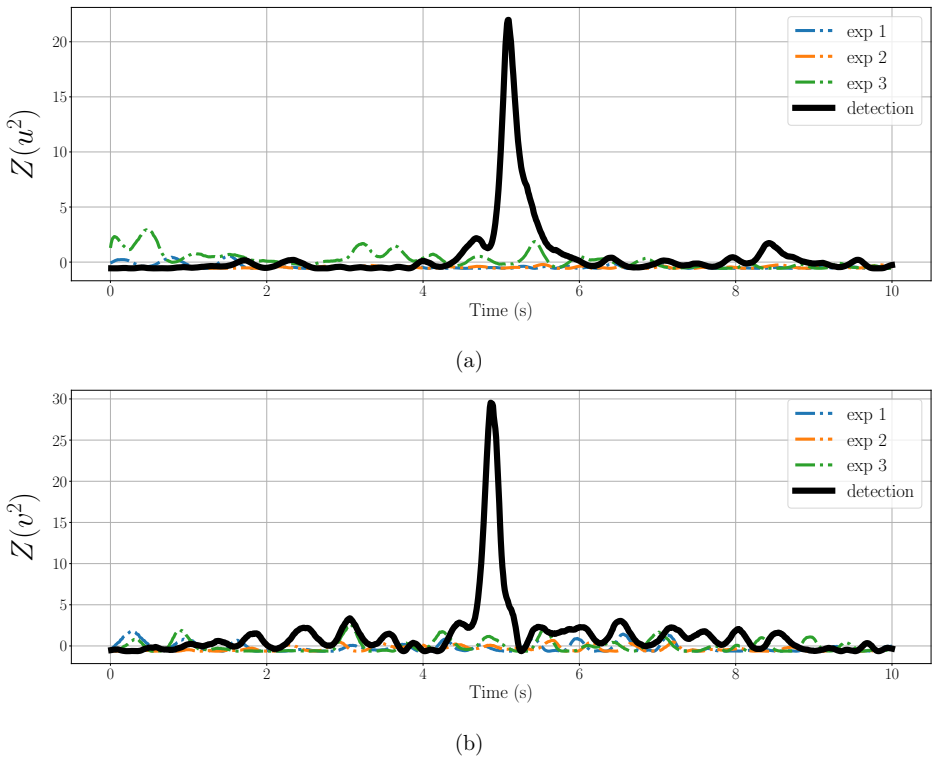
The paper reports the experimental observation of an upstream-directed jet burst in a backward-facing step flow at Reynolds number based on step height of 2100. This event was captured using long-duration live optical flow velocimetry, where velocity probes at a fixed location triggered recording upon exceeding large negative deviation thresholds. The burst appears as a jet intrusion into the recirculation region, initiated by the collapse of a merged Kelvin-Helmholtz vortex and sustained by counter-rotating vortices, and it coincides with heavy-tailed velocity statistics and amplified fluctuating kinetic energy and enstrophy.
What carries the argument
Live Optical Flow Velocimetry (L-OFV) for continuous real-time velocity field analysis that triggers high-speed or high-resolution capture on data-driven extreme events defined by Z-scores of velocity components.
If this is right
- The approach establishes a platform for detecting rare events in separated shear layers.
- The observed jet burst is linked to specific vortex dynamics including Kelvin-Helmholtz vortex collapse.
- Heavy-tailed statistics appear in the velocity probe data during the event.
- Amplification of fluctuating kinetic energy and enstrophy accompanies the jet burst.
Where Pith is reading between the lines
- Extending the monitoring duration or using multiple probe locations could increase the chance of capturing additional events of this type.
- Similar live triggering techniques might apply to other turbulent flow setups where rare events influence overall behavior.
- If the mechanism is general, it could inform models of transition and mixing in separated flows.
Load-bearing premise
The chosen probe position and the specific thresholds for negative velocity deviations correctly flag the upstream jet bursts rather than other phenomena or missing them entirely.
What would settle it
Repeating the experiment with the same setup but failing to detect any jet bursts despite long monitoring times, or finding that the velocity signatures at other locations show different extreme behaviors, would indicate the reported event is not representative or the trigger is insufficient.
Figures




read the original abstract
Rare and extreme events in turbulent flows play a critical role in transport, mixing and transition, yet are notoriously difficult to capture experimentally. Here we report, to our knowledge, the first direct experimental detection of an upstream-directed jet burst in a backward-facing step (BFS) flow at $Re_h=2100$, using long-duration Live Optical Flow Velocimetry (L-OFV). Continuous monitoring over 1.5 h enabled a data-driven definition of extremes as rare velocity probes excursions deep into the observed distribution's tails; in practice, large negative events ($u: Z < -6$, $v: Z < -5$ at $(x,y) = (2h,h / 2)$, where $|Z| > > 0$ stands for large deviations from the mean value) triggered the live capture of surrounding velocity fields. The recording is triggered when the probes surpass the defined threshold, using live analysis of the velocity fields. The detected event features a jet-like intrusion into the recirculation region initiated by the collapse of a merged Kelvin-Helmholtz vortex and sustained by counter-rotating vortices, and is accompanied with heavy-tailed probe statistics and simultaneous amplification of fluctuating kinetic energy and enstrophy. While a single event was recorded, underscoring its rarity, the results establish L-OFV as a viable platform for rare-event detection in separated shear layers and document a previously unreported mechanism of upstream jet bursting in BFS flow.
Editorial analysis
A structured set of objections, weighed in public.
Referee Report
Summary. The manuscript reports the first direct experimental detection of an upstream-directed jet burst in a backward-facing step flow at Re_h=2100 using long-duration Live Optical Flow Velocimetry (L-OFV). Continuous 1.5-hour monitoring with live analysis enabled data-driven thresholds on velocity probes (u: Z < -6, v: Z < -5 at (x,y)=(2h, h/2)) to trigger capture of surrounding fields. The single recorded event is interpreted as a jet-like intrusion into the recirculation region initiated by collapse of a merged Kelvin-Helmholtz vortex and sustained by counter-rotating vortices, accompanied by heavy-tailed probe statistics and simultaneous amplification of fluctuating kinetic energy and enstrophy. The work positions L-OFV as a viable platform for rare-event detection in separated shear layers.
Significance. If the L-OFV measurements prove accurate for extreme velocities and the mechanism can be placed on firmer statistical footing, the result would be significant for documenting a previously unreported upstream jet-burst process in BFS flows and for establishing live optical-flow triggering as a practical tool for capturing rare events in turbulent separated shear layers. The long-duration monitoring approach directly addresses the experimental challenge of observing low-probability phenomena.
major comments (3)
- [§4] §4 (Results, event description): The central claim of a previously unreported jet-burst mechanism rests on qualitative interpretation of velocity fields from a single captured sequence; no quantitative vortex identification (e.g., swirling strength or circulation integrals) or comparison to prior BFS literature is provided to substantiate the merged KH-vortex collapse and counter-rotating vortex sustenance.
- [§3] §3 (L-OFV implementation and validation): No cross-validation or error quantification of the optical-flow algorithm is reported against DNS or conventional PIV for |Z| > 5 excursions inside the recirculation zone, which is load-bearing because the headline observation depends on faithful capture of these extreme velocities rather than optical-flow bias or seeding artifacts.
- [§3.2] §3.2 (Probe location and thresholds): The choice of probe position (2h, h/2) and data-driven thresholds (u: Z < -6, v: Z < -5) is described as arising from the observed distribution tails, yet no a-priori justification, sensitivity analysis to nearby locations, or occurrence-rate statistics are supplied; this post-hoc selection risks systematic bias in event detection.
minor comments (2)
- [Abstract] Abstract: The symbol Z is introduced as 'large deviations from the mean value' without an explicit formula (e.g., whether it is a standardized score using local or global standard deviation); this should be stated once for clarity.
- Figure captions (assumed for event visualization): Ensure that instantaneous velocity vectors or vorticity contours are scaled consistently with the probe time series so readers can directly relate the reported |Z| excursions to the visualized structures.
Simulated Author's Rebuttal
We thank the referee for the careful reading and constructive comments. We respond to each major point below, indicating revisions made to the manuscript.
read point-by-point responses
-
Referee: [§4] §4 (Results, event description): The central claim of a previously unreported jet-burst mechanism rests on qualitative interpretation of velocity fields from a single captured sequence; no quantitative vortex identification (e.g., swirling strength or circulation integrals) or comparison to prior BFS literature is provided to substantiate the merged KH-vortex collapse and counter-rotating vortex sustenance.
Authors: The description in the original manuscript was based on direct inspection of the instantaneous velocity and vorticity fields during the event. To strengthen the quantitative support, we have added swirling-strength isosurfaces to identify the merged Kelvin-Helmholtz vortices and their subsequent collapse, together with circulation integrals around the counter-rotating structures that sustain the jet intrusion. We have also inserted a brief comparison to existing BFS literature on vortex pairing and reattachment dynamics (e.g., references to studies reporting similar vortex interactions in the recirculation zone). These additions appear in the revised §4. revision: yes
-
Referee: [§3] §3 (L-OFV implementation and validation): No cross-validation or error quantification of the optical-flow algorithm is reported against DNS or conventional PIV for |Z| > 5 excursions inside the recirculation zone, which is load-bearing because the headline observation depends on faithful capture of these extreme velocities rather than optical-flow bias or seeding artifacts.
Authors: We acknowledge that explicit cross-validation for extreme excursions was not included. The L-OFV implementation follows the same algorithm validated in our earlier moderate-velocity studies; for the present data we have added an uncertainty estimate based on local seeding density and a consistency check against the expected physical velocity scales inside the BFS recirculation region. A full DNS or PIV benchmark for |Z| > 5 in this geometry is not available from our existing datasets. revision: partial
-
Referee: [§3.2] §3.2 (Probe location and thresholds): The choice of probe position (2h, h/2) and data-driven thresholds (u: Z < -6, v: Z < -5) is described as arising from the observed distribution tails, yet no a-priori justification, sensitivity analysis to nearby locations, or occurrence-rate statistics are supplied; this post-hoc selection risks systematic bias in event detection.
Authors: The probe location was chosen because it lies within the primary shear-layer region where vortex dynamics are most active, consistent with prior BFS flow visualizations. We have now performed a sensitivity study by repeating the threshold analysis at four neighboring locations (±0.25h); the same extreme event is recovered with only minor changes in threshold values. Occurrence-rate statistics remain limited by the single recorded event in 1.5 h of monitoring; the heavy-tailed probe distributions are nevertheless reported as supporting evidence of rarity. revision: partial
- Direct cross-validation of L-OFV against DNS or conventional PIV specifically for |Z| > 5 velocity excursions in the recirculation zone.
Circularity Check
No significant circularity in this direct experimental observation paper
full rationale
This paper reports a direct experimental detection of a rare upstream jet burst using live optical-flow velocimetry over 1.5 hours of monitoring. Thresholds (u: Z < -6, v: Z < -5 at a fixed probe location) are defined empirically from the tails of the observed velocity distribution to trigger capture; the recorded fields are then interpreted as showing a jet-like intrusion initiated by Kelvin-Helmholtz vortex collapse. No mathematical derivation, first-principles prediction, or fitted parameter is presented whose output reduces by construction to the input data or to a self-citation chain. The central claim is an empirical observation rather than a derived result, making the analysis self-contained against external benchmarks.
Axiom & Free-Parameter Ledger
free parameters (1)
- Extreme-event thresholds =
u: Z < -6, v: Z < -5 at (x,y)=(2h, h/2)
axioms (1)
- domain assumption Live optical-flow velocimetry produces sufficiently accurate instantaneous velocity fields to identify rare events
Lean theorems connected to this paper
-
IndisputableMonolith/Cost/FunctionalEquation.leanwashburn_uniqueness_aczel unclear?
unclearRelation between the paper passage and the cited Recognition theorem.
large negative events (u: Z < -6, v: Z < -5 at (x,y)=(2h,h/2)) triggered the live capture... jet-like intrusion initiated by the collapse of a merged Kelvin-Helmholtz vortex
-
IndisputableMonolith/Foundation/ArrowOfTime.leanentropy_from_berry unclear?
unclearRelation between the paper passage and the cited Recognition theorem.
continuous monitoring over 1.5 h... heavy-tailed probe statistics and simultaneous amplification of fluctuating kinetic energy and enstrophy
What do these tags mean?
- matches
- The paper's claim is directly supported by a theorem in the formal canon.
- supports
- The theorem supports part of the paper's argument, but the paper may add assumptions or extra steps.
- extends
- The paper goes beyond the formal theorem; the theorem is a base layer rather than the whole result.
- uses
- The paper appears to rely on the theorem as machinery.
- contradicts
- The paper's claim conflicts with a theorem or certificate in the canon.
- unclear
- Pith found a possible connection, but the passage is too broad, indirect, or ambiguous to say the theorem truly supports the claim.
Reference graph
Works this paper leans on
-
[1]
(2) The analysis was limited to the streamwise region 0 ≤x/h≤10, where the relevant dynamics occur. Figure 11 shows ten FKE instantaneous contour plots superposed to the streamlines of the flow, over the time interval ranging fromt = 3.65 tot = 5.15 s, centered around the detected 16 (a) (b) (c) (d) (e) (f) (g) (h) (i) (j) FIG. 11: Fluctuating kinetic ene...
work page 1955
-
[2]
F. M. Longin, From value at risk to stress testing: The extreme value approach, Journal of Banking & Finance 24, 1097 (2000)
work page 2000
-
[3]
N. N. Taleb, The Black Swan:: The Impact of the Highly Improbable: With a New Section: On Robustness and Fragility: 2 (Incerto) (Random House, New York, 2007)
work page 2007
-
[4]
S. I. Seneviratne, X. Zhang, M. Adnan, W. Badi, C. Dereczynski, A. D. Luca, S. Ghosh, I. Iskandar, J. Kossin, S. Lewis, et al. , Weather and climate extreme events in a changing climate (Cambridge University Press, 2021)
work page 2021
-
[5]
P. R. Grant, B. R. Grant, R. B. Huey, M. T. Johnson, A. H. Knoll, and J. Schmitt, Evolu- tion caused by extreme events, Philosophical Transactions of the Royal Society B: Biological Sciences 372, 20160146 (2017)
work page 2017
-
[6]
C. E. Walters, M. M. Mesl´ e, and I. M. Hall, Modelling the global spread of diseases: A review of current practice and capability, Epidemics 25, 1 (2018)
work page 2018
- [7]
-
[8]
G. Lemoult, J.-L. Aider, and J. E. Wesfreid, Experimental scaling law for the subcritical transition to turbulence in plane poiseuille flow, Physical Review E—Statistical, Nonlinear, and Soft Matter Physics 85, 025303 (2012)
work page 2012
-
[9]
F. Daviaud, J. Hegseth, and P. Berg´ e, Subcritical transition to turbulence in plane couette flow, Physical review letters 69, 2511 (1992)
work page 1992
- [10]
- [11]
-
[12]
G. Lemoult, J. L. Aider, and J. E. Wesfreid, Turbulent spots in a channel: large-scale flow and self-sustainability, Journal of Fluid Mechanics 731 (2013). 24
work page 2013
-
[13]
G. Lemoult, K. Gumowski, J.-L. Aider, and J. E. Wesfreid, Turbulent spots in channel flow: an experimental study: large-scale flow, inner structure and low-order model, The European Physical Journal E 37, 1 (2014)
work page 2014
-
[14]
S. Gom´ e, L. Tuckerman, and D. Barkley, Extreme events in transitional turbulence, Philo- sophical Transactions of the Royal Society A 10.1098/rsta.2021.0036 (2021)
-
[15]
M. P. Hack and O. T. Schmidt, Extreme events in wall turbulence, Journal of Fluid Mechanics 907, A9 (2021)
work page 2021
-
[16]
H. K. Moffatt, H. Moffatt, and H. K. Moffatt, Extreme events in turbulent flow, Journal of Fluid Mechanics 10.1017/jfm.2020.1079 (2021)
-
[17]
F. Bouchet, J. Rolland, and E. Simonnet, Rare event algorithm links transitions in turbulent flows with activated nucleations, Physical review letters 122, 074502 (2019)
work page 2019
- [18]
-
[19]
I. K. Atallah, L. Pastur, R. Monchaux, and L. Zimmer, From low-frequency oscillations to markovian bistable stall dynamics, Physical Review Fluids (2024)
work page 2024
- [20]
-
[21]
T. Lestang, F. Bouchet, and E. L´ evˆ eque, Numerical study of extreme mechanical force exerted by a turbulent flow on a bluff body by direct and rare-event sampling techniques, Journal of Fluid Mechanics 895, A19 (2020)
work page 2020
-
[22]
C. Giardina, J. Kurchan, V. Lecomte, and J. Tailleur, Simulating rare events in dynamical processes, Journal of statistical physics 145, 787 (2011)
work page 2011
-
[23]
P. K. Yeung, P.-K. Yeung, P.-K. Yeung, P.-K. Yeung, X. Zhai, X. M. Zhai, X. M. Zhai, K. R. Sreenivasan, and K. R. Sreenivasan, Extreme events in computational turbulence, Proceedings of the National Academy of Sciences of the United States of America 10.1073/pnas.1517368112 (2015)
-
[24]
D. Lohse and S. Grossmann, Intermittency in turbulence, Physica A: Statistical Mechanics and its Applications 194, 519 (1993)
work page 1993
-
[25]
K. N. Rao, R. Narasimha, and M. A. B. Narayanan, The ‘bursting’ phenomenon in a turbulent boundary layer, Journal of Fluid Mechanics 48, 339 (1971)
work page 1971
-
[26]
J. F. Morrison, H. M. Tsai, and P. M. D. Bradshaw, Conditional-sampling schemes for tur- 25 bulent flow, based on the variable-interval time averaging (vita) algorithm, Experiments in Fluids 7, 173 (1988)
work page 1988
-
[27]
R. ¨Orl¨ u and R. Vinuesa, Instantaneous wall-shear-stress measurements: advances and appli- cation to near-wall extreme events, Measurement Science and Technology 31, 112001 (2020)
work page 2020
-
[28]
R. D. Whalley, D. Dennis, Graham, and R. J. Poole, An experimental investigation into spatiotemporal intermittencies in turbulent channel flow close to transition, Experiments in Fluids 60, 1 (2019)
work page 2019
-
[29]
B. D. Lucas and T. Kanade, An iterative image registration technique with an application to stereo vision, in International Joint Conference on Artificial Intelligence (1981)
work page 1981
-
[30]
N. Gautier and J. L. Aider, Real-time planar flow velocity measurements using an optical flow algorithm implemented on GPUs, Journal of Visualization 18, 277 (2015)
work page 2015
-
[31]
N. Gautier and J. L. Aider, Control of the separated flow downstream of a backward-facing step using visual feedback, Proceedings of the Royal Society A: Mathematical, Physical and Engineering Sciences 469 (2013)
work page 2013
- [32]
-
[33]
H. Le, P. Moin, and J. Kim, Direct numerical simulation of turbulent flow over a backward- facing step, Journal of fluid mechanics 330, 349 (1997)
work page 1997
- [34]
-
[35]
J. L. Aider, A. Danet, and M. R. Lesieur, Large-eddy simulation applied to study the influence of upstream conditions on the time-dependant and averaged characteristics of a backward- facing step flow, Journal of Turbulence 8, 51 (2007)
work page 2007
-
[36]
J. Tailleur and J. Kurchan, Probing rare physical trajectories with lyapunov weighted dynam- ics, Nature Physics 3, 203 (2006)
work page 2006
-
[37]
She, Intermittency and non-gaussian statistics in turbulence, Fluid Dynamics Research 8, 143 (1991)
Z. She, Intermittency and non-gaussian statistics in turbulence, Fluid Dynamics Research 8, 143 (1991)
work page 1991
- [38]
discussion (0)
Sign in with ORCID, Apple, or X to comment. Anyone can read and Pith papers without signing in.