Bifurcation Curve Diagrams for a Diffusive Generalized Logistic Problem with Minkowski Curvature Operator and Constant-Yield Harvesting
Pith reviewed 2026-05-18 11:23 UTC · model grok-4.3
The pith
Bifurcation curves for positive solutions of the diffusive generalized logistic problem with Minkowski curvature are C-shaped on the parameter-sup norm planes.
A machine-rendered reading of the paper's core claim, the machinery that carries it, and where it could break.
Core claim
The bifurcation curves on the (λ, sup-norm of u)-plane and the (μ, sup-norm of u)-plane are C-shaped. Characterizing the bifurcation set on the (μ, λ)-plane determines the exact multiplicity of positive solutions.
What carries the argument
Global bifurcation theory combined with turning-point analysis to trace the C-shaped curves in the solution-norm planes.
Load-bearing premise
The generalized logistic nonlinearity and constant-yield harvesting satisfy positivity, monotonicity, and growth conditions that allow global bifurcation without singularities or loss of positivity.
What would settle it
A numerical computation or analytical counterexample showing a bifurcation curve in the (λ, sup-norm of u) plane that is not C-shaped or possesses more than one turning point would falsify the central claim.
Figures


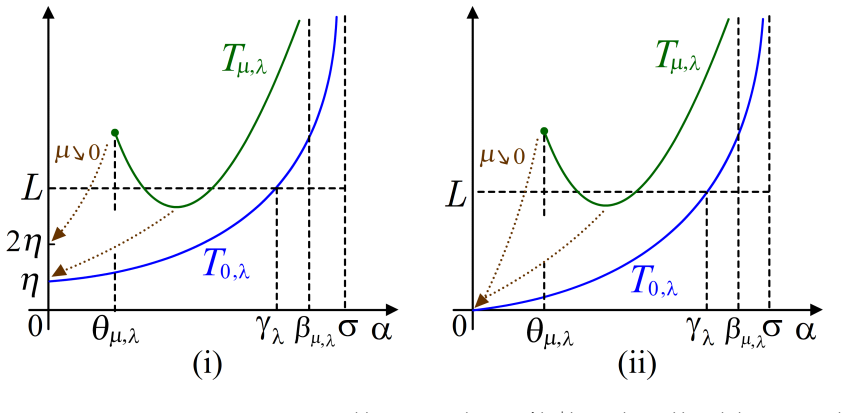


read the original abstract
This paper investigates the bifurcation diagrams of positive solutions for a one-dimensional diffusive generalized logistic boundary-value problem with the Minkowski curvature operator and constant yield harvesting. We prove that the corresponding bifurcation curves on both the (lambda, sup-norm of u)-plane and the (mu, sup-norm of u)-plane are C-shaped. Furthermore, by characterizing the bifurcation set on the (mu, lambda)-plane, we determine the exact multiplicity of positive solutions.
Editorial analysis
A structured set of objections, weighed in public.
Referee Report
Summary. The paper investigates bifurcation diagrams for positive solutions of a one-dimensional boundary-value problem involving the Minkowski curvature operator, a generalized logistic nonlinearity, and constant-yield harvesting. It claims to prove that the bifurcation curves are C-shaped in both the (λ, ‖u‖_∞) and (μ, ‖u‖_∞) planes and, by characterizing the bifurcation set in the (μ, λ)-plane, determines the exact multiplicity of positive solutions.
Significance. If the central claims hold, the work provides a complete multiplicity picture for this quasilinear problem with harvesting, extending standard global bifurcation techniques to the Minkowski operator setting. The C-shaped curves and the resulting bifurcation diagram in parameter space would be a useful contribution to the analysis of curvature-driven logistic models.
major comments (1)
- The global bifurcation and turning-point analysis (used to establish the C-shape on both planes and the multiplicity via the (μ, λ) set) requires that every solution on the continuum satisfies |u'| < 1 strictly so that the Minkowski operator remains classically defined and non-degenerate. The manuscript provides no a priori bound ensuring max |u'| ≤ 1 − δ(λ, μ) > 0 uniformly along the entire branch; with the constant-yield harvesting term this bound is not automatic and its absence risks the continuation exiting the domain of the operator before a turning point is reached, undermining the multiplicity conclusion.
Simulated Author's Rebuttal
We thank the referee for the careful reading and insightful comments on our manuscript. The major concern regarding the uniform a priori bound on |u'| is well-taken and will be addressed explicitly in the revision.
read point-by-point responses
-
Referee: The global bifurcation and turning-point analysis (used to establish the C-shape on both planes and the multiplicity via the (μ, λ) set) requires that every solution on the continuum satisfies |u'| < 1 strictly so that the Minkowski operator remains classically defined and non-degenerate. The manuscript provides no a priori bound ensuring max |u'| ≤ 1 − δ(λ, μ) > 0 uniformly along the entire branch; with the constant-yield harvesting term this bound is not automatic and its absence risks the continuation exiting the domain of the operator before a turning point is reached, undermining the multiplicity conclusion.
Authors: We appreciate this observation, which correctly identifies a point that requires clarification. The constant-yield harvesting term, combined with the logistic nonlinearity and the structure of the Minkowski operator, does permit derivation of the required bound. Specifically, one can obtain an estimate showing that any positive solution satisfies max |u'| ≤ 1 − δ(λ, μ) for some δ > 0 by integrating the equation after multiplication by a suitable factor or by applying a comparison argument adapted to the quasilinear setting. This bound is uniform along the continuum because the parameters remain in a compact set before any turning point. We will insert a new lemma establishing this a priori bound (together with its dependence on λ and μ) immediately before the global bifurcation analysis. With this addition the continuation stays inside the classical domain of the operator, and the C-shaped character of the bifurcation curves together with the multiplicity conclusions remain valid. revision: yes
Circularity Check
No circularity; standard global bifurcation theory applied to specific operator and nonlinearity.
full rationale
The paper states it proves C-shaped bifurcation curves on the (λ,‖u‖∞) and (μ,‖u‖∞) planes and determines exact multiplicity by characterizing the bifurcation set on the (μ,λ)-plane. This rests on global bifurcation and turning-point analysis applied to the diffusive generalized logistic problem with Minkowski curvature operator and constant-yield harvesting, under the technical conditions on the nonlinearity (positivity, monotonicity, growth restrictions). No load-bearing step reduces by the paper's own equations or self-citation to a fitted input, self-definition, or ansatz smuggled from prior author work; the central multiplicity result follows from the application of external theorems to the given equation without redefining the target quantities in terms of themselves. The derivation is therefore self-contained against standard mathematical benchmarks for bifurcation continua.
Axiom & Free-Parameter Ledger
axioms (2)
- standard math Standard global bifurcation theory and turning-point analysis apply to the quasilinear elliptic operator with the given boundary conditions.
- domain assumption The generalized logistic reaction term and constant-yield harvesting satisfy the usual positivity, monotonicity, and sublinear growth conditions required for positivity preservation and a priori bounds.
Lean theorems connected to this paper
-
IndisputableMonolith/Cost/FunctionalEquation.leanwashburn_uniqueness_aczel unclear?
unclearRelation between the paper passage and the cited Recognition theorem.
time-map formula T_{μ,λ}(α) ≡ ∫_α^0 [B(α,u)+1]/√[B²(α,u)+2B(α,u)] du ... T'_{μ,λ}(α) ... turning point analysis ... C-shaped bifurcation curves
-
IndisputableMonolith/Foundation/AlexanderDuality.leanalexander_duality_circle_linking unclear?
unclearRelation between the paper passage and the cited Recognition theorem.
Minkowski curvature operator (u'/√(1-u'²))' with |u'|<1 domain restriction
What do these tags mean?
- matches
- The paper's claim is directly supported by a theorem in the formal canon.
- supports
- The theorem supports part of the paper's argument, but the paper may add assumptions or extra steps.
- extends
- The paper goes beyond the formal theorem; the theorem is a base layer rather than the whole result.
- uses
- The paper appears to rely on the theorem as machinery.
- contradicts
- The paper's claim conflicts with a theorem or certificate in the canon.
- unclear
- Pith found a possible connection, but the passage is too broad, indirect, or ambiguous to say the theorem truly supports the claim.
Reference graph
Works this paper leans on
-
[1]
J. Ali, R. Shivaji and K.Wampler, Population models with diffusion, strong Allee effect and constant yield harvesting, J. Math. Anal. Appl., 352(2009), 907–913
work page 2009
-
[2]
C. Corsato, Mathematical analysis of some differential models in- volving the Euclidean or the Minkowski mean curvature op- erator, PhD thesis, University of Trieste, 2015. Available at https://www.openstarts.units.it/bitstream/10077/11127/1/PhD Thesis Corsato.pdf
work page 2015
-
[3]
P. Gir˜ ao and H. Tehrani, Positive solutions to logistic type equations with harvesting, J. Differential Equations, 247(2009), 574–595
work page 2009
-
[4]
S.-Y. Huang, Classification and evolution of bifurcation curves of semipositone prob- lem with Minkowski curvature operator and its applications, J. Differential Equa- tions, 400(2024), 278–313
work page 2024
-
[5]
S.-Y. Huang, Bifurcation diagrams of positive solutions for one-dimensional Minkowski curvature problem and its applications, Discrete Contin. Dyn. Syst., 39(2019), 3443–3462
work page 2019
-
[6]
S.-Y. Huang and W.-H. Lee, Sufficient conditions for exact bifurcation curves in Minkowski curvature problems and their applications, accepted to appear in Electron. Res. Arch
-
[7]
S.-Y. Huang and P.-H. Hsie h, Exact multiplicity and bifurcation curves of positive solutions of generalized logistic problems, Czechoslovak Math. J., 73(2023), 1081– 1098
work page 2023
-
[8]
S.-Y. Huang and S.-H. Wang, Proof of a Conjecture for the One-dimensional Per- turbed Gelfand Problem from Combustion Theory, Arch Ration. Mech. Anal., 222(2016), 769–825. 30
work page 2016
-
[9]
K.-C. Hung, Y.-N. Suen and S.-H. Wang, Structures and evolution of bifurcation diagrams for a one-dimensional diffusive generalized logistic problem with constant yield harvesting, J. Differential Equations, 269(2020), 3456–3488
work page 2020
-
[10]
K.-C. Hung and S.-H. Wang, Structures and evolution of bifurcation diagrams for a one-dimensional diffusive generalized logistic problem with constant yield harvesting. II. Convex-concave and convex-concave-convex nonlinearities, J. Differential Equa- tions, 308(2022), 1–39
work page 2022
-
[11]
K.-C. Hung and S.-H. Wang, Global bifurcation and exact multiplicity of positive solutions for a positone problem with cubic nonlinearity and their applications, Trans. Amer. Math. Soc., 365(2013), 1933–1956
work page 2013
- [12]
-
[13]
M. R. Myerscough, B. F. Gray, W. L. Hogarth and J. Norbury, An analysis of an ordinary differential equations model for a two species predator-prey system with harvesting and stocking, J. Math. Biol., 30(1992), 389–411
work page 1992
-
[14]
S. Oruganti, J. Shi and R. Shivaji, Diffusive logistic equation with constant effort harvesting, I: Steady states, Trans. Amer. Math.Soc., 354(2002), 3601–3619
work page 2002
-
[15]
S. Oruganti, J. Shi and R. Shivaji, Logistic equation with thep-Laplacian and con- stant yield harvesting, Abstr. Appl. Anal., 2004(2004), 723–727
work page 2004
-
[16]
R. L. Wheeden and A. Zygmund, Measure and Integral: An Introduction to Real Analysis, Marcel Dekker, New York, 1977. 31
work page 1977
discussion (0)
Sign in with ORCID, Apple, or X to comment. Anyone can read and Pith papers without signing in.