Diffuse neutrino flux from coronal magnetospheric current sheets of accreting black holes
Pith reviewed 2026-05-18 10:59 UTC · model grok-4.3
The pith
Protons accelerated in current sheets of AGN coronae produce a diffuse neutrino flux matching IceCube data when magnetization is fixed at 10^5.
A machine-rendered reading of the paper's core claim, the machinery that carries it, and where it could break.
Core claim
Relativistic protons accelerated inside black-hole magnetospheric current sheets within AGN coronae generate neutrinos whose diffuse flux, after population synthesis, reproduces the IceCube measurements in both normalization and power-law index when the proton plasma magnetization is taken to be 10^5 across the entire sample.
What carries the argument
Magnetospheric current sheets whose proton plasma magnetization σ_p sets the maximum energy reached by accelerated protons and therefore the peak of the resulting neutrino spectrum.
If this is right
- The observed diffuse neutrino background can be accounted for by non-jetted AGN alone.
- The spectral shape of the neutrino flux is controlled almost entirely by the fixed magnetization value.
- The overall flux normalization scales with the distribution of Eddington ratios across the AGN population.
- Neutrino production is directly tied to the same plasma responsible for the hard X-ray corona emission.
Where Pith is reading between the lines
- If the fixed-magnetization assumption holds, similar current-sheet acceleration should operate in other accreting compact objects whose coronae produce hard X-rays.
- Individual bright AGN could become detectable neutrino point sources for next-generation telescopes if their Eddington ratios are high enough.
- The model links the X-ray corona directly to high-energy neutrino output without requiring relativistic jets.
Load-bearing premise
The proton magnetization σ_p is the same fixed value of 10^5 in every AGN corona and is set by the same current-sheet physics independent of source properties.
What would settle it
An IceCube measurement or future neutrino observatory result showing that the diffuse neutrino spectrum has a slope or overall intensity clearly inconsistent with the value calculated for σ_p equal to 10^5 using the observed AGN luminosity function.
Figures

read the original abstract
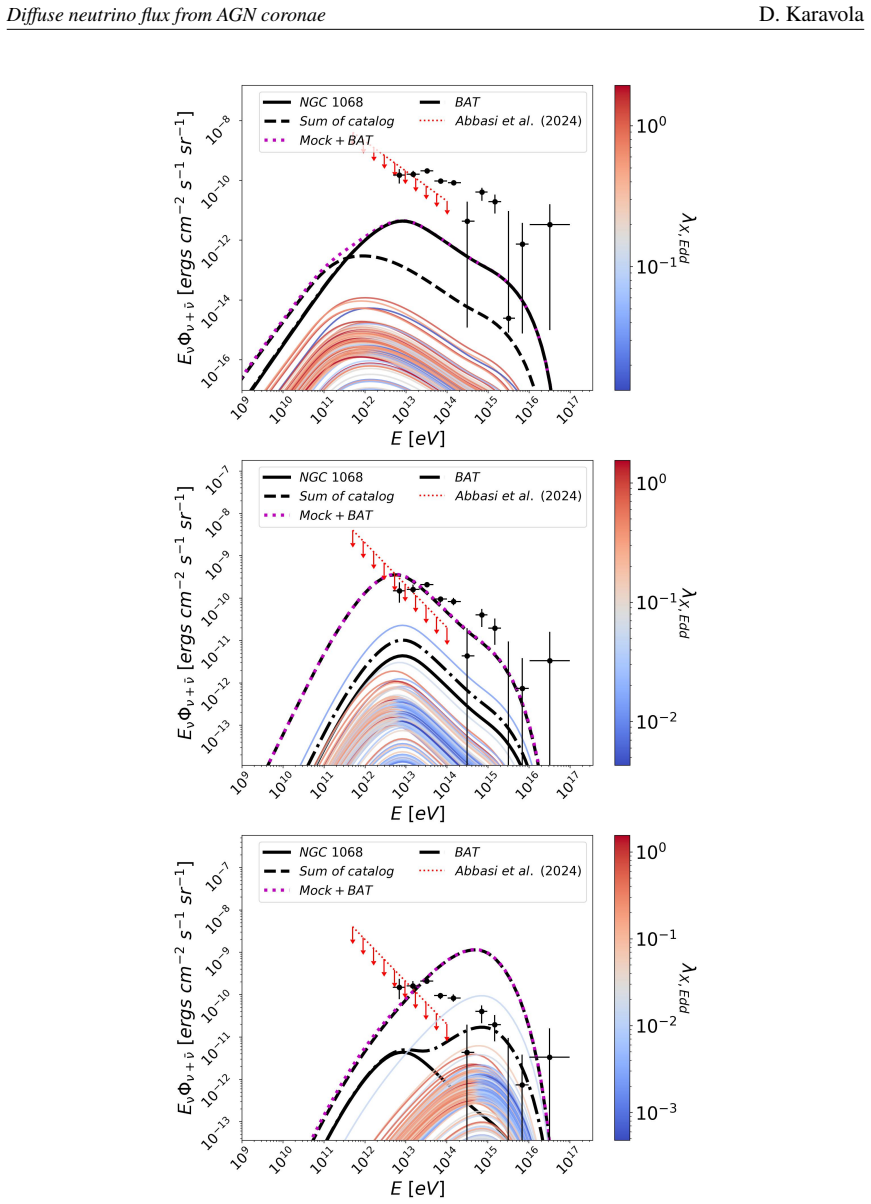
Non-jetted AGN exhibit hard X-ray emission with a power law spectrum above $\sim$2 keV, which is thought to be produced through Comptonization of soft photons by electrons and positrons (pairs) in the vicinity of the black hole. The origin and composition of this plasma source, known as the corona, is a matter open for debate. Our study focuses on the role of relativistic protons accelerated in black-hole magnetospheric current sheets in the neutrino production of AGN coronae. We present a model that has two free parameters, namely the proton plasma magnetization $\sigma_{\rm p}$, which controls the peak energy of the neutrino spectrum, and the Eddington ratio $\lambda_{\rm Edd}$ (defined as the ratio between X-ray luminosity $L_{\rm X}$ and Eddington luminosity $L_{\rm Edd}$), which controls the amount of energy transferred to secondary particles. Furthermore, we combine our coronal model with an AGN population in order to provide a prediction for the diffuse neutrino flux measured on Earth. We compare our results with the observational data by IceCube and we find a satisfactory agreement on both the flux value and the slope of the neutrino distribution when we assume a $\sigma_{\rm p}$ value of $10^5$ for all the sources in our sample.
Editorial analysis
A structured set of objections, weighed in public.
Referee Report
Summary. The paper models neutrino production in non-jetted AGN coronae through relativistic protons accelerated in black-hole magnetospheric current sheets. It introduces a two-parameter framework (proton plasma magnetization σ_p controlling neutrino peak energy, and Eddington ratio λ_Edd controlling energy transfer to secondaries), combines the coronal emission model with an AGN population synthesis, and reports that setting σ_p = 10^5 uniformly across all sources yields a diffuse neutrino flux whose normalization and spectral slope agree with IceCube data.
Significance. If the result holds after addressing parameter justification, the work would provide a concrete mechanism linking hard X-ray coronae to high-energy neutrinos, offering an alternative to jet-based models for the diffuse flux. The population-level integration and explicit two-parameter structure are strengths that could be developed into falsifiable predictions once σ_p is either derived from first principles or allowed to vary with source properties.
major comments (2)
- [Abstract and model description] Abstract and model description: the reported agreement with IceCube flux normalization and slope is obtained only after fixing σ_p = 10^5 for every source in the sample. The text states that this single value 'controls the peak energy of the neutrino spectrum' and is assumed uniform independent of λ_Edd or black-hole mass; no derivation from reconnection rate, pair loading, or magnetospheric structure is provided to justify universality. Because the integrated flux and spectral index shift if σ_p varies across the population, this choice is load-bearing for the central claim of satisfactory agreement.
- [Population synthesis and results] Population synthesis section: the paper does not show how the diffuse flux changes when σ_p is drawn from a distribution motivated by current-sheet physics rather than held fixed. A sensitivity test or error propagation on σ_p would be required to establish whether the match to IceCube is robust or an artifact of the uniform choice.
minor comments (2)
- [Introduction] Notation for σ_p and λ_Edd should be defined at first use with explicit units or dimensionless status; the current introduction leaves the physical meaning of the magnetization parameter implicit for readers outside the reconnection literature.
- [Figures] Figure captions for the neutrino spectrum plots should state the exact value of σ_p used and whether the curves include the full population integration or a single-source template.
Simulated Author's Rebuttal
We thank the referee for their thoughtful comments on our manuscript. The referee correctly identifies that our central result relies on the choice of a uniform proton magnetization σ_p = 10^5. We address this and the request for sensitivity tests in detail below. We will revise the manuscript to include additional discussion and analysis as outlined in our responses.
read point-by-point responses
-
Referee: [Abstract and model description] Abstract and model description: the reported agreement with IceCube flux normalization and slope is obtained only after fixing σ_p = 10^5 for every source in the sample. The text states that this single value 'controls the peak energy of the neutrino spectrum' and is assumed uniform independent of λ_Edd or black-hole mass; no derivation from reconnection rate, pair loading, or magnetospheric structure is provided to justify universality. Because the integrated flux and spectral index shift if σ_p varies across the population, this choice is load-bearing for the central claim of satisfactory agreement.
Authors: We agree that the agreement with IceCube data is achieved with a fixed value of σ_p = 10^5 across the population, and that this parameter choice is central to the result. In the current version, σ_p is treated as a free parameter that sets the characteristic energy scale for proton acceleration in current sheets, motivated by the requirement that the resulting neutrino spectrum peaks in the TeV-PeV range relevant for IceCube. While we do not provide a first-principles derivation of why this value should be universal, we note that it corresponds to a plausible magnetization in the corona where magnetic energy density greatly exceeds the rest-mass energy density of protons. In the revised manuscript, we will add a dedicated paragraph discussing the physical motivation for this choice, referencing reconnection studies in similar environments, and explicitly state that it is assumed constant as a baseline model. We will also note that future work could explore dependencies on source properties. revision: partial
-
Referee: [Population synthesis and results] Population synthesis section: the paper does not show how the diffuse flux changes when σ_p is drawn from a distribution motivated by current-sheet physics rather than held fixed. A sensitivity test or error propagation on σ_p would be required to establish whether the match to IceCube is robust or an artifact of the uniform choice.
Authors: We acknowledge the value of demonstrating robustness against variations in σ_p. Although the manuscript presents results for the fiducial uniform value, we agree that a sensitivity study is warranted. In the revised version, we will add a new subsection or figure showing the diffuse neutrino flux for σ_p varied by factors of a few (e.g., 10^4 to 10^6) and for a simple distribution such as a log-normal with mean 10^5 and dispersion 0.5 dex. This will illustrate the range of possible fluxes and confirm that the spectral slope remains compatible with IceCube data within reasonable variations. revision: yes
Circularity Check
Diffuse flux agreement with IceCube holds only after fixing σ_p=10^5 uniformly across sources
specific steps
-
fitted input called prediction
[Abstract]
"We compare our results with the observational data by IceCube and we find a satisfactory agreement on both the flux value and the slope of the neutrino distribution when we assume a σ_p value of 10^5 for all the sources in our sample."
σ_p is introduced as a free parameter that directly sets the peak energy of the neutrino spectrum. The paper reports agreement with data specifically under the assumption that this parameter equals 10^5 for the entire population; the flux and slope match is therefore produced by the choice of the fitted input rather than derived independently from magnetospheric current-sheet equations.
full rationale
The paper's central result is a population-integrated prediction for the diffuse neutrino flux that reproduces both normalization and slope of IceCube data. This match is obtained by adopting a single fixed value σ_p=10^5 for every AGN in the sample, a choice the abstract explicitly states controls the peak neutrino energy. The model description identifies σ_p as one of two free parameters with no first-principles derivation supplied for its universality. Consequently the reported agreement reduces to a tuned input rather than an independent output of the current-sheet physics. The population synthesis and reconnection framework retain independent content, preventing a higher circularity score.
Axiom & Free-Parameter Ledger
free parameters (2)
- proton plasma magnetization σ_p =
10^5
- Eddington ratio λ_Edd
axioms (1)
- domain assumption Relativistic protons are accelerated to high energies in black-hole magnetospheric current sheets within the corona
Lean theorems connected to this paper
-
IndisputableMonolith/Cost/FunctionalEquation.leanwashburn_uniqueness_aczel unclear?
unclearRelation between the paper passage and the cited Recognition theorem.
We present a model that has two free parameters, namely the proton plasma magnetization σ_p, which controls the peak energy of the neutrino spectrum, and the Eddington ratio λ_Edd ... we find a satisfactory agreement ... when we assume a σ_p value of 10^5 for all the sources in our sample.
-
IndisputableMonolith/Foundation/RealityFromDistinction.leanreality_from_one_distinction unclear?
unclearRelation between the paper passage and the cited Recognition theorem.
Magnetic reconnection ... can accelerate a fraction of the aforementioned protons to highly relativistic energies ... protons may interact with coronal X-ray photons and produce neutrinos through photohadronic (pγ) interactions.
What do these tags mean?
- matches
- The paper's claim is directly supported by a theorem in the formal canon.
- supports
- The theorem supports part of the paper's argument, but the paper may add assumptions or extra steps.
- extends
- The paper goes beyond the formal theorem; the theorem is a base layer rather than the whole result.
- uses
- The paper appears to rely on the theorem as machinery.
- contradicts
- The paper's claim conflicts with a theorem or certificate in the canon.
- unclear
- Pith found a possible connection, but the passage is too broad, indirect, or ambiguous to say the theorem truly supports the claim.
Reference graph
Works this paper leans on
-
[1]
R. Abbasi et al.,Evidence for neutrino emission from the nearby active galaxy NGC 1068, Science378(2022) 538 [2211.09972]
-
[2]
A. Chernoglazov, H. Hakobyan and A.A. Philippov,High-Energy Radiation and Ion Acceleration in Three-dimensional Relativistic Magnetic Reconnection with Strong Synchrotron Cooling, Oct., 2023
work page 2023
-
[3]
L. Comisso,Concurrent Particle Acceleration and Pitch-angle Anisotropy Driven by Magnetic Reconnection: Ion-electron Plasmas,ApJ972(2024) 9 [2405.18227]
-
[4]
B. Ripperda, F. Bacchini and A.A. Philippov,Magnetic reconnection and hot spot formation in black hole accretion disks,The Astrophysical Journal900(2020) 100
work page 2020
-
[5]
I. El Mellah, B. Cerutti and B. Crinquand,Reconnection-driven flares in 3D black hole magnetospheres: A scenario for hot spots around Sagittarius A*,Astronomy & Astrophysics 677(2023) A67
work page 2023
-
[6]
A. Nathanail, V. Mpisketzis, O. Porth, C.M. Fromm and L. Rezzolla,Magnetic reconnection and plasmoid formation in three-dimensional accretion flows around black holes,Monthly Notices of the Royal Astronomical Society513(2022) 4267
work page 2022
- [7]
-
[8]
M. Petropoulou, L. Sironi, A. Spitkovsky and D. Giannios,Relativistic Magnetic Reconnection in Electron-Positron-Proton Plasmas: Implications for Jets of Active Galactic Nuclei,ApJ880(2019) 37 [1906.03297]
- [9]
- [10]
-
[11]
Hillas,The Origin of Ultra-High-Energy Cosmic Rays,ARA&A22(1984) 425
A.M. Hillas,The Origin of Ultra-High-Energy Cosmic Rays,ARA&A22(1984) 425
work page 1984
-
[12]
D. Karavola, M. Petropoulou, D.F.G. Fiorillo, L. Comisso and L. Sironi,Neutrino and pair creation in reconnection-powered coronae of accreting black holes, 2025
work page 2025
-
[13]
A. Georgakakis, A. Ruiz and S.M. LaMassa,Forward modelling the multiwavelength properties of active galactic nuclei: application to X-ray and WISE mid-infrared samples, Monthly Notices of the Royal Astronomical Society499(2020) 710
work page 2020
- [14]
-
[15]
S. Dimitrakoudis, A. Mastichiadis, R.J. Protheroe and A. Reimer,The time-dependent one-zone hadronic model - first principles,A&A546(2012) A120
work page 2012
-
[16]
Spectral and temporal signatures of ultrarelativistic protons in compact sources
A. Mastichiadis, R.J. Protheroe and J.G. Kirk,Spectral and temporal signatures of ultrarelativistic protons in compact sources,astro-ph/0501156
work page internal anchor Pith review Pith/arXiv arXiv
- [17]
-
[18]
Naab, IceCube Collaboration, R
R. Naab, IceCube Collaboration, R. Abbasi, M. Ackermann, J. Adams, S.K. Agarwalla et al., Measurement of the astrophysical diffuse neutrino flux in a combined fit of IceCube’s high energy neutrino data, inProceedings of 38th International Cosmic Ray Conference — PoS(ICRC2023), (Nagoya, Japan), p. 1064, Sissa Medialab, Aug., 2023, DOI
work page 2023
-
[19]
P. Padovani, R. Gilli, E. Resconi, C. Bellenghi and F. Henningsen,The neutrino background from non-jetted active galactic nuclei,A&A684(2024) . 8
work page 2024
discussion (0)
Sign in with ORCID, Apple, or X to comment. Anyone can read and Pith papers without signing in.