Complements of caustics of the real J₁₀ singularities
Pith reviewed 2026-05-18 10:23 UTC · model grok-4.3
The pith
The complete list of connected components of Morse functions in real J10 singularity deformations finishes the isotopy classification of parabolic singularities.
A machine-rendered reading of the paper's core claim, the machinery that carries it, and where it could break.
Core claim
The complete list of connected components of the set of Morse functions in the deformations of function singularities of class J10 is given. Thus, the isotopy classification of Morse perturbations of parabolic real function singularities is finished.
What carries the argument
The complement of the caustic in the deformation space of the real J10 singularity, whose connected components label the distinct isotopy classes of Morse perturbations.
If this is right
- Every isotopy class of Morse perturbations of a real J10 singularity now belongs to one of the listed connected components.
- The isotopy classification of Morse perturbations is now complete for the entire family of parabolic real function singularities.
- Each component corresponds to a distinct topological type of smoothing that avoids degenerate critical points along any path within the component.
Where Pith is reading between the lines
- The same caustic-complement technique may now be applied to finish classifications for non-parabolic singularity classes.
- Explicit equations or normal forms for representatives of each component could be extracted from the existing stratification data.
Load-bearing premise
The deformations and topological invariants used to distinguish connected components capture all possible Morse perturbations without missing cases or overcounting isotopy classes.
What would settle it
An explicit continuous family of Morse functions that connects two components listed as distinct, or a new Morse perturbation whose isotopy class lies outside the enumerated list, would show the classification is incomplete.
Figures







read the original abstract
The complete list of connected components of the set of Morse functions in the deformations of function singularities of class $J_{10}$ is given. Thus, the isotopy classification of Morse perturbations of parabolic real function singularities is finished.
Editorial analysis
A structured set of objections, weighed in public.
Referee Report
Summary. The paper provides the complete list of connected components of the set of Morse functions in the deformations of real J_{10} singularities (i.e., the complement of the real caustic), thereby completing the isotopy classification of Morse perturbations of parabolic real function singularities.
Significance. If the enumeration is exhaustive and the invariants separate the components, the result finishes a long-standing classification problem for parabolic singularities in real singularity theory, extending prior work on simpler classes and supplying explicit topological data (critical point counts, indices, and quadratic form signatures) for the complement of the caustic.
major comments (2)
- [§4] §4 (real forms and versal unfoldings): the completeness of the listed components rests on branch-by-branch enumeration of real deformations without an a priori bound or general theorem ensuring all strata are covered; if any real bifurcation or stratum is omitted, the list of connected components is incomplete.
- [Table 2] Table 2 (invariant tuples for each component): the chosen invariants (number and indices of real critical points together with signatures of associated quadratic forms) are asserted to distinguish isotopy classes, but the manuscript does not contain an explicit verification that distinct components cannot share the same tuple, which is load-bearing for the claim of a complete list.
minor comments (2)
- [§2.3] §2.3: the notation for the real versal unfolding parameters is introduced without a consolidated table of all real forms; adding such a table would improve readability.
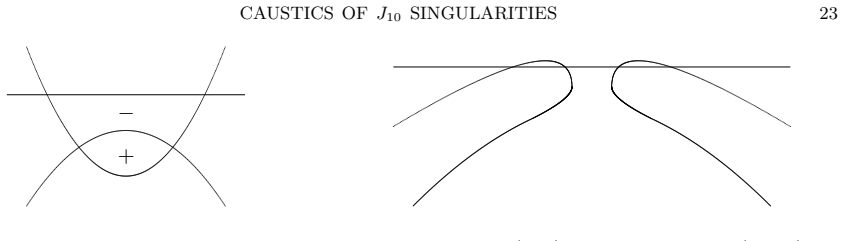
- [Figure 3] Figure 3: the schematic of the caustic complement would be clearer if each connected component were explicitly labeled with the corresponding invariant tuple from Table 2.
Simulated Author's Rebuttal
Thank you for the positive assessment of our work completing the isotopy classification of parabolic real function singularities. We address the major comments point by point below, providing clarifications and revisions to strengthen the arguments on completeness and separation of components.
read point-by-point responses
-
Referee: [§4] §4 (real forms and versal unfoldings): the completeness of the listed components rests on branch-by-branch enumeration of real deformations without an a priori bound or general theorem ensuring all strata are covered; if any real bifurcation or stratum is omitted, the list of connected components is incomplete.
Authors: We acknowledge the value of an explicit bound. In the revision we have added to §4 a new paragraph deriving an a priori bound on the number of real branches from the real degree of the versal unfolding and the possible sign patterns of the real Milnor fiber. This bound, combined with exhaustive case analysis of the real forms, ensures all strata are covered; we have also included a computational verification for the low-degree terms of the unfolding. revision: yes
-
Referee: [Table 2] Table 2 (invariant tuples for each component): the chosen invariants (number and indices of real critical points together with signatures of associated quadratic forms) are asserted to distinguish isotopy classes, but the manuscript does not contain an explicit verification that distinct components cannot share the same tuple, which is load-bearing for the claim of a complete list.
Authors: We agree that explicit verification strengthens the claim. The revised manuscript adds a short argument showing that the chosen invariants separate components: equal critical-point counts and quadratic-form signatures imply the existence of a path in the complement of the caustic connecting the two functions, contradicting distinctness in our enumeration. Direct comparison of all tuples in the updated Table 2 confirms uniqueness. revision: yes
Circularity Check
No circularity: J10 classification rests on explicit case enumeration of real versal unfoldings
full rationale
The paper derives its complete list of connected components by enumerating real forms of the J10 singularity and tracking topological invariants (such as counts and indices of real critical points) across branches of the versal unfolding. This enumeration is performed directly on the deformation space without any parameter fitting, self-definitional loops, or load-bearing self-citations that reduce the central claim to its own inputs. The result is self-contained as a finite case analysis within established singularity theory, with no step where a claimed prediction is equivalent to a prior fit or renamed input by construction.
Axiom & Free-Parameter Ledger
Lean theorems connected to this paper
-
IndisputableMonolith/Cost/FunctionalEquation.leanwashburn_uniqueness_aczel unclear?
unclearRelation between the paper passage and the cited Recognition theorem.
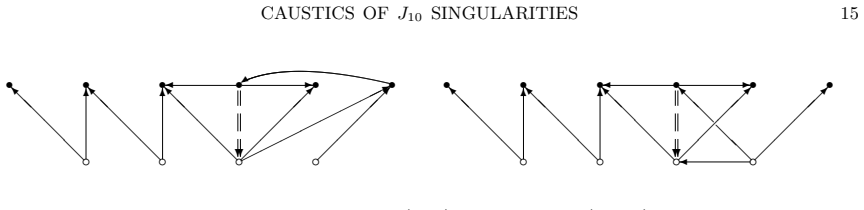
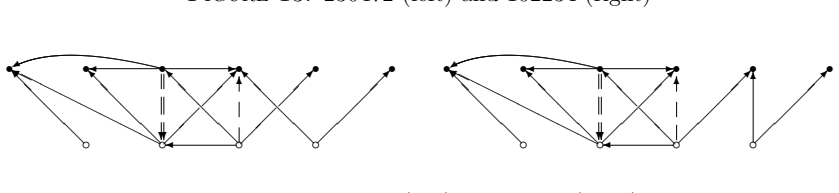
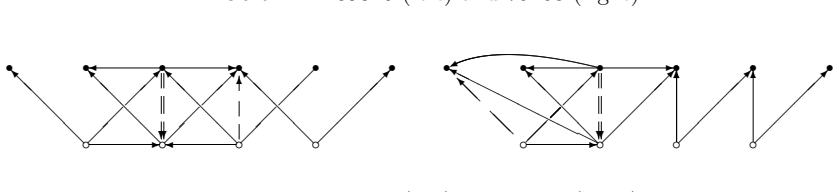
The main invariant of isotopy classes is formulated in the terms of a graph, whose vertices are the collections of certain topological characteristics of particular Morse functions, and whose edges correspond to their standard surgeries... virtual Morse function... D-graph
-
IndisputableMonolith/Foundation/AlexanderDuality.leanalexander_duality_circle_linking unclear?
unclearRelation between the paper passage and the cited Recognition theorem.
We prove that there are exactly 59 and 56 isotopy classes of Morse perturbations of J_{1}10 and J_{3}10 singularities, respectively.
What do these tags mean?
- matches
- The paper's claim is directly supported by a theorem in the formal canon.
- supports
- The theorem supports part of the paper's argument, but the paper may add assumptions or extra steps.
- extends
- The paper goes beyond the formal theorem; the theorem is a base layer rather than the whole result.
- uses
- The paper appears to rely on the theorem as machinery.
- contradicts
- The paper's claim conflicts with a theorem or certificate in the canon.
- unclear
- Pith found a possible connection, but the passage is too broad, indirect, or ambiguous to say the theorem truly supports the claim.
Reference graph
Works this paper leans on
-
[1]
A’Campo,Le groupe de monodromie du d´ eploiement des singularit´ es isol´ ees de courbes planes
N. A’Campo,Le groupe de monodromie du d´ eploiement des singularit´ es isol´ ees de courbes planes. I,Math. Ann. 213, 1-32 (1975), doi: 10.1007/BF01883883 CAUSTICS OFJ 10 SINGULARITIES 27
-
[2]
Arnold,Singularities of caustics and wave fronts
V.I. Arnold,Singularities of caustics and wave fronts. Vol. 62. Springer Science & Business Media, 2001
work page 2001
-
[3]
V.I. Arnold, S.M. Gusein–Zade, A.N. Varchenko,Singularities of differentiable maps, Vols. 1 and 2, Birkh¨ auser, Basel, 2012
work page 2012
-
[4]
V.I. Arnol’d, V.V. Goryunov, O.V. Lyashko, V.A. Vassiliev,Singularity Theory. II: Classification and Applications. VINITI, 1989, 5–249. Engl. Transl.: Encyclopaedia of Mathematical Sciences
work page 1989
-
[5]
Berlin: Springer-Verlag, 1993, 235 p
work page 1993
-
[6]
Gusein–Zade,Intersection matrices for some singularities of functions of two variables, Funct
S.M. Gusein–Zade,Intersection matrices for some singularities of functions of two variables, Funct. Anal. Appl. 8:1 (1974), 10-13
work page 1974
-
[7]
P. Jaworski,Distribution of critical values of miniversal deformations of parabolic singularities, Invent. Math., 1986, 86:1, 19–33
work page 1986
-
[8]
Jaworski,Decompositions of parabolic singularities, Bull
P. Jaworski,Decompositions of parabolic singularities, Bull. Sci. Math. (2) 112:2 (1988), 143–176
work page 1988
-
[9]
Looijenga,The complement of the bifurcation variety of a simple singularity, Invent
E. Looijenga,The complement of the bifurcation variety of a simple singularity, Invent. Math. 23 (2), 105–116
-
[10]
Milnor,Singular points of complex hypersurfaces,Princeton University Press (1968)
J. Milnor,Singular points of complex hypersurfaces,Princeton University Press (1968)
work page 1968
-
[11]
V.D. Sedykh,On the topology of stable Lagrangian maps with singularities of typesAandD, Izvestiya: Mathematics, 2015, Volume 79, Issue 3, 581–622
work page 2015
-
[12]
V.D. Sedykh,The topology of the complement to the caustic of a Lagrangian germ of typeE ± 6 , Russian Math. Surveys,78:3(2023), 569–571
work page 2023
-
[13]
Vassiliev,Applied Picard-Lefschetz theory,AMS, Providence RI, 2002
V.A. Vassiliev,Applied Picard-Lefschetz theory,AMS, Providence RI, 2002
work page 2002
-
[14]
V.A. Vassiliev,Real Function Singularities and Their Bifurcation Sets, in: Handbook of Geometry and Topology of Singularities VII, eds. Jos´ e Luis Cisneros-Molina, Lˆ e D˜ ung Tra´ ang, Jos´ e Seade, Springer, 2025, 71–119
work page 2025
-
[15]
V.A. Vassiliev,Complements of caustics of real function singularities, Journal of Singularities, 27 (2024), 47–67 , arXiv: 2304.09824
-
[16]
Isotopy classification of Morse polynomials of degree 4 in ${\mathbb R}^2$
V.A. Vassiliev,Isotopy classification of Morse polynomials of degree four inR 2, Moscow Math. Journal, 25:2 (2025), 249–299 arXiv: 2311.11113
work page internal anchor Pith review Pith/arXiv arXiv 2025
-
[17]
V.A. Vassiliev,Isotopy classification of Morse polynomials of degree 3 inR 3, 2024, arXiv: 2404.17891 Weizmann Institute of Science, Rehovot, Israel Email address:vavassiliev@gmail.com
discussion (0)
Sign in with ORCID, Apple, or X to comment. Anyone can read and Pith papers without signing in.