Pricing Short-Circuit Current via a Primal-Dual Formulation for Preserving Integrality Constraints
Pith reviewed 2026-05-18 09:00 UTC · model grok-4.3
The pith
A primal-dual formulation assigns revenue-adequate short-circuit current prices without uplift payments while preserving binary unit commitments.
A machine-rendered reading of the paper's core claim, the machinery that carries it, and where it could break.
Core claim
The paper claims that a primal-dual formulation of the SCC-constrained dispatch preserves the binary unit commitment decisions while correctly yielding interpretable shadow prices for the SCC service, thereby enabling revenue-adequate and explicit prices without uplift payments, an outcome not achieved by dispatchable or restricted pricing methods.
What carries the argument
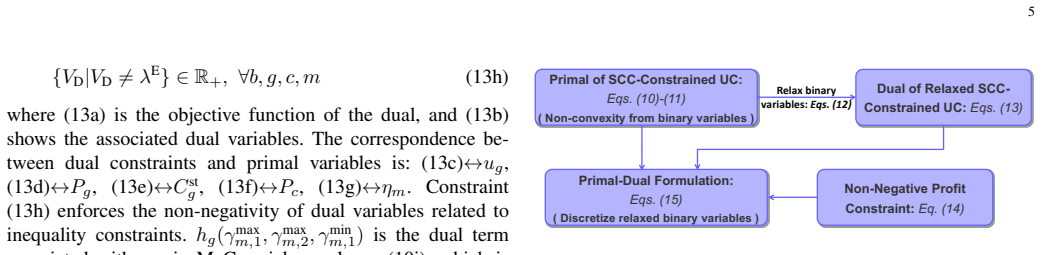
The primal-dual formulation of the SCC-constrained dispatch that preserves binary UC decisions for shadow-price computation.
If this is right
- SCC service prices can be assigned explicitly from the dual variables.
- The prices recover the full operating costs of the committed units providing the service.
- No uplift payments are required to achieve revenue adequacy.
- The prices remain interpretable as marginal values of the SCC constraints.
Where Pith is reading between the lines
- The same primal-dual construction could be applied to price other ancillary services that involve discrete commitment decisions.
- Market operators might use the resulting prices to send clearer long-term signals for retaining synchronous generation capacity.
- Numerical tests on larger networks would be needed to confirm that the dual solution remains stable at scale.
Load-bearing premise
The primal-dual formulation exactly reproduces the original binary unit commitment solution while supplying valid dual prices for the short-circuit current constraints.
What would settle it
Solve the proposed primal-dual model and the original integer model on the same test system; check whether the resulting prices, when used for settlement, recover provider costs exactly and produce identical commitment decisions without any uplift.
Figures


read the original abstract
Synchronous Generators (SGs) currently provide important levels of Short-Circuit Current (SCC), a critical ancillary service that ensures line protections trip during short-circuit faults. Given the ongoing replacement of SGs by power-electronics-based generation, which has a hard limit on current injection, it has become relevant to optimize the procurement of SCC services provided by remaining SGs. Pricing this service is, however, challenging due to the integrality constraints in Unit Commitment (UC). Existing methods, e.g., dispatchable pricing and restricted pricing, attempt to address this issue but exhibit limitations in handling non-convexities, resulting in SCC prices that either fail to cover the operating costs of units or lack interpretability. To overcome these pitfalls, we adopt a primal-dual formulation of the SCC-constrained dispatch that preserves the binary UC for effectively computing shadow prices of SCC services. Using a modified IEEE 30-bus system, the proposed method is compared with the previously developed pricing schemes. It is demonstrated that, under the proposed pricing method, revenue-adequate and explicit service prices can be assigned without the need for uplift payments, an advantage that cannot be achieved by other pricing approaches.
Editorial analysis
A structured set of objections, weighed in public.
Referee Report
Summary. The manuscript proposes a primal-dual formulation of the short-circuit current (SCC) constrained dispatch problem that preserves binary unit commitment decisions to compute shadow prices for SCC services. It compares this approach to dispatchable and restricted pricing methods using a modified IEEE 30-bus test system and claims superior performance in achieving revenue adequacy without uplift payments.
Significance. This contribution is potentially significant for electricity market design in systems transitioning to high shares of inverter-based generation, where SCC provision becomes a scarce resource. A method that delivers explicit, revenue-adequate prices while respecting the non-convex UC structure could reduce reliance on ad-hoc uplifts and improve transparency in ancillary service procurement.
major comments (1)
- [§3] The central claim relies on the primal-dual formulation preserving the exact optimal binary commitment vector from the original SCC-constrained UC. A rigorous demonstration—such as a proof that the Lagrangian relaxation or auxiliary variables do not change the integer optimum—is required. If this preservation does not hold, the derived shadow prices would not correspond to the realized dispatch, invalidating both the revenue-adequacy result and the comparison to other pricing schemes.
minor comments (2)
- [Abstract] The abstract states that the method is demonstrated on a modified IEEE 30-bus system but provides no quantitative results, error metrics, or specific outcomes; adding a sentence summarizing the key findings would improve clarity.
- [Notation] Ensure consistent use of symbols for SCC quantities and dual variables throughout the manuscript.
Simulated Author's Rebuttal
We thank the referee for their constructive comments and the opportunity to clarify the technical foundations of our primal-dual formulation. We address the major comment point by point below and are prepared to strengthen the manuscript where needed.
read point-by-point responses
-
Referee: [§3] The central claim relies on the primal-dual formulation preserving the exact optimal binary commitment vector from the original SCC-constrained UC. A rigorous demonstration—such as a proof that the Lagrangian relaxation or auxiliary variables do not change the integer optimum—is required. If this preservation does not hold, the derived shadow prices would not correspond to the realized dispatch, invalidating both the revenue-adequacy result and the comparison to other pricing schemes.
Authors: We agree that a rigorous demonstration is necessary to substantiate the central claim. In our formulation the SCC constraints are dualized while the binary unit-commitment variables remain unchanged in the primal problem; the auxiliary variables are introduced only for the continuous power-flow and current-injection variables. Consequently the feasible set for the binary decisions is identical to that of the original SCC-constrained UC, and any optimal binary vector of the original problem remains feasible and optimal for the primal-dual model. To make this argument fully rigorous we will insert a short appendix containing a formal proof that the Lagrangian relaxation applied exclusively to the continuous blocks does not alter the integer optimum. With this addition the correspondence between the derived shadow prices and the realized dispatch is preserved, supporting both the revenue-adequacy result and the numerical comparisons. revision: yes
Circularity Check
No significant circularity; derivation derives shadow prices directly from primal-dual optimization
full rationale
The paper presents a primal-dual formulation applied to the SCC-constrained unit commitment problem to preserve binary decisions and obtain interpretable shadow prices for the service. This construction is grounded in standard optimization duality applied to the given dispatch model, with no evidence of self-definitional loops (e.g., defining prices in terms of themselves), fitted parameters relabeled as predictions, or load-bearing self-citations that reduce the core claim to unverified prior results by the same authors. Numerical comparisons on the modified IEEE 30-bus system provide an externally checkable benchmark, rendering the revenue-adequacy claim falsifiable without circular reduction to inputs.
Axiom & Free-Parameter Ledger
axioms (1)
- domain assumption Primal-dual optimality conditions yield meaningful shadow prices for the SCC service even when binary variables are present.
Reference graph
Works this paper leans on
-
[1]
B. Chaudhuri, D. Ramasubramanian, J. Matevosyan, M. O’Malley, N. Miller, T. Green, and X. Zhou, “Rebalancing Needs and Services for Future Grids: System Needs and Service Provisions with Increasing Shares of Inverter-Based Resources,”IEEE Power and Energy Magazine, vol. 22, no. 2, pp. 30–41, 2024
work page 2024
-
[2]
J. S. Ali, Y . Qiblawey, A. Alassi, A. M. Massoud, S. Muyeen, and H. Abu-Rub, “Power System Stability with High Penetration of Renewable Energy Sources: Challenges, Assessment, and Mitigation Strategies,”IEEE Access, 2025
work page 2025
-
[3]
J. Jia, G. Yang, and A. H. Nielsen, “A Review on Grid-Connected Con- verter Control for Short-Circuit Power Provision under Grid Unbalanced Faults,”IEEE Transactions on Power Delivery, vol. 33, no. 2, pp. 649– 661, 2017
work page 2017
-
[4]
Short-Circuit Analysis Techniques in Large-Scale AC Power Systems,
N. Tleis, “Short-Circuit Analysis Techniques in Large-Scale AC Power Systems,”Power Systems Modelling and Fault Analysis, pp. 597–664, 2019
work page 2019
-
[5]
Development of Available Short- Circuit Power in Germany from 2011 up to 2033,
A. Kubis, S. Ruberg, and C. Rehtanz, “Development of Available Short- Circuit Power in Germany from 2011 up to 2033,” inCIRED workshop, Rome, Italy, 2014, pp. 11–12
work page 2011
-
[6]
M. Ferrari, L. M. Tolbert, and E. C. Piesciorovsky, “Grid Forming Inverter with Increased Short-Circuit Contribution to Address Inverter- Based Microgrid Protection Challenges,”IEEE Open Journal of the Industrial Electronics Society, vol. 5, pp. 481–500, 2024
work page 2024
-
[7]
Optimal Transmission Switching with Short-Circuit Current Limitation Constraints,
Z. Yang, H. Zhong, Q. Xia, and C. Kang, “Optimal Transmission Switching with Short-Circuit Current Limitation Constraints,”IEEE Transactions on Power Systems, vol. 31, no. 2, pp. 1278–1288, 2015
work page 2015
-
[8]
S. Tang, T. Li, Y . Liu, Y . Su, Y . Wang, F. Liu, and S. Gao, “Optimal Transmission Switching for Short-Circuit Current Limitation Based on Deep Reinforcement Learning,”Energies, vol. 15, no. 23, p. 9200, 2022
work page 2022
-
[9]
C. Xiao, Q. Cao, Y . Ren, and X. Han, “Optimization of Distribution Net- work Current Protection for Inverter-Based Distributed Power Access,” Algorithms, vol. 17, no. 12, p. 555, 2024
work page 2024
-
[10]
F. Wang, X. Zhang, J. Zhu, H. Xu, H. Sun, and W. Wang, “Adaptive Current Protection Scheme for Distribution Network with Inverter- Interfaced Distributed Generation,”Electric Power Systems Research, vol. 247, p. 111864, 2025
work page 2025
-
[11]
Short Circuit Current Constrained UC in High IBG-Penetrated Power Systems,
Z. Chu and F. Teng, “Short Circuit Current Constrained UC in High IBG-Penetrated Power Systems,”IEEE Transactions on Power Systems, vol. 36, no. 4, pp. 3776–3785, 2021
work page 2021
-
[12]
Pricing of Short Circuit Current in High IBR-Penetrated System,
Z. Chu, J. Wu, and F. Teng, “Pricing of Short Circuit Current in High IBR-Penetrated System,”Electric Power Systems Research, vol. 235, p. 110690, 2024
work page 2024
-
[13]
L. Badesa, C. Matamala, Y . Zhou, and G. Strbac, “Assigning Shadow Prices to Synthetic Inertia and Frequency Response Reserves from Renewable Energy Sources,”IEEE Transactions on Sustainable Energy, vol. 14, no. 1, pp. 12–26, 2022
work page 2022
-
[14]
Pricing Non-Convexities in An Electricity Pool,
C. Ruiz, A. J. Conejo, and S. A. Gabriel, “Pricing Non-Convexities in An Electricity Pool,”IEEE Transactions on Power Systems, vol. 27, no. 3, pp. 1334–1342, 2012
work page 2012
-
[15]
Repository of Pricing SCC Services by Primal-Dual Formu- lation,
P. Wang, “Repository of Pricing SCC Services by Primal-Dual Formu- lation,” https://github.com/pwang30/Pricing Services by Primal Dual Formulation, 2025
work page 2025
-
[16]
S. Urban, “McCormick Envelopes,”Cornell University, SYSEN, vol. 5800, 2021
work page 2021
-
[17]
Strategic Bidding under Uncertainty: A Binary Expansion Approach,
M. V . Pereira, S. Granville, M. H. Fampa, R. Dix, and L. A. Barroso, “Strategic Bidding under Uncertainty: A Binary Expansion Approach,” IEEE Transactions on Power Systems, vol. 20, no. 1, pp. 180–188, 2005
work page 2005
-
[18]
Imperfect Competition in Markets for Short- Circuit Current Services,
P. Wang and L. Badesa, “Imperfect Competition in Markets for Short- Circuit Current Services,”arXiv preprint arXiv:2508.09425, 2025
discussion (0)
Sign in with ORCID, Apple, or X to comment. Anyone can read and Pith papers without signing in.