Bayesian Active Learning for Bayesian Model Updating: the Art of Acquisition Functions and Beyond
Pith reviewed 2026-05-18 08:25 UTC · model grok-4.3
The pith
Four new acquisition functions measure prediction uncertainties to improve Bayesian quadrature in model updating.
A machine-rendered reading of the paper's core claim, the machinery that carries it, and where it could break.
Core claim
The paper primarily develops four new acquisition functions inspired by distinct intuitions on expected rewards. Mathematically, these functions measure the prediction uncertainty of the posterior, the contribution to prediction uncertainty of the evidence, the expected reduction of prediction uncertainty concerning the posterior, and that concerning the evidence. This provides flexibility for designing integration points. The acquisition functions are extended to the transitional Bayesian quadrature scheme with refinements to achieve high efficiency and robustness for complex posteriors.
What carries the argument
Acquisition functions that govern the active generation of integration points in Bayesian quadrature schemes for estimating posteriors and model evidences.
If this is right
- Provides flexibility for highly effective design of integration points based on different uncertainty measures.
- Extends to transitional BQ scheme enabling handling of posteriors with multi-modalities of unequal importance.
- Refinements ensure high efficiency and robustness on posteriors with nonlinear dependencies and high sharpness.
- Demonstrated effectiveness through benchmark studies and engineering applications.
Where Pith is reading between the lines
- These acquisition functions might be combined with other active learning strategies to further optimize computational budgets.
- Applications could extend to high-dimensional problems where traditional quadrature struggles.
- The approach highlights the value of tailoring acquisition to specific aspects of uncertainty in inference tasks.
Load-bearing premise
Intuitions based on expected rewards for the acquisition functions will result in superior numerical performance and robustness for complex posteriors without introducing instabilities or biases.
What would settle it
Numerical experiments on a posterior with sharp multi-modal features where the new methods show higher error rates or require more model evaluations than established acquisition functions.
Figures



read the original abstract
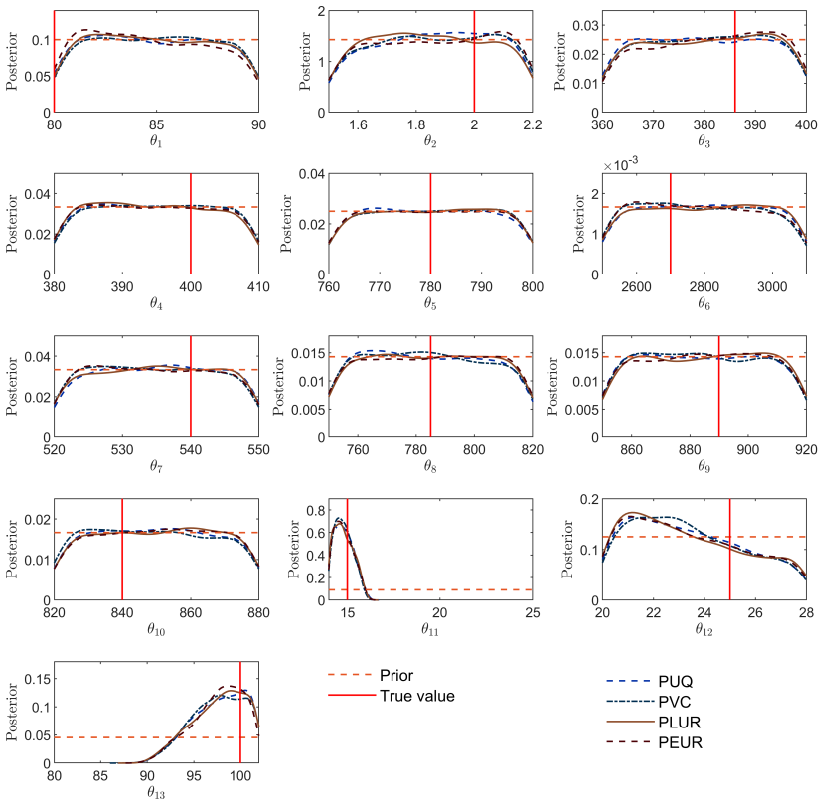
Estimating posteriors and the associated model evidences, with desired accuracy and affordable computational cost, is a core issue of Bayesian model updating, and can be of great challenge given expensive-to-evaluate models and posteriors with complex features such as multi-modalities of unequal importance, nonlinear dependencies and high sharpness. Bayesian Quadrature (BQ) equipped with active learning has emerged as a competitive framework for tackling this challenge, as it provides flexible balance between computational cost and accuracy. The performance of a BQ scheme is fundamentally dictated by the acquisition function as it exclusively governs the active generation of integration points. After reexamining one of the most advanced acquisition function from a prospective inference perspective and reformulating the quadrature rules for prediction, four new acquisition functions, inspired by distinct intuitions on expected rewards, are primarily developed, all of which are accompanied by elegant interpretations and highly efficient numerical estimators. Mathematically, these four acquisition functions measure, respectively, the prediction uncertainty of posterior, the contribution to prediction uncertainty of evidence, as well as the expected reduction of prediction uncertainties concerning posterior and evidence, and thus provide flexibility for highly effective design of integration points. These acquisition functions are further extended to the transitional BQ scheme, along with several specific refinements, to tackle the above-mentioned challenges with high efficiency and robustness. Effectiveness of the developments is ultimately demonstrated with extensive benchmark studies and application to an engineering example.
Editorial analysis
A structured set of objections, weighed in public.
Referee Report
Summary. The paper re-examines an existing acquisition function for Bayesian quadrature (BQ) from a prospective inference viewpoint, reformulates the underlying quadrature rules for prediction, and introduces four new acquisition functions motivated by distinct expected-reward intuitions. These functions respectively quantify posterior predictive uncertainty, the evidence contribution to that uncertainty, and the expected reductions in each; they are accompanied by efficient numerical estimators and extended to a transitional BQ scheme with ad-hoc refinements for robustness. The developments are demonstrated on benchmark problems involving multi-modal, nonlinear, and sharp posteriors as well as an engineering application.
Significance. If the empirical performance gains hold under the stated conditions, the new acquisition functions would supply a principled and flexible toolkit for active point selection in BQ-based Bayesian model updating, potentially improving the trade-off between computational cost and accuracy for expensive forward models with complex posterior features. The explicit interpretations of the acquisition functions also contribute to the conceptual understanding of uncertainty reduction in this setting.
major comments (1)
- [Benchmark studies and transitional BQ extension] The central claim that the four new acquisition functions deliver 'high efficiency and robustness' on posteriors with multi-modalities of unequal importance, nonlinear dependencies, and high sharpness rests on empirical benchmark studies alone. No convergence rates, bias bounds, or worst-case stability analysis for the resulting quadrature estimators are supplied, leaving the translation from expected-reward intuition to numerical reliability unverified (see the description of the benchmark studies and the transitional BQ extension).
minor comments (2)
- Notation for the four new acquisition functions and their estimators should be introduced with explicit definitions and cross-references to the reformulated quadrature rules to improve readability.
- The abstract and introduction would benefit from a concise table or diagram contrasting the existing acquisition function with the four new ones in terms of the uncertainty quantities they target.
Simulated Author's Rebuttal
We thank the referee for the constructive feedback and positive evaluation of the paper's significance. Below we respond to the major comment and indicate the revisions we will make.
read point-by-point responses
-
Referee: [Benchmark studies and transitional BQ extension] The central claim that the four new acquisition functions deliver 'high efficiency and robustness' on posteriors with multi-modalities of unequal importance, nonlinear dependencies, and high sharpness rests on empirical benchmark studies alone. No convergence rates, bias bounds, or worst-case stability analysis for the resulting quadrature estimators are supplied, leaving the translation from expected-reward intuition to numerical reliability unverified (see the description of the benchmark studies and the transitional BQ extension).
Authors: We agree that the claims of efficiency and robustness for the proposed acquisition functions rest on empirical validation. The functions are derived from distinct expected-reward intuitions, each accompanied by efficient numerical estimators, and their performance is demonstrated across benchmark problems that specifically include multi-modal posteriors of unequal importance, nonlinear dependencies, and high sharpness, as well as within the transitional BQ scheme with the described refinements. We do not supply convergence rates, bias bounds, or worst-case stability analysis, as obtaining such theoretical guarantees for these novel acquisition functions under general posterior conditions is technically challenging and lies outside the primary scope of the manuscript, which emphasizes method development and practical applicability. To address the referee's concern, we will revise the manuscript by (i) explicitly qualifying the claims to reflect the empirical nature of the supporting evidence and (ii) adding a short discussion paragraph on the current verification approach and the value of future theoretical work. This constitutes a partial revision that improves transparency while preserving the core contributions. revision: partial
Circularity Check
No significant circularity detected in acquisition function derivations
full rationale
The paper proposes four new acquisition functions motivated by separate intuitions on expected rewards for reducing posterior and evidence prediction uncertainties, with explicit mathematical definitions and numerical estimators provided independently of any fitted parameters or prior results. These are extended to transitional BQ with refinements, and effectiveness is shown via benchmark studies and an engineering application rather than by algebraic reduction to inputs. No self-definitional loops, fitted inputs renamed as predictions, or load-bearing self-citations appear in the described chain; the derivations remain self-contained against external benchmarks.
Axiom & Free-Parameter Ledger
axioms (1)
- domain assumption Bayesian quadrature with active learning can flexibly balance computational cost and accuracy for estimating posteriors and model evidences in complex settings.
Lean theorems connected to this paper
-
IndisputableMonolith/Cost/FunctionalEquation.leanwashburn_uniqueness_aczel unclear?
unclearRelation between the paper passage and the cited Recognition theorem.
four new acquisition functions... measure, respectively, the prediction uncertainty of posterior, the contribution to prediction uncertainty of evidence, as well as the expected reduction of prediction uncertainties
-
IndisputableMonolith/Foundation/DimensionForcing.leanalexander_duality_circle_linking unclear?
unclearRelation between the paper passage and the cited Recognition theorem.
TBQ algorithm... tempering parameter γj... intermediate densities
What do these tags mean?
- matches
- The paper's claim is directly supported by a theorem in the formal canon.
- supports
- The theorem supports part of the paper's argument, but the paper may add assumptions or extra steps.
- extends
- The paper goes beyond the formal theorem; the theorem is a base layer rather than the whole result.
- uses
- The paper appears to rely on the theorem as machinery.
- contradicts
- The paper's claim conflicts with a theorem or certificate in the canon.
- unclear
- Pith found a possible connection, but the passage is too broad, indirect, or ambiguous to say the theorem truly supports the claim.
Reference graph
Works this paper leans on
-
[1]
M. C. Kennedy, A. O’Hagan, Bayesian calibration of computer models, Journal of the Royal Statistical Society: Series B (Statistical Methodology) 63 (3) (2001) 425–464
work page 2001
-
[2]
S. Bi, M. Beer, S. Cogan, J. Mottershead, Stochastic model updating with uncertainty quantification: an overview and tutorial, Mechanical Systems and Signal Processing 204 (2023) 110784
work page 2023
- [3]
-
[4]
Y. Zeng, J. Zeng, M. D. Todd, Z. Hu, Data augmentation based on image translation for bayesian inference-based damage diagnostics of miter gates, ASCE-ASME Journal of Risk and Uncertainty in Engineering Systems, Part B: Mechanical Engineering 11 (1) (2025) 011103
work page 2025
-
[5]
T. Yin, A practical bayesian framework for structural model updating and prediction, ASCE-ASME Journal of Risk and Uncertainty in Engineering Systems, Part A: Civil Engineering 8 (1) (2022) 04021073
work page 2022
-
[6]
A. F. Psaros, X. Meng, Z. Zou, L. Guo, G. E. Karniadakis, Uncertainty quantification in scientific machine learning: Methods, metrics, and comparisons, Journal of Computational Physics 477 (2023) 111902
work page 2023
- [7]
-
[8]
D. Bingham, T. Butler, D. Estep, Inverse problems for physics-based process models, Annual Review of Statistics and Its Application 11 (2024)
work page 2024
-
[9]
A. Bryutkin, M. E. Levine, I. Urteaga, Y. Marzouk, Canonical bayesian linear system identification, arXiv preprint arXiv:2507.11535 (2025)
-
[10]
D. Van Ravenzwaaij, P. Cassey, S. D. Brown, A simple introduction to Markov Chain Monte–Carlo sampling, Psychonomic Bulletin & Review 25 (1) (2018) 143–154
work page 2018
-
[11]
G. L. Jones, Q. Qin, Markov chain Monte Carlo in practice, Annual Review of Statistics and Its Application 9 (1) (2022) 557–578
work page 2022
-
[12]
N. Metropolis, A. W. Rosenbluth, M. N. Rosenbluth, A. H. Teller, E. Teller, Equation of state calcu- lations by fast computing machines, The Journal of Chemical Physics 21 (6) (1953) 1087–1092
work page 1953
-
[13]
W. K. Hastings, Monte Carlo sampling methods using Markov chains and their applications (1970)
work page 1970
-
[14]
R. M. Neal, et al., MCMC using Hamiltonian dynamics, Handbook of markov chain monte carlo 2 (11) (2011) 2
work page 2011
-
[15]
M.Betancourt, S.Byrne, S.Livingstone, M.Girolami, ThegeometricfoundationsofHamiltonianMonte Carlo, Bernoulli (2017) 2257–2298. 44
work page 2017
-
[16]
J. Ching, Y.-C. Chen, Transitional Markov Chain Monte Carlo method for Bayesian model updating, model class selection, and model averaging, Journal of Engineering Mechanics 133 (7) (2007) 816–832
work page 2007
-
[17]
W. Betz, I. Papaioannou, D. Straub, Transitional Markov Chain Monte Carlo: observations and im- provements, Journal of Engineering Mechanics 142 (5) (2016) 04016016
work page 2016
-
[18]
S. L. Cotter, G. O. Roberts, A. M. Stuart, D. White, Mcmc methods for functions: modifying old algorithms to make them faster, Statistical Science 28 (3) (2013) 424–446
work page 2013
- [19]
-
[20]
S. Syed, A. Bouchard-Côté, G. Deligiannidis, A. Doucet, Non-reversible parallel tempering: a scalable highlyparallelMCMCscheme, JournaloftheRoyalStatisticalSocietySeriesB:StatisticalMethodology 84 (2) (2022) 321–350
work page 2022
-
[21]
V. Roy, Convergence diagnostics for Markov Chain Monte Carlo, Annual Review of Statistics and Its Application 7 (1) (2020) 387–412
work page 2020
-
[22]
L. F. South, M. Riabiz, O. Teymur, C. J. Oates, Postprocessing of MCMC, Annual Review of Statistics and Its Application 9 (1) (2022) 529–555
work page 2022
-
[23]
D. G. Tzikas, A. C. Likas, N. P. Galatsanos, The variational approximation for Bayesian inference, IEEE Signal Processing Magazine 25 (6) (2008) 131–146
work page 2008
- [24]
-
[25]
C. W. Fox, S. J. Roberts, A tutorial on variational Bayesian inference, Artificial intelligence review 38 (2012) 85–95
work page 2012
-
[26]
arXiv preprint arXiv:2103.01327 , year=
M.-N. Tran, T.-N. Nguyen, V.-H. Dao, A practical tutorial on variational bayes, arXiv preprint arXiv:2103.01327 (2021)
- [27]
-
[28]
R. Ranganath, S. Gerrish, D. Blei, Black box variational inference, in: Artificial intelligence and statis- tics, PMLR, 2014, pp. 814–822
work page 2014
-
[29]
A. Kucukelbir, D. Tran, R. Ranganath, A. Gelman, D. M. Blei, Automatic differentiation variational inference, Journal of machine learning research 18 (14) (2017) 1–45
work page 2017
-
[30]
D. Rezende, S. Mohamed, Variational inference with normalizing flows, in: International conference on machine learning, PMLR, 2015, pp. 1530–1538
work page 2015
-
[31]
F. Hong, P. Wei, S. Bi, M. Beer, Efficient variational Bayesian model updating by Bayesian active learning, Mechanical Systems and Signal Processing 224 (2025) 112113
work page 2025
-
[32]
P. Ni, J. Li, H. Hao, Q. Han, X. Du, Probabilistic model updating via variational Bayesian inference and adaptive Gaussian process modeling, Computer Methods in Applied Mechanics and Engineering 383 (2021) 113915
work page 2021
-
[33]
I. Yoshida, T. Nakamura, S.-K. Au, Bayesian updating of model parameters using adaptive Gaussian process regression and particle filter, Structural Safety 102 (2023) 102328
work page 2023
-
[34]
R.Baptista, Y.Marzouk, O.Zahm, Ontherepresentationandlearningofmonotonetriangulartransport maps, Foundations of Computational Mathematics 24 (6) (2024) 2063–2108. 45
work page 2024
-
[35]
G. Papamakarios, E. Nalisnick, D. J. Rezende, S. Mohamed, B. Lakshminarayanan, Normalizing flows for probabilistic modeling and inference, Journal of Machine Learning Research 22 (57) (2021) 1–64
work page 2021
- [36]
-
[37]
M. Osborne, R. Garnett, Z. Ghahramani, D. K. Duvenaud, S. J. Roberts, C. Rasmussen, Active learning of model evidence using Bayesian quadrature, Advances in neural information processing systems 25 (2012)
work page 2012
- [38]
-
[39]
J. Song, Z. Liang, P. Wei, M. Beer, Sampling-based adaptive Bayesian quadrature for probabilistic model updating, Computer Methods in Applied Mechanics and Engineering 433 (2025) 117467
work page 2025
-
[40]
M. Kitahara, T. Kitahara, Sequential and adaptive probabilistic integration for Bayesian model updat- ing, Mechanical Systems and Signal Processing 223 (2025) 111825
work page 2025
-
[41]
P. Wei, Bayesian model inference with complex posteriors: Exponential-impact-informed bayesian quadrature, Mechanical Systems and Signal Processing (2025)
work page 2025
-
[42]
L. Acerbi, An exploration of acquisition and mean functions in Variational Bayesian Monte Carlo, in: Symposium on Advances in Approximate Bayesian Inference, PMLR, 2019, pp. 1–10
work page 2019
- [43]
-
[44]
K. Friston, L. Da Costa, N. Sajid, C. Heins, K. Ueltzhöffer, G. A. Pavliotis, T. Parr, The free energy principle made simpler but not too simple, Physics Reports 1024 (2023) 1–29
work page 2023
-
[45]
C. E. Rasmussen, C. K. Williams, Gaussian processes for machine learning, Vol. 2, MIT press Cam- bridge, MA, 2006
work page 2006
-
[46]
C. E. Rasmussen, Z. Ghahramani, Bayesian Monte Carlo, Advances in neural information processing systems (2003) 505–512
work page 2003
-
[47]
P.Wei, X.Zhang, M.Beer, Adaptiveexperimentdesignforprobabilisticintegration, ComputerMethods in Applied Mechanics and Engineering 365 (2020) 113035
work page 2020
-
[48]
F.-X.Briol, C.J.Oates, M.Girolami, M.A.Osborne, D.Sejdinovic, Probabilisticintegration, Statistical Science 34 (1) (2019) 1–22
work page 2019
-
[49]
F. Hong, P. Wei, M. Beer, Parallelization of adaptive Bayesian cubature using multimodal optimization algorithms, Engineering Computations 41 (2) (2024) 413–437
work page 2024
-
[50]
C. Chevalier, D. Ginsbourger, X. Emery, Corrected Kriging update formulae for batch-sequential data assimilation, in: Mathematics of Planet Earth: Proceedings of the 15th Annual Conference of the International Association for Mathematical Geosciences, Springer, 2013, pp. 119–122
work page 2013
-
[51]
T. Zhou, T. Guo, Y. Dong, F. Yang, D. M. Frangopol, Look-ahead active learning reliability analysis based on stepwise margin reduction, Reliability Engineering & System Safety 243 (2024) 109830
work page 2024
-
[52]
P.Wei, Y.Zheng, J.Fu, Y.Xu, W.Gao, Anexpectedintegratederrorreductionfunctionforaccelerating Bayesian active learning of failure probability, Reliability Engineering & System Safety 231 (2023) 108971. 46
work page 2023
-
[53]
P. Wei, Transitional active learning of small probabilities, Computer Methods in Applied Mechanics and Engineering 444 (2025) 118144
work page 2025
-
[54]
C. H. Bennett, Efficient estimation of free energy differences from Monte Carlo data, Journal of Com- putational Physics 22 (2) (1976) 245–268
work page 1976
-
[55]
L. Katafygiotis, K. Zuev, Estimation of small failure probabilities in high dimensions by adaptive linked importance sampling, COMPDYN 2007 (2007). 47
work page 2007
discussion (0)
Sign in with ORCID, Apple, or X to comment. Anyone can read and Pith papers without signing in.