REVIEW 4 major objections 5 minor 88 references
Beyond the Brightest: A Deep Learning Approach to Identifying Major and Minor Galaxy Mergers in CANDELS at $z \sim 1$
T0 review · 4 major / 5 minor · reviewed 2026-08-04 · deepseek-v4-flash
Pith's one-line read A neural network trained on simulated Hubble images can identify faint, minor galaxy mergers at z~1 with about 73% accuracy, a level comparable to networks trained on brighter, lower-redshift samples.
desk verdict Solid mock-image merger classifier with honest failure analysis, but the abstract overclaims real-CANDELS applicability and contradicts the body on the headline accuracy. read the letter →
The pith
A machine-rendered reading of the paper's core claim, the machinery that carries it, and where it could break.
The reading
What carries the argument
The essential mechanism is the mock-image pipeline: simulated galaxies are post-processed with full dust radiative transfer, filtered into three HST bands, convolved with a simulated point-spread function, and embedded in real CANDELS background cutouts, so each image has a known ground-truth label, realistic noise, and contamination by background objects. This gives the network labeled training data close to actual HST observations, letting it learn morphology-based merger signatures rather than artifacts. The CNN itself is a residual convolutional network initialized with weights from a model trained on millions of citizen-scientist galaxy classifications, then fine-tuned on the mock image
What would settle it
Run the trained network on a sample of real CANDELS galaxies with independent, reliable merger labels (e.g., from spectroscopic close pairs or expert visual inspections in fields not used for background cutouts) and measure whether accuracy, purity, and completeness remain near 73% for low-mass and minor mergers. Another concrete test: apply the network to mock images from a different simulation (e.g., with different subgrid physics) and see if accuracy drops; if it does, the network has learned simulation-specific morphologies rather than universal merger features.
Extended reading notes
Core claim
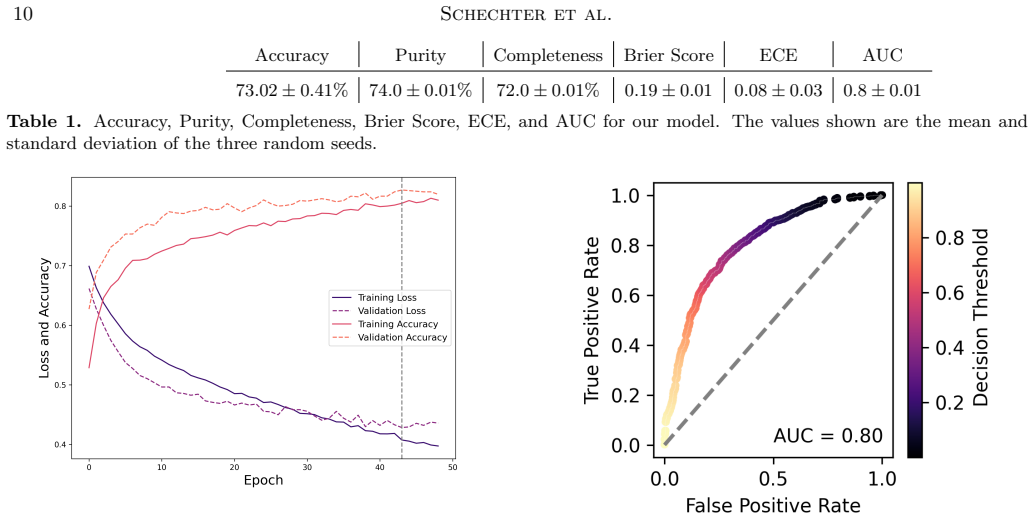
The central discovery is that a CNN fed three HST bands with realistic PSF, noise, and background sources classifies mergers and nonmergers among galaxies with stellar masses from 10^8 to 10^12.5 solar masses and mass ratios down to 1:10 with ~73% balanced accuracy. The authors claim this is the first demonstration that a CNN trained on such a diverse mass and mass-ratio range performs comparably to networks trained on more massive or lower-redshift samples, with ~76% accuracy on major mergers and ~68% on minor mergers. They also find that orientation angle is a fundamental limit: 98% of mergers are identified from at least one of six viewpoints, but only 61% from the majority, meaning some
Load-bearing premise
The load-bearing assumption is that mock CANDELS images built from TNG50 with radiative transfer are similar enough to real CANDELS data—in morphology, noise, and normalization—that the CNN's 73% accuracy on mock images will transfer to real galaxies; the paper itself notes there will always be differences between mock images and real data.
Editorial extensions
If this is right
- The method can produce a merger catalog from existing CANDELS imaging that extends to stellar masses about 100 times lower than previous CNN-based catalogs at z~1.
- Such a catalog would let astronomers measure merger rates for minor mergers at cosmic noon and test whether minor mergers drive the growth of low-mass galaxies.
- The orientation-angle statistics imply that no single-angle image can ever find every merger; catalogs must state incompleteness as a function of viewing angle, and multi-angle or multi-epoch data would be needed to push above the ~90% ceiling.
- The network's reliance on star formation as a discriminating feature means real-data merger samples will inherit an sSFR-dependent selection function; the authors show that removing color information lowers accuracy by ~10%, so color is a genuine aid, not just a confounder.
Reading between the lines
- A testable extension is to apply this network (after domain adaptation) to real CANDELS galaxies and compare its predictions with spectroscopic close-pair catalogs; agreement would validate the mock-to-real transfer, while disagreement would localize where the simulation assumptions break.
- The per-galaxy detectability across six viewpoints could be used as a prior to derive an orientation-unbiased merger rate from single-view observations, a step the paper leaves implicit.
- The sSFR-sensitivity suggests that a real CANDELS catalog built this way will preferentially include star-forming mergers; matching nonmergers in both mass and SFR would reduce false positives but might also suppress the very merger-induced starbursts of scientific interest.
- The same pipeline can be re-run with JWST, Rubin, Roman, or Euclid PSFs and filters; the paper's principle that realistic environments matter more than radiative transfer predicts that retraining on appropriate mock backgrounds is the main cost, not redoing the physics.
Editorial analysis
A structured set of objections, weighed in public.
Referee Report
Summary. This paper trains a ResNet18 CNN, initialized with Zoobot weights, on mock HST/CANDELS three-band images of TNG50 galaxies at 1 ≤ z ≤ 1.5, spanning stellar masses 10^8–10^12.5 M_sun and merger mass ratios μ > 1:10. Merger labels are taken from SubLink merger trees, and mock images are produced with SKIRT radiative transfer, TinyTim PSFs, and real CANDELS background cutouts. The reported test-set performance on a balanced, per-galaxy held-out set is ~73% accuracy, purity, and completeness, with early-stage mergers identified at ~80% and major mergers at ~76%. The paper also analyzes the effect of orientation angle, presents Grad-CAM and UMAP interpretability results, and identifies star formation rate as a confound. The authors conclude that the network is ready to enable merger identification in CANDELS and future surveys.
Significance. If the reported performance transfers to real observations, this would be a valuable extension of CNN-based merger identification to lower stellar masses and higher mass ratios at z ~ 1, a regime that previous work has largely excluded. The experimental design is in several respects careful: all six viewpoints of a galaxy are kept in the same split, results are averaged over three random seeds, and standard metrics plus calibration statistics are reported. The orientation analysis and the explicit sSFR misclassification analysis are honest and informative. However, the central external-validity claim is not yet supported: all evaluation is performed on mock images from the same simulation/pipeline used for training, and the paper's own sSFR analysis indicates a potential confound that may not transfer to real CANDELS data.
major comments (4)
- [Abstract; §5.3] The headline claim that the network 'enables the exploration of ... mergers ... in CANDELS' is supported only by metrics on mock images built from TNG50 with the same SKIRT/CANDELS-background pipeline. The authors concede in §5.3 that 'there will always be differences between mock images and real data' and defer domain adaptation to future work. The 73% accuracy/purity/completeness (Table 1) is therefore a simulation-validated figure, not a demonstrated real-data performance. Please either add a sanity check against existing CANDELS merger catalogs (e.g., visual or non-parametric classifications) or reframe the abstract/conclusion to say the classifier is 'prepared for' rather than 'enables' real-data science.
- [§4.3, Figures 10–11; §2.1] The nonmerger sample is mass-matched but not SFR-matched, and the paper's own UMAP and misclassification analysis show that the network's decisions track sSFR: misclassified nonmergers have higher sSFR and misclassified mergers lower sSFR. Because TNG50 mass-matched mergers have higher sSFR on average (Figure 1), some of the reported accuracy may reflect the network using blue/star-forming structure as a proxy for merging rather than a robust morphological merger signature. This is not circular, but it weakens the morphological claim. Please report performance stratified by sSFR (e.g., accuracy on high-sSFR nonmergers versus low-sSFR nonmergers) or evaluate on an SFR-matched test set, and discuss how much separation remains after controlling for sSFR.
- [Table 1, §4.1] All headline metrics are quoted at the default decision threshold of 0.5 on a balanced test set. At realistic CANDELS merger fractions, the same per-class error rates (completeness ≈ 0.73, false-positive rate ≈ 0.26 from Figure 4) imply purity of roughly 25–40% (e.g., ≈34% at a 15% merger fraction). The paper does not discuss prior correction, threshold selection, or the resulting purity/completeness at realistic operating points. To support the claimed applicability to CANDELS, please include precision–recall curves or recalibrate the threshold for representative merger fractions and state the expected purity at those operating points.
- [Abstract vs. Table 1] The abstract in the arXiv header reports overall accuracy of ~65%, while the abstract in the full text and §4/Table 1 report 73.02 ± 0.41%. This is a direct discrepancy in the central quantitative result. The inconsistency must be reconciled, and if the 65% figure refers to a different configuration it should be clearly explained.
minor comments (5)
- [Eq. (4)] The Brier score is defined with o_t as the network's own final class ('cutoff score of 0.5'), not the true binary label. The standard Brier score compares the predicted probability to the true outcome, (p_t − y_t)^2. As written, the reported Brier score is not a proper scoring rule and its value may be misinterpreted.
- [§3.1 and Figure 3 caption] The text says the best model is chosen by the epoch with the lowest validation loss, but the Figure 3 caption says 'lowest validation accuracy.' Please make the selection criterion consistent.
- [§2.1] The description of 'one mini snapshot on each side of the central full snapshot' within 250 Myr may be asymmetric in time at z = 1.5; a short clarification of the actual snapshot spacing would help reproducibility.
- [Abstract and §2.1] The abstract uses q ≥ 1:10 while the text uses μ > 1:10. Please use one notation consistently and define q/μ at first use.
- [Figure 2 caption] Typo: 'classifiy' should be 'classify'.
Circularity Check
No circularity: merger labels come from TNG50 SubLink merger trees, the test set is held out, and mock-to-real transfer is an acknowledged extrapolation, not a fitted prediction.
full rationale
The derivation chain is self-contained: ground-truth merger/nonmerger labels are assigned by SubLink merger-tree definitions in Section 2.1, independently of the CNN; images are produced through SKIRT radiative transfer and real CANDELS backgrounds (Section 2.2); and the reported accuracy/purity/completeness are computed on a held-out test set from which all six viewpoints of a galaxy are excluded during training (Section 2.3, Table 1). No parameter is fitted to the test set and no fitted quantity is renamed as a prediction. The paper's own limitation statements — e.g., 'there will always be differences between mock images and real data' (Section 5.3), and the sSFR confound discussed in Sections 4.3 and 5.2.3 — concern external validity of applying the network to real CANDELS, not circularity of the mock-image evaluation. The self-citations (Schechter et al. 2025 for the nonmerger matching scheme, Shen et al. and Nevin et al. for the radiative-transfer setup) are methodological and not load-bearing proof of the classification result. The central claim of ~73% accuracy on mock CANDELS images is an honest measurement within one simulation pipeline; the extension to real CANDELS is an unvalidated extrapolation, which is a transferability risk, not a circular step.
Assumptions & free parameters
free parameters (5)
- merger mass-ratio threshold μ > 0.1 =
0.1 (1:10)
- merger snapshot window =
±250 Myr around z=1 and z=1.5
- nonmerger quiescence window =
2 Gyr
- decision threshold =
0.5
- mass-matching tolerance =
e^0.1 with 1.5 expansion factor
assumptions (5)
- domain assumption IllustrisTNG50 physics produces realistic galaxy morphologies and merger properties at z≈1
- domain assumption SubLink/Rodriguez-Gomez merger trees correctly identify true mergers and nonmergers
- domain assumption SKIRT dust radiative transfer with adopted dust-to-metal ratio (0.4 below z=2) and FsPS/Mappings-III SEDs yields realistic CANDELS fluxes
- domain assumption Real CANDELS cutouts without central sources provide representative backgrounds and noise for mock images
- domain assumption Freezing all but the dense layer of ResNet18 preserves enough information for merger identification
Cite this review
Pith. "Pith review of Beyond the Brightest: A Deep Learning Approach to Identifying Major and Minor Galaxy Mergers in CANDELS at $z \sim 1$." pith.science (2026). https://pith.science/paper/PGBQAAOK
@misc{pith2026251012173,
  author       = {Pith},
  title        = {Pith review of: Beyond the Brightest: A Deep Learning Approach to Identifying Major and Minor Galaxy Mergers in CANDELS at $z \sim 1$},
  year         = {2026},
  howpublished = {\url{https://pith.science/paper/PGBQAAOK}},
  note         = {Machine review of arXiv:2510.12173}
}
abstract
Galaxy mergers play an important role in galaxy evolution. Therefore, accurate merger identifications are paramount for achieving a complete understanding of how galaxies evolve. As we enter the era of large, deep, high-resolution imaging surveys, we can observe mergers extending to even lower masses and higher redshifts. Despite low-mass galaxies being more common, many previous merger identification methods were calibrated for high-mass galaxies, which are easier to identify. To prepare for upcoming surveys, we train a convolutional neural network (CNN) using mock $\textit{HST}$ CANDELS images at $z\sim1$ created from the IllustrisTNG50 cosmological simulation. We successfully identify galaxy mergers between a wide range of galaxies ($10^8M_\odot < M_\star < 10^{12.5}M_\odot$, and $q\geq1:10$), achieving overall accuracy, purity, and completeness of $\sim65\%$. We show, for the first time, that a CNN trained on this diverse set of galaxies is capable of identifying major mergers, especially at early stages (74% accuracy), similar to that of networks trained at lower redshifts and/or higher masses (with accuracies between $66-80$%). We discuss the inherent limits of galaxy merger identification due to orientation angle, finding 98% of mergers are correctly identified from at least one angle, and 61% from the majority of angles. We additionally explore the confounding variables, such as star formation, to consider when applying to real data.This network enables the exploration of the impact of previously overlooked mergers of high mass ratio and low stellar masses on galaxy evolution in CANDELS, and can be expanded to surveys from $\textit{JWST}$, Rubin, $\textit{Roman}$, and $\textit{Euclid}$.
Figures


Figures from the paper (6 more)


Reference graph
Works this paper leans on
-
[1]
Turp, M. D. 2018, Monthly Notices of the Royal Astronomical Society, 479, 415, doi: 10.1093/mnras/sty1398
-
[2]
2019, The Wide Field Infrared Survey Telescope: 100 Hubbles for the 2020s
Akeson, R., Armus, L., Bachelet, E., et al. 2019, The Wide Field Infrared Survey Telescope: 100 Hubbles for the 2020s. https://arxiv.org/abs/1902.05569
arXiv 2019
-
[3]
B., D ´ ıaz-Rodr ´ ıguez, N., Del Ser, J., et al
Arrieta, A. B., D ´ ıaz-Rodr ´ ıguez, N., Del Ser, J., et al. 2019, Explainable Artificial Intelligence (XAI): Concepts,
2019
-
[4]
Taxonomies, Opportunities and Challenges toward Responsible AI, arXiv, doi: 10.48550/arXiv.1910.10045
-
[5]
S., Villforth, C., Huertas-Company, M., et al
Avirett-Mackenzie, M. S., Villforth, C., Huertas-Company, M., et al. 2024, Monthly Notices of the Royal Astronomical Society, 528, 6915, doi: 10.1093/mnras/stae183 Galaxy Merger Identification atz∼1 19
-
[6]
2015, Astronomy and Computing, 12, 33, doi: 10.1016/j.ascom.2015.05.006
Baes, M., & Camps, P. 2015, Astronomy and Computing, 12, 33, doi: 10.1016/j.ascom.2015.05.006
-
[7]
2011, The Astrophysical Journal Supplement Series, 196, 22, doi: 10.1088/0067-0049/196/2/22
Baes, M., Verstappen, J., De Looze, I., et al. 2011, The Astrophysical Journal Supplement Series, 196, 22, doi: 10.1088/0067-0049/196/2/22
-
[8]
W., Wilkinson, S., Ferreira, L., et al
Bickley, R. W., Wilkinson, S., Ferreira, L., et al. 2024, Monthly Notices of the Royal Astronomical Society, 534, 2533, doi: 10.1093/mnras/stae2246
Show all 88 references
-
[9]
W., Bottrell, C., Hani, M
Bickley, R. W., Bottrell, C., Hani, M. H., et al. 2021, Monthly Notices of the Royal Astronomical Society, 504, 372, doi: 10.1093/mnras/stab806
2021 doi
-
[10]
Ellison, S. L. 2022, Monthly Notices of the Royal Astronomical Society, 511, 100, doi: 10.1093/mnras/stab3717
2022 doi
-
[11]
H., Teimoorinia, H., et al
Bottrell, C., Hani, M. H., Teimoorinia, H., et al. 2019, Monthly Notices of the Royal Astronomical Society, 490, 5390, doi: 10.1093/mnras/stz2934
2019 doi
-
[12]
J., & Franx, M
Broadhurst, T. J., & Franx, M. 2004, The Astrophysical Journal, 611, L1, doi: 10.1086/423786
2004 doi
-
[13]
Brier, G. W. 1950, Monthly Weather Review, 78, 1, doi: 10.1175/1520-0493(1950)078⟨0001:VOFEIT⟩2.0.CO;2
1950 doi
-
[14]
J., & H¨ außler, B
Buitrago, F., Trujillo, I., Conselice, C. J., & H¨ außler, B. 2013, Monthly Notices of the Royal Astronomical Society, 428, 1460, doi: 10.1093/mnras/sts124
2013 doi
-
[15]
2015, Astronomy and Computing, 9, 20, doi: 10.1016/j.ascom.2014.10.004 —
Camps, P., & Baes, M. 2015, Astronomy and Computing, 9, 20, doi: 10.1016/j.ascom.2014.10.004 —. 2020, SKIRT 9: redesigning an advanced dust radiative transfer code to allow kinematics, line transfer and polarization by aligned dust grains, arXiv, doi: 10.48550/arXiv.2003.00721
-
[16]
K., Bekki, K., & Groves, B
Cavanagh, M. K., Bekki, K., & Groves, B. A. 2021, Monthly Notices of the Royal Astronomical Society, 506, 659, doi: 10.1093/mnras/stab1552
2021 doi
-
[17]
Conroy, C., & Gunn, J. E. 2010, The Astrophysical Journal, 712, 833, doi: 10.1088/0004-637X/712/2/833
2010 doi
-
[18]
E., & White, M
Conroy, C., Gunn, J. E., & White, M. 2009, The Astrophysical Journal, 699, 486, doi: 10.1088/0004-637X/699/1/486
2009 doi
-
[19]
Conselice, C. J. 2003, The Astrophysical Journal Supplement Series, 147, 1, doi: 10.1086/375001 —. 2014, Annual Review of Astronomy and Astrophysics, 52, 291, doi: 10.1146/annurev-astro-081913-040037
2003 doi
-
[21]
A., Schaye, J., Bower, R
Crain, R. A., Schaye, J., Bower, R. G., et al. 2015, Monthly Notices of the Royal Astronomical Society, 450, 1937, doi: 10.1093/mnras/stv725
2015 doi
-
[23]
H., & Fienberg, S
DeGroot, M. H., & Fienberg, S. E. 1983, Journal of the Royal Statistical Society. Series D (The Statistician), 32, 12, doi: 10.2307/2987588
1983 doi
-
[24]
2012, IEEE Signal Processing Magazine, 29, 141, doi: 10.1109/MSP.2012.2211477
Deng, L. 2012, IEEE Signal Processing Magazine, 29, 141, doi: 10.1109/MSP.2012.2211477
2012
-
[25]
W., & Dambre, J
Dieleman, S., Willett, K. W., & Dambre, J. 2015, Monthly Notices of the Royal Astronomical Society, 450, 1441, doi: 10.1093/mnras/stv632 Dom ´ ınguez S´ anchez, H., Huertas-Company, M., Bernardi, M., Tuccillo, D., & Fischer, J. L. 2018, Monthly Notices of the Royal Astronomica...
2015 doi
-
[26]
T., Dale, D
Draine, B. T., Dale, D. A., Bendo, G., et al. 2007, The Astrophysical Journal, 663, 866, doi: 10.1086/518306
2007 doi
-
[27]
J., Mundy, C., et al
Duncan, K., Conselice, C. J., Mundy, C., et al. 2019, The Astrophysical Journal, 876, 110, doi: 10.3847/1538-4357/ab148a
2019 doi
- [28]
-
[29]
J., Duncan, K., et al
Ferreira, L., Conselice, C. J., Duncan, K., et al. 2020, The Astrophysical Journal, 895, 115, doi: 10.3847/1538-4357/ab8f9b
2020 doi
-
[30]
J., Kuchner, U., & Tohill, C.-B
Ferreira, L., Conselice, C. J., Kuchner, U., & Tohill, C.-B. 2022, The Astrophysical Journal, 931, 34, doi: 10.3847/1538-4357/ac66ea
2022 doi
-
[31]
L., Patton, D
Ferreira, L., Ellison, S. L., Patton, D. R., et al. 2024a, Galaxy evolution in the post-merger regime I – Most merger-induced in-situ stellar mass growth happens post-coalescence, arXiv. http://arxiv.org/abs/2410.06356
-
[32]
J., Sazonova, E., et al
Ferreira, L., Conselice, C. J., Sazonova, E., et al. 2023, The Astrophysical Journal, 955, 94, doi: 10.3847/1538-4357/acec76
2023 doi
-
[33]
W., Ellison, S
Ferreira, L., Bickley, R. W., Ellison, S. L., et al. 2024b, Monthly Notices of the Royal Astronomical Society, 533, 2547, doi: 10.1093/mnras/stae1885
-
[34]
Finkelstein, S. L. 2016, Publications of the Astronomical Society of Australia, 33, e037, doi: 10.1017/pasa.2016.26
2016 doi
-
[35]
P., Mather, J
Gardner, J. P., Mather, J. C., Clampin, M., et al. 2006, SSRv, 123, 485, doi: 10.1007/s11214-006-8315-7
2006 doi
-
[36]
A., Kocevski, D
Grogin, N. A., Kocevski, D. D., Faber, S. M., et al. 2011, The Astrophysical Journal Supplement Series, 197, 35, doi: 10.1088/0067-0049/197/2/35 20Schechter et al
2011 doi
-
[37]
A., Sutherland, R
Groves, B., Dopita, M. A., Sutherland, R. S., et al. 2008, The Astrophysical Journal Supplement Series, 176, 438, doi: 10.1086/528711
2008 doi
-
[38]
C., Giavalisco, M., et al
Guo, Y., Ferguson, H. C., Giavalisco, M., et al. 2013, The Astrophysical Journal Supplement Series, 207, 24, doi: 10.1088/0067-0049/207/2/24
2013 doi
-
[39]
2015, Deep Residual Learning for Image Recognition, arXiv, doi: 10.48550/arXiv.1512.03385 Ivezi´ c,\., Kahn, S
He, K., Zhang, X., Ren, S., & Sun, J. 2015, Deep Residual Learning for Image Recognition, arXiv, doi: 10.48550/arXiv.1512.03385 Ivezi´ c,\., Kahn, S. M., Tyson, J. A., et al. 2019, The Astrophysical Journal, 873, 111, doi: 10.3847/1538-4357/ab042c J. Bouwens, R., Aravena, M., ...
-
[40]
Johnson, B. D. 2021, bd-j/sedpy: sedpy v0.2.0, Zenodo, doi: 10.5281/zenodo.4582723
2021 doi
-
[41]
S., Mozena, M., Kocevski, D., et al
Kartaltepe, J. S., Mozena, M., Kocevski, D., et al. 2015, The Astrophysical Journal Supplement Series, 221, 11, doi: 10.1088/0067-0049/221/1/11
2015 doi
-
[42]
2014, Monthly Notices of the Royal Astronomical Society, 440, 2944, doi: 10.1093/mnras/stu338
Kaviraj, S. 2014, Monthly Notices of the Royal Astronomical Society, 440, 2944, doi: 10.1093/mnras/stu338
2014 doi
-
[43]
2017, Monthly Notices of the Royal Astronomical Society, 467, 4739, doi: 10.1093/mnras/stx126
Kaviraj, S., Laigle, C., Kimm, T., et al. 2017, Monthly Notices of the Royal Astronomical Society, 467, 4739, doi: 10.1093/mnras/stx126
2017 doi
- [44]
-
[45]
M., Faber, S
Koekemoer, A. M., Faber, S. M., Ferguson, H. C., et al. 2011, The Astrophysical Journal Supplement Series, 197, 36, doi: 10.1088/0067-0049/197/2/36
2011 doi
-
[46]
E., Hook, R
Krist, J. E., Hook, R. N., & Stoehr, F. 2011, 8127, 81270J, doi: 10.1117/12.892762
2011 doi
-
[48]
M., Jonsson, P., Cox, T
Lotz, J. M., Jonsson, P., Cox, T. J., & Primack, J. R. 2008, Monthly Notices of the Royal Astronomical Society, 391, 1137, doi: 10.1111/j.1365-2966.2008.14004.x
2008
-
[49]
M., Primack, J., & Madau, P
Lotz, J. M., Primack, J., & Madau, P. 2004, The Astronomical Journal, 128, 163, doi: 10.1086/421849
2004 doi
-
[50]
B., McIntosh, D
Mantha, K. B., McIntosh, D. H., Brennan, R., et al. 2018, Monthly Notices of the Royal Astronomical Society, 475, 1549, doi: 10.1093/mnras/stx3260
2018 doi
-
[51]
L., et al
Margalef-Bentabol, B., Wang, L., Marca, A. L., et al. 2024, Astronomy & Astrophysics, 687, A24, doi: 10.1051/0004-6361/202348239
2024 doi
-
[52]
2018, Monthly Notices of the Royal Astronomical Society, 480, 5113, doi: 10.1093/mnras/sty2206
Marinacci, F., Vogelsberger, M., Pakmor, R., et al. 2018, Monthly Notices of the Royal Astronomical Society, 480, 5113, doi: 10.1093/mnras/sty2206
2018 doi
-
[53]
2018, Monthly Notices of the Royal Astronomical Society, 480, 2266, doi: 10.1093/mnras/sty1936
Pichon, C. 2018, Monthly Notices of the Royal Astronomical Society, 480, 2266, doi: 10.1093/mnras/sty1936
2018 doi
- [54]
-
[55]
2009, Monthly Notices of the Royal Astronomical Society, 395, 2196, doi: 10.1111/j.1365-2966.2009.14677.x
Almaini, O. 2009, Monthly Notices of the Royal Astronomical Society, 395, 2196, doi: 10.1111/j.1365-2966.2009.14677.x
2009
-
[56]
C., & Hernquist, L
Mihos, J. C., & Hernquist, L. 1996, The Astrophysical Journal, 464, 641, doi: 10.1086/177353
1996 doi
-
[57]
P., Cooper, G., & Hauskrecht, M
Naeini, M. P., Cooper, G., & Hauskrecht, M. 2015, Proceedings of the AAAI Conference on Artificial Intelligence, 29, doi: 10.1609/aaai.v29i1.9602
2015 doi
-
[58]
P., Pillepich, A., Springel, V., et al
Naiman, J. P., Pillepich, A., Springel, V., et al. 2018, Monthly Notices of the Royal Astronomical Society, 477, 1206, doi: 10.1093/mnras/sty618
2018 doi
-
[59]
2018, Monthly Notices of the Royal Astronomical Society, 475, 624, doi: 10.1093/mnras/stx3040 —
Nelson, D., Pillepich, A., Springel, V., et al. 2018, Monthly Notices of the Royal Astronomical Society, 475, 624, doi: 10.1093/mnras/stx3040 —. 2019, Monthly Notices of the Royal Astronomical Society, 490, 3234, doi: 10.1093/mnras/stz2306
2018 doi
-
[60]
2019, The Astrophysical Journal, 872, 76, doi: 10.3847/1538-4357/aafd34
Nevin, R., Blecha, L., Comerford, J., & Greene, J. 2019, The Astrophysical Journal, 872, 76, doi: 10.3847/1538-4357/aafd34
2019 doi
-
[61]
B., Ellis, R
Newman, A. B., Ellis, R. S., Bundy, K., & Treu, T. 2012, The Astrophysical Journal, 746, 162, doi: 10.1088/0004-637X/746/2/162
2012 doi
-
[62]
Niculescu-Mizil, A., & Caruana, R. 2005, in Proceedings of the 22nd international conference on Machine learning, ICML ’05 (New York, NY, USA: Association for Computing Machinery), 625–632, doi: 10.1145/1102351.1102430
2005
-
[63]
A., Bouwens, R
Oesch, P. A., Bouwens, R. J., Illingworth, G. D., Labb´ e, I., & Stefanon, M. 2018, The Astrophysical Journal, 855, 105, doi: 10.3847/1538-4357/aab03f
2018 doi
-
[64]
C., Bottrell, C., Walmsley, M., et al
Omori, K. C., Bottrell, C., Walmsley, M., et al. 2023, Astronomy and Astrophysics, 679, A142, doi: 10.1051/0004-6361/202346743
2023 doi
-
[65]
2009, The Astrophysical Journal, 706, 1136, doi: 10.1088/0004-637X/706/2/1136
Ouchi, M., Mobasher, B., Shimasaku, K., et al. 2009, The Astrophysical Journal, 706, 1136, doi: 10.1088/0004-637X/706/2/1136
2009 doi
-
[66]
J., Wang, L., Trayford, J
Pearson, W. J., Wang, L., Trayford, J. W., Petrillo, C. E., & Tak, F. F. S. v. d. 2019, Astronomy & Astrophysics, 626, A49, doi: 10.1051/0004-6361/201935355 Galaxy Merger Identification atz∼1 21
2019 doi
-
[67]
2018, Monthly Notices of the Royal Astronomical Society, 475, 648, doi: 10.1093/mnras/stx3112
Pillepich, A., Nelson, D., Hernquist, L., et al. 2018, Monthly Notices of the Royal Astronomical Society, 475, 648, doi: 10.1093/mnras/stx3112
2018 doi
-
[68]
2019, Monthly Notices of the Royal Astronomical Society, 490, 3196, doi: 10.1093/mnras/stz2338 Planck Collaboration, Ade, P
Pillepich, A., Nelson, D., Springel, V., et al. 2019, Monthly Notices of the Royal Astronomical Society, 490, 3196, doi: 10.1093/mnras/stz2338 Planck Collaboration, Ade, P. A. R., Aghanim, N., et al. 2016, Astronomy and Astrophysics, 594, A13, doi: 10.1051/0004-6361/201525830
2019 doi
-
[69]
2015, Monthly Notices of the Royal Astronomical Society, 449, 49, doi: 10.1093/mnras/stv264
Rodriguez-Gomez, V., Genel, S., Vogelsberger, M., et al. 2015, Monthly Notices of the Royal Astronomical Society, 449, 49, doi: 10.1093/mnras/stv264
2015 doi
-
[70]
F., Lotz, J
Rodriguez-Gomez, V., Snyder, G. F., Lotz, J. M., et al. 2019, MNRAS, 483, 4140, doi: 10.1093/mnras/sty3345
2019 doi
-
[71]
S., Snyder, G
Rose, C., Kartaltepe, J. S., Snyder, G. F., et al. 2023, The Astrophysical Journal, 942, 54, doi: 10.3847/1538-4357/ac9f10 —. 2024, The Astrophysical Journal, 976, L8, doi: 10.3847/2041-8213/ad8dd4
2023 doi
-
[72]
2014, A&A, 561, A77, doi: 10.1051/0004-6361/201322593
Saftly, W., Baes, M., & Camps, P. 2014, A&A, 561, A77, doi: 10.1051/0004-6361/201322593
2014 doi
-
[73]
2022, Astronomy &; Astrophysics, 662, A112, doi: 10.1051/0004-6361/202141938
Scaramella, R., Amiaux, J., Mellier, Y., et al. 2022, Astronomy &; Astrophysics, 662, A112, doi: 10.1051/0004-6361/202141938
2022 doi
-
[74]
2005, Astronomy & Astrophysics, 437, 861, doi: 10.1051/0004-6361:20042363
Schartmann, M., Meisenheimer, K., Camenzind, M., Wolf, S., & Henning, T. 2005, Astronomy & Astrophysics, 437, 861, doi: 10.1051/0004-6361:20042363
2005 doi
-
[75]
A., Bower, R
Schaye, J., Crain, R. A., Bower, R. G., et al. 2015, Monthly Notices of the Royal Astronomical Society, 446, 521, doi: 10.1093/mnras/stu2058
2015 doi
-
[76]
L., Genel, S., Terrazas, B., et al
Schechter, A. L., Genel, S., Terrazas, B., et al. 2025, The Astrophysical Journal, 989, 149, doi: 10.3847/1538-4357/ade791
2025 doi
-
[77]
R., Cogswell, M., Das, A., et al
Selvaraju, R. R., Cogswell, M., Das, A., et al. 2020, International Journal of Computer Vision, 128, 336, doi: 10.1007/s11263-019-01228-7
2020 doi
-
[78]
2022, Monthly Notices of the Royal Astronomical Society, 510, 5560, doi: 10.1093/mnras/stab3794 —
Shen, X., Vogelsberger, M., Nelson, D., et al. 2022, Monthly Notices of the Royal Astronomical Society, 510, 5560, doi: 10.1093/mnras/stab3794 —. 2020, Monthly Notices of the Royal Astronomical Society, 495, 4747, doi: 10.1093/mnras/staa1423
2022 doi
-
[79]
2024, MNRAS, 534, 1433, doi: 10.1093/mnras/stae2156
Shen, X., Vogelsberger, M., Borrow, J., et al. 2024, MNRAS, 534, 1433, doi: 10.1093/mnras/stae2156
2024 doi
-
[80]
D., Lintott, C., Willett, K
Simmons, B. D., Lintott, C., Willett, K. W., et al. 2017, Monthly Notices of the Royal Astronomical Society, 464, 4420, doi: 10.1093/mnras/stw2587
2017 doi
-
[81]
2013, Deep Inside Convolutional Networks: Visualising Image Classification Models and Saliency Maps, arXiv, doi: 10.48550/arXiv.1312.6034
Simonyan, K., Vedaldi, A., & Zisserman, A. 2013, Deep Inside Convolutional Networks: Visualising Image Classification Models and Saliency Maps, arXiv, doi: 10.48550/arXiv.1312.6034
-
[82]
J., Simmons, B
Smethurst, R. J., Simmons, B. D., G´ eron, T., et al. 2025, Monthly Notices of the Royal Astronomical Society, doi: 10.1093/mnras/staf506
2025 doi
-
[83]
F., Rodriguez-Gomez, V., Lotz, J
Snyder, G. F., Rodriguez-Gomez, V., Lotz, J. M., et al. 2019, Monthly Notices of the Royal Astronomical Society, 486, 3702, doi: 10.1093/mnras/stz1059
2019 doi
-
[84]
2018, Monthly Notices of the Royal Astronomical Society, 475, 676, doi: 10.1093/mnras/stx3304
Springel, V., Pakmor, R., Pillepich, A., et al. 2018, Monthly Notices of the Royal Astronomical Society, 475, 676, doi: 10.1093/mnras/stx3304
2018 doi
-
[85]
1972, The Astrophysical Journal, 178, 623, doi: 10.1086/151823
Toomre, A., & Toomre, J. 1972, The Astrophysical Journal, 178, 623, doi: 10.1086/151823
1972 doi
-
[86]
F., Vogelsberger, M., et al
Torrey, P., Snyder, G. F., Vogelsberger, M., et al. 2015, MNRAS, 447, 2753, doi: 10.1093/mnras/stu2592
2015 doi
-
[87]
2014, Monthly Notices of the Royal Astronomical Society, 444, 1518, doi: 10.1093/mnras/stu1536
Vogelsberger, M., Genel, S., Springel, V., et al. 2014, Monthly Notices of the Royal Astronomical Society, 444, 1518, doi: 10.1093/mnras/stu1536
2014 doi
-
[88]
2020, Monthly Notices of the Royal Astronomical Society, 492, 5167, doi: 10.1093/mnras/staa137
Vogelsberger, M., Nelson, D., Pillepich, A., et al. 2020, Monthly Notices of the Royal Astronomical Society, 492, 5167, doi: 10.1093/mnras/staa137
2020 doi
-
[89]
2023, Journal of Open Source Software, 8, 5312, doi: 10.21105/joss.05312
Walmsley, M., Allen, C., Aussel, B., et al. 2023, Journal of Open Source Software, 8, 5312, doi: 10.21105/joss.05312
2023 doi
-
[90]
L., Bottrell, C., et al
Wilkinson, S., Ellison, S. L., Bottrell, C., et al. 2024, Monthly Notices of the Royal Astronomical Society, 528, 5558, doi: 10.1093/mnras/stae287
2024 doi
-
[91]
W., Galloway, M
Willett, K. W., Galloway, M. A., Bamford, S. P., et al. 2017, Monthly Notices of the Royal Astronomical Society, 464, 4176, doi: 10.1093/mnras/stw2568 ´Ciprijanovi´ c, A., Snyder, G. F., Nord, B., & Peek, J. E. G. 2020, Astronomy and Computing, 32, 100390, doi: 10.1016/j.ascom...
2017
Reviewed August 4, 2026 · model on record in the stance chip above.
Discussion (0). Continue with ORCID to comment.