The Complex Dimensions of Every Sierpinski Carpet Modification of Dust Type
Pith reviewed 2026-05-18 06:24 UTC · model grok-4.3
The pith
An algorithm computes the complex dimensions of every dust-type modification of the Sierpinski carpet.
A machine-rendered reading of the paper's core claim, the machinery that carries it, and where it could break.
Core claim
The paper establishes an analytical and combinatorial algorithm to compute the complex dimensions of every Sierpiński Carpet modification of Dust Type using fractal zeta functions. The constructions divide a square into an n by n grid and remove a subset of squares at each iteration, repeating the process on the remaining squares, such that the result is a dust-type set with a path-connected complement.
What carries the argument
The fractal zeta function, whose poles determine the complex dimensions, applied through a combinatorial analysis of the grid removal patterns at each step.
If this is right
- Complex dimensions become computable for every valid iterative removal pattern that produces a dust-type carpet.
- The method classifies these fractals according to the full set of complex dimensions arising from their scaling rules.
- No separate zeta function derivation is needed for each new modification once the combinatorial rules are fixed.
- The oscillatory contributions to the geometry are fully captured for the entire family of such sets.
Where Pith is reading between the lines
- The same combinatorial approach to zeta functions could be tested on other self-similar sets whose complements remain connected.
- The resulting dimension lists might be compared with numerical spectra from boundary-value problems on domains bounded by these fractals.
- Explicit calculations for small n would allow direct checks against existing tables for the classical Sierpinski carpet itself.
Load-bearing premise
The constructions yield dust-type carpets with path-connected complement for which the fractal zeta function method directly produces the complex dimensions without additional restrictions or exceptions.
What would settle it
Apply the algorithm to one specific low-order grid removal pattern, extract the predicted complex dimensions, and check whether they match the poles found by independent numerical approximation of the corresponding fractal zeta function.
Figures








read the original abstract
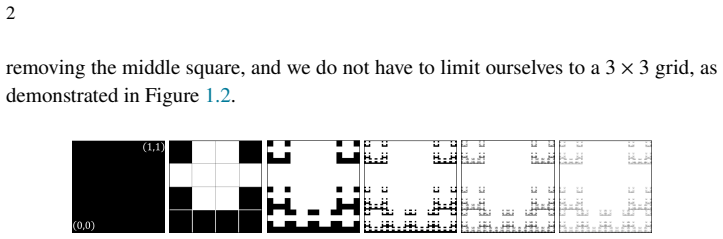
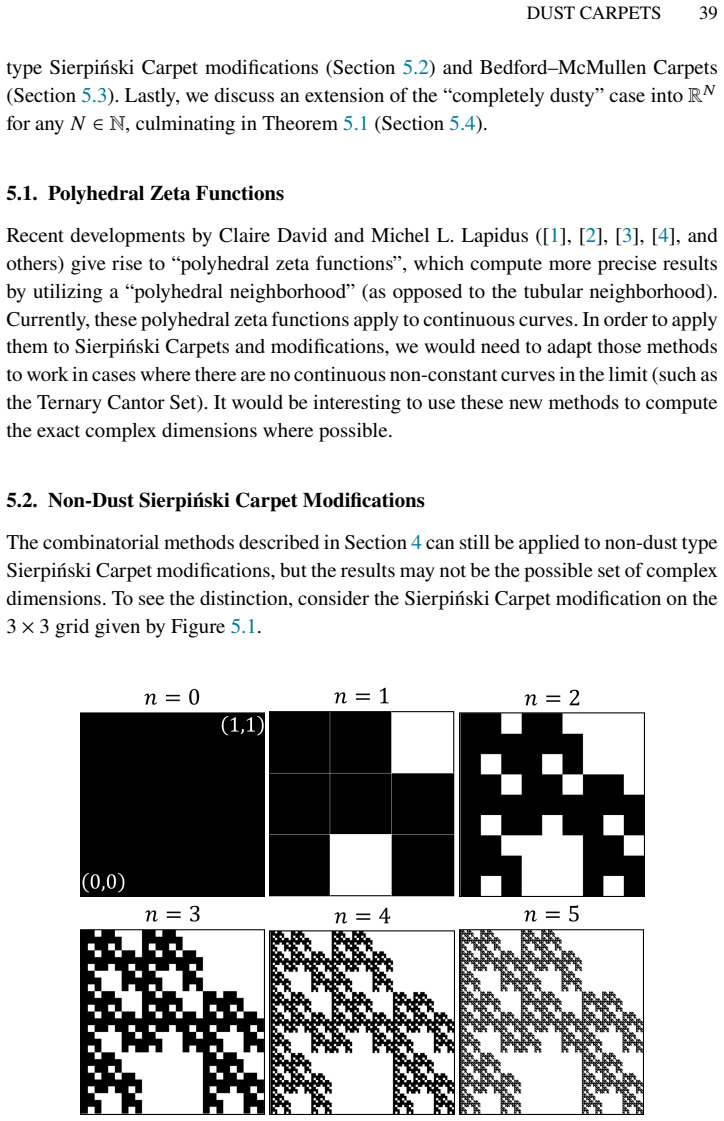
We investigate modified Sierpi\'nski Carpet fractals, constructed by dividing a square into a square $n \times n$ grid, removing a subset of the squares at each step, and then repeating that process for each square remaining in that grid. If enough squares are removed and in the proper places, we get ``Dust Type'' carpets, which have a path-connected complement and are themselves not path-connected. We study these fractals using the Fractal Zeta Functions, first introduced by Michel Lapidus, Goran Radunovi\'c, and Darko \vZubrini\'c in their book \emph{Fractal Zeta Functions and Fractal Drums}, from which we devised an analytical and combinatorial algorithm to compute the complex dimensions of every Sierpi\'nski Carpet modification of Dust Type.
Editorial analysis
A structured set of objections, weighed in public.
Referee Report
Summary. The manuscript constructs modified Sierpiński carpets of dust type by iteratively removing a chosen subset of squares from an n×n grid so that the limit set is totally disconnected while its complement remains path-connected. It then applies the fractal zeta function framework of Lapidus–Radunović–Žubrinić and presents an analytical-combinatorial algorithm claimed to compute the complex dimensions of every such modification.
Significance. If the algorithm is shown to be rigorously derived from the zeta-function definition and to apply uniformly without extra singularities for arbitrary removal patterns, the work would supply a systematic, non-case-by-case method for obtaining complex dimensions in a broad family of self-similar fractals. This would usefully extend the cited book’s theory and could support further spectral and geometric investigations.
major comments (3)
- [§3] §3 (Construction and dust-type conditions): the topological requirements (path-connected complement, set not path-connected) are stated but not shown to guarantee that the fractal zeta function remains meromorphic in the expected half-plane or that its poles coincide exactly with the dimensions produced by the algorithm; arbitrary removal patterns may introduce overlaps or scaling relations that alter the product formula for the zeta function.
- [§4] §4 (Description of the algorithm): the combinatorial procedure is asserted to extract all complex dimensions directly from the zeta function, yet no derivation is supplied that starts from the explicit expression for the zeta function (product over retained and removed squares) and arrives at the claimed pole locations; without this step the claim that the algorithm works for every qualifying removal pattern remains unsubstantiated.
- [§5] §5 (Examples and verification): no concrete computation of the zeta function, its explicit poles, or comparison with a known case (e.g., the classical Sierpiński carpet) is given for any specific n and removal subset; the absence of such verification examples leaves the soundness of the algorithm untested.
minor comments (1)
- [§2] The notation used to label the retained versus removed squares in the iterative grid could be made more explicit to prevent ambiguity when the algorithm is applied to new patterns.
Simulated Author's Rebuttal
We thank the referee for the careful reading and constructive comments on our manuscript. We address each major comment point by point below and indicate the revisions we will make to strengthen the presentation and rigor.
read point-by-point responses
-
Referee: §3 (Construction and dust-type conditions): the topological requirements (path-connected complement, set not path-connected) are stated but not shown to guarantee that the fractal zeta function remains meromorphic in the expected half-plane or that its poles coincide exactly with the dimensions produced by the algorithm; arbitrary removal patterns may introduce overlaps or scaling relations that alter the product formula for the zeta function.
Authors: The dust-type conditions are chosen precisely so that the retained subsquares at each iteration satisfy the open set condition: the path-connected complement ensures that the holes connect the exterior without creating unintended overlaps between scaled copies. Under these conditions the fractal zeta function admits the standard product formula from the Lapidus–Radunović–Žubrinić framework and is meromorphic in the expected half-plane, with poles exactly at the complex dimensions given by the algorithm. We agree, however, that this implication is not proved explicitly in the current text. In the revision we will insert a short proposition in §3 establishing that any removal pattern meeting the dust-type criteria yields an IFS obeying the open set condition, thereby confirming the product formula and the location of the poles. revision: yes
-
Referee: §4 (Description of the algorithm): the combinatorial procedure is asserted to extract all complex dimensions directly from the zeta function, yet no derivation is supplied that starts from the explicit expression for the zeta function (product over retained and removed squares) and arrives at the claimed pole locations; without this step the claim that the algorithm works for every qualifying removal pattern remains unsubstantiated.
Authors: We acknowledge that the manuscript states the algorithm without supplying the intermediate steps that connect the explicit product expression for the zeta function to the pole locations. The algorithm proceeds by forming the denominator polynomial whose degree equals the number of retained squares and whose roots are the complex dimensions; the combinatorial counting simply enumerates the coefficients of that polynomial. To remedy the omission we will add a dedicated subsection in §4 that begins with the product formula, derives the characteristic equation, and shows how the combinatorial procedure extracts its roots. This derivation will be written so that it applies uniformly to every removal pattern satisfying the dust-type hypotheses. revision: yes
-
Referee: §5 (Examples and verification): no concrete computation of the zeta function, its explicit poles, or comparison with a known case (e.g., the classical Sierpiński carpet) is given for any specific n and removal subset; the absence of such verification examples leaves the soundness of the algorithm untested.
Authors: We agree that the lack of explicit worked examples is a genuine weakness. The revised manuscript will contain a new subsection in §5 that presents two fully computed cases: a 2×2 dust-type modification and a 3×3 modification with a minimal admissible removal set. For each case we will write the explicit product form of the zeta function, apply the algorithm to locate the poles, and tabulate the resulting complex dimensions. Although the classical Sierpiński carpet is not of dust type, we will also include a brief comparison remark noting how the algorithm recovers the known dimensions when the removal pattern is adjusted to the carpet case. revision: yes
Circularity Check
No significant circularity detected
full rationale
The paper applies the established fractal zeta function framework from the independent 2017 book by Lapidus, Radunović, and Žubrinić to a family of dust-type Sierpiński carpet modifications defined by explicit iterative removal rules on an n×n grid. The claimed analytical/combinatorial algorithm is presented as a direct consequence of that external method applied to the given constructions; no equation or result is shown to be obtained by fitting a parameter to a subset of the target data and then relabeling it as a prediction, nor does any central claim reduce to a self-citation chain or to a quantity defined in terms of itself. The topological dust-type conditions are used only to select the class of sets to which the pre-existing zeta-function theory is asserted to apply, without circular redefinition.
Axiom & Free-Parameter Ledger
axioms (1)
- domain assumption Fractal zeta functions, as defined in the cited book, determine the complex dimensions of the dust-type Sierpinski carpet modifications.
Lean theorems connected to this paper
-
IndisputableMonolith/Foundation/AlexanderDuality.leanalexander_duality_circle_linking unclear?
unclearRelation between the paper passage and the cited Recognition theorem.
We study these fractals using the Fractal Zeta Functions... from which we devised an analytical and combinatorial algorithm to compute the complex dimensions of every Sierpiński Carpet modification of Dust Type.
-
IndisputableMonolith/Cost/FunctionalEquation.leanwashburn_uniqueness_aczel unclear?
unclearRelation between the paper passage and the cited Recognition theorem.
P(A) ⊆ {log_p(m) + 2πij/ln(p) : j∈Z} ∪ ⋃_{r∈R} {log_p(r) + 2πij/ln(p) : j∈Z}
What do these tags mean?
- matches
- The paper's claim is directly supported by a theorem in the formal canon.
- supports
- The theorem supports part of the paper's argument, but the paper may add assumptions or extra steps.
- extends
- The paper goes beyond the formal theorem; the theorem is a base layer rather than the whole result.
- uses
- The paper appears to rely on the theorem as machinery.
- contradicts
- The paper's claim conflicts with a theorem or certificate in the canon.
- unclear
- Pith found a possible connection, but the passage is too broad, indirect, or ambiguous to say the theorem truly supports the claim.
Reference graph
Works this paper leans on
-
[1]
C. David, M. L. Lapidus,Polyhedral neighborhoods vs. tubular neighborhoods: new insights for fractal zeta functions and complex dimensions. Ramanujan J 67, 73 (2025). https://doi.org/10.1007/s11139-024-01023-0
-
[2]
C. David, M. L. Lapidus,Understanding Fractality: A Polyhedral Approach to the Koch Curve and its Complex Dimensions, Asymptotic Analysis (2025), vol. 145, issue 1. https://doi.org/10.1177/09217134241308435 46
-
[3]
C. David, M. L. Lapidus,Weierstrass Fractal Drums - I - A Glimpse of Complex Dimen- sions. Advanced Mathematics, vol. 481 (2025), 110545. https://doi.org/10.1016/j.aim.2025.110545
-
[4]
Mathematische Zeitschrift 308, 35 (2024)
C.David,M.L.Lapidus,WeierstrassFractalDrums-II-TowardsaFractalCohomology. Mathematische Zeitschrift 308, 35 (2024). https://doi.org/10.1007/s00209-024-03547-z
-
[5]
K.J.Falconer,TheGeometryofFractalSets.CambridgeTractsinMathematics,Cambridge University Press, 1985
work page 1985
- [6]
-
[7]
M. L. Lapidus,An Overview of Complex Fractal Dimensions: From Fractal Strings to Fractal Drums, and Back. Contemporary Mathematics, American Mathematics Society, Providence, RI, Volume 731, pg. 143-265, 2019
work page 2019
- [8]
-
[9]
M. L. Lapidus, G. Radunović,An Invitation to Fractal Geometry: Fractal Dimensions, Self-Similarity,andFractalCurves.GraduateStudiesinMathematics,Vol.247,American Mathematical Society, Providence, R.I., 2024
work page 2024
-
[10]
M. L. Lapidus, M. Frankenhuijsen,Fractal Geometry, Complex Dimensions, and Zeta Functions: Geometry and Spectra of Fractal Strings, second revised and enlarged edition, Springer Monographs in Mathematics, Springer, New York, 2013
work page 2013
-
[11]
Masters thesis, California Polytechnic State University, San Luis Obispo, 2023
G.Leathrum,E.Pearse,ComplexDimensionsOf100DifferentSierpińskiCarpetModific- ations. Masters thesis, California Polytechnic State University, San Luis Obispo, 2023
work page 2023
-
[12]
W. Sierpiński,Sur une courbe cantorienne qui contient une image biunivoque et continue de toute courbe donnée. C. R. Acad. Sci. Paris (in French), 1916. 162: 629-632. JFM 46.0295.02. ISSN 0001-4036 Jade Leathrum Department of Mathematics, University of California Riverside, 900 University Avenue, Riverside, CA 92521-0135, USA; jade.leathrum@ucr.edu
work page 1916
discussion (0)
Sign in with ORCID, Apple, or X to comment. Anyone can read and Pith papers without signing in.