A multilayer level-set method for eikonal-based traveltime tomography
Pith reviewed 2026-05-18 06:30 UTC · model grok-4.3
The pith
A single level-set function with multiple i_n-level sets represents arbitrarily many interfaces for eikonal traveltime tomography.
A machine-rendered reading of the paper's core claim, the machinery that carries it, and where it could break.
Core claim
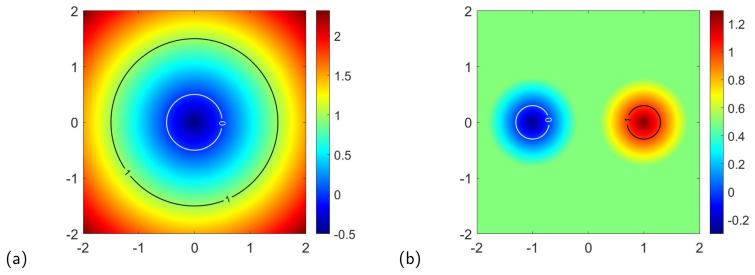
The multilayer level-set method represents multiple phases through a sequence of i_n-level sets, with the function designed to behave like a local signed-distance function near each i_n-level set. This single formulation captures arbitrarily many interfaces and subregions. First-arrival traveltimes are obtained as viscosity solutions of the eikonal equation, Fréchet derivatives of the misfit are computed by the adjoint state method, and the inversion is stabilized by multilayer reinitialization, arc-length penalization, and Sobolev smoothing.
What carries the argument
Multilayer level-set representation in which one function uses a sequence of i_n-level sets, each locally resembling a signed-distance function.
If this is right
- Complex discontinuous slowness models containing multiple phases and interfaces can be recovered from first-arrival traveltimes without explicit interface tracking.
- First-arrival traveltimes are obtained inside the Eulerian framework as viscosity solutions of the eikonal equation.
- Fréchet derivatives needed for the inversion are supplied by the adjoint-state method.
- Multilayer reinitialization combined with arc-length penalization and Sobolev smoothing keeps the reconstructed interfaces sharp and the inversion stable.
- An illumination-based error measure supplies an additional diagnostic for reconstruction quality.
Where Pith is reading between the lines
- The same single-function representation could be reused for other interface-rich inverse problems once the eikonal solver and adjoint are replaced.
- The illumination-based diagnostic might be combined with standard misfit norms to decide when to stop iterations or adapt regularization weights.
- Because the method stays Eulerian, it may extend directly to three-dimensional domains or to problems that include multiple wave types.
Load-bearing premise
Near each i_n-level set the function behaves like a local signed-distance function.
What would settle it
A controlled numerical experiment on a known multi-interface slowness model in which the recovered interfaces remain visibly offset or merged after the proposed regularizations are applied.
Figures


read the original abstract
We present a novel multilayer level-set method (MLSM) for eikonal-based first-arrival traveltime tomography. Unlike classical level-set approaches that rely solely on the zero-level set, the MLSM represents multiple phases through a sequence of $i_n$-level sets ($n = 0, 1, 2, \cdots$). Near each $i_n$-level set, the function is designed to behave like a local signed-distance function, enabling a single level-set formulation to capture arbitrarily many interfaces and subregions. Within this Eulerian framework, first-arrival traveltimes are computed as viscosity solutions of the eikonal equation, and Fr\'{e}chet derivatives of the misfit are obtained via the adjoint state method. To stabilize the inversion, we incorporate several regularization strategies, including multilayer reinitialization, arc-length penalization, and Sobolev smoothing of model parameters. In addition, we introduce an illumination-based error measure to assess reconstruction quality. Numerical experiments demonstrate that the proposed MLSM efficiently recovers complex discontinuous slowness models with multiple phases and interfaces.
Editorial analysis
A structured set of objections, weighed in public.
Referee Report
Summary. The manuscript proposes a multilayer level-set method (MLSM) for eikonal-based first-arrival traveltime tomography. It represents multiple phases and interfaces via a sequence of i_n-level sets within a single level-set function that is designed to behave locally as a signed-distance function near each level. First-arrival traveltimes are obtained as viscosity solutions of the eikonal equation, Fréchet derivatives via the adjoint-state method, and inversion is stabilized by multilayer reinitialization, arc-length penalization, and Sobolev smoothing. An illumination-based error measure is introduced, and numerical experiments are presented to illustrate recovery of complex discontinuous slowness models with multiple phases and interfaces.
Significance. If the local signed-distance property is reliably maintained, the MLSM would provide a compact Eulerian representation for models containing arbitrarily many interfaces, which is a useful advance over classical single-interface level-set formulations in traveltime tomography. The reliance on established eikonal solvers and adjoint-state derivatives is a methodological strength, and the illumination-based error measure offers a practical diagnostic. The overall significance hinges on whether the numerical results remain robust when the reinitialization is applied across multiple levels during adjoint-driven updates.
major comments (2)
- [§3] §3 (Multilayer reinitialization): The procedure is stated to enforce local signed-distance behavior near each i_n-level set, yet no analysis or diagnostic is supplied showing that |∇φ| remains close to 1 simultaneously at all levels after each adjoint update. Because the central claim that a single formulation captures arbitrarily many interfaces rests on this property, its preservation must be demonstrated explicitly.
- [§5.2] §5.2 (Numerical experiments, complex model test): The illumination-based error measure reports low misfit in illuminated zones, but the experiments do not include a quantitative check (e.g., max | |∇φ| − 1 | near each i_n) after convergence. Without this, it is unclear whether interface locations remain accurate when multiple phases are present.
minor comments (2)
- [§2] The notation i_n is introduced without an explicit equation defining the level values; adding a short definition and a schematic in §2 would improve readability.
- [Figure 4] Figure captions for the reconstruction results should state the regularization weights used, as these are free parameters listed in the method.
Simulated Author's Rebuttal
We thank the referee for the constructive comments, which help clarify the presentation of the multilayer reinitialization and its verification. We address each major comment below and will revise the manuscript accordingly to strengthen the supporting evidence for the local signed-distance property.
read point-by-point responses
-
Referee: [§3] §3 (Multilayer reinitialization): The procedure is stated to enforce local signed-distance behavior near each i_n-level set, yet no analysis or diagnostic is supplied showing that |∇φ| remains close to 1 simultaneously at all levels after each adjoint update. Because the central claim that a single formulation captures arbitrarily many interfaces rests on this property, its preservation must be demonstrated explicitly.
Authors: We agree that explicit verification of the preservation of |∇φ| ≈ 1 near all i_n-level sets after adjoint updates is necessary to substantiate the claim of representing arbitrarily many interfaces with a single function. The multilayer reinitialization is constructed to act locally and sequentially around each level set, which we expect to maintain the signed-distance property due to its localized application and the viscosity solution framework. In the revised manuscript, we will add a short analysis of the reinitialization operator together with quantitative diagnostics (e.g., evolution of max |∇φ| − 1| near each level during iterations) to demonstrate this preservation explicitly. revision: yes
-
Referee: [§5.2] §5.2 (Numerical experiments, complex model test): The illumination-based error measure reports low misfit in illuminated zones, but the experiments do not include a quantitative check (e.g., max | |∇φ| − 1 | near each i_n) after convergence. Without this, it is unclear whether interface locations remain accurate when multiple phases are present.
Authors: We acknowledge that a post-convergence quantitative check on |∇φ| near the level sets would provide direct confirmation of interface accuracy for the multi-phase case. While the reported experiments already show faithful recovery of the discontinuous slowness model, we will augment §5.2 with the requested diagnostic: computation and reporting of max | |∇φ| − 1 | in small neighborhoods of each i_n-level set at convergence. This addition will explicitly link the maintained signed-distance property to the observed interface fidelity. revision: yes
Circularity Check
No significant circularity; multilayer formulation and adjoint derivatives are independent of fitted inputs
full rationale
The paper introduces a multilayer level-set representation with i_n-level sets designed to act as local signed-distance functions, computes traveltimes via standard viscosity solutions to the eikonal equation, and obtains Fréchet derivatives through the adjoint-state method. Regularization terms (multilayer reinitialization, arc-length penalization, Sobolev smoothing) and the illumination-based error measure are presented as stabilization and assessment tools rather than quantities that reduce the central reconstruction result to its own inputs by construction. No derivation step equates a claimed prediction or uniqueness result to a fitted parameter or self-citation chain; the numerical experiments on discontinuous slowness models supply independent validation outside the formulation itself. The method is therefore self-contained against external benchmarks.
Axiom & Free-Parameter Ledger
free parameters (1)
- regularization weights for multilayer reinitialization, arc-length penalization, and Sobolev smoothing
axioms (1)
- standard math First-arrival traveltimes are viscosity solutions of the eikonal equation.
invented entities (1)
-
Multilayer level-set method (MLSM) with i_n-level sets
no independent evidence
Reference graph
Works this paper leans on
-
[1]
M. K. Ben Hadj Miled and E. L. Miller. A projection-based level-set approach to enhance conductivity anomaly reconstruction in electrical resistance tomography. Inverse Problem, 23:2375–2400, 2007
work page 2007
- [2]
- [3]
-
[4]
R Phillip Bording, Adam Gersztenkorn, Larry R Lines, John A Scales, and Sven Treitel. Applications of seismic travel-time tomography.Geophysical Journal Inter- national, 90(2):285–303, 1987
work page 1987
-
[5]
Kwunlun Chu and Shingyu Leung. A level set method for the dirichlet k-partition problem.Journal of Scientific Computing, 86(1):11, 2021
work page 2021
-
[6]
M. G. Crandall and P. L. Lions. Viscosity solutions of Hamilton-Jacobi equations. Trans. Amer. Math. Soc., 277:1–42, 1983. 24
work page 1983
-
[7]
A. DeCezaro, A. Leitao, and X-C Tai. On multiple level-set regularization methods for inverse problems.Inverse Problems, 25(3):035004, 2009
work page 2009
-
[8]
F. Delprat-Jannaud and P. Lailly. Reflection tomography: how to handle multiple arrivals?J. Geophys. Res., 100:703–715, 1995
work page 1995
-
[9]
O. Dorn and D. Lesselier. Level set methods for inverse scattering.Inverse Problems, 22:R67–R131, 2006
work page 2006
-
[10]
J. Gabbard and W.M. van Rees. A high-order finite difference method for moving im- mersed domain boundaries and material interfaces.J. Comput. Phys., 507(112979), 2024
work page 2024
-
[11]
Gray H Glover and JC Sharp. Reconstruction of ultrasound propagation speed distributions in soft tissue: time-of-flight tomography.IEEE Transactions on sonics and ultrasonics, 24(4):229–234, 1977
work page 1977
- [12]
-
[13]
Fong Ming Hooi and Paul L Carson. First-arrival traveltime sound speed inversion with a priori information.Medical physics, 41(8Part1):082902, 2014
work page 2014
-
[14]
S. Hou, K. Solna, and H.-K. Zhao. Imaging of location and geometry for extended targets using the response matrix.J. Comput. Phys., 199:317–338, 2004
work page 2004
- [15]
-
[16]
Victor Isakov, Shingyu Leung, and Jianliang Qian. A fast local level set method for inverse gravimetry.Communications in Computational Physics, 10:1044–1070, 2011
work page 2011
-
[17]
Joseph Kain and Daniel N Ostrov. Numerical shape-from-shading for discontinuous photographic images.International Journal of Computer Vision, 44(3):163–173, 2001
work page 2001
-
[18]
S. Leung and J. Qian. An adjoint state method for three-dimensional transmission traveltime tomography using first-arrivals.Comm. Math. Sci., 4:249–266, 2006
work page 2006
-
[19]
S. Leung and J. Qian. Transmission traveltime tomography based on paraxial Liou- ville equations and level set formulations.Inverse Problems, 23:799–821, 2007
work page 2007
- [20]
-
[21]
Wenbin Li, Shingyu Leung, and Jianliang Qian. A level-set adjoint-state method for crosswell transmission-reflection traveltime tomography.Geophysical Journal Inter- national, 199(1):348–367, 2014
work page 2014
-
[22]
Wenbin Li and Jianliang Qian. Newton-type gauss–seidel lax–friedrichs high-order fast sweeping methods for solving generalized eikonal equations at large-scale dis- cretization.Computers & Mathematics with Applications, 79(4):1222–1239, 2020. 25
work page 2020
-
[23]
Wenbin Li and Jianliang Qian. Simultaneously recovering both domain and varying density in inverse gravimetry by efficient level-set methods.Inverse Problems and Imaging, 15(3):387–413, 2021
work page 2021
-
[24]
Wenbin Li, Jianliang Qian, and Yaoguo Li. Joint inversion of surface and borehole magnetic data: A level-set approach.Geophysics, 85(1):J15–J32, 2020
work page 2020
-
[25]
WenbinLi, KangzhiWang, andTingtingFan. Astochasticgradientdescentapproach with partitioned-truncated singular value decomposition for large-scale inverse prob- lems of magnetic modulus data.Inverse Problems, 38(7):075002, 2022
work page 2022
- [26]
-
[27]
Nolet.A Breviary of Seismic Tomography
G. Nolet.A Breviary of Seismic Tomography. Cambridge Univ. Press, 2008
work page 2008
-
[28]
S. J. Osher and J. A. Sethian. Fronts propagating with curvature dependent speed: algorithms based on Hamilton-Jacobi formulations.J. Comput. Phys., 79:12–49, 1988
work page 1988
-
[29]
Springer Science & Business Media, 2006
Stanley Osher and Ronald Fedkiw.Level set methods and dynamic implicit surfaces, volume 153. Springer Science & Business Media, 2006
work page 2006
-
[30]
Daniel N Ostrov. Extending viscosity solutions to eikonal equations with discon- tinuous spatial dependence.Nonlinear analysis: theory, methods & applications, 42(4):709–736, 2000
work page 2000
-
[31]
R. E. Plessix. A review of the adjoint-state method for computing the gradient of a functional with geophysical applications.Geophysical Journal International, 167:495–503, 2006
work page 2006
-
[32]
J. Qian, Y. T. Zhang, and H. K. Zhao. Fast sweeping methods for eikonal equations on triangulated meshes.SIAM J. Numer. Analy., 45:83–107, 2007
work page 2007
-
[33]
F. Santosa. A level-set approach for inverse problems involving obstacles.Control, Optimizat. Calculus Variat., 1:17–33, 1996
work page 1996
-
[34]
J. A. Sethian. Fast marching methods.SIAM Review, 41:199–235, 1999
work page 1999
-
[35]
P.D.M. Spelt. A level-set approach for simulations of flows with multiple moving contact lines with hysteresis.J. Comput. Phys., 207:389–404, 2005
work page 2005
-
[36]
C. Taillandier, M. Noble, H. Chauris, and H. Calandra. First-arrival traveltime tomography based on the adjoint-state method.Geophysics, 74:WCB1–WCB10, 2009
work page 2009
-
[37]
K. van den Doel, U. M. Ascher, and A. Leitao. Multiple level sets for piecewise constant surface reconstruction in highly ill-posed problems.Journal of Scientific Computing, 43(1):44–66, 2010
work page 2010
-
[38]
Luminita A Vese and Tony F Chan. A multiphase level set framework for image segmentation using the mumford and shah model.International journal of computer vision, 50(3):271–293, 2002. 26
work page 2002
- [39]
-
[40]
C. A. Zelt and R. B. Smith. Seismic traveltime inversion for 2-d crustal velocity structure.Geophysical Journal International, 108:16–34, 1992
work page 1992
-
[41]
H. K. Zhao. Fast sweeping method for eikonal equations.Math. Comp., 74:603–627, 2005
work page 2005
-
[42]
H. K. Zhao, T. Chan, B. Merriman, and S. Osher. A variational level set approach to multiphase motion.Journal of computational physics, 127(1):179–195, 1996
work page 1996
-
[43]
Q. Zhao, S. Xu, and W. Ren. A level set method for simulation of moving contact lines in three dimensions.Commun. Comput. Phys., 32(5):1310–1331, 2022. 27
work page 2022
discussion (0)
Sign in with ORCID, Apple, or X to comment. Anyone can read and Pith papers without signing in.