The illusion of illusions: There are no optical corrections in the Parthenon
Pith reviewed 2026-05-18 06:40 UTC · model grok-4.3
The pith
The Parthenon contains no optical corrections because the illusions they would address are either non-existent or imperceptible.
A machine-rendered reading of the paper's core claim, the machinery that carries it, and where it could break.
Core claim
The Parthenon does not incorporate optical corrections for illusions. All proposed corrections follow the same basic principle but address effects that are either absent or imperceptible, with no historical or scientific evidence supporting their intentional use.
What carries the argument
Scientific analysis of the twelve proposed optical corrections using models of visual perception and optics to assess the size of any illusions.
If this is right
- The curved profiles measured in the Parthenon were not intended to counteract visual distortions.
- Ancient viewers would have perceived the structure without needing such adjustments.
- The myth lacks any basis in evidence from the building's construction period.
- Other supposed optical refinements in classical architecture may warrant similar re-examination.
Where Pith is reading between the lines
- Architectural historians might need to seek alternative explanations for the observed curvatures, such as structural or aesthetic purposes.
- This finding could encourage similar scientific scrutiny of optical myths in other ancient monuments.
- Modern perceptions of ancient design may be influenced more by later interpretations than by original intent.
Load-bearing premise
Modern models of visual perception and optics accurately reflect what ancient observers would have experienced.
What would settle it
Finding historical evidence from the time of the Parthenon's construction that explicitly describes the use of optical corrections, or experimental demonstration that the curvature produces a noticeable illusion to the naked eye.
Figures


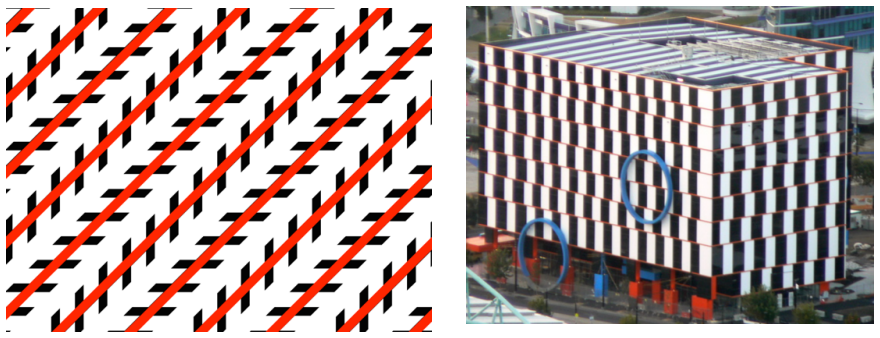


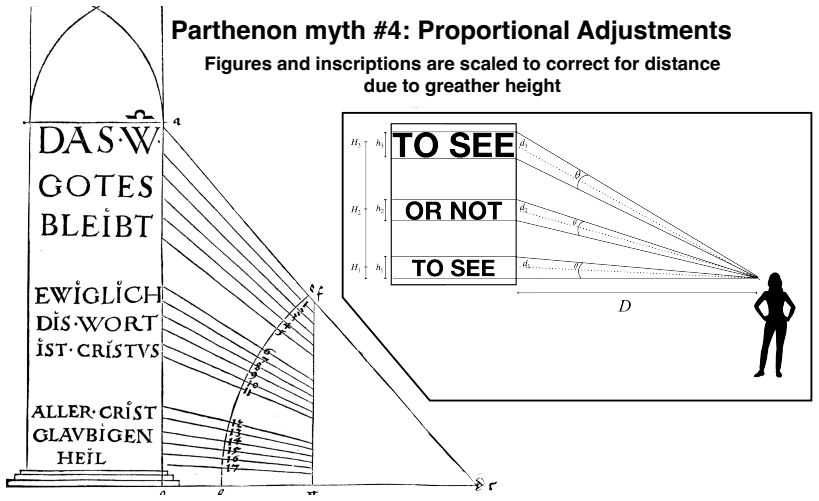
read the original abstract
One of the oldest and most enduring myths in human history is the belief that the Parthenon was cleverly designed with various curved structures and sizes in order to correct optical illusions, and therefore appear straight and regular. The myth has its origin in the writings of Vitruvius more than 2,000 years ago and was renewed in the nineteenth century when curved profiles were carefully measured. At least twelve different \textit{optical corrections} have been proposed, all following the same basic principle. The myth is still widely acknowledged as an obvious truth despite a complete absence of historical or scientific evidence. This paper analyzes these corrections scientifically and demonstrates that the illusions they are supposed to correct are either non-existent or so small as to be imperceptible.
Editorial analysis
A structured set of objections, weighed in public.
Referee Report
Summary. The paper reviews the historical claim, originating with Vitruvius and revived by 19th-century measurements, that the Parthenon incorporates at least twelve optical corrections (entasis, curved stylobates, etc.) to counteract visual illusions and appear rectilinear. It asserts that scientific analysis of optics and human perception shows these supposed illusions are either nonexistent or imperceptible, thereby demonstrating an absence of evidence for intentional design of this kind.
Significance. If the quantitative perceptual thresholds and historical measurements hold under scrutiny, the work would supply a clear scientific counter to a durable architectural myth, shifting emphasis in classical studies toward structural, symbolic, or constructional explanations for the observed curvatures. The explicit enumeration of twelve corrections and their individual refutations adds precision beyond prior qualitative dismissals.
major comments (2)
- [§3] §3 (Perceptual thresholds): The demonstration that curvature-induced effects fall below detection relies on modern contrast-sensitivity and visual-acuity data without explicit justification for transferring these thresholds to 5th-century BCE observers under Acropolis-specific illumination, viewing distances, and possible differences in eye optics or adaptation. This transfer is load-bearing for the central claim that the illusions are imperceptible.
- [§4.2] §4.2 (Historical measurement comparison): The paper cites 19th-century and later surveys to bound the actual curvatures, yet does not report an error-propagation analysis or discuss how measurement uncertainty (e.g., ±1–2 cm on stylobate curvature) propagates into the imperceptibility conclusion; if the upper-bound curvature exceeds the cited perceptual limit, the refutation weakens.
minor comments (2)
- [Figure 2] Figure 2 caption: the scale bar is unlabeled; add physical units (meters) and viewing-distance annotation to clarify the simulated observer position.
- Notation: the symbol Δh is used both for height deviation and for angular subtense in different sections; a single glossary or consistent subscript would reduce ambiguity.
Simulated Author's Rebuttal
We thank the referee for their thorough review and valuable feedback on our manuscript. We address each of the major comments in detail below and outline the revisions we plan to make to strengthen the paper.
read point-by-point responses
-
Referee: [§3] §3 (Perceptual thresholds): The demonstration that curvature-induced effects fall below detection relies on modern contrast-sensitivity and visual-acuity data without explicit justification for transferring these thresholds to 5th-century BCE observers under Acropolis-specific illumination, viewing distances, and possible differences in eye optics or adaptation. This transfer is load-bearing for the central claim that the illusions are imperceptible.
Authors: We appreciate the referee's emphasis on the applicability of modern perceptual data to ancient observers. The fundamental aspects of human vision, including contrast sensitivity functions and visual acuity limits, are determined by retinal and neural structures that have not changed appreciably since the 5th century BCE. Our thresholds are drawn from standard psychophysical literature and are applied conservatively to account for typical outdoor illumination and distances at the Acropolis. We will revise §3 to include a dedicated paragraph justifying this extrapolation, citing evidence from visual anthropology and the fact that any differences in adaptation would not alter the conclusion that the effects are imperceptible. revision: yes
-
Referee: [§4.2] §4.2 (Historical measurement comparison): The paper cites 19th-century and later surveys to bound the actual curvatures, yet does not report an error-propagation analysis or discuss how measurement uncertainty (e.g., ±1–2 cm on stylobate curvature) propagates into the imperceptibility conclusion; if the upper-bound curvature exceeds the cited perceptual limit, the refutation weakens.
Authors: This is a valid observation, and we agree that incorporating measurement uncertainties would enhance the rigor of our quantitative refutations. The manuscript relies on published survey results without propagating errors explicitly. In the revised manuscript, we will add an analysis of error propagation for the key curvatures, demonstrating that even at the upper bounds of uncertainty (such as ±2 cm for stylobate curvature), the induced visual distortions remain below the perceptual thresholds established in the paper. This will be included in §4.2 or as a supplementary note. revision: yes
Circularity Check
No circularity: derivation uses independent historical measurements and standard optics
full rationale
The paper applies established models of optics and visual perception to pre-existing historical measurements of the Parthenon's curvatures and proposed corrections. These calculations determine the size of any visual effects and compare them against perceptual thresholds without redefining the illusions in terms of the corrections, fitting parameters to the target conclusion, or relying on self-citations for the load-bearing steps. The central demonstration that effects are non-existent or imperceptible follows from external data and physical principles rather than internal construction, making the argument self-contained against independent benchmarks.
Axiom & Free-Parameter Ledger
Lean theorems connected to this paper
-
IndisputableMonolith/Cost/FunctionalEquation.leanwashburn_uniqueness_aczel unclear?
unclearRelation between the paper passage and the cited Recognition theorem.
the illusions they are supposed to correct are either non-existent or so small as to be imperceptible
What do these tags mean?
- matches
- The paper's claim is directly supported by a theorem in the formal canon.
- supports
- The theorem supports part of the paper's argument, but the paper may add assumptions or extra steps.
- extends
- The paper goes beyond the formal theorem; the theorem is a base layer rather than the whole result.
- uses
- The paper appears to rely on the theorem as machinery.
- contradicts
- The paper's claim conflicts with a theorem or certificate in the canon.
- unclear
- Pith found a possible connection, but the passage is too broad, indirect, or ambiguous to say the theorem truly supports the claim.
Reference graph
Works this paper leans on
-
[1]
1905A History of Architecture on the Comparative Method: For Students, Craftsmen & Amateurs
Fletcher BF. 1905A History of Architecture on the Comparative Method: For Students, Craftsmen & Amateurs. London: B.T. Batsford 5th edition
-
[2]
Johannsen DE. 1971 Early history of perceptual, Illusions.Journal of the History of the Behavioral Sciences7, 127–140
work page 1971
-
[3]
1982Ancient Greek architects at work: Problems of structure and design
Coulton JJ. 1982Ancient Greek architects at work: Problems of structure and design. Cor- nell University Press
-
[4]
1443–1452De re aedificatoria (On the Art of Building)
Alberti LB. 1443–1452De re aedificatoria (On the Art of Building). Florence: Niccolò di Lorenzo (Laurentii) Alamani. First printed Latin edition
-
[5]
1537–1575Tutte l’opere d’architettura et prospetiva
Serlio S. 1537–1575Tutte l’opere d’architettura et prospetiva. Venice: various Venetian pub- lishers (e.g. Francesco de Franceschi). Seven books; in Italian
-
[6]
1570I quattro libri dell’architettura
Palladio A. 1570I quattro libri dell’architettura. Venice: Dominico de’ Francheschi. First edition
-
[7]
1993 Optical correction in sixteenth-century theory and practice.Renais- sance studies7, 207–228
Frangenberg T. 1993 Optical correction in sixteenth-century theory and practice.Renais- sance studies7, 207–228
work page 1993
-
[8]
1851An Investigation of the Principles of Athenian Architecture
Penrose FC. 1851An Investigation of the Principles of Athenian Architecture. London: Society of Dilettanti
-
[9]
Pennethorne J. 1878The Geometry and Optics of Ancient Architecture: Illustrated by Ex- amples from Thebes, Athens and Rome. London: Williams and Norgate
-
[10]
1905A History of Architecture on the Comparative Method
Fletcher B. 1905A History of Architecture on the Comparative Method. London: B. T. Batsford 5th edition. First published 1896; many subsequent editions
-
[11]
1899Histoire de l’architecture
Choisy A. 1899Histoire de l’architecture. Paris: Gauthier-Villars. 2 vols
-
[12]
1973The Architecture of Ancient Greece: An Account of Its Historic Devel- opment
Dinsmoor WB. 1973The Architecture of Ancient Greece: An Account of Its Historic Devel- opment. London: Batsford revised edition edition. Reprint of the 1950 third edition, with revisions
work page 1950
-
[13]
1683Ordonnance des cinq espèces de colonnes selon la méthode des Anciens
Perrault C. 1683Ordonnance des cinq espèces de colonnes selon la méthode des Anciens. Paris: Jean-Baptiste Coignard. First edition. 26
-
[14]
Perrault C. 1673Les Dix Livres d’Architecture de Vitruve, corrigez et traduits nouvellement en françois, avec des notes et des figures. Paris: Jean-Baptiste Coignard. French translation and commentary on Vitruvius’De Architectura
-
[15]
1912Greek Refinements: Studies in Temperamental Architecture
Goodyear WH. 1912Greek Refinements: Studies in Temperamental Architecture. New Haven: Yale University Press. Also published in London by Henry Frowde, Oxford Uni- versity Press
-
[16]
1970Optics, Painting & Photography
Pirenne MH. 1970Optics, Painting & Photography. Cambridge, U.K.: Cambridge Univer- sity Press
-
[17]
1998 Refinements of the Refinements
Korres M. 1998 Refinements of the Refinements. In Haselberger L, editor,Appearance and Essence: Refinements of Classical Architecture. Curvature. Proceedings of the Sec- ond Williams Symposium on Classical Architecture held at the University of Pennsylvania, Philadelphia, April 2-4, 1993, pp. 79–104. Philadelphia: Journal of the Society of Archi- tectural...
work page 1998
-
[18]
InActa Classica: Proceedings of the Classical Association of South Africavol
RankinE.1986Geometryenlivened: interpretingtherefinementsoftheGreekDorictemple. InActa Classica: Proceedings of the Classical Association of South Africavol. 29 pp. 29–41. Classical Association of South Africa (CASA)
-
[19]
Hoffer J. 1838 Ueber die neuesten Messungen am Parthenon (Nach einer Mitteilung des Herrn Regierungs-Architekten Joseph Hoffer in Athen).Allgemeine Bauzeitung3, 249–251. Tafeln CCXXXVII–CCXXXIX; short editorial notice based on Hoffer’s communication
-
[20]
Pennethorne J. 1844The Elements and Mathematical Principles of the Greek Architects and Artists Recovered by an Analysis and Study of the Remaining Works of Architecture Designed and Executed in the Age of Pericles. William Clowes and Sons
-
[21]
1999 Appearance and essence.Refinements of Classical Architecture: Cur- vature (Philadelphia 1999)
Haselberger L. 1999 Appearance and essence.Refinements of Classical Architecture: Cur- vature (Philadelphia 1999)
work page 1999
-
[22]
Stevens GP. 1943 The curve of the North stylobate of the Parthenon.Hesperia: The Journal of the American School of Classical Studies at Athens12, 135–143
work page 1943
-
[23]
Georgopoulos G, Telioni E. 2012 Approximation of the Curvature of the Parthenon Stylo- bate Using Least Squares Techniques.Journal of Surveying Engineering138, 154–159
work page 2012
-
[24]
Keppens D, Keppens N. 2021 A Survey on Conics in Historical Context: An Overview of Definitions and Their Relationships.International Journal of Geometry10, 50–66
work page 2021
-
[25]
1993 Coping with curvature: the practical aspects
Coulton J. 1993 Coping with curvature: the practical aspects. InAppearance and essence: refinements of classical architecture-curvature; Proceedings of the second Williams sympo- sium on classical architecture held at the University of Pennsylvaniapp. 69–77
work page 1993
-
[26]
Stevens GP. 1934 Concerning the Curvature of the Steps of the Parthenon.American Jour- nal of Archaeology38, 533–542
work page 1934
-
[27]
1985 The construction plans for the Temple of Apollo at Didyma.Scientific American253, 126–133
Haselberger L. 1985 The construction plans for the Temple of Apollo at Didyma.Scientific American253, 126–133
work page 1985
-
[28]
1967 Surfaces for computer-aided design of space forms
Coons SA. 1967 Surfaces for computer-aided design of space forms. Technical Report MAC- TR-41 MIT Laboratory for Computer Science Cambridge, Massachusetts
work page 1967
-
[29]
2013Design of Highway Bridges: An LRFD Approach
Barker RM, Puckett JA. 2013Design of Highway Bridges: An LRFD Approach. Hoboken, NJ: John Wiley & Sons 3rd edition. 27
-
[30]
2016 Full dynamic model of Golden Gate Bridge
Game T, Vos C, Morshedi R, Gratton R, Alonso-Marroquin F, Tahmasebinia F. 2016 Full dynamic model of Golden Gate Bridge. InAIP Conference Proceedingsvol. 1762 p. 020005. AIP Publishing LLC
work page 2016
-
[31]
1874The Architecture of Marcus Vitruvius Pollio: In Ten Books
Gwilt J. 1874The Architecture of Marcus Vitruvius Pollio: In Ten Books. London: Lock- wood & Co. Translated from the Latin, carefully revised by the translator, and with addi- tional plates
-
[32]
1980 Scamilli inpares: a problem in Vitruvius.Papers of the British School at Rome48, 17–22
Campbell I. 1980 Scamilli inpares: a problem in Vitruvius.Papers of the British School at Rome48, 17–22
work page 1980
-
[33]
1612Scamilli impares Vitruviani
Baldi B. 1612Scamilli impares Vitruviani. Urbino: Bartholomeo e Simone Ragusii. First edition
-
[34]
Penrose FC. 1888An Investigation of the Principles of Athenian Architecture: The Results of a Survey Conducted Chiefly with Reference to the Optical Refinements Exhibited in the Construction of the Ancient Buildings at Athens. London and New York: Society of Dilet- tanti, Macmillan and Co. new and enlarged edition edition. Published by the Society of Dilettanti
-
[35]
1905A History of Architectural Development
Simpson FM. 1905A History of Architectural Development. London and New York: Long- mans, Green, and Co. First edition
-
[36]
1910L’Acropole d’Athènes: Le Parthénon
Fougères G. 1910L’Acropole d’Athènes: Le Parthénon. Paris: A. Morancé
-
[37]
1987 The detection of deviation from straightness in lines
Watt RJ, Ward RM, Casco C. 1987 The detection of deviation from straightness in lines. Vision Research27, 1659–1678
work page 1987
-
[38]
1996 A Simple Mechanism for Detecting Low Curvatures.Vision Research36, 1411–1419
Kramer D, Fahle M. 1996 A Simple Mechanism for Detecting Low Curvatures.Vision Research36, 1411–1419
work page 1996
-
[39]
2005Perceiving Geometry: Geometrical Illusions Explained by Natural Scene Statistics
Howe CQ, Purves D. 2005Perceiving Geometry: Geometrical Illusions Explained by Natural Scene Statistics. New York, NY: Springer Science & Business Media
-
[40]
2022Vision and art (updated and expanded edition)
Livingstone MS. 2022Vision and art (updated and expanded edition). Abrams
-
[41]
1992 Elastica and Computer Vision.Algebraic Geometry and Its Applications pp
Mumford D. 1992 Elastica and Computer Vision.Algebraic Geometry and Its Applications pp. 491–506
work page 1992
-
[42]
2012The perception of illusory contours
Petry S, Meyer GE. 2012The perception of illusory contours. Springer Science & Business Media
-
[43]
Hering E. 1861Beiträge zur Physiologie. I. Zur Lehre vom Ortssinne der Netzhaut. Leipzig: Engelmann
-
[44]
Wundt W. 1898 Die geometrisch-optischen Täuschungen.Abhandlungen der Mathematisch- Physischen Classe der Königlich Sächsischen Gesellschaft der Wissenschaften24, 55–178
-
[45]
Zöllner JKF. 1860 Ueber eine neue Art von Pseudoskopie und ihre Beziehungen zu den von Plateau und Oppel beschriebenen Bewegungsphänomenen.Annalen der Physik186, 500–525. (10.1002/andp.18601860712)
-
[46]
1873 Optische Täuschungen auf dem Gebiete der Architektur.Zeitschrift für Bauwesen23, 9–34
Thiersch A. 1873 Optische Täuschungen auf dem Gebiete der Architektur.Zeitschrift für Bauwesen23, 9–34
-
[47]
1867Handbuch der physiologischen Optikvol
Von Helmholtz H. 1867Handbuch der physiologischen Optikvol. 9. L. Voss. 28
-
[48]
1925Helmholtz’s treatise on physiological opticsvol
Von Helmholtz H. 1925Helmholtz’s treatise on physiological opticsvol. 3. Optical Society of America
-
[49]
1903Course in Experimental Psychology, Part I: Sensation and Perception
Sanford EC. 1903Course in Experimental Psychology, Part I: Sensation and Perception. Boston, U.S.A.: D. C. Heath & Co
-
[50]
Nusselt W. 1916 Die Oberflächenkondensation des Wasserdampfes.Zeitschrift des Vereines Deutscher Ingenieure60, 541–546
work page 1916
-
[51]
2000 Improved modeling of flows down inclined planes.The European Physical Journal B15, 357–369
Ruyer-Quil C, Manneville P. 2000 Improved modeling of flows down inclined planes.The European Physical Journal B15, 357–369
work page 2000
-
[52]
Bird RB, Stewart WE, Lightfoot EN. 2006Transport Phenomena. New York: John Wiley & Sons 2 edition
-
[53]
2017Charles Robert Cockerell in the Mediterranean: Letters and Travels, 1810-1817
Pearce SM, Ormrod T, Cockerell CR. 2017Charles Robert Cockerell in the Mediterranean: Letters and Travels, 1810-1817. Boydell & Brewer
-
[54]
2008 CR Cockerell and the Discovery of Entasis in the Columns of the Parthenon
Salmon F. 2008 CR Cockerell and the Discovery of Entasis in the Columns of the Parthenon. The Persistence of the Classical. Essays on Architecture Presented to David Watkin. Hrsg. von F. Salmon. Cambridge: Philip Wilson Publisherspp. 106–124
work page 2008
-
[55]
1924 Entasis of Roman columns.Memoirs of the American Academy in Rome 4, 121–152
Stevens GP. 1924 Entasis of Roman columns.Memoirs of the American Academy in Rome 4, 121–152
work page 1924
-
[56]
Raynaud D. 2020 Mathématiques et architecture: le tracé de l’entasis par Nicolas-François Blondel.Archive for History of Exact Sciences74, 445–468
work page 2020
-
[57]
Pakkanen J. 1997 Entasis in fourth-century BC Doric buildings in the Peloponnese and at Delphi.Annual of the British School at Athens92, 323–344
work page 1997
-
[58]
Radelet-de Grave P. 2025 The Entasis of Columns from Blondel to Lagrange: Mathematical Games in Search of the Greatest Stability. InBetween Mechanics and Architecture: The Mathematical Search for Stability in Architecture, pp. 247–263. Springer
work page 2025
-
[59]
1999Vitruvius: Ten Books on Architecture
Pollio V. 1999Vitruvius: Ten Books on Architecture. Cambridge: Cambridge University Press. With illustrations, notes, and commentary
-
[60]
1931On Architecture, Books I–IIvol
Pollio V. 1931On Architecture, Books I–IIvol. 251Loeb Classical Library. Cambridge, MA and London: Harvard University Press
-
[61]
2007 The origins of entasis: illusion, aesthetics or engineering?.Spatial Vision20
Thompson P, Papadopoulou G, Vassiliou E. 2007 The origins of entasis: illusion, aesthetics or engineering?.Spatial Vision20
work page 2007
-
[62]
Euler L. 1744Methodus inveniendi lineas curvas maximi minimive proprietate gaudentes sive solutio problematis isoperimetrici latissimo sensu accepti. apud Marcum-Michaelem Bousquet & socios
-
[63]
1759 Sur la force des colonnes.Mem
Euler L. 1759 Sur la force des colonnes.Mem. Acad. , Berlin13
-
[64]
1770 Sur la figure des colonnes.Miscellanea Taurinensia5, 123–66
Lagrange JL. 1770 Sur la figure des colonnes.Miscellanea Taurinensia5, 123–66
-
[65]
Goriely A, Vandiver R, Destrade M. 2008 Nonlinear euler buckling.Proceedings of the royal society A: mathematical, physical and engineering sciences464, 3003–3019
work page 2008
-
[66]
De Pascalis R, Destrade M, Goriely A. 2011 Nonlinear correction to the Euler buckling formula for compressed cylinders with guided-guided end conditions.J. Elasticity102, 191–200. 29
work page 2011
-
[67]
1960 The shape of the strongest column.Archive for Rational Mechanics and Analysis5, 275–285
Keller JB. 1960 The shape of the strongest column.Archive for Rational Mechanics and Analysis5, 275–285
work page 1960
-
[68]
1992 The shape of the ideal column.The Mathematical Intelligencer14, 16–24
Cox SJ. 1992 The shape of the ideal column.The Mathematical Intelligencer14, 16–24
work page 1992
-
[69]
2010 Seismic behaviour of ancient multidrum structures
Papaloizou L, Komodromos P. 2010 Seismic behaviour of ancient multidrum structures. In Computational Methods in Earthquake Engineering, pp. 237–264. Springer
work page 2010
-
[70]
Drosos VA, Anastasopoulos I. 2015 Experimental investigation of the seismic response of classical temple columns.Bulletin of Earthquake Engineering13, 299–310
work page 2015
-
[71]
Vassiliou MF, Makris N. 2012 Analysis of the rocking response of rigid blocks standing free on a seismically isolated base.Earthquake Engineering and Structural Dynamics41, 177–196
work page 2012
-
[72]
2017The Mathematics and Mechanics of Biological Growth
Goriely A. 2017The Mathematics and Mechanics of Biological Growth. Springer Verlag, New York
-
[73]
Skoulikidis T, Vassiliou P, Tsakona K, Kritikou E. 2025 Stress corrosion cracking of un- treated Pentelic marble of artificially weathered or treated with pigmented or unpigmented polymer.WIT Transactions on The Built Environment4
work page 2025
-
[74]
RuedrichJ,KnellC,EnseleitJ,RieffelY,SiegesmundS.2013Stabilityassessmentofmarble statuaries of the Schlossbrücke (Berlin, Germany) based on rock strength measurements and ultrasonic wave velocities.Environmental Earth Sciences69, 1451–1469
-
[75]
1914Vitruvius: The Ten Books on Architecture
Pollio V. 1914Vitruvius: The Ten Books on Architecture. Cambridge, MA and London: Harvard University Press and Oxford University Press. English translation with introduc- tion by Morris H. Morgan
-
[76]
1873Statique expérimentale et théorique des liquides soumis aux seules forces moléculairesvol
Plateau J. 1873Statique expérimentale et théorique des liquides soumis aux seules forces moléculairesvol. 2. Gauthier-Villars
-
[77]
2003Psychology of Visual Illusion
Robinson J. 2003Psychology of Visual Illusion. Dover Publications, Incorporated. Dover reprint of classic work on visual illusions
-
[78]
1978Seeing is deceiving: The psychology of visual illusions
Coren S, Girgus J. 1978Seeing is deceiving: The psychology of visual illusions. John Wiley & Sons
-
[79]
Long GM, Murtagh MP. 1984 Task and size effects in the Oppel-Kundt and irradiation illusions.The Journal of General Psychology111, 229–240
work page 1984
-
[80]
MatherG,MorganM.1986Irradiation: Implicationsfortheoriesofedgelocalization.Vision Research26, 1007–1015
discussion (0)
Sign in with ORCID, Apple, or X to comment. Anyone can read and Pith papers without signing in.