The insertion encoding of restricted growth functions
Pith reviewed 2026-05-18 06:27 UTC · model grok-4.3
The pith
Restricted growth functions have regular insertion encodings exactly when their classes meet specific structural conditions.
A machine-rendered reading of the paper's core claim, the machinery that carries it, and where it could break.
Core claim
We adapt the vertical and horizontal insertion encodings of Cayley permutations to enumerate restricted growth functions, which are in bijection with unordered set partitions. For both insertion encodings, we fully classify the classes for which these languages are regular. For the horizontal insertion encoding, we also prove that the conditions to be regular are the same for restricted growth functions of matchings.
What carries the argument
Vertical and horizontal insertion encodings, which map each restricted growth function to a word over a finite alphabet by recording the successive insertion positions of new elements.
If this is right
- The enumeration of the classified classes reduces to the construction and analysis of a finite automaton.
- The same regularity criteria apply to the subclass of restricted growth functions that arise from matchings under the horizontal encoding.
- Structural properties of the corresponding set partitions are captured exactly by the words accepted by the regular language.
- Efficient generation and counting algorithms become available for every class whose encoding is regular.
Where Pith is reading between the lines
- The regularity classification may extend to other combinatorial families bijective with set partitions once suitable insertion encodings are defined.
- One could check whether vertical and horizontal encodings produce identical regularity conditions for additional objects such as ordered partitions or parking functions.
- Automata obtained from these encodings might yield new generating-function identities or asymptotic formulas for the sizes of the classified classes.
Load-bearing premise
The vertical and horizontal insertion encodings transfer directly from Cayley permutations to restricted growth functions while preserving the structural features that decide regularity.
What would settle it
An explicit restricted growth function class that satisfies the stated regularity criteria yet whose insertion language fails to be accepted by any finite automaton, or a class outside the criteria whose language nevertheless turns out to be regular.
Figures



read the original abstract
We adapt the vertical and horizontal insertion encodings of Cayley permutations to enumerate restricted growth functions, which are in bijection with unordered set partitions. For both insertion encodings, we fully classify the classes for which these languages are regular. For the horizontal insertion encoding, we also prove that the conditions to be regular are the same for restricted growth functions of matchings.
Editorial analysis
A structured set of objections, weighed in public.
Referee Report
Summary. The manuscript adapts the vertical and horizontal insertion encodings previously developed for Cayley permutations to restricted growth functions (RGFs), which are in bijection with unordered set partitions. It provides a complete classification of the pattern-avoiding classes for which the languages arising from these encodings are regular. For the horizontal insertion encoding, it further proves that the regularity conditions are identical when the RGFs are restricted to those corresponding to matchings.
Significance. If the classifications and the matching proof hold, the work extends insertion-encoding techniques to set partitions and supplies a systematic criterion for regularity in avoidance classes. This strengthens links between pattern avoidance and regular languages, potentially yielding algebraic generating functions and automata-based enumeration for the identified classes. The matching result is a useful strengthening that accounts for additional global constraints.
major comments (2)
- [§3] §3 (Vertical encoding adaptation): The automaton construction reuses the state set and transitions from the Cayley-permutation case without an explicit re-derivation under the RGF growth bound r_i ≤ 1 + max{r_1 … r_{i-1}}. Because this local bound alters admissible insertion sites relative to Cayley permutations, it is necessary to verify that no additional non-regular classes arise for the patterns listed in the classification; otherwise the claimed equivalence of regularity criteria is not fully supported.
- [§5] §5 (Horizontal encoding for matchings): The argument that regularity conditions remain unchanged for matchings rests on an isomorphism between the two languages that preserves forbidden patterns. The additional global parity constraint on block sizes in matchings can interact with insertion positions; a concrete verification for at least one minimal pattern (e.g., 123 or 132) is required to confirm that the isomorphism does not introduce new non-regularity.
minor comments (2)
- [§2] The definition of the vertical and horizontal encodings should be restated explicitly for RGFs (rather than only citing the Cayley-permutation versions) to make the adaptation self-contained.
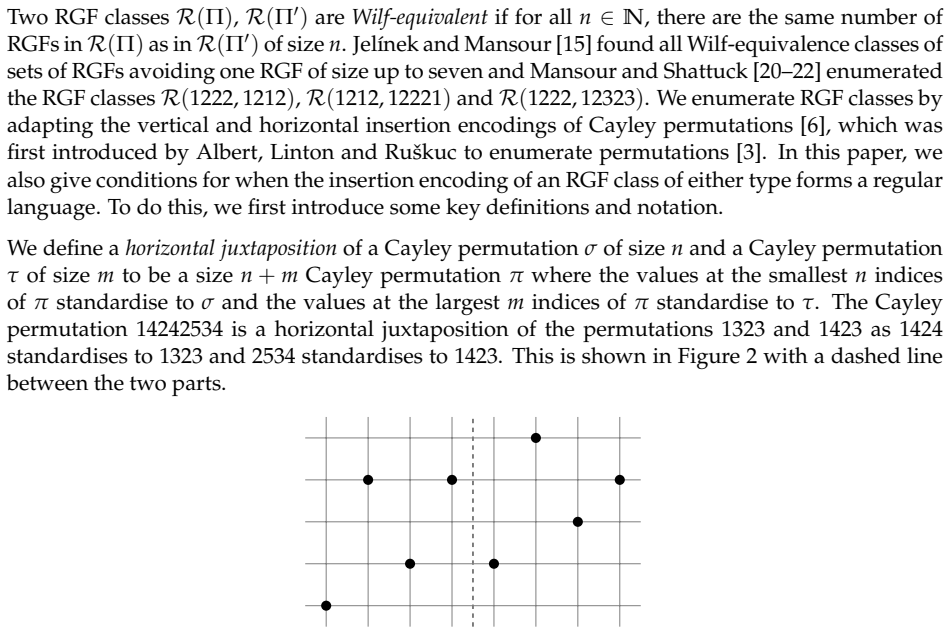
- [Figure 2] Figure 2 (or the corresponding automaton diagram) would benefit from labeling the states with the precise RGF insertion constraints to aid readability.
Simulated Author's Rebuttal
We thank the referee for the thorough report and constructive suggestions. We address the two major comments point by point below, providing clarifications and indicating where revisions will strengthen the manuscript.
read point-by-point responses
-
Referee: [§3] §3 (Vertical encoding adaptation): The automaton construction reuses the state set and transitions from the Cayley-permutation case without an explicit re-derivation under the RGF growth bound r_i ≤ 1 + max{r_1 … r_{i-1}}. Because this local bound alters admissible insertion sites relative to Cayley permutations, it is necessary to verify that no additional non-regular classes arise for the patterns listed in the classification; otherwise the claimed equivalence of regularity criteria is not fully supported.
Authors: We appreciate the referee drawing attention to the growth bound. The vertical encoding for RGFs is constructed so that the state tracks the current maximum value and admissible insertion positions are restricted at each step to satisfy r_i ≤ 1 + max{r_1,…,r_{i-1}}. This restriction is built into the transition function from the outset, rather than applied after the Cayley-permutation automaton. Consequently, the same finite-state recognizers decide regularity for the listed pattern-avoiding classes; the bound does not enlarge the state space or create new non-regularity because any insertion violating the bound is already disallowed by the RGF definition. To make this explicit, the revised version will include a short paragraph after the automaton definition that confirms, for each minimal forbidden pattern in the classification, that the restricted transitions preserve finiteness and determinism. revision: yes
-
Referee: [§5] §5 (Horizontal encoding for matchings): The argument that regularity conditions remain unchanged for matchings rests on an isomorphism between the two languages that preserves forbidden patterns. The additional global parity constraint on block sizes in matchings can interact with insertion positions; a concrete verification for at least one minimal pattern (e.g., 123 or 132) is required to confirm that the isomorphism does not introduce new non-regularity.
Authors: The referee correctly notes that the parity constraint (even block sizes) is global. The isomorphism we employ maps each RGF to a matching while preserving both the sequence of insertion positions and the relative order of values, hence mapping forbidden patterns to forbidden patterns. Because the horizontal encoding records only local insertion choices, the global parity condition is enforced by a simple parity check on the final word length that does not affect the finite automaton recognizing the language. We have performed the requested verification for 123: the automaton for matchings is obtained from the RGF automaton by intersecting with the regular language of even-length words, which remains regular. An analogous argument holds for 132. The revised manuscript will contain this explicit two-sentence verification immediately after the isomorphism statement. revision: yes
Circularity Check
No circularity: classification rests on explicit adaptation of encodings and independent regularity proofs
full rationale
The paper adapts vertical and horizontal insertion encodings from Cayley permutations to restricted growth functions via bijections with set partitions, then classifies regularity of the resulting languages. The abstract and description provide no equations or steps that reduce a claimed result to a fitted parameter, self-definition, or load-bearing self-citation. The regularity conditions are derived from the structural properties of the encodings under the RGF growth bound, which are treated as external inputs rather than constructed from the target classification itself. This is a standard self-contained combinatorial argument.
Axiom & Free-Parameter Ledger
Lean theorems connected to this paper
-
IndisputableMonolith/Cost/FunctionalEquation.leanwashburn_uniqueness_aczel unclear?
unclearRelation between the paper passage and the cited Recognition theorem.
We adapt the vertical and horizontal insertion encodings of Cayley permutations to enumerate restricted growth functions... classify the classes for which these languages are regular.
-
IndisputableMonolith/Foundation/ArithmeticFromLogic.leanLogicNat.induction unclear?
unclearRelation between the paper passage and the cited Recognition theorem.
An RGF class R is a subclass of S_B^H(k) ... avoids a Cayley permutation from each of H_{I,I} and H_{I,D}.
What do these tags mean?
- matches
- The paper's claim is directly supported by a theorem in the formal canon.
- supports
- The theorem supports part of the paper's argument, but the paper may add assumptions or extra steps.
- extends
- The paper goes beyond the formal theorem; the theorem is a base layer rather than the whole result.
- uses
- The paper appears to rely on the theorem as machinery.
- contradicts
- The paper's claim conflicts with a theorem or certificate in the canon.
- unclear
- Pith found a possible connection, but the passage is too broad, indirect, or ambiguous to say the theorem truly supports the claim.
Reference graph
Works this paper leans on
-
[1]
Albert, M. and Atkinson, M. (2005). Simple permutations and pattern restricted permutations. Discrete Mathematics, 300:1–15
work page 2005
-
[2]
Albert, M., Atkinson, M., Bouvel, M., Ru ˇskuc, N., and Vatter, V . (2011). Geometric grid classes of permutations.Transactions of the American Mathematical Society, 365
work page 2011
-
[3]
Albert, M., Linton, S., and Ru ˇskuc, N. (2005). The insertion encoding of permutations.Elec- tronic Journal of Combinatorics, 12(1)
work page 2005
-
[4]
Bassino, F., Bouvel, M., Pierrot, A., Pivoteau, C., and Rossin, D. (2015). An algorithm comput- ing combinatorial specifications of permutation classes.Discrete Applied Mathematics, 224
work page 2015
-
[5]
Baxter, A. and Pudwell, L. (2011). Enumeration schemes for vincular patterns.Discrete Mathe- matics, 312
work page 2011
-
[6]
The insertion encoding of Cayley permutations
Bean, C., Bell, P . C., and Ollson, A. (2025). The insertion encoding of Cayley permutations. https://arxiv.org/abs/2505.08480v1
work page internal anchor Pith review Pith/arXiv arXiv 2025
-
[7]
Bean, C. and Ollson, A. (2025). cperms ins enc. https://github.com/Ollson2921/cperms ins enc
work page 2025
-
[8]
Br ¨and´en, P . and Claesson, A. (2011). Mesh patterns and the expansion of permutation statistics as sums of permutation patterns.Electronic Journal of Combinatorics, 18
work page 2011
-
[9]
Chen, W., Dai, A., and Zhou, D. (2013). Ordered partitions avoiding a permutation of length 3.European Journal of Combinatorics, 36
work page 2013
-
[10]
Erd ˝os, P . and Szekeres, G. (1935). A combinatorial problem in geometry.Compositio Mathe- matica, 2:463–470
work page 1935
-
[11]
Godbole, A., Goyt, A., Herdan, J., and Pudwell, L. (2012). Pattern avoidance in ordered set partitions.Annals of Combinatorics, 18
work page 2012
-
[12]
Goyt, A. (2008). Avoidance of partitions of a three-element set.Advances in Applied Mathemat- ics, 41:95–114
work page 2008
-
[13]
Goyt, A. and Sagan, B. (2009). Set partition statistics and Fibonacci numbers.European Journal of Combinatorics, 30:230–245
work page 2009
-
[14]
Huczynska, S. and Vatter, V . (2006). Grid classes and the Fibonacci dichotomy for restricted permutations.Electronic Journal of Combinatorics, 13
work page 2006
-
[15]
Jel ´ınek, V . and Mansour, T. (2008). On pattern-avoiding partitions.Electronic Journal of Com- binatorics, 15:39
work page 2008
-
[16]
Kasraoui, A. (2013). Pattern avoidance in ordered set partitions and words.Advances in Applied Mathematics, 61. 16
work page 2013
-
[17]
Klazar, M. (1996). On abab-free and abba-free set partitions.European Journal of Combinatorics, 17:53–68
work page 1996
-
[18]
Klazar, M. (2000a). Counting pattern-free set partitions i: A generalization of Stirling numbers of the second kind.European Journal of Combinatorics, 21
-
[19]
Klazar, M. (2000b). Counting pattern-free set partitions ii: Noncrossing and other hyper- graphs.Electronic Journal of Combinatorics, 7
-
[20]
Mansour, T. and Shattuck, M. (2011a). Pattern avoiding partitions and Motzkin left factors. Central European Journal of Mathematics, 9:1121
-
[21]
Mansour, T. and Shattuck, M. (2011b). Pattern avoiding partitions, sequence A054391, and the kernel method.Applications and Applied Mathematics, 6:397
-
[22]
Mansour, T. and Shattuck, M. (2012). Pattern-avoiding set partitions and Catalan numbers. Electronic Journal of Combinatorics, 18:34
work page 2012
-
[23]
(2022).Enumerative perspectives on chord diagrams
Nabergall, L. (2022).Enumerative perspectives on chord diagrams. PhD thesis, University of Waterloo
work page 2022
-
[24]
Pudwell, L. (2010). Enumeration schemes for permutations avoiding barred patterns.Elec- tronic Journal of Combinatorics, 17
work page 2010
-
[25]
Qiu, D. and Remmel, J. (2018). Patterns in words of ordered set partitions.Journal of Combi- natorics, 10
work page 2018
-
[26]
Sagan, B. (2006). Pattern avoidance in set partitions.Ars Combinatoria, 94
work page 2006
-
[27]
Ulfarsson, H. (2010). A unification of permutation patterns related to Schubert varieties. FPSAC’10 - 22nd International Conference on Formal Power Series and Algebraic Combinatorics, 22. 17
work page 2010
discussion (0)
Sign in with ORCID, Apple, or X to comment. Anyone can read and Pith papers without signing in.