Inference-Optimal ISAC via Task-Oriented Feature Transmission and Power Allocation
Pith reviewed 2026-05-21 20:27 UTC · model grok-4.3
The pith
Maximizing discriminant gain rather than minimizing mean squared error improves inference performance in integrated sensing and communication systems.
A machine-rendered reading of the paper's core claim, the machinery that carries it, and where it could break.
Core claim
Under the compress-and-estimate framework, inference performance is characterized by an error probability bound that decreases monotonically with discriminant gain. Closed-form DG-optimal and MSE-optimal transceiver designs are obtained; both exhibit water-filling structures. The DG-optimal solution allocates power selectively to the most informative features, thereby achieving lower error probability for the same total power and leaving more power available for sensing, with the advantage most pronounced in the low-SNR regime.
What carries the argument
Discriminant gain, defined as the quantity that monotonically controls the error probability bound and is used to optimize feature transmission and power allocation.
If this is right
- DG-optimal transceiver designs achieve lower inference error probability than MSE-optimal designs under the same power budget.
- Power is allocated only to the most informative features, freeing resources for the sensing task.
- The performance advantage of DG optimization is largest when SNR is low.
- Closed-form expressions make the sensing-communication tradeoff explicit for both design criteria.
Where Pith is reading between the lines
- The same monotonic-proxy approach could be applied to other task-driven wireless systems where reconstruction is not the end goal.
- Hardware experiments with real channels would reveal how sensitive the reported low-SNR gains are to imperfect channel knowledge.
- Extending the framework to multiple inference tasks or multiple receivers would test whether selective feature transmission remains advantageous.
Load-bearing premise
Inference error probability can be bounded by a function that decreases monotonically with discriminant gain.
What would settle it
Numerical comparison of actual inference error probability under DG-optimal versus MSE-optimal designs at identical total power, especially in the low-SNR regime.
Figures


read the original abstract
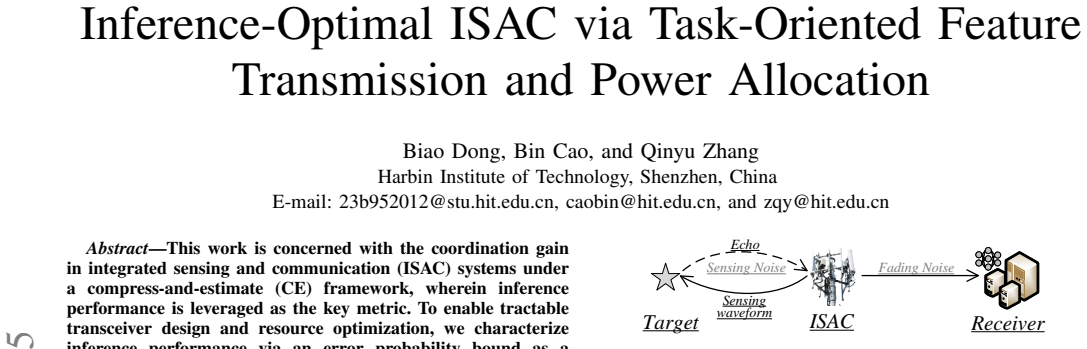
This work is concerned with the coordination gain in integrated sensing and communication (ISAC) systems under a compress-and-estimate (CE) framework, wherein inference performance is leveraged as the key metric. To enable tractable transceiver design and resource optimization, we characterize inference performance via an error probability bound as a monotonic function of the discriminant gain (DG). This raises the natural question of whether maximizing DG, rather than minimizing mean squared error (MSE), can yield better inference performance. Closed-form solutions for DG-optimal and MSE-optimal transceiver designs are derived, revealing water-filling-type structures and explicit sensing and communication (S\&C) tradeoff. Numerical experiments confirm that DG-optimal design achieves more power-efficient transmission, especially in the low signal-to-noise ratio (SNR) regime, by selectively allocating power to informative features and thus saving transmit power for sensing.
Editorial analysis
A structured set of objections, weighed in public.
Referee Report
Summary. The paper proposes an inference-optimal transceiver design for integrated sensing and communication (ISAC) systems under the compress-and-estimate (CE) framework. Inference performance is characterized via an error probability bound that is monotonic in the discriminant gain (DG). Closed-form DG-optimal and MSE-optimal designs are derived, both exhibiting water-filling structures, along with explicit sensing-communication tradeoffs. Numerical experiments show that the DG-optimal design achieves more power-efficient transmission in low-SNR regimes by selectively allocating power to informative features.
Significance. If the central assumptions hold, the work offers a principled shift from MSE minimization to task-oriented inference optimization in ISAC, yielding analytical S&C tradeoffs and power savings. The closed-form derivations and water-filling structures provide concrete design guidelines that could be useful for resource allocation in inference-focused ISAC applications.
major comments (1)
- [§3.2, Eq. (15)] §3.2, Eq. (15): the error probability bound is asserted to be monotonic in DG, enabling the DG-optimal water-filling solution in Eq. (22). However, the derivation does not explicitly confirm that monotonicity (and sufficient tightness) is preserved once feature compression, the ISAC channel, and sensing interference are jointly incorporated under the CE framework. This is load-bearing for the claim that DG optimization outperforms MSE optimization for actual inference error.
minor comments (3)
- [Abstract] The abstract introduces 'S&C' without prior expansion; define the acronym at first use in the main text as well.
- [Figure 3] Figure 3 caption: clarify whether the plotted curves use the bound or the empirical inference error rate, to directly address the tightness concern.
- [§2.3] Notation: the definition of the compression matrix in §2.3 could be cross-referenced when it appears in the DG expression to improve readability.
Simulated Author's Rebuttal
We thank the referee for the constructive comment on the monotonicity of the error probability bound. We address this point directly below and will revise the manuscript accordingly to strengthen the exposition.
read point-by-point responses
-
Referee: [§3.2, Eq. (15)] §3.2, Eq. (15): the error probability bound is asserted to be monotonic in DG, enabling the DG-optimal water-filling solution in Eq. (22). However, the derivation does not explicitly confirm that monotonicity (and sufficient tightness) is preserved once feature compression, the ISAC channel, and sensing interference are jointly incorporated under the CE framework. This is load-bearing for the claim that DG optimization outperforms MSE optimization for actual inference error.
Authors: We thank the referee for this observation. The monotonicity result in Section 3.2 is established for the general binary Gaussian hypothesis testing problem, where the error probability bound (derived via the Chernoff exponent or equivalent distance measures) is strictly monotonic in the discriminant gain. Under the compress-and-estimate framework, the sensor applies a linear compression matrix to the raw features, the ISAC channel is a linear MIMO link with additive white Gaussian noise, and the sensing interference appears as additional colored Gaussian noise at the receiver. The net effect is that the observations available for inference remain jointly Gaussian with a covariance structure that is an affine function of the allocated powers. Consequently, the effective discriminant gain retains the same functional form, and the monotonicity (as well as the relative tightness of the bound) is preserved. We will add a short paragraph and a reference to the relevant Gaussianity preservation step immediately after Eq. (15) to make this explicit. revision: yes
Circularity Check
No significant circularity; derivations rely on standard optimization under stated modeling assumptions
full rationale
The paper introduces an error probability bound that is monotonic in discriminant gain (DG) to enable tractable transceiver optimization under the compress-and-estimate framework. Closed-form DG-optimal and MSE-optimal designs are derived via water-filling structures and explicit S&C tradeoffs. These steps use conventional convex optimization and do not reduce by construction to fitted inputs, self-definitions, or self-citation chains. The monotonicity characterization is presented as an enabling modeling choice rather than a tautological renaming or imported uniqueness theorem. No load-bearing self-citations or ansatzes are required for the central claims, which remain self-contained against external benchmarks such as numerical validation of power efficiency in low-SNR regimes.
Axiom & Free-Parameter Ledger
axioms (1)
- domain assumption Inference performance is characterized by an error probability bound monotonic in discriminant gain
Lean theorems connected to this paper
-
IndisputableMonolith/Cost/FunctionalEquation.leanwashburn_uniqueness_aczel unclear?
unclearRelation between the paper passage and the cited Recognition theorem.
We characterize inference performance via an error probability bound as a monotonic function of the discriminant gain (DG). ... DG-optimal design achieves more power-efficient transmission, especially in the low SNR regime, by selectively allocating power to informative features
What do these tags mean?
- matches
- The paper's claim is directly supported by a theorem in the formal canon.
- supports
- The theorem supports part of the paper's argument, but the paper may add assumptions or extra steps.
- extends
- The paper goes beyond the formal theorem; the theorem is a base layer rather than the whole result.
- uses
- The paper appears to rely on the theorem as machinery.
- contradicts
- The paper's claim conflicts with a theorem or certificate in the canon.
- unclear
- Pith found a possible connection, but the passage is too broad, indirect, or ambiguous to say the theorem truly supports the claim.
Forward citations
Cited by 2 Pith papers
-
Optimized Power Control for Multi-User Integrated Sensing and Edge AI
The work establishes two proxies linking AirComp distortion to inference quality and derives threshold-based and dual-decomposition power allocations for TDM and FDM modes in an integrated sensing and edge AI system.
-
Distributed Integrated Sensing and Edge AI Exploiting Prior Information
A Bayesian distributed ISEA system uses a Gaussian-mixture prior for an RWB estimator at sensing and derives threshold-based optimal power allocation at communication to gain inference performance.
Reference graph
Works this paper leans on
-
[1]
Integrated sensing and communications: Toward dual-functional wire- less networks for 6g and beyond,
F. Liu, Y . Cui, C. Masouros, J. Xu, T. X. Han, Y . C. Eldar, and S. Buzzi, “Integrated sensing and communications: Toward dual-functional wire- less networks for 6g and beyond,”IEEE J. Sel. Areas Commun., vol. 40, no. 6, pp. 1728–1767, 2022
work page 2022
-
[2]
Communication-assisted sensing in 6G networks,
F. Dong, F. Liu, S. Lu, Y . Xiong, Q. Zhang, Z. Feng, and F. Gao, “Communication-assisted sensing in 6G networks,”IEEE J. Sel. Areas Commun., vol. 43, no. 4, pp. 1371–1386, 2025
work page 2025
-
[3]
Universal decentralized estimation in a bandwidth con- strained sensor network,
Z.-Q. Luo, “Universal decentralized estimation in a bandwidth con- strained sensor network,”IEEE Trans. Inf. Theory, vol. 51, no. 6, pp. 2210–2219, 2005
work page 2005
-
[4]
The CEO problem [multi- terminal source coding],
T. Berger, Z. Zhang, and H. Viswanathan, “The CEO problem [multi- terminal source coding],”IEEE Trans. Inf. Theory, vol. 42, no. 3, pp. 887–902, 1996
work page 1996
-
[5]
Task-oriented over-the-air computation for multi-device edge AI,
D. Wen, X. Jiao, P. Liu, G. Zhu, Y . Shi, and K. Huang, “Task-oriented over-the-air computation for multi-device edge AI,”IEEE Trans. Wire- less Commun., vol. 23, no. 3, pp. 2039–2053, 2023
work page 2039
-
[6]
Progressive feature transmission for split classification at the wireless edge,
Q. Lan, Q. Zeng, P. Popovski, D. G ¨und¨uz, and K. Huang, “Progressive feature transmission for split classification at the wireless edge,”IEEE Trans. Wireless Commun., vol. 22, no. 6, pp. 3837–3852, 2022
work page 2022
-
[7]
On the view-and-channel aggregation gain in integrated sensing and edge AI,
X. Chen, K. B. Letaief, and K. Huang, “On the view-and-channel aggregation gain in integrated sensing and edge AI,”IEEE J. Sel. Areas Commun., vol. 42, no. 9, pp. 2292–2305, 2024
work page 2024
-
[8]
Ultra-low- latency edge inference for distributed sensing,
Z. Wang, A. E. Kalør, Y . Zhou, P. Popovski, and K. Huang, “Ultra-low- latency edge inference for distributed sensing,”IEEE Trans. Wireless Commun., 2025
work page 2025
-
[9]
In- tegrated sensing, communication, and computation over-the-air: MIMO beamforming design,
X. Li, F. Liu, Z. Zhou, G. Zhu, S. Wang, K. Huang, and Y . Gong, “In- tegrated sensing, communication, and computation over-the-air: MIMO beamforming design,”IEEE Trans. Wireless Commun., vol. 22, no. 8, pp. 5383–5398, 2023
work page 2023
-
[10]
MU-MIMO commu- nications with MIMO radar: From co-existence to joint transmission,
F. Liu, C. Masouros, A. Li, H. Sun, and L. Hanzo, “MU-MIMO commu- nications with MIMO radar: From co-existence to joint transmission,” IEEE Trans. Wireless Commun., vol. 17, no. 4, pp. 2755–2770, 2018
work page 2018
- [11]
-
[12]
Federated edge learning with misaligned over-the-air computation,
Y . Shao, D. G ¨und¨uz, and S. C. Liew, “Federated edge learning with misaligned over-the-air computation,”IEEE Trans. Wireless Commun., vol. 21, no. 6, pp. 3951–3964, 2021
work page 2021
-
[13]
B. Dong, B. Cao, G. Gui, and Q. Zhang, “Robust deep joint source- channel coding enabled distributed image transmission with imperfect channel state information,”IEEE Trans. Wireless Commun., early access, Sep. 2025, doi: 10.1109/TWC.2025.3601155
-
[14]
Fukunaga,Introduction to statistical pattern recognition
K. Fukunaga,Introduction to statistical pattern recognition. Amster- dam, The Netherlands: Elsevier, 2013
work page 2013
- [15]
-
[16]
S. M. Kay,Fundamentals of statistical signal processing: Estimation theory. Prentice-Hall, Inc., 1993
work page 1993
-
[17]
S. P. Boyd and L. Vandenberghe,Convex optimization. Cambridge, U.K.: Cambridge Univ. Press, 2004
work page 2004
discussion (0)
Sign in with ORCID, Apple, or X to comment. Anyone can read and Pith papers without signing in.